
Half the TikTok ads advice still floating around the internet describes a platform TikTok stopped running over a year ago.
You’re setting budgets for objectives that got merged, picking bidding strategies that got renamed, and running manual TikTok Shop campaigns when TikTok only lets you run one type now.
None of this is your fault. TikTok changes faster than most advertisers can track, and a lot of “current” guides just never got updated. But it’s still your budget getting spent on outdated assumptions.
This isn’t a list of tips. It’s a correction pass on the specific mistakes still draining new advertisers’ accounts in 2026, verified against TikTok’s own documentation, not recycled from whatever ranked first last year.
Table of Contents
Get Up to $6,000 in Free TikTok Ad Credits
TikTok offers ad credit incentives for new advertisers, helping you test campaigns with a lower upfront cost.
TL;DR
- TikTok merged Website Conversions and Product Sales into one Sales objective, and old “Conversions” advice no longer maps cleanly to the current setup.
- Bidding is now Maximum Delivery and Cost Cap. Lowest Cost and Bid Cap are legacy terms.
- TikTok’s learning phase guidance centers on roughly 50 conversions in a week, not a fixed 7 to 14 day calendar rule.
- GMV Max has been the only supported campaign type for TikTok Shop Ads since July 2025.
- A Custom Audience needs 1,000 matched users before you can target it. There’s no 500 event threshold.
Your TikTok campaigns aren’t failing because you picked the wrong interests. They’re failing because half the advice you’re following describes a platform that doesn’t exist anymore.
Quick Answer
Most TikTok ad budgets get wasted on outdated advice: old objective names, bidding strategies TikTok already replaced, and Pixel-only tracking that ignores Events API. The bigger 2026 problem is what advertisers skip entirely, mainly Smart+ and GMV Max, TikTok’s current automated systems for performance and Shop campaigns.
You’re optimizing for an objective TikTok retired
TikTok Ads Manager groups objectives under three categories: Awareness, Consideration, and Conversion. Inside Conversion, TikTok merged Website Conversions and Product Sales into a single Sales objective, rolling out in phases across accounts.
That matters because “Conversions” as a standalone campaign objective isn’t the current terminology. If you’re setting up a purchase-focused campaign, you’re now choosing Sales, and the destination (TikTok Shop, website, app, or both) determines what happens next.
One detail trips people up constantly. According to TikTok’s own Sales objective documentation, TikTok Shop’s Sales objective doesn’t require a catalog or a Pixel at all. If you’ve been telling clients Pixel is mandatory for every conversion campaign, that’s no longer accurate for Shop-based selling.
Your bidding strategy doesn’t exist anymore
TikTok’s current bidding interface runs on two strategies: Maximum Delivery and Cost Cap. Maximum Delivery replaced what used to be called Lowest Cost. It spends your full budget to get the most results without targeting a specific price per result.
Cost Cap is different. You set a target cost per action, and TikTok tries to hold delivery near that number, sometimes underspending rather than blowing past your target. TikTok’s bidding strategies page lays out both in detail, including when each one is the default.
Bid Cap still shows up in TikTok’s glossary, but it’s a legacy option for narrow use cases now, not one of “three main choices.” Start new campaigns with Maximum Delivery unless you already have a defensible CPA from past data.
How long does the TikTok learning phase actually take?
There’s no single universal number here, and treating it like one causes real damage. TikTok’s general learning phase guidance says delivery volatility typically starts settling after around 25 results or 7 days, whichever comes first.
Separately, TikTok’s bidding documentation points to roughly 50 conversions within a week as a stronger signal that an ad group has passed the learning phase for many auction campaigns. These are two different benchmarks for two different questions, not one rule.
The practical version: don’t touch budgets, bids, or creative in an ad set that’s still accumulating its first 50 conversions. A campaign with 3 conversions in 7 days hasn’t learned anything yet, no matter what the calendar says.
The exact math behind TikTok’s learning phase thresholds shifts by objective, so it’s worth checking your specific optimization event before you set expectations.
Your targeting is either too tight or too empty
TikTok’s own guidance increasingly leans toward broad targeting for performance campaigns, especially inside Smart+. Broad targeting isn’t a fallback for advertisers without data. It’s often the recommended starting point.
There’s no TikTok source anywhere that says “1 to 3 interests” is a rule. Stacking eight interest layers on top of narrow age ranges chokes the auction pool before the algorithm gets a chance to work.
The other extreme is real too. Running a completely open audience with zero tracking signal and no optimization event behind it just burns spend without generating anything useful.
Sizing the audience correctly matters more than the interest count, and TikTok’s targeting options cover how to do that before you decide how tight to go. TikTok’s audience size estimator will tell you if your current pool is even large enough to deliver.
You set up Pixel and called it done
Pixel alone is incomplete tracking in 2026. TikTok recommends pairing Pixel with Events API for website campaigns, because browser-based tracking misses events that server-side tracking catches, especially after cookie restrictions tightened across browsers.
Installing Pixel isn’t the finish line either. Confirm the actual events are firing, that purchase values pass through correctly, and that duplicate events aren’t inflating your numbers.
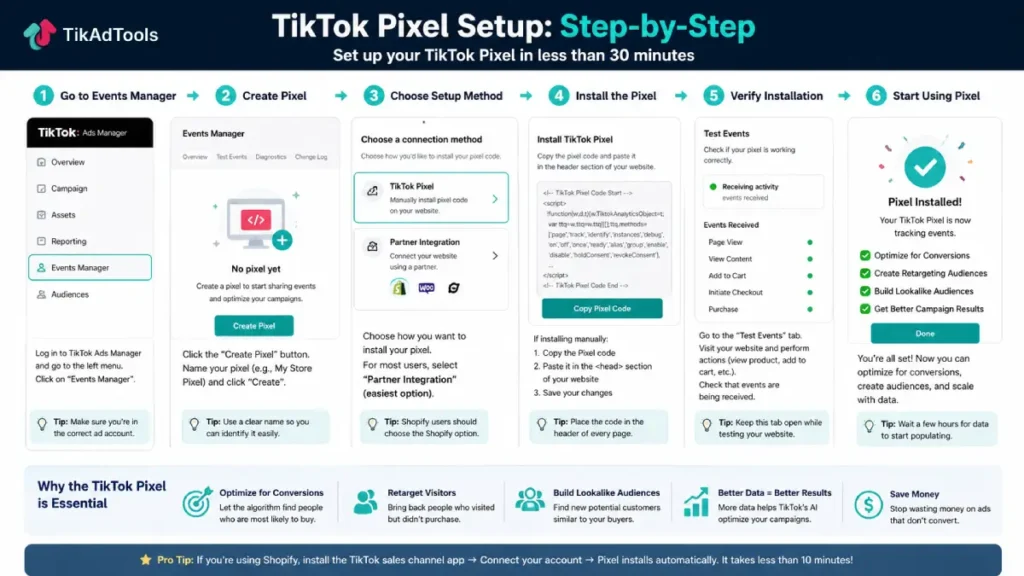
For Shopify and other supported platforms, the native integration handles a lot of this, but “handles most of the setup automatically” still needs a manual check before you spend real money. The pixel setup and verification steps for ecommerce cover exactly what to test before launch.
Your Custom Audience numbers are off
A Custom Audience needs 1,000 total matched users before TikTok will let you target it in an ad group, a requirement stated directly on TikTok’s Custom Audiences help page. That’s a platform requirement, not a suggestion, and there’s no “500 to 1,000 events” threshold anywhere in TikTok’s documentation.
Uploading a list under that size just wastes the export. Wait until you cross 1,000 matched users, and check TikTok’s match rate on your account before assuming your list qualifies.
Building a Custom Audience that actually clears this bar starts with clean identifiers, mainly email, phone, and mobile ad ID together.
Lookalike Audiences carry the same 1,000 minimum for the source audience. Smaller, higher quality lists, actual purchasers instead of general site visitors, usually outperform larger low-intent lists anyway, and building a Lookalike Audience correctly depends more on that seed quality than on raw size.
Your budget clears the minimum, not the bar
TikTok’s platform minimums are $50 per day at the campaign level and $20 per day at the ad group level, confirmed directly in TikTok’s budget and bidding FAQ. Those numbers keep your campaign eligible to run. They don’t mean $20 a day is enough to actually learn anything.
The real number depends on your target cost per action. If you need roughly 50 conversions in a week to exit the learning phase and your CPA runs $25, that’s about $1,250 in learning budget, not $140.
Don’t confuse a platform floor with a performance plan. A solid TikTok ads budget strategy works backward from your CPA target instead of forward from the platform minimum.
TikTok’s budget planner will size the number for you before you launch, so you’re not guessing.
You’re ignoring Smart+ and GMV Max
This is the biggest gap in most 2026 TikTok advice, including a lot of what’s still published as current. Smart+ automates targeting, creative selection, and bidding for performance campaigns. It’s built for advertisers who want the system managing structure while they focus on creative supply.
TikTok Shop advertisers have an even bigger shift to deal with. As of July 2025, TikTok confirms GMV Max became the default and only supported campaign type for TikTok Shop Ads. (Source) Product Shopping Ads, Video Shopping Ads, and LIVE Shopping Ads are no longer available for new campaign creation under Shop destinations.
If you’re building a fully manual campaign structure for TikTok Shop in 2026, you’re not choosing between manual and automated. Manual isn’t on the menu anymore for that use case, and getting familiar with GMV Max before your next Shop campaign will save a rebuild later.
Selling through Shop makes a TikTok Shop account worth setting up correctly from the start, since GMV Max pulls from paid, organic, and affiliate traffic together.
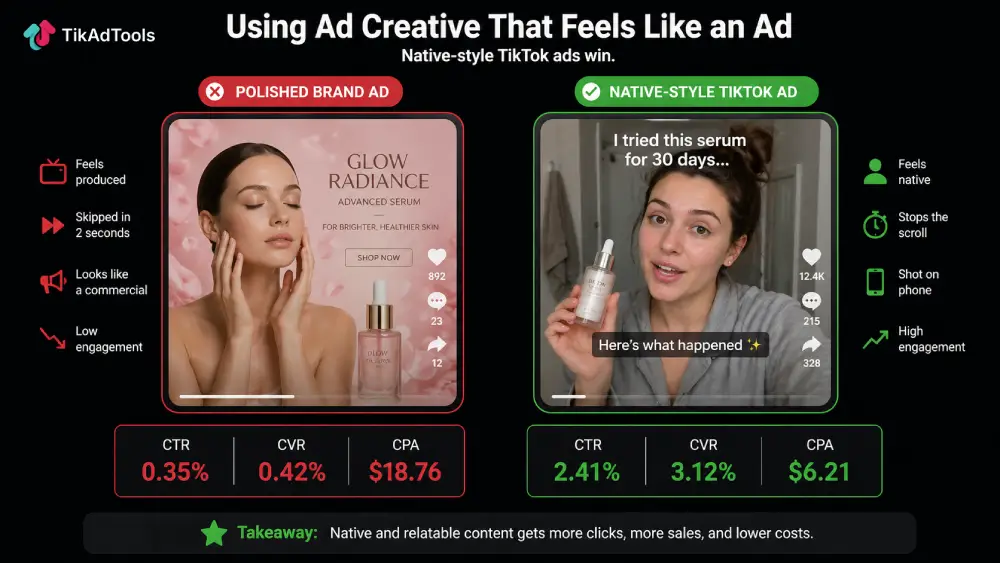
Native doesn’t mean amateur
TikTok’s own creative research shows top ads mix music, voiceover, text, and branding, not that polish automatically kills performance. The real issue is pacing and tone, not production budget.
The often-misquoted stat here is worth getting right. TikTok’s Creative Center research found that 93 percent of TikTok users spend time on the platform with sound on, not that 93 percent of top ads use audio. It’s a real number describing platform behavior, not ad performance.
A UGC-style ad shot professionally can outperform a genuinely amateur clip. What loses is content that opens like a TV commercial: a logo card, a slow build, studio music that doesn’t match the scroll speed of the feed.
The first 1 to 3 seconds decide whether someone stops scrolling, so testing different hooks matters more than testing anything else in the creative. On sound, use tracks you have commercial rights to, not just whatever’s trending organically, since paid and organic licensing aren’t the same thing.
You’re reading CTR, CPA, and ROAS wrong
Low CTR usually points to a creative or hook problem, but it’s not automatic. Audience mismatch, weak offers, and even the wrong optimization event can drag CTR down too.
ROAS is not the same thing as profitability. ROAS measures revenue against ad spend. Whether that revenue is actually profitable depends on your margin, fulfillment cost, and returns, none of which TikTok’s dashboard sees.
Matching the right metrics to the right objective is the part most advertisers skip, and it’s usually why the same CTR gets read two completely different ways on two different campaigns.
If CTR specifically is the problem, troubleshooting a low click-through rate starts with the hook, then the audience, before you touch the offer.
You’re editing too early, or waiting too long
Constant edits during the learning phase reset it. Pausing an ad set after 48 hours because the numbers look slow throws away data the system hasn’t finished collecting yet.
But patience has a limit too. If tracking is broken, the ad got rejected, or the landing page is down, waiting out a fixed 7 to 14 day window is just wasting money on a problem that isn’t going to fix itself with time.
The distinction that matters: don’t make premature performance judgments, but do fix actual technical failures immediately.
Common Questions
What’s the minimum TikTok ads budget in 2026?
TikTok requires $50 a day at the campaign level and $20 a day at the ad group level. Those are platform floors, not a performance recommendation, so a realistic test budget usually runs higher depending on your target CPA.
Do I still need the TikTok Pixel?
For most website conversion campaigns, yes, paired with Events API for more reliable tracking. TikTok Shop’s Sales objective is the exception and doesn’t require a Pixel or catalog.
How many conversions does TikTok need to exit the learning phase?
TikTok’s guidance points to roughly 50 conversions within a week as a strong signal for many auction campaigns, alongside a general benchmark of about 25 results or 7 days for delivery to stabilize.
What bidding strategy should new TikTok advertisers use?
Start with Maximum Delivery. It has no target CPA attached, so it gives the algorithm the most room to find conversions while you build a performance baseline.
Is GMV Max mandatory for TikTok Shop ads?
Yes. Since July 2025, GMV Max has been the default and only supported campaign type for TikTok Shop Ads, replacing Product, Video, and LIVE Shopping Ads for new campaigns.
Why is my TikTok ad CTR low?
Creative and hook problems are the most common cause, but audience mismatch and the wrong optimization event can cause it too. Check the hook first, then the audience, before assuming the whole creative needs to be scrapped.
Conclusion
The mistakes that actually cost money in 2026 aren’t the ones from three years ago. They’re outdated objective names, bidding strategies TikTok already phased out, and a total blind spot around Smart+ and GMV Max.
Fix the terminology, feed the learning phase real signal, and stop treating TikTok Shop like it still runs on manual campaigns. That’s most of the fix right there.
Once the outdated assumptions are cleared out, the TikTok ads optimization guide covers the current, correct process stage by stage.
Sources