
Your TikTok campaign isn’t stuck because your product is bad. It’s stuck because you’re running a 2023 setup on a 2026 platform.
TikTok has changed a lot since the “pick Advanced, set $50, wait 72 hours” playbooks made the rounds. Objectives merged. TikTok Shop moved to GMV Max. Smart+ handles more of the targeting now.
This guide walks through what’s actually true right now, with the sources to back it up. No invented CPM averages, no made-up thresholds, just the current rules and how to work with them.
Table of Contents
Get Up to $6,000 in Free TikTok Ad Credits
TikTok offers ad credit incentives for new advertisers, helping you test campaigns with a lower upfront cost.
TL;DR
- TikTok Shop Ads run through GMV Max only. TikTok made it the default and only supported campaign type starting July 2025.
- Website Conversions and Product Sales merged into one Sales objective, though the rollout is still phased across accounts.
- TikTok’s own guidance says performance volatility usually settles after about 25 campaign results or 7 days, not a fixed conversion count per week.
- Campaign budgets need at least $50 a day, ad groups need at least $20 a day, no exceptions.
- TikTok Shop’s global GMV hit $64.3 billion in 2025, up 94% year over year, so the opportunity is real, but so is the competition.
Do TikTok Ads actually work for dropshipping in 2026?
Yes, if your product suits short video and your tracking is set up correctly. Results depend on your creative, offer, margins, and landing page, not on the product alone. There’s no reliable industry-wide ROAS number for dropshipping, so be skeptical of anyone promising a fixed multiple.
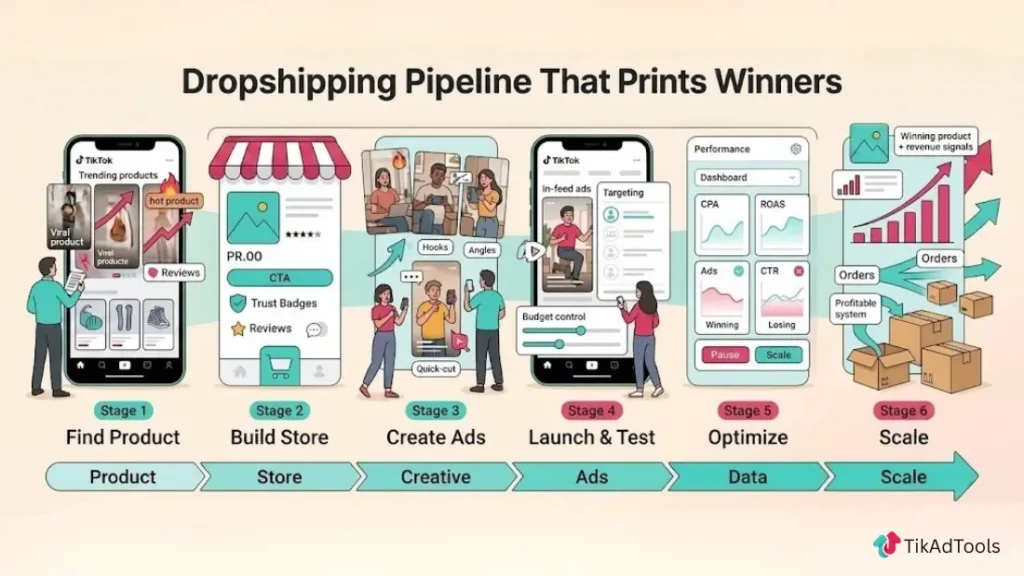
Is your market and product even eligible?
Check this before you spend a cent. TikTok rejects a lot of week-one campaigns for reasons that have nothing to do with ad quality.
Run through this before you build anything:
- Business verification completed, with documentation that matches TikTok’s requirements for your country
- Product category cleared against current restrictions (weight-loss claims, supplements, weapons, and gambling get flagged hardest, but rules shift by market)
- Landing page with real contact info, visible policies, and a working mobile checkout, per TikTok’s landing page guidelines
- TikTok Shop eligibility confirmed, if that’s your path (see the market list below)
Where TikTok Shop is currently available for advertisers:
| Region | Markets |
|---|---|
| Americas | United States, Brazil, Mexico |
| Europe | United Kingdom, Ireland, Spain, Germany, Italy |
| Asia-Pacific | Indonesia, Malaysia, Philippines, Thailand, Vietnam, Singapore, Japan |
Source: TikTok Ads Manager, Sales advertising objective documentation.
Outside those markets, you’re running Website Sales, not Shop.
Run a quick policy check with a compliance checker before you build anything you’ll have to redo.
TikTok Shop or your own website: which should you use?
This decision shapes everything downstream. Here’s the honest breakdown.
| Factor | TikTok Shop | Website Sales |
|---|---|---|
| Checkout location | Inside the TikTok app | Your own store |
| Checkout friction | Lower | Higher, more drop-off |
| Platform commission | Yes, TikTok takes a cut | No |
| Customer data ownership | Limited | Full, yours to keep |
| Retargeting with email/SMS | Not directly available | Full access |
| Best fit | Impulse-friendly products, markets on the eligibility list | Higher-consideration products, brand building, any market |
There’s no universal price threshold that decides this for you. Products with strong impulse appeal often do well in Shop. Higher-ticket or higher-consideration products usually do better on a real store where you can build trust across more than one touchpoint.
Want to test both? Shopify makes it easy to stand up a proper storefront next to your Shop presence.
What to set up before you spend a dollar
Tracking comes first. Skip this step and every metric downstream becomes unreliable.
- Install the TikTok Pixel through your platform’s native integration
- Add the Conversions API for server-side tracking, a second, more reliable data path alongside the Pixel
- Map your real events: ViewContent, AddToCart, InitiateCheckout, and Purchase or Complete Payment, whichever your integration actually reports
- Run a real test purchase from your own phone to confirm every event fires
- Have three to five ad variations ready before launch. One creative isn’t a test, it’s a guess
Picking the right campaign objective
TikTok merged Website Conversions and Product Sales into a single Sales objective. It’s still rolling out in phases, so you might not see it in every account yet, per TikTok’s own documentation.
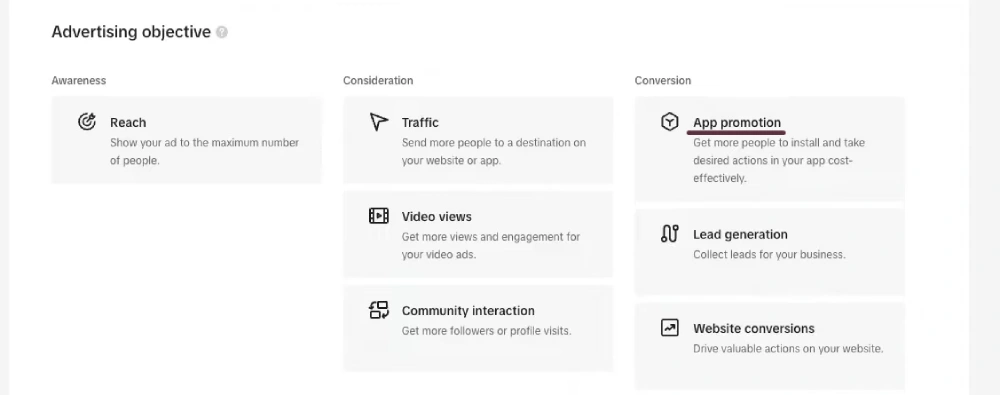
Under Sales, you pick your destination: website, TikTok Shop, app, or a combined website-and-app flow. If you’re running TikTok Shop ads specifically, GMV Max is now the only supported campaign type for that path, effective July 2025.
That’s a real shift from the old manual Shop setup. GMV Max automates more of the targeting and creative selection, so don’t expect the same manual control you had before.
Manual targeting or Smart+: what actually works
TikTok’s Smart+ Web Campaigns handle audience, placement, and most of the optimization automatically for website conversion goals, according to TikTok’s Smart+ documentation. You still set location, and sometimes gender or language, while the system runs the rest.
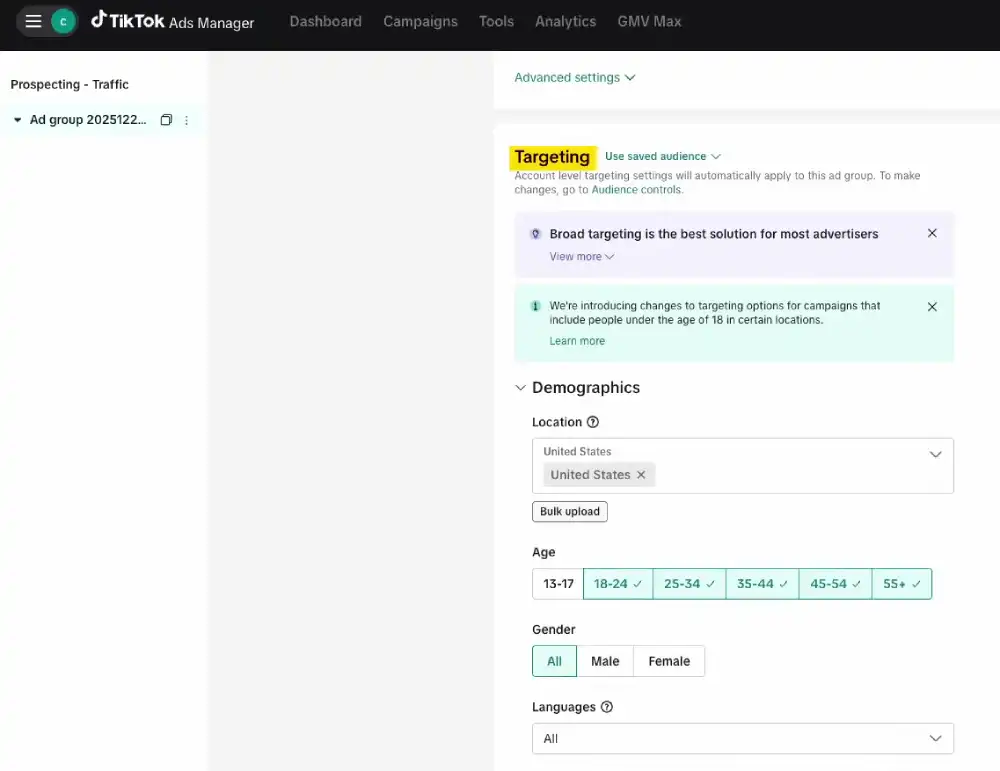
Manual campaigns still give you full control over interests, behaviors, custom audiences, and lookalikes.
Quick comparison:
- Go manual if you already have a clear read on your audience or you want full control over exclusions
- Go Smart+ if you’re newer, short on time, or want a fast benchmark to test against
- Run both side by side on a new product. That’s a real test, not a guess about which one TikTok “wants” you to use
Broad manual targeting can work well once your Pixel has clean data flowing in. That’s a testing hypothesis worth trying, not a guaranteed rule. Narrow interest stacks aren’t automatically wrong either, they just need enough audience size to actually deliver.
Creative that converts (and the legal stuff nobody mentions)
Native-feeling video tends to hold attention better than a polished commercial. That’s a real pattern, not proof that polish always fails.
What actually matters in the creative itself:
- A hook that gives someone a real reason to keep watching, not a copied template
- Captions throughout, since you can’t know who’s watching with sound off
- A clear, single call to action near the end
Two things most guides skip entirely:
- Music rights. Trending sounds carry commercial licensing considerations. Check what you’re actually cleared to use before you build an ad around one.
- Creator usage rights. If you’re sourcing UGC-style creative from freelance platforms, get written terms covering how long you can run the content as a paid ad and in which countries.
Spark Ads let you boost an existing organic post and keep its engagement attached. TikTok’s own Spark Ads Creative Playbook reported 142% higher engagement and 43% higher conversion rates versus standard In-Feed ads. That comparison is internal TikTok data from Q4 2020 through Q2 2021, not a fresh 2026 number, so treat it as a historical data point rather than a current benchmark.
CapCut covers most of the editing you’ll need for native-style cuts without a big production budget.
How much should you actually spend?
TikTok’s platform floor is firm, per TikTok’s own budget documentation:
| Level | Minimum daily budget |
|---|---|
| Campaign | $50 |
| Ad group | $20 |
Hitting the floor keeps your campaign live. It doesn’t mean you’ll gather useful data fast.
TikTok’s guidance ties a workable testing budget to your target cost per action, generally somewhere between 10 and 50 times that target, depending on your objective. If your target CPA is $25, that puts a real testing range at roughly $250 to $1,250, closer to the low end for simpler objectives and higher for deeper-funnel goals like purchases.
Skip the idea of one fixed “monthly test budget” that applies to every dropshipper. Your real number depends on your margins, your target CPA, and how many products you can realistically test creative for at once.
Run your own numbers with a budget planner before you commit spend. For a deeper breakdown by campaign type, the budget strategy guide covers it by campaign type.
Understanding TikTok’s Learning Phase (the real rules)
Here’s what TikTok actually says, not what most blog posts repeat. Performance volatility typically starts to settle after about 25 campaign results or 7 days from when a campaign enters the learning phase, straight from TikTok’s learning phase documentation.
That’s a general pattern, not a per-ad-group weekly quota.
TikTok’s own budget scaling rules:
| Campaign status | Max budget increase per adjustment | Minimum time between adjustments |
|---|---|---|
| Still in learning phase | 40% | 2 days |
| Exited learning phase | 30% | 2 days |
Pausing a campaign is also flagged as something that can prevent it from exiting learning. If you need to make a change, make one change and leave it alone.
Our learning phase guide breaks down what counts as a significant edit versus a minor one.
Diagnosing a campaign that isn’t converting
Low CTR usually points to a weak hook, but not always. Placement, audience size, and objective all affect what a “good” CTR looks like, so don’t judge it against a number from a different niche.
Add to Carts with no checkouts can mean several things:
- Broken or incomplete tracking
- Unexpected shipping cost shown late in checkout
- Missing trust signals (reviews, policies, contact info)
- Limited payment options
- Price mismatch with what the ad implied
If your Pixel and Conversions API are both firing correctly and this gap persists, the problem is almost always somewhere in the checkout experience, not the ad itself.
Check your ad reporting daily during a test, but resist reacting to single-day swings. One bad day isn’t a trend.
Scaling without wrecking your ROAS
Once a campaign clears the learning phase and holds steady CPA, you’ve got two real paths:
- Raise budget within TikTok’s recommended limits (see the table above)
- Duplicate the winning ad group and test a fresh budget on the copy, which protects your original’s optimization history
Duplication is the safer move when you want to scale aggressively without risking a stable campaign.
Lookalike audiences are worth building once you have a real base of converters. TikTok’s own documentation isn’t fully consistent on the exact minimum source size across different help pages, so don’t chase an exact headcount. Build one once your buyer list is substantial and test it.
Our guide to lookalike audiences covers sizing and refresh timing in more depth.
Mistakes that quietly kill dropshipping campaigns
- Launching with one creative and calling it a test
- Editing daily out of impatience, resetting the data you’re trying to build
- Skipping Conversions API because Pixel alone “seems fine”
- Ignoring your break-even math (product cost, shipping, fees, and payment processing, all before ad spend)
- Treating TikTok Shop and Website Sales as interchangeable when they have different economics and data access
Our common mistakes roundup covers more of these in detail.
FAQs
Is TikTok Shop or a website better for dropshipping?
Neither wins universally. TikTok Shop reduces checkout friction and works well for impulse products, but you lose direct customer data and pay a platform commission. Your own website costs more in checkout friction but gives you full retargeting control.
How much does TikTok Shop take in commission?
TikTok Shop charges a percentage-based commission that varies by category and market, and it’s changed more than once since launch. Check your current rate directly in Seller Center before pricing your product.
What’s the minimum budget for TikTok ads?
At least $50 a day at the campaign level and $20 a day at the ad group level. That’s the platform floor, not the budget you need to actually gather useful data, which depends on your target cost per action.
How long does the TikTok learning phase take?
TikTok says volatility usually settles after about 25 campaign results or 7 days. That’s a general pattern based on results and time, not a fixed daily or weekly quota you need to hit.
Do Spark Ads really outperform regular In-Feed ads?
TikTok’s own internal data showed 142% higher engagement and 43% higher conversion rates for Spark Ads, but that comparison is from Q4 2020 through Q2 2021. Treat it as a historical data point, not a current 2026 benchmark.
How big is TikTok Shop right now?
TikTok Shop’s global GMV hit $64.3 billion in 2025, up 94% year over year across 16 markets, according to Momentum Works. Southeast Asia remains the largest region, with the US as the single biggest national market.
Final thoughts
TikTok’s mechanics changed more in the last year than most guides admit. Get your tracking right, respect the platform’s actual budget and learning-phase rules, and build your creative around a real hook instead of a template. Everything else is testing, and testing takes real data, not shortcuts.
If you’re ready to launch, TikTok Ads gets you into Ads Manager with your account structure ready to go.