
TikTok is no longer just a place to discover products. It is where people buy them.
Brands running TikTok Shopping Ads, also known as TikTok Shop Ads, are closing the gap between discovery and purchase inside a single scroll. These TikTok eCommerce ads help shoppers move from product discovery to checkout without leaving the app.
But most advertisers set up campaigns without understanding how the platform’s algorithm, ad formats, and new automation tools actually work in 2026.
If your TikTok ads are burning budget without a clear return, the problem usually comes down to one of three things: the wrong format, weak creative structure, or campaign settings that have not caught up with how TikTok’s ad system operates today.
This guide covers all three. You will learn how TikTok shopping ads work, which formats to use and when, how to set up your first campaign correctly, what GMV Max means for your strategy, and how to measure and improve results from day one.
Table of Contents
Get Up to $6,000 in Free TikTok Ad Credits
TikTok offers ad credit incentives for new advertisers, helping you test campaigns with a lower upfront cost.
Key Takeaways
- TikTok Shopping Ads (also called TikTok Shop Ads) let people discover and buy products without leaving the app.
- GMV Max is now the default and only supported way to run Sales-objective Shopping Ads for TikTok Shop.
- Video, LIVE, and product-based formats each fit a different stage of the shopping journey, from discovery to checkout.
- Most underperforming Shopping Ads campaigns trace back to the wrong format, weak creative structure, or settings that haven’t kept up with 2026 platform changes.
- Creative volume and variety matter more for Shopping Ads than for standard awareness campaigns, since the algorithm needs enough assets to test.
Quick Answer
TikTok Shopping Ads are ad formats that connect your TikTok Shop or product catalog directly to in-feed and LIVE placements, letting shoppers browse and buy without leaving TikTok. In 2026, GMV Max is the default engine behind most Shopping Ads campaigns, automating targeting, bidding, and creative selection toward a sales or ROI goal you set.
What are TikTok Shopping Ads?
TikTok Shopping Ads are paid ad formats that let brands sell products directly inside the TikTok app. They connect your product catalog to TikTok Video Shopping Ads, LIVE Shopping Ads, and TikTok Product Shopping Ads, allowing shoppers to discover and purchase products without leaving TikTok. Shoppers can browse and buy without leaving TikTok, which shortens the path from discovery to purchase. Results vary based on creative quality, product type, and audience targeting.
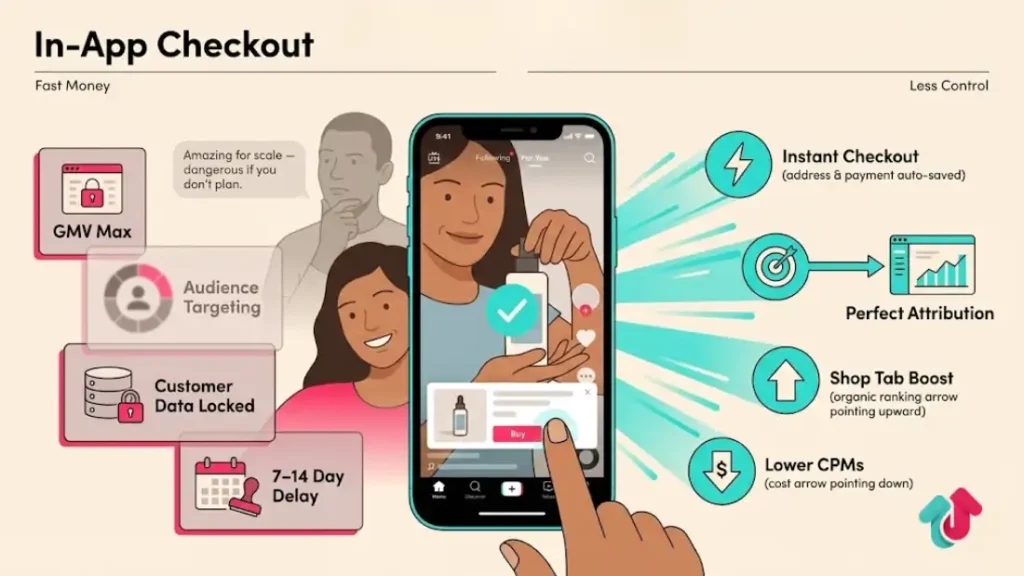
How TikTok Shopping Ads actually work and their benefits
TikTok’s algorithm is built around content discovery, not intent matching. This is the key difference between TikTok and Google Shopping.
On Google, someone searches for a product and finds your ad. On TikTok, the algorithm shows your ad to someone who has not searched for anything yet, but whose behavior matches the profile of a buyer in your category. That is discovery-led commerce.
When someone sees your shoppable video, they tap the product link and check out without leaving the app. TikTok’s in-app checkout removes the friction that kills conversions on external landing pages.
This is why TikTok Shopping Ads consistently outperform traditional traffic campaigns for impulse-driven product categories like beauty, fashion, home goods, and accessories.
For many brands running TikTok Ads for eCommerce, the shorter buying journey leads to higher conversion rates and lower checkout friction.
Core benefits of running TikTok shopping ads:
- Lower CPM than Meta: According to Lebesgue’s TikTok Ads Benchmarks, TikTok’s global average CPM is approximately 30% lower than comparable Facebook placements. Note: US-specific CPMs run higher at $10 to $15, but still sit below Meta’s average of $14.91
- In-app checkout: Shoppers complete the purchase without leaving TikTok, which significantly reduces drop-off compared to external landing pages
- Algorithm-powered reach: TikTok pushes your content to users with matching purchase behavior, even at a smaller budget
- Organic and paid in one system: GMV Max (covered below) combines paid ads with your organic and affiliate content inside a single campaign structure
- Creative flexibility: You can run polished brand videos, raw UGC-style clips, or LIVE sessions, and the algorithm identifies which format drives the best result
- Shoppable placements across the app: Your products appear in the For You feed, Search, the TikTok Shop tab, and TikTok Pangle simultaneously
- Built-in social proof: LIVE shopping and product reviews create real-time trust signals that static ads cannot replicate
The 3 TikTok Shopping ad formats, and when to use each
TikTok shopping ads come in three core formats. Each one serves a different stage of the buying journey. Understanding when to use each saves budget and improves your overall conversion rate.
Video Shopping Ads
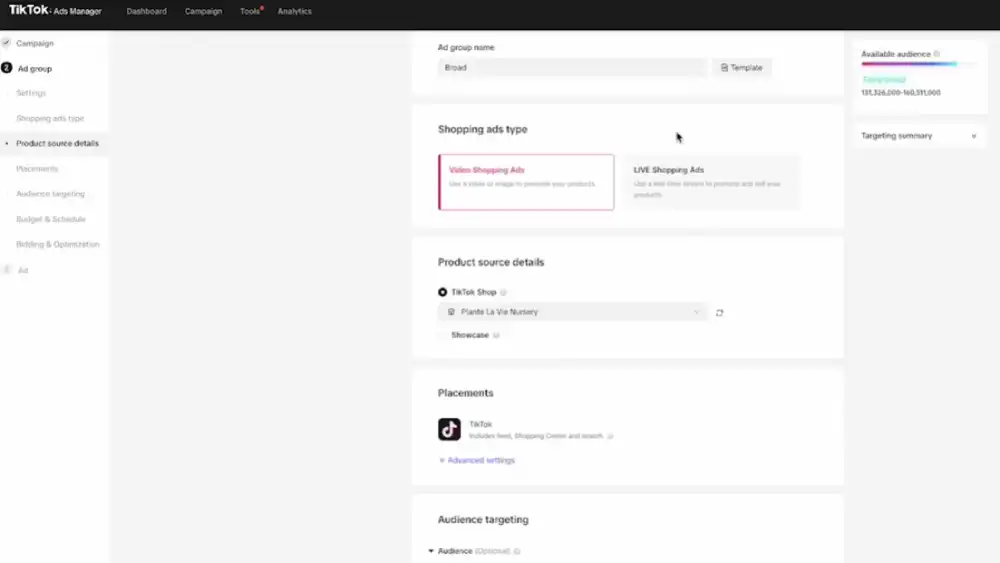
TikTok Video Shopping Ads (VSA) appear as shoppable videos in the For You feed. These Video Shopping Ads on TikTok combine short-form video with an embedded product card, making them one of the most effective formats for product discovery.
A product link is embedded directly in the video, and viewers tap to view the product page and complete a purchase without leaving TikTok.
These work best for new audiences and cold traffic. You are introducing a product through storytelling, a demo, or a hook-driven clip. VSA is TikTok’s most versatile format for direct response, and UGC-style shopping videos generate CPMs 30 to 40% lower than polished brand videos because users engage with native-feeling content more readily.
LIVE Shopping Ads
LIVE Shopping Ads promote your TikTok LIVE session to a wider audience beyond your existing followers. The ad drives traffic into your livestream, where viewers can browse a product showcase, ask questions in real time, and buy on the spot.
These work best when you have a consistent LIVE schedule and products that benefit from live demonstration. Brands in beauty, apparel, and consumer electronics see strong LIVE shopping performance because the format builds immediate trust through real-time interaction.
Product Shopping Ads
Product Shopping Ads (PSA) display your products as card-style placements in the TikTok Shop tab and search results. They function similarly to Google Shopping ads: a product image, name, and price appear to users who are actively browsing the shop.
These work best for warm audiences already in purchase mode, not cold discovery traffic.
| Format | Best For | Placement | Sales Funnel Stage |
|---|---|---|---|
| Video Shopping Ads | Cold audience discovery | For You Feed | Top to mid funnel |
| LIVE Shopping Ads | Real-time conversion | LIVE feed promotion | Mid to bottom funnel |
| Product Shopping Ads | Active buyer intent | Shop tab, Search | Bottom funnel |
How to set up TikTok Shopping Ads step by step
Setting up TikTok Shopping Ads correctly from the start prevents wasted budget during the learning phase. Follow these steps in order:
Create a TikTok Business Account and access TikTok Ads Manager at ads.tiktok.com
Set up your TikTok Shop through Seller Center and link it to your Business Center account
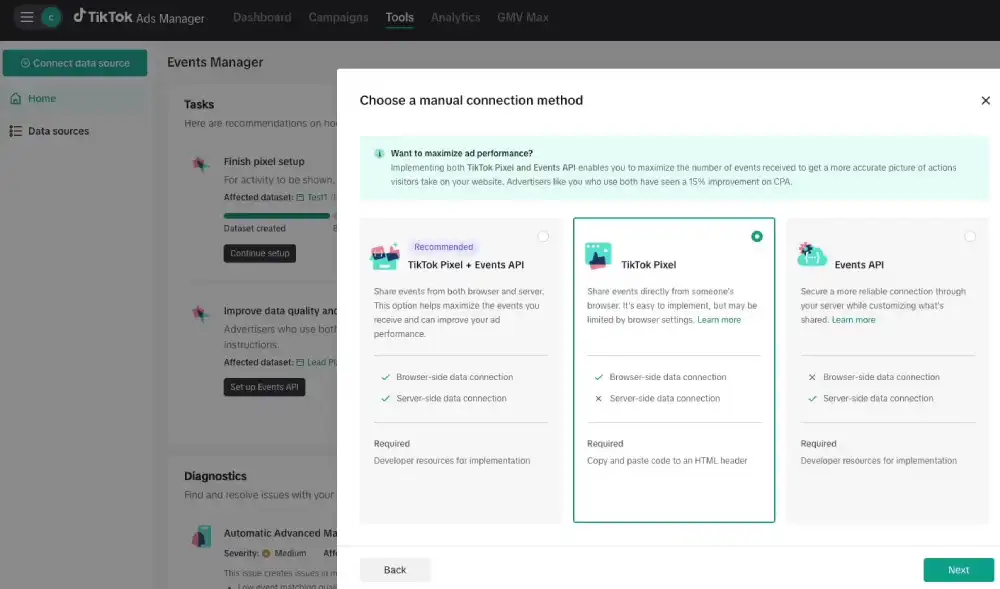
Install the TikTok Pixel on your website or TikTok SDK in your app to track key conversion events: purchases, add-to-carts, and product page views
Build your product catalog by syncing your product feed inside TikTok Ads Manager, either manually or through supported eCommerce platforms like Shopify or WooCommerce. A complete product catalog is essential for TikTok Shop Ads and other TikTok eCommerce ads.
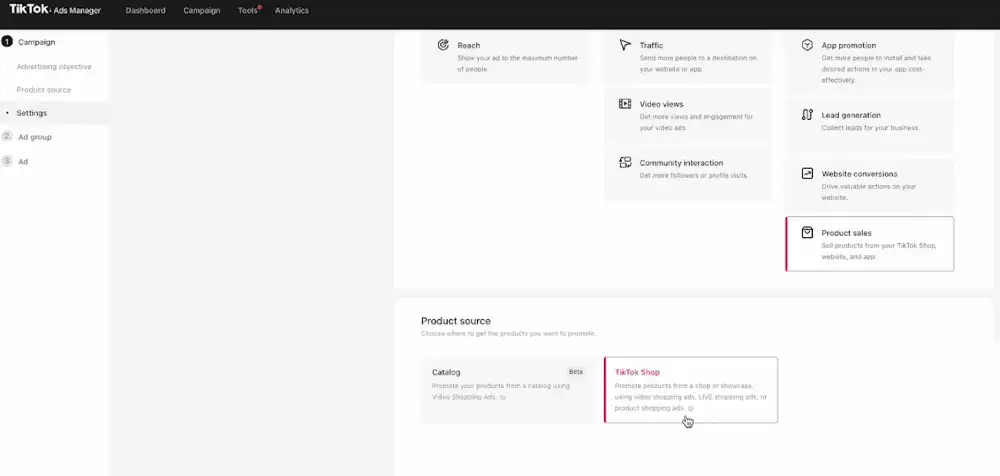
Choose your campaign type. For TikTok Shop sellers in 2026, GMV Max is TikTok’s recommended and default starting point (detailed in the next section)
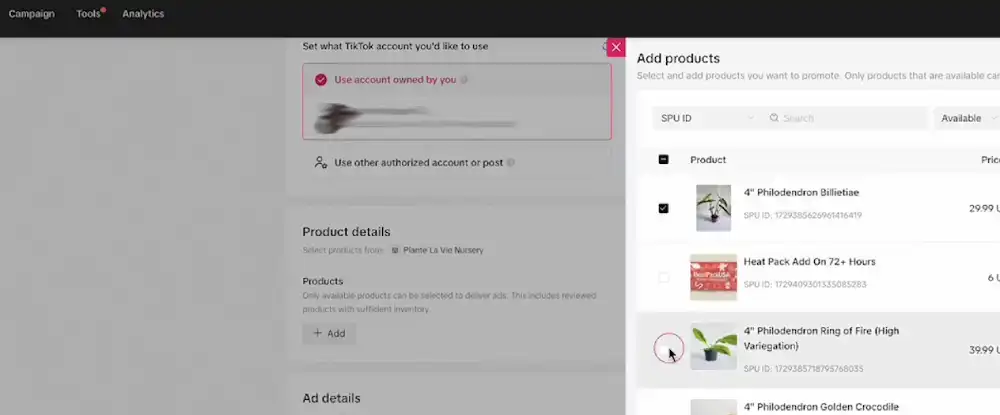
Select your product set. Promote specific products or your full catalog. Starting with your top 3 to 5 bestsellers gives the algorithm the strongest purchase signals early
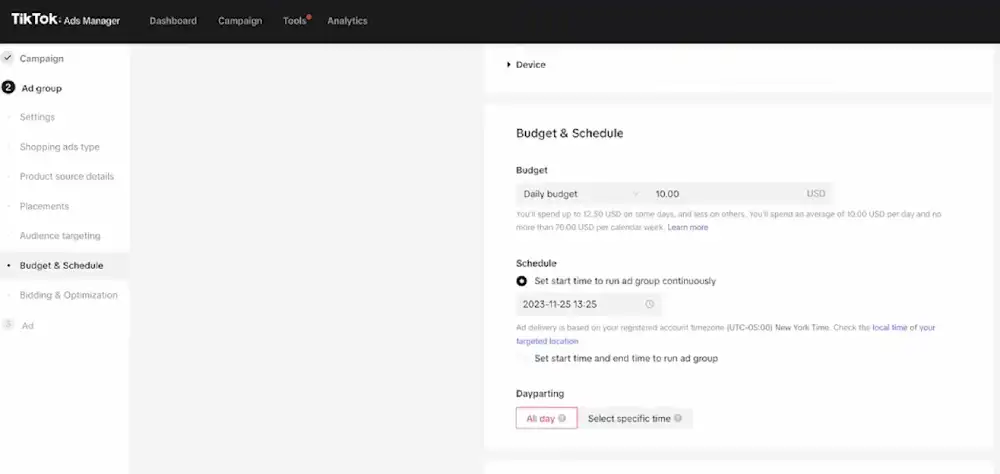
Set your daily budget. According to Darkroom Agency’s TikTok advertising cost guide, TikTok requires a minimum of $50 per day at the campaign level and $20 per day at the ad group level
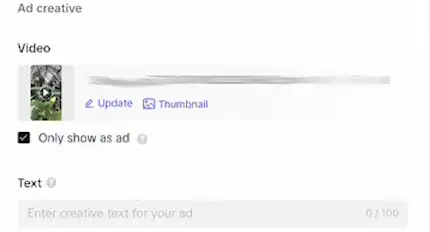
Add your creative assets. Upload at least 3 to 5 video creatives. More creative variety gives the algorithm more options to test and optimize from
Set your ROI target and launch. TikTok’s system enters a learning phase for approximately 7 days after launch
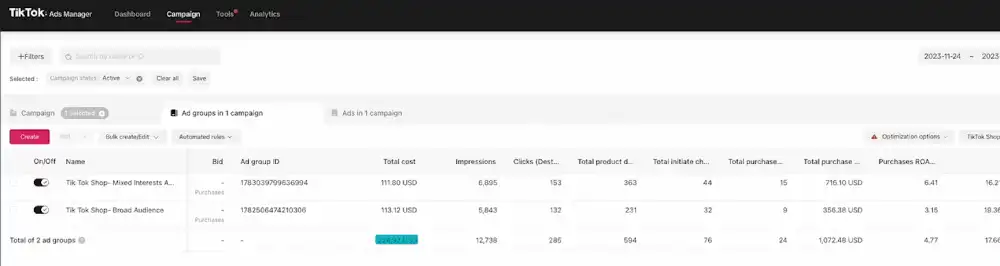
Do not adjust budgets, pause ad groups, or swap creative in the first 7 days. The algorithm needs consistent data to optimize effectively.
GMV Max and Smart+, TikTok’s new default campaign tools in 2026
In July 2025, TikTok consolidated its shopping ad campaign types into one automated system: GMV Max.
Before GMV Max, advertisers managed TikTok Video Shopping Ads, LIVE Shopping Ads, and TikTok Product Shopping Ads as separate campaigns with different budgets, audiences, and creative sets. GMV Max replaces that fragmented structure.
As confirmed by TikTok’s official GMV Max migration documentation, it is now the only campaign type for TikTok Shop ad types, and separate VSA and PSA campaigns have been phased out as of July 15, 2025.
GMV Max uses TikTok’s machine learning to automatically select your best-performing creative assets, set audience targeting, allocate budget across all placements, and optimize for total sales value (GMV) rather than clicks or impressions alone.
As TikTok’s official Product GMV Max documentation confirms, it pulls simultaneously from your organic videos, paid creative, and authorized affiliate content, then distributes budget toward whatever combination drives the highest revenue.
Use GMV Max when:
- You are a TikTok Shop seller with an active product catalog
- You have 15 to 20 or more creative assets available. According to Dataslayer’s GMV Max performance guide, fewer than 10 videos cause campaigns to stall in the learning phase. You need 15 to 20 minimum, with 50-plus being optimal for scaling
- You want reduced manual campaign management
- You are comfortable with blended attribution across paid, organic, and affiliate traffic
Smart+ campaigns are TikTok’s broader automation suite built for non-Shop advertisers. They use machine learning to optimize delivery for traffic, lead generation, and website conversions. Smart+ works with external landing pages and Shopify stores, not just TikTok Shop checkout.
The core difference: GMV Max optimizes for in-app TikTok Shop sales. Smart+ optimizes for any conversion goal, including off-platform ones.
How much do TikTok Shopping Ads cost in 2026?
TikTok shopping ad costs vary by format, audience, creative performance, and time of year. There is no fixed price. Here are the benchmarks you need to plan your budget realistically.
| Metric | Benchmark Range |
|---|---|
| CPM (United States) | $10 to $15 |
| CPM (Global average) | $4.80 to $9.16 |
| CPC | $0.30 to $1.50 |
| CVR (eCommerce) | 1% to 5% |
| Min. daily budget (campaign level) | $50 |
| Min. daily budget (ad group level) | $20 |
Creative quality directly affects your costs. Costs also spike during Q4. Black Friday and Cyber Monday push US CPMs toward the $10 to $20 range in competitive eCommerce categories, per Marketing LTB’s TikTok Ads statistics report. Test your creative before peak season, not during it.
A realistic starting budget for new TikTok Shopping Ads is $50 to $100 per day for at least 14 days. This gives TikTok Ads for eCommerce enough data to exit the learning phase before meaningful optimization begins. This gives the algorithm enough spend to exit the learning phase and return meaningful conversion data.
How to create TikTok Shopping ad creative that stops the scroll
Your creative is the most important variable in TikTok Shopping Ads performance. Whether you’re running TikTok Video Shopping Ads or other TikTok Shop Ads, strong creative has the biggest impact on CPM, CTR, and conversions.
The algorithm rewards content that earns attention. If users skip your ad within 3 seconds, your CPM rises and your delivery declines.
The 3-second threshold: TikTok penalizes ads that fail to hold attention past the opening seconds with higher CPMs, which they call a “boredom tax.” Your hook is not the opening line. It is the opening frame.
Hook structure that works:
- Start with movement, contrast, or an unexpected visual
- Front-load the benefit or the problem in the first 2 seconds
- Never open with a logo or a brand name
UGC vs. polished video: UGC-style creative consistently outperforms polished brand video on TikTok. UGC formats can deliver CPMs 30 to 40% lower because they blend naturally into the organic feed. That does not mean low effort. It means the production style should feel native, not promotional.
Creative fatigue cycles: Most TikTok shopping ad creative declines in performance within 2 to 3 weeks at moderate spend levels. According to Marpipe’s creative fatigue research, TikTok’s own data suggests consumer-facing campaigns often reach saturation within 7 to 10 days, faster at higher spend. Keep your best-performing hook structure. Swap the middle section and the ending.
Test these variables first:
- Hook format: visual movement vs. text overlay vs. direct voiceover
- Product angle: feature demonstration vs. problem-solution vs. customer result
- Video length: 9 to 15 seconds vs. 21 to 34 seconds
Run at least 3 creative variations per ad group. More variation gives the algorithm more signals to work with before your budget scales.
How to measure TikTok Shopping ad performance and improve your ROAS
Knowing which numbers matter stops you from optimizing the wrong things. The core metrics for TikTok Shopping Ads and other TikTok Ads ecommerce campaigns:
- ROAS (Return on Ad Spend): Your primary performance indicator. A 2x to 4x ROAS is a reasonable starting benchmark for most eCommerce categories, but results vary significantly by product margin and average order value
- CVR (Conversion Rate): According to Lebesgue’s TikTok benchmark data, the average CVR for conversion-optimized TikTok ads is approximately 1.92%. If you are consistently below 1%, the issue is usually your product page or checkout flow, not the ad itself
- 3-second video view rate: This tells you directly whether your hook is working. A rate below 30% means your opening frame needs rethinking
- Video completion rate: Aim for 40% or higher. Low completion rates signal poor pacing or a weak content structure in the middle of your video
- CTR (Click-Through Rate): According to Marketing LTB’s 2026 TikTok Ads statistics, the average CTR sits at approximately 0.84%. If your CTR is consistently above this, your creative is doing its job
The attribution problem most advertisers miss:
TikTok is frequently undervalued in last-click attribution models. Many DTC brands use third-party tools like Triple Whale or Northbeam to measure TikTok’s real contribution across the full customer journey.
If you are only measuring TikTok through Google Analytics last-click data, you are almost certainly underreporting its revenue impact.
To improve ROAS over time:
- Rotate creatives before the 3-week fatigue mark hits
- Add conversion value data to your pixel events so GMV Max can prioritize higher-order-value buyers
- Start with broad targeting and let the data narrow your audience, not the other way around
The biggest TikTok Shopping ad mistakes, and how to fix them
Most TikTok shopping campaigns underperform because of a small number of repeatable, fixable errors. Here is what we see most often.
Mistake 1: Running paid ads without organic signals: Spending on a brand-new TikTok account with zero organic content is one of the fastest ways to waste budget. TikTok’s algorithm performs better when your account already has organic engagement data to build on. Post 5 to 10 organic videos before running paid campaigns. You do not need viral reach. You need enough signal for the algorithm to understand your content and audience.
Mistake 2: Over-targeting your audience: Stacking multiple interest layers, age restrictions, and behavioral filters shrinks your potential audience and drives CPMs higher. In 2026, TikTok’s broad targeting outperforms heavy manual segmentation across most TikTok ecommerce ads, including campaigns for fashion, beauty, consumer goods, and TikTok Ads for retail. Start wide. Let GMV Max find your buyers. Narrow targeting only after you have real conversion data to justify a restriction.
Mistake 3: Under-budgeting at the ad group level: Running $5 to $10 per day per ad group means the algorithm never accumulates enough conversion data to exit the learning phase. TikTok requires a minimum of $20 per day per ad group. For meaningful results within a reasonable timeframe, $50 per day or more is the practical floor for most product categories.
Mistake 4: Recycling the same creative: Reusing one video across multiple ad groups without variation creates creative fatigue across your entire account, not just a single campaign. Build a library of at least 3 to 5 distinct creatives before scaling any budget. Test hook variations first. Scale what the data confirms.
Mistake 5: Editing campaigns during the learning phase: Changing budgets, pausing ad groups, or swapping creative in the first 7 days resets TikTok’s learning phase completely. Set your campaign up correctly, launch it, and let it run for a full week before making any decisions based on performance data.
FAQs
What are TikTok shopping ads?
TikTok shopping ads are paid placements that let brands sell products directly inside TikTok. You connect your product catalog to shoppable video, LIVE, and product card formats across the app.
How do TikTok shopping ads work?
TikTok shopping ads connect your product catalog to shoppable placements in the For You feed, Shop tab, and search results.
How much do TikTok shopping ads cost?
In 2026, the average US CPM for TikTok ads sits between $10 and $15, according to Marketing LTB. Your minimum daily spend is $50 at the campaign level and $20 at the ad group level.
What is the difference between TikTok Shopping Ads and regular TikTok Ads for eCommerce?
Regular TikTok ads, such as standard In-Feed ads, drive traffic to an external website or app. TikTok shopping ads are specifically built for in-app commerce.
Is GMV Max the same as a TikTok shopping ad campaign?
GMV Max is the campaign type you use to run TikTok shopping ads for TikTok Shop sellers. As confirmed byTikTok’s official migration documentation, TikTok consolidated Video Shopping Ads, LIVE Shopping Ads, and Product Shopping Ads under the GMV Max framework as of July 2025.
Do TikTok shopping ads work for small brands?
Yes, but results depend on product type, creative quality, and starting budget. We have seen small brands run effective TikTok shopping campaigns with $50 per day, particularly in categories like beauty, fashion, and home goods, where TikTok’s audience engagement is strongest.
Conclusion
TikTok Shopping Ads give ecommerce brands a direct line between content and checkout. Whether you’re using TikTok Video Shopping Ads, TikTok Product Shopping Ads, or broader TikTok Shop Ads, the platform makes it easier to convert product discovery into sales.
The platform’s discovery-first algorithm, in-app purchase flow, and automated tools like GMV Max have made it a real performance channel for eCommerce brands, not just an awareness play.
You now know how the three core ad formats serve different stages of the buying journey, what a correct campaign setup looks like, and why GMV Max changes the way TikTok shopping campaigns are built and managed in 2026.
You also know what realistic costs look like, how to build creative that earns attention past the 3-second threshold, and which errors drain budget before results have a chance to show up.
The brands that perform best on TikTok in 2026 are not the ones with the largest budgets. They are the ones who understand how the algorithm actually works, take creative seriously, and give their campaigns enough runway to learn.
Start with strong creative, set a budget that allows the algorithm to exit the learning phase, and let the data guide what you scale next.