
You can’t create a TikTok Collection Ad anymore, and most of the guides telling you how to “bring it back” are pointing you at features that don’t work the way they describe.
Here’s what actually replaced Collection Ads, broken down by where you sell, plus the exact setup steps for each path.
Table of Contents
Get Up to $6,000 in Free TikTok Ad Credits
TikTok offers ad credit incentives for new advertisers, helping you test campaigns with a lower upfront cost.
TL;DR
- TikTok pulled Collection Ads from active use starting in 2023. There’s no single 2026 replacement. The right one depends on where you sell.
- TikTok Shop sellers now run shoppable video through Product GMV Max, the default and only supported TikTok Shop Ads campaign type since July 2025.
- Website and catalog sellers use Smart+ Catalog Ads, which work without a TikTok Shop at all.
- Product GMV Max is only live in the US, UK, Indonesia, Malaysia, the Philippines, Thailand, Vietnam, and Singapore.
- Campaign minimums are still $50 a day at the campaign level and $20 a day at the ad group level.
Quick Answer
TikTok Collection Ads are discontinued. Their core function moved into Video Shopping Ads, and which tool you use now depends on your sales destination: Product GMV Max for TikTok Shop, Smart+ Catalog Ads for your website, or Video Shopping Ads with Showcase for your TikTok profile.
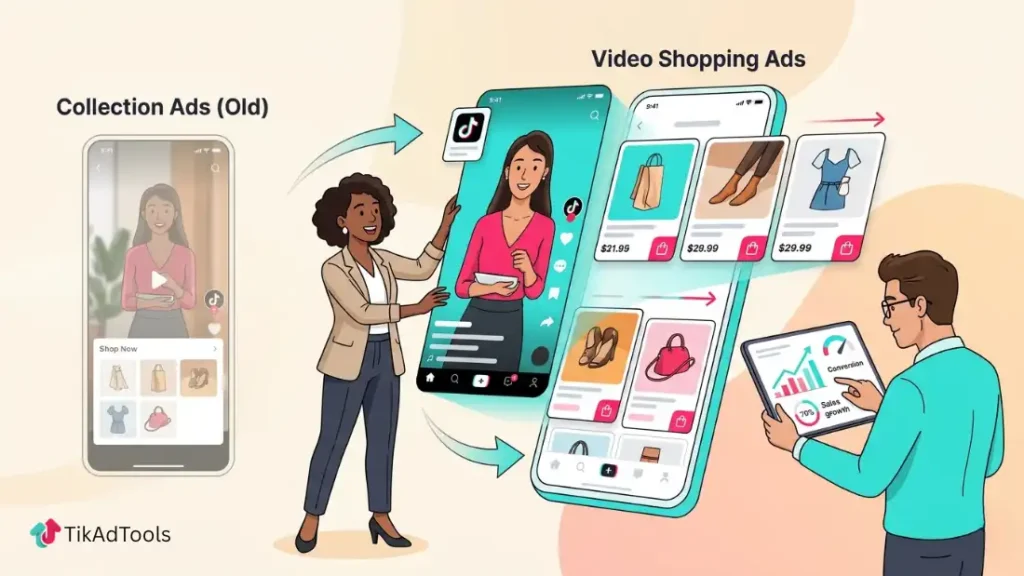
What TikTok Collection Ads were
Collection Ads were an in-feed video ad that opened into a full-screen product gallery inside TikTok. Tap the video, land on a page called the Instant Gallery Page, browse products pulled from your catalog, and buy without leaving the app.
The old Collection Ads help page now redirects straight to TikTok’s Video Shopping Ads (Catalog) documentation, which confirms the format is no longer active and that its core functionality was folded into Video Shopping Ads under the Product Sales objective.
That page doesn’t list an exact shutdown date anymore. The closest confirmed date comes from a sibling format: TikTok’s Dynamic Showcase Ads documentation states plainly that advertisers lost the ability to create, duplicate, or edit that format starting April 3, 2023.
Why Collection Ads worked
Collection Ads solved a real problem. Sending someone to an external site kills conversions, and keeping the whole shopping experience inside TikTok cut that drop-off.
That principle didn’t die with the format. It’s still the logic behind every current TikTok shopping product, even though the interface changed completely. If you’re still sending people to a generic landing page instead of a native product experience, you’re fighting the same friction Collection Ads were built to remove.
TikTok Collection Ads specs (historical reference only)
These specs describe the discontinued format. They are not current requirements for Video Shopping Ads, Smart+ Catalog Ads, or GMV Max. Don’t build a current campaign against this table.
| Spec | Old Collection Ads Requirement |
|---|---|
| Aspect ratio | 9:16 (recommended), 1:1, 16:9 |
| Minimum resolution | 720 x 1280px (9:16), 640 x 640px (1:1), 1280 x 720px (16:9) |
| File types | .mp4, .mov, .mpeg, .avi |
| Max file size | 500 MB |
| Video duration | 5 to 16 seconds |
| Gallery product images | Minimum 800 x 800px, JPG or PNG |
| Products per gallery | Up to 8 tiles |
| Loading experience | TikTok-hosted, in-app only |
For current creative specs, check the format-specific setup page you’re actually building against. TikTok updates those numbers by product, not by a single blanket spec sheet.
Collection Ads vs. Dynamic Showcase Ads
Both formats are gone. Both fed their core functions into Video Shopping Ads. But they solved different problems, and it’s worth knowing the distinction.
| Feature | Collection Ads | Dynamic Showcase Ads |
|---|---|---|
| Creative control | You created the video | TikTok auto-generated from a catalog template |
| Product targeting | You picked which products showed | Algorithm picked based on user behavior |
| Best for | Curated launches, featured SKUs | Large catalogs, automated retargeting |
| Audience type | New audiences, discovery | Warm audiences, retargeting |
| Landing experience | Instant Gallery Page | Product detail pages |
| Status | Discontinued, merged into VSA | Discontinued April 3, 2023, merged into VSA |
If you want AI-driven catalog automation today, that logic now lives in Smart+ Catalog Ads. If you want manual control over which products get featured, a hand-picked product set inside Video Shopping Ads is the closer match to what Collection Ads used to do.
What replaced TikTok Collection Ads in 2026?
There isn’t one replacement. TikTok didn’t rename Collection Ads three times and call it a day. It split the functionality across products based on where you actually sell.
| If you sell through… | Use this in 2026 |
|---|---|
| TikTok Shop | Video Shopping Ads, run through Product GMV Max |
| Your own website, via a catalog | Smart+ Catalog Ads |
| Your TikTok profile Showcase | Video Shopping Ads with Showcase |
| A livestream | LIVE GMV Max |
TikTok Shop sellers. TikTok’s own Video Shopping Ads setup page states that GMV Max became the default and only supported campaign type for TikTok Shop Ads starting July 2025. If you’re selling through TikTok Shop, this is the path you’re on whether you planned for it or not.
Website and catalog sellers. You don’t need a TikTok Shop for this one. TikTok’s Smart+ Catalog Ads documentation confirms catalog-based campaigns run entirely off a product catalog and a website destination.
Showcase sellers. If your products live on a TikTok profile Showcase rather than a full Shop, Video Shopping Ads with Showcase is the closer fit.
Don’t assume GMV Max applies to you just because it’s the headline product. As of mid-2026, Product GMV Max is only available in the United States, United Kingdom, Indonesia, Malaysia, the Philippines, Thailand, Vietnam, and Singapore. Outside those markets, you’re working with different tools.
How to set up each 2026 replacement
If you sell through TikTok Shop
- Connect your TikTok Shop to your Business Center or Ads Manager account, and confirm you have GMV Max authorization for that shop.
- In Ads Manager, choose Sales as your objective and TikTok Shop as your product source.
- TikTok routes eligible campaigns into Product GMV Max automatically. You can add up to 20 active products per ad and up to 50 videos per ad group.
- Let GMV Max pull in organic and affiliate content. All resulting orders attribute back to your campaign dashboard in Seller Center.
If you sell through your website
- Build a catalog with at least 4 products that are in stock, approved, and activated. TikTok requires this minimum before Smart+ Catalog Ads will run.
- In Ads Manager, click Campaign, then Create, then choose Sales as your objective and Website as your destination.
- Select Smart+ campaign as the campaign type, then toggle on Use catalog.
- Pick your product scope: all products, a dynamic product set, or up to 20 specific products.
- Add your website URL with tracking parameters, and upload at least 6 videos. TikTok recommends this minimum to get useful creative variety.
- Publish and submit for review.
Budget minimums (both paths)
TikTok’s budget documentation sets the same floor across shopping campaign types:
- Campaign-level daily budget: minimum $50
- Ad group-level daily budget: minimum $20
- Lifetime budget: campaign minimum $50, ad group minimum equal to days running times $20
Get these numbers wrong and delivery gets unstable before you even reach the learning phase. A budget planning framework built for TikTok’s actual thresholds saves you the trial and error.
Historical example: how MAKE UP FOR EVER used Collection Ads
This is a 2021 case study, not a current benchmark. TikTok’s own case study page documents it.
MAKE UP FOR EVER paired In-Feed Ads for awareness with Collection Ads for conversion, promoting its WATERTONE foundation launch in France. The campaign ran three weeks, from May 31 to June 22, 2021.
Results: over 11 million impressions, over 10 million video views, a 94% increase in conversion rate, and a 51% decrease in cost-per-action against the brand’s benchmarks. That performance came from a discontinued format on a five-year-old version of the platform, so treat it as a proof of concept, not a promise.
Optimization tips for the 2026 replacements
Don’t follow a fixed “don’t touch it” window. TikTok’s own budget guidance is more specific than a blanket seven-day rule. During the learning phase, keep budget increases under 40% per adjustment. After learning, cap it at 30%. Space changes at least two days apart either way.
Test All Products before you assume a tight set wins. There’s no verified TikTok data showing a small product set beats a full catalog. If anything, TikTok’s own guidance points the other way: run at least one campaign using your full product catalog alongside any curated sets you’re testing.
Use Spark Ads where it fits your funnel. TikTok’s comparison data for Video Shopping Ads shows Spark Ads outperforming standard non-Spark In-Feed Ads on completion rate, engagement, and conversion. Treat that as a directional signal for your vertical, not a guaranteed lift, and run your own A/B test before committing budget.
Upload more than one or two creatives. Smart+ Catalog Ads perform better with creative variety. TikTok recommends at least 6 videos per campaign so the system has enough to rotate and test.
Keep gallery and video imagery consistent. If your product cards look visually disconnected from your video hook, that mismatch breaks trust right at the point someone’s deciding to buy. A tighter creative workflow fixes this before it costs you conversions.
What you’ll actually budget for in 2026
Collection Ads were never free. They ran on TikTok’s standard auction, same as every format that replaced them.
Skip generic CPM benchmarks here. TikTok doesn’t publish a single global or “Tier 1” CPM figure, and any number you see quoted without a source, date range, and campaign type isn’t something you can plan a budget around. Run your actual numbers through a CPM calculator once your first campaign has spend data, and compare that against your real ad costs instead of a benchmark that doesn’t specify its methodology.
What you can plan around: the $50 campaign and $20 ad group daily minimums, and TikTok’s occasional ad credit promotions for new advertisers, which show up inside Ads Manager when you’re eligible.
TikTok Collection Ads FAQs
Are TikTok Collection Ads still available in 2026?
No. You can’t create, edit, or duplicate a Collection Ad anymore. TikTok folded the format’s core function into Video Shopping Ads, and depending on your sales destination, you’ll now run that through Product GMV Max, Smart+ Catalog Ads, or Video Shopping Ads with Showcase.
What replaced TikTok Collection Ads?
There’s no single replacement. TikTok Shop sellers use Product GMV Max, website sellers use Smart+ Catalog Ads, and Showcase sellers use Video Shopping Ads with Showcase. Which one applies to you depends entirely on where your products are sold.
Is product GMV Max available in my country?
Only in specific markets. As of mid-2026, TikTok lists availability in the United States, United Kingdom, Indonesia, Malaysia, the Philippines, Thailand, Vietnam, and Singapore. Outside those countries, you’ll run Video Shopping Ads or Smart+ Catalog Ads instead.
What’s the difference between Video Shopping Ads and Smart+ Catalog Ads?
Video Shopping Ads connect to your TikTok Shop and let people buy without leaving the app. Smart+ Catalog Ads run off a product catalog and can drive traffic to your website without any TikTok Shop setup at all.
How much do I need to budget for TikTok shopping ads in 2026?
TikTok requires a minimum $50 daily budget at the campaign level and $20 at the ad group level, whether you’re running GMV Max or Smart+ Catalog Ads. Your actual cost per result depends on your vertical, creative quality, and audience size, so check current numbers before locking in a budget.
Were TikTok Collection Ads free?
No. Collection Ads ran on TikTok’s standard cost-per-result auction, the same system that powers every current shopping ad format. There was never a separate fee structure for the format itself.
Final thoughts
Collection Ads didn’t get replaced by one product. TikTok split the job across GMV Max, Smart+ Catalog Ads, and Showcase, and the one that matters to you depends entirely on where you sell. Figure out your sales destination first, then build against the current setup for that path instead of chasing a format that stopped existing in 2023.