
TikTok is no longer a channel beauty brands test out of curiosity. It is the platform where brands are built, products sell out overnight, and unknown labels become household names in weeks.
The problem? Most beauty brands waste their first $3,000 running ads that look like ads. They polish the creative, tighten the messaging, and wonder why the results are flat.
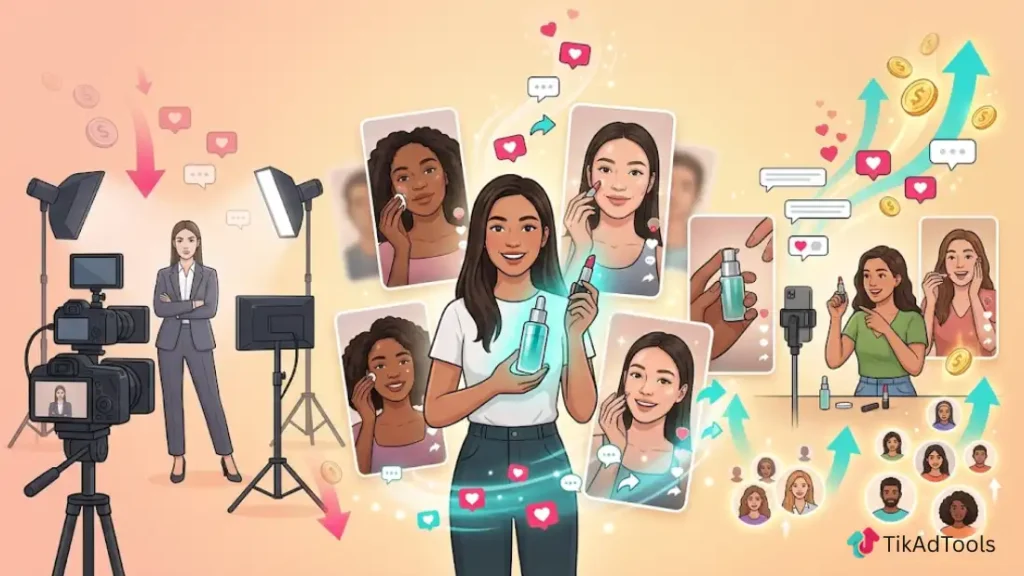
TikTok ads for beauty brands work differently from almost every other advertising platform. The algorithm rewards authenticity, not production budgets.
The audience rewards creators, not brand accounts. And the formats that drive sales are ones most brands still have not used correctly.
In this article, you will find a clear breakdown of the TikTok ad formats that perform, the creative rules beauty audiences respond to in 2026, real cost benchmarks, and exactly how to launch your first 30 days with confidence.
Table of Contents
Get Up to $6,000 in Free TikTok Ad Credits
TikTok offers ad credit incentives for new advertisers, helping you test campaigns with a lower upfront cost.
What makes TikTok beauty Ads work in 2026?
TikTok beauty ads work when they lead with creator-driven, sensory-first content that feels native to the feed, not like a commercial. The highest-converting formats are Spark Ads amplifying organic creator content and Video Shopping Ads linked directly to TikTok Shop. Results vary based on your creative quality, budget tier, and how well your content aligns with current platform behavior.
Why TikTok is now the most powerful channel for beauty brands
No other platform converts beauty discovery into purchase the way TikTok does right now.
According to YouGov’s product discovery analysis, adults aged 25 to 34 make up 29% of daily TikTok users who actively discover products through creators, followed by 18 to 24-year-olds at 21%. That is your core beauty buyer, already in a purchase mindset, on this platform by default. The #TikTokMadeMeBuyIt hashtag has surpassed 30 million videos and counting.
According to NielsenIQ data reported by Cosmetics Business, TikTok Shop shoppers are placing 3.5 times more orders than the average online buyer. That is not a marginal lift. That is a structural difference in purchase behavior that no other platform currently matches.
The platform performance data confirms the shift. According to Dash Social’s Beauty Industry Benchmarks, TikTok beauty content saw views up 40%, reach up 38%, and shares up 31% in the first half of 2025, with engagement rate holding steady at 3.9%.
More creators. Less engagement. That is the Instagram story. TikTok is moving in the opposite direction. Beauty brands winning right now are not outspending competitors. They are out-creating them.
The 4 TikTok ad formats every beauty brand needs to know
Not all TikTok ad formats serve the same purpose. Before you spend a dollar, understand what each format does and when to use it.
Spark Ads: the non-negotiable starting point
Spark Ads let you amplify an existing organic TikTok post, from a creator or your own account, as a paid ad. The content keeps all its original likes, comments, and shares. That social proof stays visible to every new viewer the ad reaches.
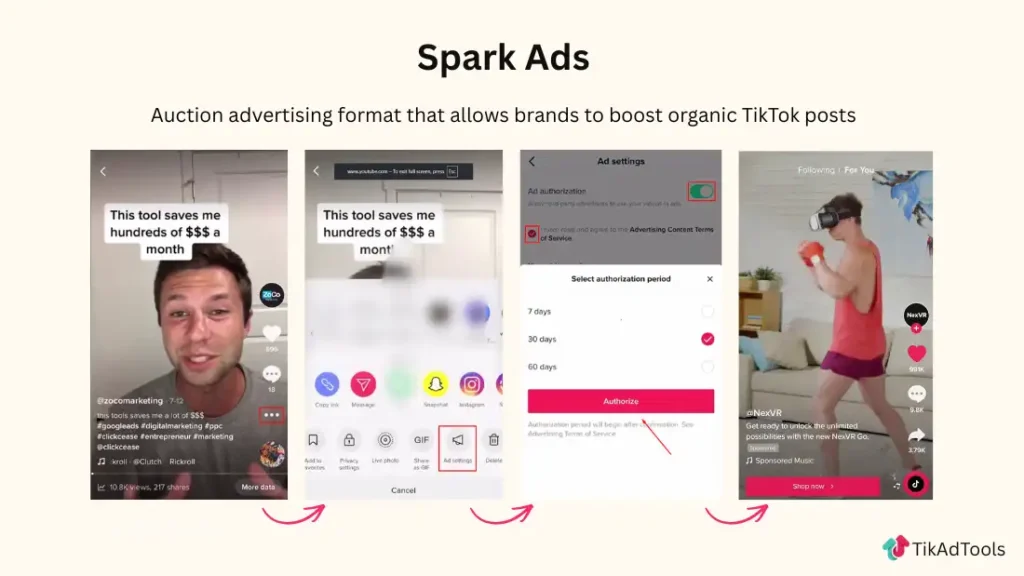
This is the most important format for beauty brands because it looks like content, not advertising.
According to Traackr’s Creator Advantage US Report, 90% of total VIT for Rhode, Rare Beauty, e.l.f. Beauty, and Makeup by Mario came from organic mentions.
Spark Ads let you put paid budget behind exactly that kind of content. The result is an ad that earns trust instead of triggering resistance.
Your starting approach: seed posts with 5 to 10 micro or nano creators, identify the top performer after 7 days, then launch it as a Spark Ad with creator whitelisting in place.
Video Shopping Ads (now GMV Max): where discovery meets checkout
Video Shopping Ads (Now GMV Max) are in-feed ads linked directly to product pages inside TikTok Shop. The viewer moves from watching the video to completing a purchase without leaving the app.
If you sell through TikTok Shop, keeping an accurate beauty product feed for TikTok is just as important as your creative.
Product titles, pricing, availability, and images directly influence how Video Shopping Ads populate product cards and shopping experiences. An outdated catalog can reduce conversion rates even when your ads perform well.
This format closes the gap between interest and action. It removes friction, and friction is the number one conversion killer in beauty commerce.
According to NielsenIQ, as reported by Cosmetics Business, TikTok Shop drives purchase frequency at 3.5 times the rate of standard online retail. Pair that with a sensory texture demo in your video, and you have a frictionless sales funnel inside the content feed.
Use this format when your goal is direct conversion, not awareness. Lead with a creator demo, not a brand voiceover.
In-Feed Ads: your creative testing engine
In-Feed Ads appear natively in the For You Page and auto-play like organic content. They are your creative testing ground before you commit to scale.
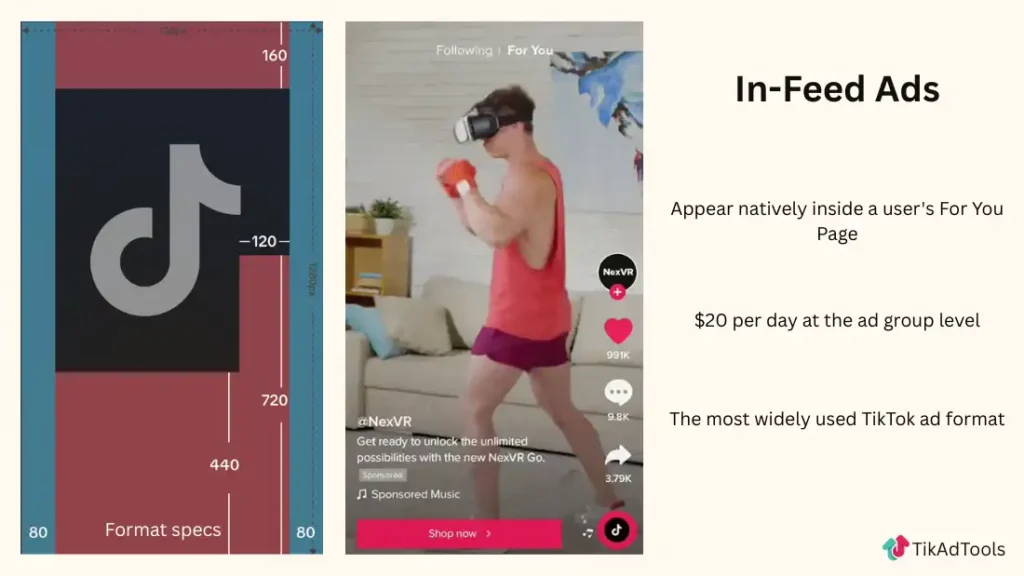
Before amplifying a Spark Ad, test your hooks, visuals, and CTAs through In-Feed campaigns. Run three to five creative variations against a broad audience. Let the data identify which hook is working before scaling spend.
According to TikTok for Business, their Smart+ automation tool delivered a 36% drop in cost per acquisition (CPA) versus manual campaign setups in closed beta tests. For brands running multiple In-Feed variations without a full-time media buyer, Smart+ is worth activating from day one.
Use In-Feed as your lab. Spark Ads are your distribution engine. Keep them in that order.
TopView and branded hashtag challenges: for scale
TopView is the first full-screen video a user sees when they open TikTok. Branded Hashtag Challenges invite the community to create content using your custom sound or visual format.
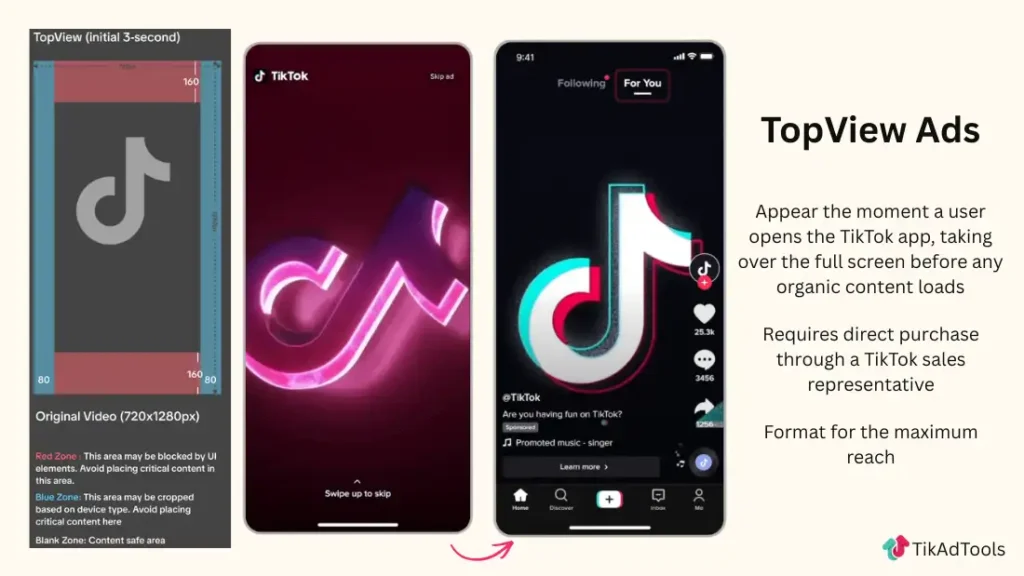
These formats are not for new advertisers. TopView is sold at a flat rate and requires a meaningful budget. Branded Hashtag Challenges need creative infrastructure, including a custom track, creator partnerships, and a content seeding strategy.
According to TikTok for Business’s published K18 Hair case study, K18’s Spark Ads and Reach and Frequency campaign drove the #K18Hair hashtag to 73 million views in a single month, showing the scale available when the right format meets the right creative.
When you are ready to move from testing to market-defining, these are your formats.
The 2026 creative rules: what beauty audiences actually respond to
The single biggest creative mistake beauty brands make on TikTok is bringing a polished studio ad to an unpolished platform. It does not work because the platform penalizes it.
Audience targeting tips for beauty brands
Audience targeting should reflect your product category rather than broad beauty interests alone.
For example, TikTok ad targeting for men’s skincare brands often performs better when combining skincare behaviors with grooming, fitness, and wellness interests instead of targeting “Beauty” as a single audience category.
Here is what is actually converting in 2026, based on pattern data from Traackr, Billo, and Dash Social.
Rule 1: Emotion beats production value. According to Billo’s TikTok Ad Trends analysis, top beauty performers focused on high emotion rather than high production. Visuals that feel personal, candid, and creator-led outperformed polished brand content across every beauty vertical. A creator sharing why they finally fixed their skin barrier converts better than a studio-shot product reveal.
Rule 2: Sensory content is rising. Billo’s trend analysis confirmed that ASMR unboxings, step-by-step how-to guides, and voiceless tactile visuals are among the top-performing beauty formats. If your product has a visible texture, that texture needs to be the hero of your shot.
Rule 3: Result-first hooks dominate. Billo’s beauty trend data shows that leading with the payoff in the first second, tight macro shots followed by a crisp result reveal, stops the scroll and earns trust fast. Start with the result. Show the process second.
Rule 4: Raw and unfiltered outperforms staged content. According to Traackr’s Creator Advantage US Report, routine-led, demo-first formats such as GRWMs, tutorials, and single-product use cases consistently outperformed campaign-driven posts in both engagement and repeat creator participation.
Rule 5: Over-produced studio ads are now a liability. The TikTok algorithm measures watch time, completion rate, and re-watches. A video that feels like an ad loses viewers in the first two seconds. Low watch time signals low quality to the algorithm. Your CPM rises and your delivery drops.
Pass every creative brief through one question: Does this look like something a creator would organically post, or does it look like an ad?
The seed-to-spark strategy: from micro-influencer to paid ad
The most underused paid strategy in TikTok beauty advertising is not even a paid strategy at first. It starts organically.
Here is the three-step framework we have seen consistently outperform direct-to-paid approaches.
Step 1: Seed to nano and micro creators. Send your product to 8 to 15 nano creators (1,000 to 10,000 followers) in your category. Give them a brief, but let them speak in their own voice. According to Traackr’s Creator, nano creators grew 55% in video views, 35% in save and share rates, and 50% in total VIT year-over-year in 2025. They are your most cost-efficient seeding layer.
Step 2: Identify your top organic performer. Monitor seeded posts for 7 to 10 days. Look for the video with the strongest hook rate, highest watch-through rate, and most organic comments. That video is already validated by the algorithm before you spend a dollar on it.
Step 3: Launch it as a Spark Ad. Get posting permission from the creator, whitelist the video, and run it as a Spark Ad. You are putting paid budget behind already-proven content. The social proof stays visible. The algorithm already has strong organic signals to work with.
The key advantage: you only pay to amplify what already works. You do not use paid budget to discover what works.
How much do TikTok Ads for beauty actually cost?
Costs depend on your format, objective, and creative quality. But you can plan around specific numbers.
CPM benchmarks for beauty:
Beauty brands on TikTok Ads carry a median CPM benchmark that you can view live on their platform for the most current monthly figure.
Cruelty-free beauty brands on TikTok can see notably lower CPMs depending on targeting. Spark Ads typically run at $1 to $4 CPM due to the organic engagement already attached to the post.
CPC benchmarks for beauty:
Beauty CPC benchmarks, you can track the most current median cost per click for beauty brands on TikTok Ads directly on their platform, updated monthly.
Minimum daily budget:
TikTok requires a minimum of approximately $20 per ad group per day to maintain delivery, and around $500 at the campaign level as a starting minimum.
Spend tiers by brand stage:
| Brand Stage | Monthly Budget | Primary Goal | Expected ROAS Range |
|---|---|---|---|
| Testing (new) | $500 to $1,000 | Creative validation | Not a primary metric |
| Growing (SMB) | $2,000 to $5,000 | Conversion + brand building | 1.5x to 3x |
| Scaling (DTC) | $5,000 to $50,000+ | Revenue + market share | 3x to 6x+ |
At the testing stage, your primary goal is not ROAS. It is learning which creative angle converts. Spend your first $500 to $1,000 finding your best hook, not chasing return.
One seasonal variable to plan for: CPMs can inflate significantly around major shopping periods like Black Friday and the holidays. Build that buffer into your Q4 media plan.
Real beauty brands, real results: TikTok ad case studies
Numbers in isolation mean little. Here is what they look like when real beauty brands execute correctly.
Case Study 1: K18 Hair (Spark Ads + Reach and Frequency)
K18 launched its first paid TikTok campaign focused on rapid brand awareness. The brand partnered with creators including Heidi D’Amelio and Mikayla Nogueira for before-and-after transformation videos, then ran those posts as Spark Ads.
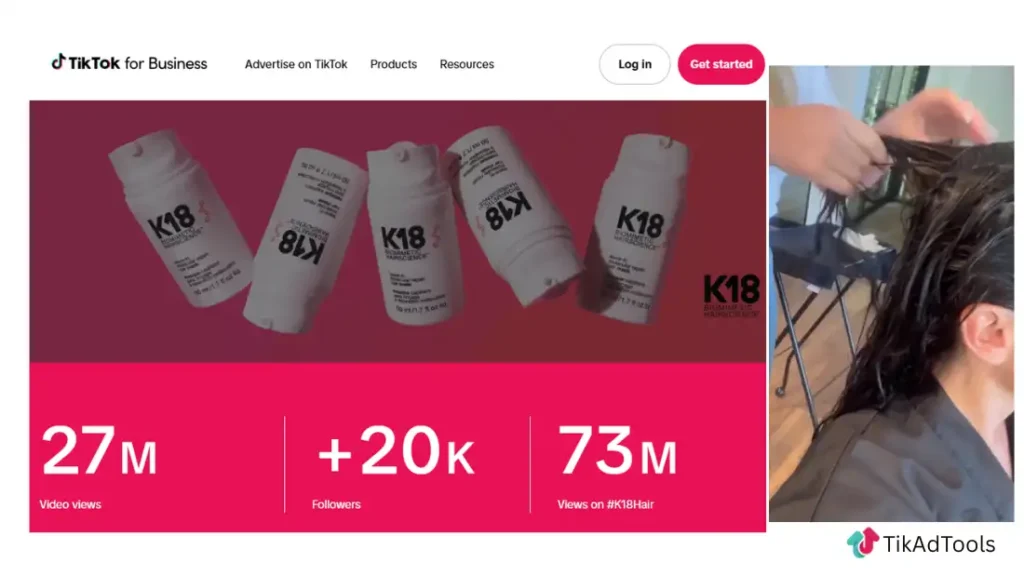
According to TikTok for Business’s published K18 case study, the month-long campaign delivered:
- 70% lift in daily average sales
- Over 27 million video views
- The #K18Hair hashtag accumulated 73 million views
- TikTok following grew from 2,000 to 20,000 in one month (10x growth)
The creative formula was straightforward: authentic creator content plus a result-first transformation structure plus the right paid format. That combination drove awareness and bottom-line revenue simultaneously.
Case Study 2: e.l.f. Cosmetics (In-Feed + Dynamic Showcase Ads)
e.l.f. Cosmetics partnered with agency Tinuiti to run an always-engaged TikTok strategy combining standard In-Feed Ads for reach with Dynamic Showcase Ads for personalized, catalog-driven conversion.
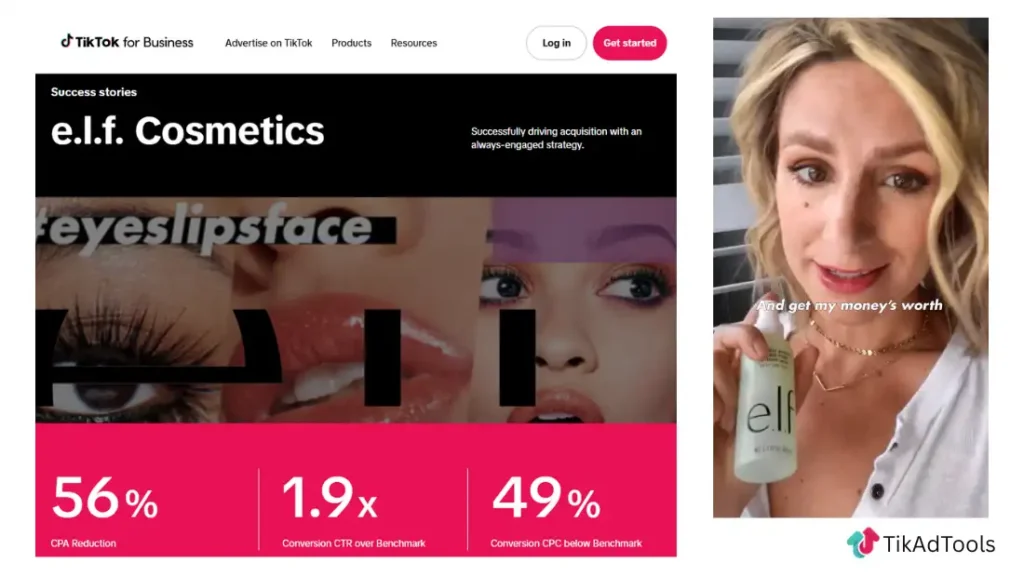
According to TikTok for Business’s published e.l.f. Cosmetics case study, e.l.f. and Tinuiti used Dynamic Showcase Ads to deliver personalized, immersive video ads powered by TikTok’s recommendation engine, pulling from thousands of products in the e.l.f. catalog. The always-engaged structure kept e.l.f. consistently visible in the feed, not just during campaign bursts.
Case Study 3: TikTok Shop Beauty Sales Growth
According to Statista data cited in The Social Shepherd’s 2026 TikTok statistics roundup, beauty and personal care dominated global TikTok Shop sales, with approximately 370 million items sold, making it the largest product category on the platform.
In the United States specifically, beauty and personal care ranked as the top-selling TikTok Shop category for the same period.
The consistent pattern across all case studies: creator authenticity plus the right ad format plus a frictionless purchase path is the formula that works at every budget level.
How to measure and optimize your TikTok beauty campaigns
Running a TikTok campaign without knowing which numbers matter is the fastest way to burn budget. These are the KPIs you track, and what to do with each one.
Primary KPIs to monitor:
- Hook Rate: Percentage of viewers who watch past the first 3 seconds. Below 25%: rewrite the opening. Above 40%: strong hook, scale this creative.
- Watch-Through Rate (WTR): Percentage who complete the full video. Below 15% after a strong hook signals pacing issues. Tighten the middle or shorten the runtime.
- ROAS: Track your current benchmark ROAS data. Use this as your real-world comparison point rather than relying on industry generalizations.
- CPM: Track weekly. A rising CPM without a corresponding ROAS lift is your earliest signal of creative fatigue.
- Add-to-Cart Rate: Critical for Video Shopping Ads. A strong video with weak add-to-cart points to a pricing or product page issue, not a creative issue.
- Cost Per Conversion: Always measure against your actual product margin. A 3x ROAS on a low-margin SKU may not be profitable. Know your numbers before you set targets.
When to kill a creative vs. when to iterate:
Kill if the hook rate is below 20% after $200 in spend. The opening is not working, and downstream changes cannot fix that.
Iterate if the hook rate is strong (above 30%), but WTR is low. Tighten the middle of the video and test a shorter cut.
Scale if the hook rate is above 35%, WTR is above 20%, and ROAS meets or exceeds your floor target.
Refresh creative every 7 to 10 days once your daily spend exceeds $1,000. According to Billo’s ad performance research, iterating on hooks and visuals every 7 to 10 days while keeping your core structure constant is the cadence that prevents fatigue without resetting what is already working. Creative fatigue is the most common reason scaling beauty campaigns plateau.
Common TikTok ad mistakes beauty brands keep making
You can have the right budget and still get flat results. These are the errors we see most consistently across beauty advertisers.
Mistake 1: Using an over-polished studio creative:
TikTok’s algorithm penalizes content that feels like an ad because users skip it fast. Low watch time signals poor quality to the delivery system. Your CPM rises, and delivery drops. According to Billo’s TikTok ad trend analysis, the top beauty performers in 2025 focused on high emotion and tactile, creator-led formats rather than polished production.
Mistake 2: Targeting too narrowly from the start:
A hyper-specific audience prevents the algorithm from learning efficiently. Start broad. Layer in tighter audience signals only after your first $500 to $1,000 in spend has generated real performance data.
Mistake 3: Ignoring TikTok Shop:
Linking Video Shopping Ads to an external website adds friction at the exact moment a buyer is ready to act. According to NielsenIQ, as reported by Cosmetics Business, TikTok Shop buyers place 3.5 times more orders than the average online buyer. That conversion advantage does not apply to off-platform traffic.
Mistake 4: Not rotating creative often enough:
Beauty audiences on TikTok are high-frequency users. They see your ad multiple times per week. After 7 to 10 days of consistent spend, even a strong creative starts to fatigue. If you are not refreshing hooks and visuals weekly at scale, you are overpaying for every result.
Mistake 5: Pausing campaigns before the algorithm finishes learning:
TikTok’s algorithm requires approximately 25 conversion events to complete its optimization cycle. At a $20 daily ad group budget, that can take 10 to 14 days. Pausing early resets the learning phase and wastes the optimization progress you already paid for.
Your 30-Day TikTok Ads launch plan for beauty brands
You do not need six months to know if TikTok ads work for your brand. Thirty days is enough to get a real signal when you structure them correctly.
Week 1: Creative Production
Your first week is not spent in Ads Manager. It is spent building content.
- Brief 5 to 8 nano creators on your product. Focus on real use, genuine reaction, and sensory demonstration.
- Produce 2 to 3 brand-side videos using the result-first hook structure.
- Set up your TikTok Shop product listings and confirm pixel tracking is active.
- Do not launch ads yet. Good creative takes a full week to build and brief correctly.
Week 2: Launch and Seed
- Publish creator posts organically. Allow 48 to 72 hours for natural engagement to build.
- Launch In-Feed Ad campaigns with 3 creative variations. Use broad targeting.
- Set a daily budget of $30 to $50 per ad group. Activate Smart+ if you are running 4 or more creative variations.
- Monitor hook rate and CPM daily. Do not optimize before 3 full days of spend data per creative.
Week 3: Identify and Amplify
- Review In-Feed performance data. Identify the creative with the best hook rate and lowest CPM.
- Take your top organic creator post and launch it as a Spark Ad using creator whitelisting permissions.
- Pause your two weakest In-Feed creatives. Reallocate that budget to the top performer.
- Begin building your Video Shopping Ad campaign using your strongest creative as the foundation.
Week 4: Scale What Works
- Increase the daily budget on your top Spark Ad by 20% every 2 to 3 days. Avoid jumps larger than 50% at once, which can destabilize delivery.
- Launch your Video Shopping Ad campaign targeting a broad beauty and skincare interest audience.
- Brief a second round of creators based on the angles and hooks that generated the strongest results in Weeks 2 and 3.
- Document hook rate, CPM, ROAS, and add-to-cart rate across the full 30 days. This data is your Month 2 roadmap.
By Day 30, you will have real creative performance data, an optimized Spark Ad running, and a clear picture of which product angles work best for your brand. That is your foundation for Month 2.
Frequently asked questions
What is the best TikTok ad format for beauty brands?
Spark Ads are the strongest starting format for beauty brands because they amplify already-proven organic content with social proof intact.
How much should a beauty brand spend on TikTok ads?
New beauty brands should start with $500 to $1,000 per month, focused on creative testing rather than scaling.
Do TikTok Spark Ads work for small beauty brands?
Yes, and they are often the most efficient option for brands with limited production budgets. Spark Ads let you amplify organic content from nano or micro creators without expensive studio shoots.
What type of video content converts best in TikTok beauty ads?
Result-first videos, where the finished look or skin transformation is shown before the tutorial, consistently outperform other formats in beauty.
Is TikTok Shop better than linking to an external website for beauty ads?
Yes, for the direct conversion rate, TikTok Shop outperforms external website links because it removes the friction of leaving the app mid-purchase.
How do you avoid creative fatigue in TikTok beauty ad campaigns?
Creative fatigue on TikTok happens faster than on other paid channels because users scroll at high frequency and can see your ad multiple times in one week.
How do you create TikTok ads for a men’s skincare brand?
Learning how to create TikTok ads for mens skincare brand campaigns starts with creator-led demonstrations rather than traditional product commercials.
Conclusion
TikTok ads for beauty brands are not complicated, but they are different from every other paid channel you have used. The platform rewards content that looks native, feels human, and shows the result before asking for the click.
We covered the four formats that matter most for beauty, the creative rules that separate high-performing brands from the ones burning budget on polished content no one watches, and a real three-step framework for moving from product seeding to paid amplification efficiently.
You also have specific cost benchmarks to plan your budget, real brand case studies showing what execution actually looks like, and a concrete 30-day plan to start without guessing.
The brands winning on TikTok right now are not the ones with the largest ad budgets. They are the ones who understand how the platform works and build their creative strategy around that understanding. Your product does not need to be perfect; your content does need to be real.
Start with one creator, find one piece of content that connects, and put real budget behind it. That is how TikTok beauty advertising actually works in 2026.