
Your best ad isn’t going to stay your best ad. On TikTok, that’s not a risk. That’s a schedule.
A creative that prints money on day one can be dead by day five. Not because you changed anything.
Because the same people kept seeing it, and they stopped caring. That’s TikTok creative fatigue, and it happens faster on TikTok than on almost any other paid channel. It’s the reason a creative supply system matters more than any single winning ad.
Most advertisers treat it as a surprise. It isn’t. It’s predictable, measurable, and beatable, if you build a system instead of reacting after the damage is done.
Table of Contents
Get Up to $6,000 in Free TikTok Ad Credits
TikTok offers ad credit incentives for new advertisers, helping you test campaigns with a lower upfront cost.
TL;DR
- TikTok creative fatigue sets in fast, often within 3 to 7 days, because users scroll past anything their brain flags as familiar.
- Watch CTR and frequency together: a 20% CTR drop while frequency climbs past 2.5 means your creative is fatiguing.
- The fix isn’t waiting for the crash. It’s a creative pipeline that feeds new variations before the old ones die.
Quick Answer
TikTok creative fatigue, sometimes called TikTok ad fatigue, happens when an audience has seen your ad enough times that they stop engaging, pushing CTR down and CPA up. You catch it by tracking CTR decline against rising frequency, and you beat it by rotating fresh creative on a fixed schedule instead of waiting for performance to collapse.
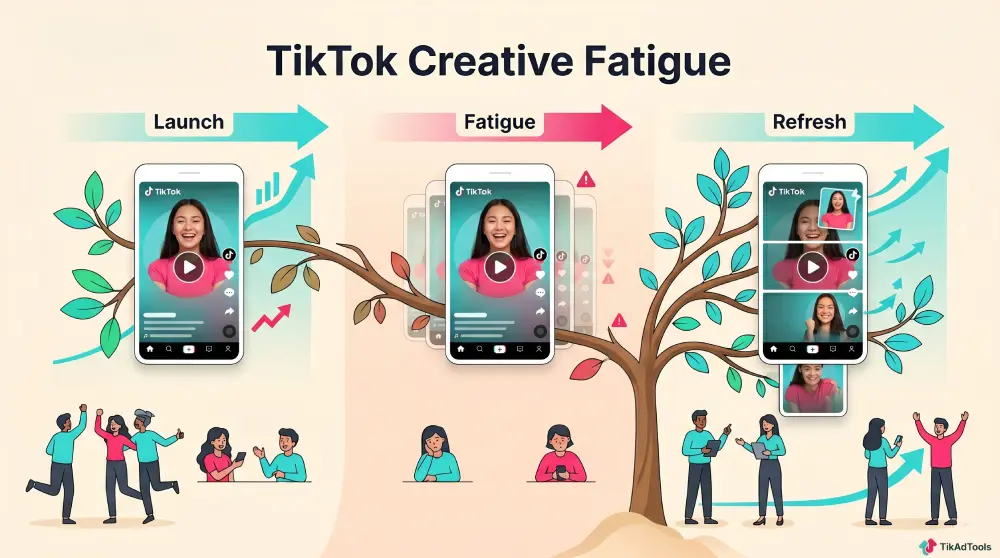
Why TikTok creative fatigue hits faster than anywhere else
Ad fatigue on TikTok develops much faster because users consume far more short-form content in a single session than on most other advertising platforms.
On Meta or Google, a winning ad can run for weeks. On TikTok, that same ad might last 72 hours. The difference is consumption speed.
TikTok users scroll through hundreds of videos an hour. With too many ads on TikTok competing for attention alongside a constant stream of fresh content, the novelty wears off fast.
There’s a brain mechanism behind it called habituation. Once someone recognizes a video as something they’ve already seen, they tune it out automatically. They don’t decide to ignore your ad. Their attention just skips it.
TikTok’s algorithm notices. When engagement on a creative drops, the system reads that as a lower-quality ad and starts charging more to keep serving it.
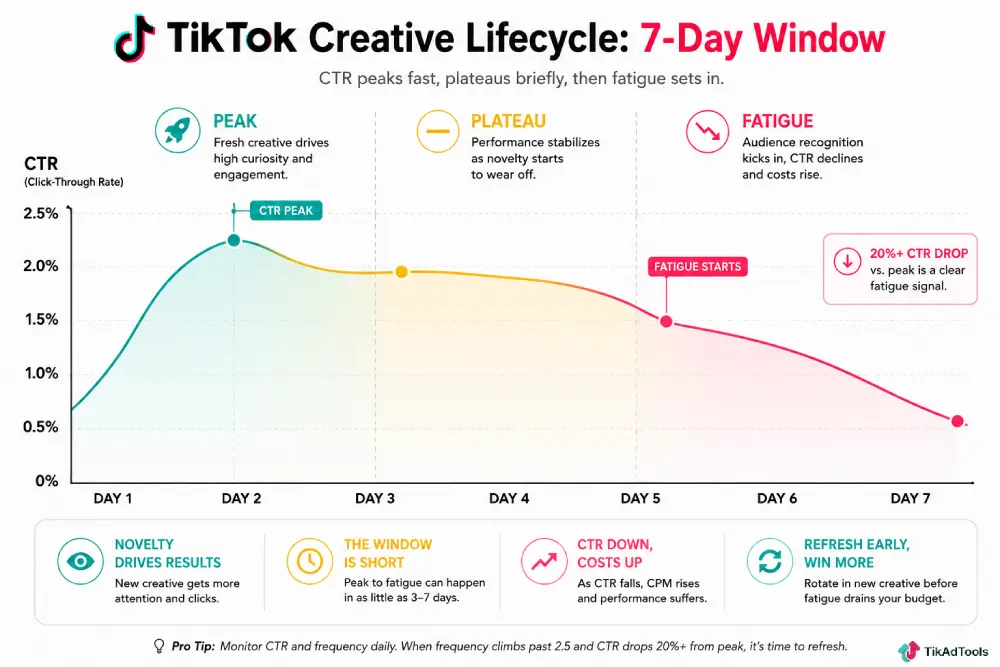
So your CPM climbs at the exact moment your CTR falls. You pay more to reach people who care less.
TikTok itself is blunt about this. In its own creative best practices, the company states that even the best ads hit fatigue eventually, and tells advertisers to refresh creative often.
When the platform building the auction tells you to swap ads on a schedule, that’s not a suggestion to file away.
The two numbers that tell you fatigue has started
TikTok ad fatigue isn’t a feeling. It’s a measurable pattern where CTR declines while frequency continues to rise.
The first is CTR: A fatiguing creative shows a steady decline, usually a 20% drop or more from its own peak over three to five days. That decline is your earliest warning, well before conversions tank.
The second is frequency: As frequency rises, CTR falls. When you see frequency climbing past 2.5 in a short window while CTR drops, that’s the inversion. That’s fatigue.
CPM is your confirmation signal. If it spikes alongside the CTR drop, the algorithm is already penalizing the creative. By the time CPA and ROAS move, you’ve burned budget you didn’t have to.
Watch these daily, not weekly. On a slow-fatigue platform, you can check in once a week. On TikTok, three days of decline is a real trend, and waiting a full week means you’ve already paid the tax.
If your click rate is sliding for reasons you can’t pin down, low CTR troubleshooting walks through the other suspects.
Is it creative fatigue or audience saturation?
These two get blamed for each other constantly, and the fixes are completely different.
TikTok creative fatigue means the audience has seen the same creative too many times. Audience saturation means you’ve simply reached most of the available people.
Audience saturation means you’ve reached almost everyone in your target pool. The ad might be perfectly good.
There’s just nobody fresh left to show it to. You fix that by widening targeting or building a new audience.
Here’s the tell. Launch a brand-new creative to the same audience. If performance recovers, it was fatigue.
If the new creative also struggles out of the gate, you’ve saturated the audience and need a bigger pool.
Getting this wrong wastes money in both directions. You can spend weeks producing new videos to fix a saturation problem that more creative won’t touch. Knowing your real audience targeting limits tells you which problem you actually have.
Your audience size sets the fatigue clock
TikTok ad fatigue develops faster in small audiences. This is the single most ignored factor in TikTok creative planning.
If your targeting pool is under 100,000 people, frequency climbs fast. You can hit a frequency of 2.0 and start seeing CTR drops within a couple of days. There just aren’t enough new eyeballs to spread the impressions across.
Run the math. A $ 200-a-day retargeting campaign pointed at a pool of 5,000 people will hit frequency 3 inside 48 hours. That’s not a creative problem. That’s an arithmetic problem.
Medium pools, roughly 100,000 to 500,000, give you more room. The same creative can usually run until frequency approaches 2.5 before it tires.
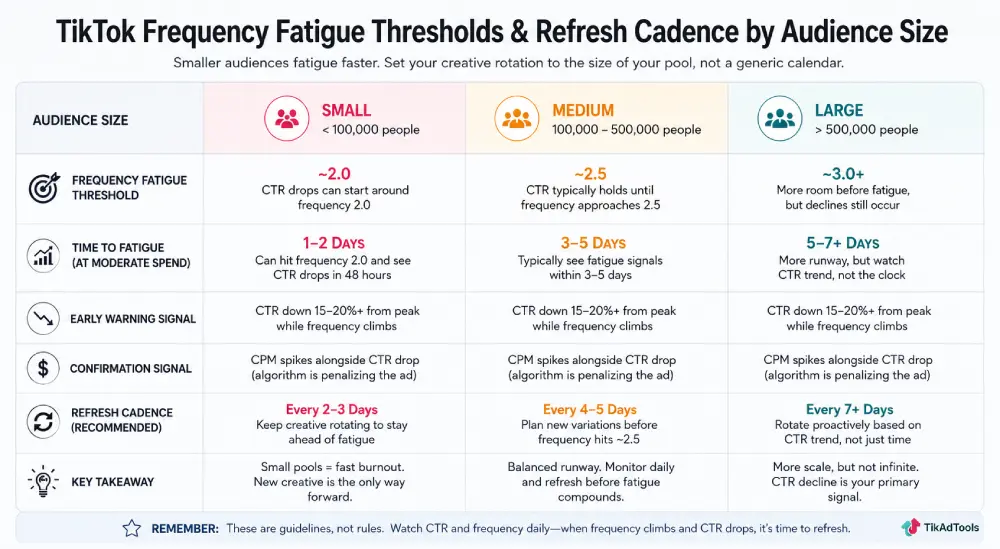
Large pools above 500,000 stretch furthest, but CTR decline is still your primary signal regardless of size.
So your refresh cadence isn’t one number. A tight retargeting audience needs new creative every few days.
A broad prospecting audience can run the same hero ad longer. Set your rotation to the pool, not to a calendar you copied from someone else.
For deeper context on how exposure builds, our breakdown of ad frequency covers the thresholds in detail.
Build a creative pipeline, not a panic response
The advertisers who beat fatigue build a TikTok creative testing process long before performance starts to decline.
TikTok’s own guidance backs this directly. In its brand awareness best practices, TikTok states that a higher quantity of creatives in a campaign increases refresh and reduces fatigue. More assets in rotation means no single ad gets overserved.
Effective TikTok creative testing doesn’t require more full productions. It requires more variations from the same shoot. That’s the creative refresh: keeping proven concepts alive by introducing new hooks, edits, and angles before performance drops.
Get more out of every shoot
Every TikTok ad has three parts: the hook in the first three seconds, the body that delivers the value, and the CTA.
The hook does almost all the heavy lifting. TikTok’s research shows that 90% of ad recall impact lands in the first six seconds.
So you don’t need ten new concepts. You need one strong body and CTA, then a stack of different hooks bolted on top.
Same product footage, fresh opening every time. The creative refresh extends the life of winning ads without another production day.
Editing tools make this cheap. Cutting new hooks onto an existing body in something like CapCut takes minutes, not a new production budget.
If you’re scaling volume, AI video tools like Pippit AI can spin out hook variations faster than a manual edit. Our deeper look at TikTok ad hooks covers which openers actually stop the scroll.
Set a fixed rotation cadence
Pick a schedule and stick to it. For most performance accounts, introducing a TikTok creative refresh every three to seven days keeps fatigue from ever fully setting in.
Don’t wait for a creative to die before queuing the next one. Stagger launches so a new variation enters rotation while the current winner is still healthy. That overlap is what keeps your CPA flat instead of spiky.
This is also where structured testing pays off. Running a clean A/B test on hooks tells you which variations to scale and which to retire before they ever fatigue.
How do you know when to refresh versus rebuild?
Not every tired ad needs to be thrown out. The cheaper move is usually a refresh, not a rebuild.
The creative refresh works when the core concept still performs, but the audience has seen it too often. Swap the hook, shorten the edit, change the on-screen text, or update the offer angle. You’re keeping what’s proven and resetting the novelty.
Rebuild when the concept itself is failing. If a fresh hook on the same body doesn’t move CTR, the angle is the problem, not the opening. That’s your signal to start from a new idea.
There’s a point of no return, though. Once a video has been heavily overserved to the same audience, forcing a tired asset back into rotation rarely works.
At that stage, testing a new variation is cheaper than reviving the old one. Pair this with a real read of ad performance data so you’re deciding on numbers, not gut feel.
Set up your fatigue dashboard in Ads Manager
You can’t catch TikTok ad fatigue if your reporting hides the warning signs. The default columns won’t show you the inversion you need to see.
In TikTok Ads Manager, customize your columns so you’re tracking the full chain in one view: CPM, Hook rate, CTR, Frequency, CVR, and CPA. That order matters. It lets you read the decay from top of funnel to bottom in a single glance.
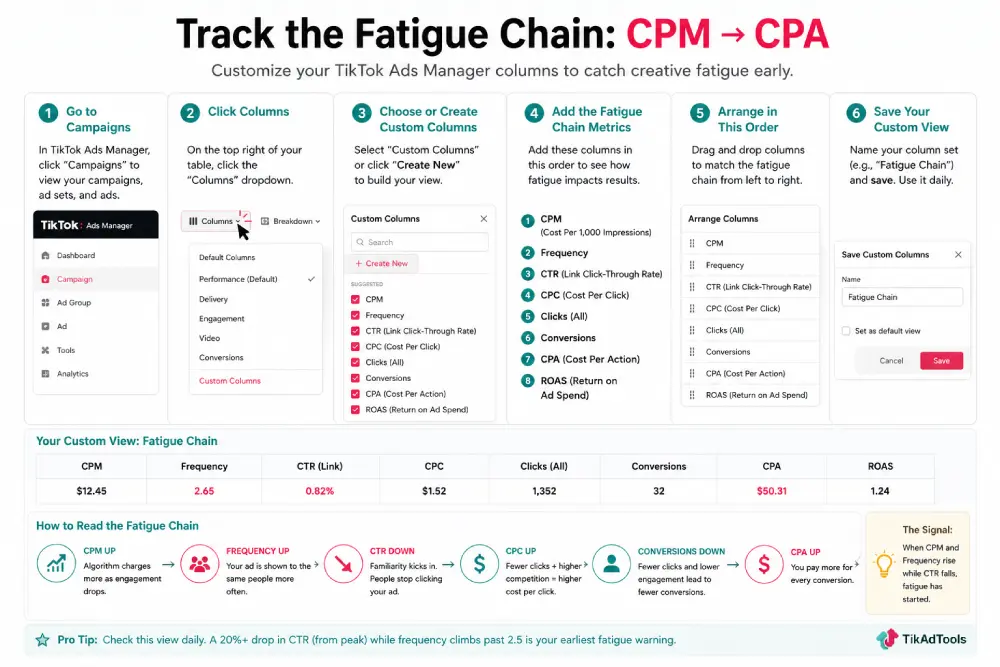
Hook rate and Hold rate are your leading indicators. Hook rate is the share of people who watch past the first seconds.
Hold rate is mid-video retention. Both decay before CTR does, which buys you even more warning time.
Set a simple rule. If an ad’s CTR drops 20% from its peak while frequency rises past 2.5, it goes on the refresh list that day. No debate, no waiting to see if it recovers. The TikTok ad creative audit tool can score a replacement asset against this same checklist before it goes live.
The whole point of a system is that you’ve already decided what to do before emotion gets involved.
When you’re scaling spend, this discipline is what stops a fatigue spiral from eating your budget at volume.
FAQs
How fast does TikTok creative fatigue set in?
Faster than most platforms. Many performance creatives start fatiguing within 3 to 7 days, and tight retargeting audiences can fatigue in under 48 hours. The smaller your audience pool and the higher your daily spend, the faster it hits.
What frequency is too high on TikTok?
For performance campaigns, CTR usually starts dropping once frequency passes 2.5 in a short window, and 3.0 is firmly the danger zone. Brand awareness campaigns tolerate more. TikTok points to a weekly frequency near 3x as the sweet spot for ad recall, which is higher than what performance creative can absorb.
Can I fix a fatigued ad without making a new one?
Yes. In many cases, a TikTok creative refresh – such as changing the hook, edit, or offer – can restore performance before a complete rebuild is necessary
How many creatives should I run to avoid fatigue?
More than one, always. TikTok says a higher quantity of creatives in a campaign reduces fatigue by spreading impressions, so no single ad gets overserved. A practical setup is one proven body and CTA with several hook variations rotating through it.
Does creative fatigue raise my CPM?
Yes. When engagement on an ad drops, TikTok’s algorithm reads it as lower quality and charges more to keep serving it. So a rising CPM alongside a falling CTR is one of the clearest confirmations that fatigue has already set in.
Conclusion
TikTok creative fatigue isn’t what beats advertisers. Failing to plan for it is. Build a repeatable TikTok creative testing system, refresh winning ads before performance collapses, and use data (not guesswork) to decide when it’s time to replace a creative.
Sources