
Most TikTok ad campaigns don’t die from bad targeting. They die from being shown to the same people too many times.
Once frequency creeps too high, CTR drops, CPA climbs, and the algorithm starts charging more for less attention.
The good news is that frequency is one of the easier levers to control once you understand how TikTok measures and serves it.
With the right cap, the right audience size, and a steady creative rotation, you can keep your campaigns fresh for weeks instead of days, which comes back to how well your ad creative pipeline can keep up.
In this guide, you’ll learn:
- What TikTok ad frequency actually measures
- The ideal frequency range for different campaign goals
- How to set frequency caps inside TikTok Ads Manager
- Warning signs that frequency is climbing too high
- How to reduce frequency without rebuilding your campaign
Table of Contents
Get Up to $6,000 in Free TikTok Ad Credits
TikTok offers ad credit incentives for new advertisers, helping you test campaigns with a lower upfront cost.
Key takeaways
- Frequency is the average number of times one user sees your ad over a given period.
- A weekly frequency of 2 to 3 is the safest starting benchmark for most campaigns.
- TikTok audiences fatigue around four times faster than Meta audiences, so creative refreshes need to happen sooner.
- Frequency caps are available for Reach campaigns, but Smart+ and other automated formats remove the manual control.
- Rising frequency paired with falling CTR is the clearest sign that your creative needs a refresh.
Quick answer
TikTok ads frequency measures how often one user sees your ad. A weekly frequency of 2 to 3 is the recommended starting point for most performance campaigns, while awareness campaigns can tolerate slightly higher exposure. Frequency caps can be set at the ad group level under Bidding and optimization, but only for Reach and Reach and Frequency objectives.
What is TikTok ad frequency
TikTok ad frequency is the average number of times a single user sees your ad during a set time window. It’s calculated by dividing total impressions by unique reach.
So if your ad ran 30,000 impressions and reached 10,000 unique users, your frequency is 3. The TikTok ad frequency calculator runs that math for you from your own impressions and reach numbers.
The metric matters because TikTok’s algorithm rewards strong engagement signals like CTR and watch time. When the same user sees your ad five, six, or seven times in a week, those signals collapse.
They’ve already decided whether to click. Showing the ad again costs you money without adding value.
How TikTok calculates frequency
TikTok measures frequency at the ad group and ad level. You can see it directly inside TikTok Ads Manager by adding the Frequency column to your reporting view.
The default attribution window is 7 days, though you can adjust it for longer-term campaigns.
It’s worth noting that organic views of a Spark Ad don’t count toward paid frequency. Only paid impressions show up in the column, which is one reason creator-led ads tend to fatigue more slowly than standard in-feed creative.
The TikTok ads metrics guide has a full breakdown of related metrics.
The ideal TikTok ad frequency
The right frequency depends on your campaign goal:
- Performance (sales, leads, app installs): 2 to 3 impressions per user per week
- Awareness and brand recall: 3 to 5 per week
- Retargeting (warm audiences): keep it under 5 over the retargeting window
- Reservation buying with set reach: TikTok lets you target a specific frequency upfront
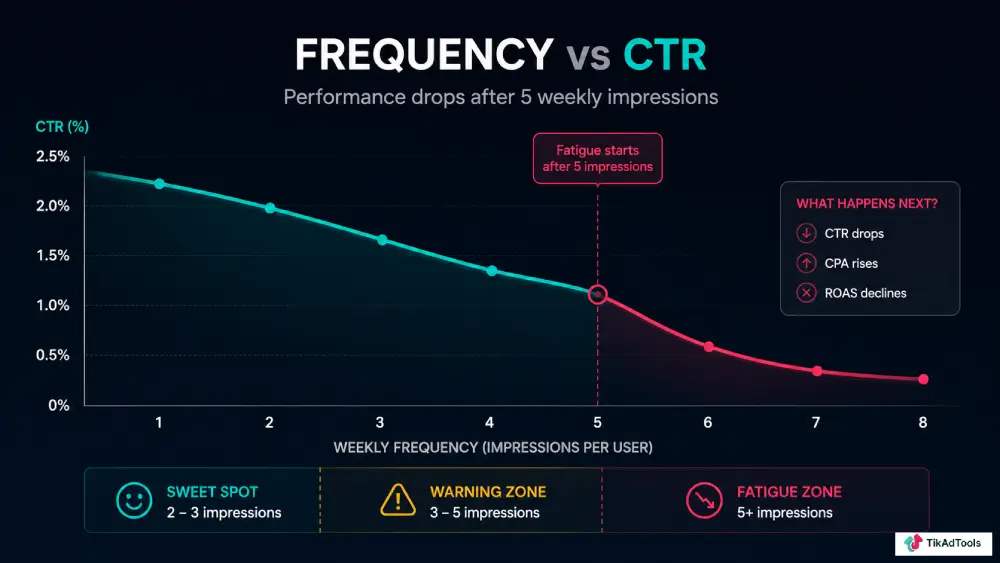
Below 2 per week, your audience may not remember the ad well enough to act. Above 5 to 6, CTR and conversion rates typically slide as fatigue kicks in. The trend matters more than the absolute number.
A frequency of 4 that’s holding steady with strong engagement is healthier than a frequency of 2.5 that’s climbing weekly while CPA rises.
How to set a frequency cap in TikTok Ads Manager
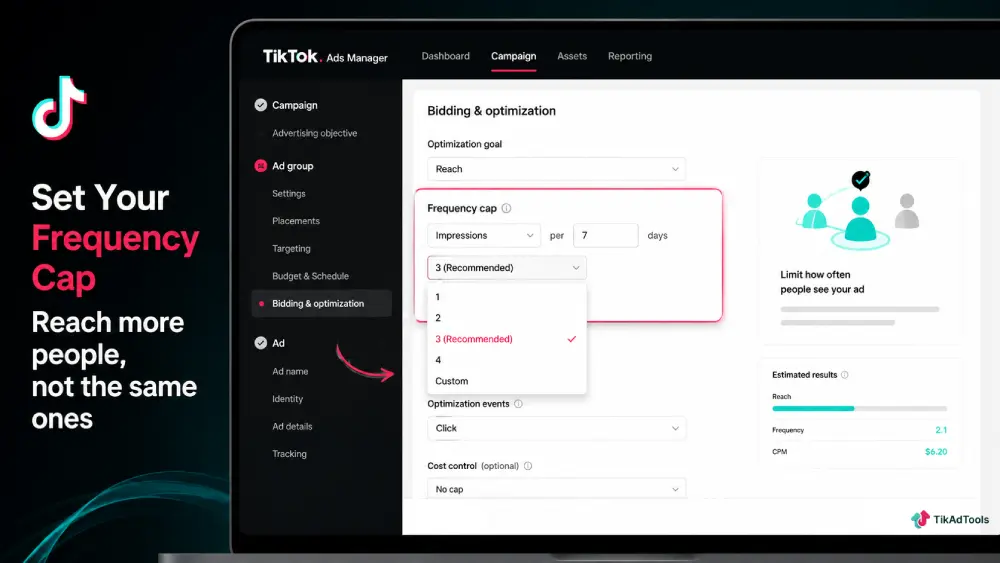
Frequency caps are set at the ad group level, not the campaign level.
To configure one:
- Open your campaign in TikTok Ads Manager and select the ad group.
- Scroll to the Bidding and optimization section.
- Choose a preset cap or enter a custom limit (impressions over a number of days).
- Save the ad group settings.
According to the official TikTok Business Help Center, frequency caps are mainly available for Reach and Reach and Frequency buying types.
Performance objectives like Conversions and Traffic don’t expose the same manual control, since the algorithm prioritizes outcomes over exposure limits.
For Smart+ and other automated campaigns, the system manages frequency on its own.
Reach and frequency campaigns
For larger campaigns where you need predictable exposure, TikTok offers a Reach and Frequency buying type.
This is a reservation-based system that lets you secure a fixed CPM up to 225 days in advance and target a specific average frequency per user.
It’s most useful for product launches, seasonal campaigns, and brand awareness pushes where guaranteed reach matters more than auction flexibility. The TikTok Reach and Frequency overview explains the full setup.
Warning signs your frequency is too high
Watch for these patterns inside your dashboard:
- Frequency climbing past 2.5 to 3 within a single week
- CTR dropping while impressions stay flat or grow
- CPA rising on days 7 to 10 of a strong campaign
- Frequency above 5 in a small retargeting pool
When you see these signs together, you’re likely watching creative fatigue in real time. The TikTok creative fatigue guide walks through the exact signals and timelines to monitor.
How to lower TikTok ad frequency
Once frequency is climbing, you have four practical options.
Refresh your creative
Upload a new video into the same ad group and pause the old one. The algorithm treats the new asset as a fresh ad, and frequency on that creative resets to zero.
Strong hooks are the fastest fatigue point, so rotating the first 3 seconds is usually enough. The TikTok ads hooks guide has examples.
Expand your audience
If your targeting is too narrow, frequency rises fast even with a small budget. Broaden interests, raise the geographic radius, or add a lookalike audience built on your strongest converters.
Lower the budget for small audiences
Retargeting pools are especially vulnerable. A high daily budget on a 1,000-person audience can hit frequency 10+ in a day. Lower the daily spend or switch to a lifetime budget. The TikTok retargeting ads guide has a full playbook.
Set a hard cap
For campaigns that allow it, manually cap frequency at 2 or 3 impressions per 7 days. This forces TikTok to spread your budget across more users instead of repeatedly serving the same ones.
Frequently asked questions
What is a good TikTok ad frequency?
A weekly frequency between 2 and 3 is generally considered healthy for most performance campaigns. Brand awareness campaigns can sustain a slightly higher range (3 to 5) since the goal is repeated exposure rather than immediate action.
How often should I refresh my TikTok ad creative?
For high-spend campaigns, refresh creative every 7 to 14 days. TikTok audiences fatigue about four times faster than Meta audiences because of the platform’s high-velocity feed, so even strong creatives tend to burn out within two weeks at scale.
Can I set a frequency cap on Smart+ campaigns?
No. Smart+ and most automated campaign types remove the manual frequency cap option. The algorithm decides delivery on its own. To control frequency on Smart+, you have to manage it indirectly through creative rotation and audience size.
Does organic exposure count toward TikTok ad frequency?
No. The frequency column only tracks paid impressions. If a user saw your Spark Ad organically before it was boosted, that view doesn’t appear in the paid frequency count. This is one reason Spark Ads often feel fresher to audiences for longer.
What frequency is too high for TikTok ads?
Anything above 5 weekly impressions per user is usually too high for performance campaigns, and the warning zone often starts around 3. Watch the trend alongside CTR and CPA. If frequency rises while CTR drops, fatigue has set in regardless of the absolute number.
Conclusion
Frequency isn’t a metric you set once and forget. It’s an early warning system that tells you when your audience is getting bored before your ROAS confirms it.
Build a weekly habit of checking frequency alongside CTR and CPA, set a personal trigger point around 3, and have a new creative ready before you hit it.
The campaigns that scale longest are the ones that treat creative rotation as a system, not a reaction. For a step-by-step look at scaling without burning out audiences, the scale TikTok ads guide is the next read.
Sources