
TikTok Ads Hooks: Types, Benchmarks, and How to Write Ones That Actually Convert
Your ad can have perfect targeting, a strong offer, and a generous budget. None of that matters if the first two seconds fail.
TikTok users decide whether to keep watching within a single thumb movement. If your opening doesn’t stop them cold, the algorithm gets the message fast. Your delivery drops, your CPMs rise, and your budget quietly evaporates.
This guide covers the hook types that work in 2026, the metrics you need to track, and how to build a testing system that finds winners before you waste spend. Hooks are the single highest-leverage piece of your ad creative, so it’s worth treating them as their own discipline.
Key takeaways
- Your hook has two seconds to stop the scroll: everything after that depends on those first frames working.
- The three hook formats with the highest performance in 2026 are the pattern interrupt, the problem-first open, and the bold claim.
- A strong TikTok hook rate sits at 30–35%. Above 40% is elite. Below 20% means your opening needs a full rebuild.
- Hook rate and hold rate work together; a high hook rate with a low hold rate signals your content doesn’t deliver on what the opening promised.
- Test at least three to five hook variations per ad group before drawing conclusions.
- Creative fatigue hits fast on TikTok, and a drop in hook rate is usually the first sign your audience has seen the creative too many times.
What is a TikTok ad hook?
A TikTok ad hook is the opening moment of your video: the first one to three seconds designed to stop a viewer from scrolling past. It can be visual, verbal, text-based, or a combination of all three.
The hook is not a preamble. It is not a logo card. It is not a product shot. It is the single most important element of your entire creative because without it, no one sees the rest of your ad.
TikTok’s algorithm is built around watch time. It reads engagement signals in real time. If viewers scroll past your ad quickly, the platform treats that as a relevance signal and throttles your distribution. A strong hook earns impressions. A weak one costs you them.
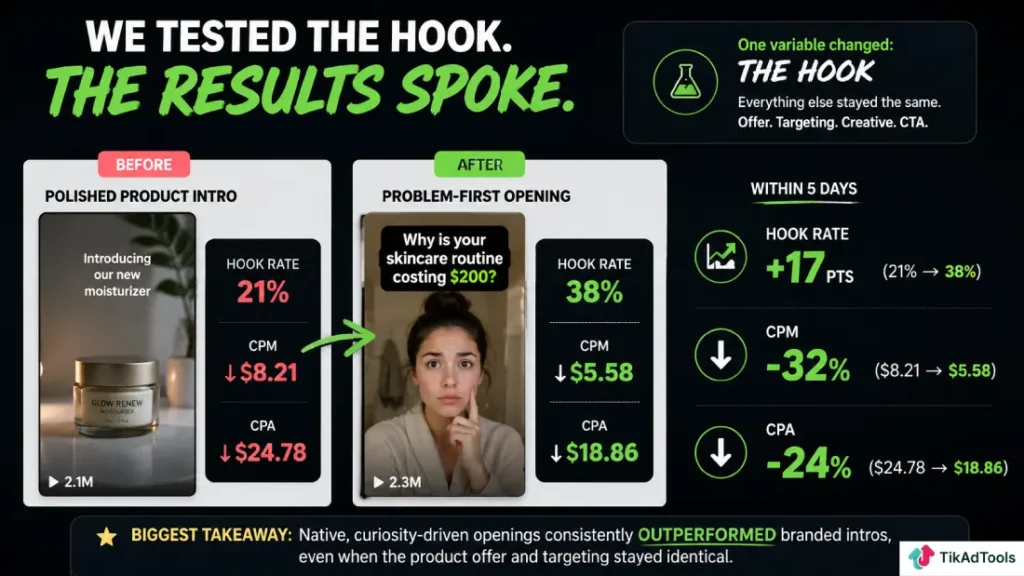
One hook test we ran for an eCommerce skincare brand replaced a polished product intro with a problem-first opening: “Why is your skincare routine costing $200?” Nothing else in the ad changed.
Within five days, the hook rate increased from 21% to 38%, CPM dropped by 32%, and CPA improved by 24%.
The biggest takeaway was that native, curiosity-driven openings consistently outperformed branded intros, even when the product offer and targeting stayed identical.
Why the first two seconds determine everything
TikTok measures a metric called hook rate: the percentage of viewers who watch at least two seconds of your video after seeing it. This is calculated by dividing two-second video views by total impressions.
A commonly used rule of thumb among TikTok media buyers puts 30–35% as a solid hook rate for most direct-response campaigns, since TikTok doesn’t publish an official benchmark.
Above 40% is generally treated as elite. Below 20% signals that your opening visual or audio is too slow, too generic, or too polished for the platform.
When the hook rate improves, CPMs tend to drop. Accounts that shift from weak to strong hooks commonly see a meaningful CPM reduction as the algorithm begins treating the creative as genuinely relevant rather than disruptive. That’s cheaper traffic on the same budget.
Hook rate also acts as an early warning system for creative fatigue. When your hook rate starts falling despite stable targeting, your audience has likely seen the creative too many times.
Refreshing the hook, even without changing the rest of the video, is often enough to reset performance.
The 6 TikTok hook types that work in 2026
1. The pattern interrupt
This is the most reliable hook format on TikTok. A pattern interrupt is anything unexpected in the first frame: a sudden movement, an unusual visual, an abrupt camera angle, or something that simply doesn’t look like every other ad in the feed.
The brain is wired to notice things that break the expected pattern. When your opening defies what a viewer expects to see next, it forces a pause. That pause is your window.
Examples:
- A creator appearing upside down and speaking normally
- A sudden jump cut with no context
- An extreme close-up of something unusual before revealing what it is
This hook type pairs well with TikTok in-feed ads, where blending into the feed is the goal, but a pattern interrupt makes the creative stand out even within that native format.
2. The problem-first open
State the viewer’s problem in the first two seconds. No setup. No brand intro. Just the pain point, delivered fast.
This works because it creates immediate relevance. The viewer hears their own situation described out loud, and their brain shifts from passive scrolling to active attention.
Strong examples:
- “POV: Your ad spend doubled, but your sales didn’t.”
- “Spent $500 on TikTok ads this week. Got zero sales.”
- “Your hook sucks. Here’s why.”
The problem-first format works especially well for TikTok ads for eCommerce where the audience has specific, recognizable frustrations you can name directly.
3. The bold claim
Open with a statement that challenges what the viewer thinks they already know. Make it specific. Make it provable. Make it slightly uncomfortable.
Examples:
- “This $5 product replaced my $200 skincare routine.”
- “Most TikTok ads fail in the first frame. Here’s what the winners do instead.”
- “You don’t need a big budget. You need a better hook.”
The bold claim creates what researchers call a curiosity gap: the distance between what the viewer knows and what they want to know. That gap keeps them watching.
4. The direct address
Speak to a specific person. Call out your audience by their identity, problem, or situation in the first line.
Examples:
- “If you’re running TikTok ads for a Shopify store, stop what you’re doing.”
- “Small business owners, this one’s for you.”
- “Beauty brand founders, listen up.”
Demographic call-outs work because they filter out irrelevant viewers and intensify relevance for the right ones. A viewer who hears themselves described in the first second is far more likely to keep watching.
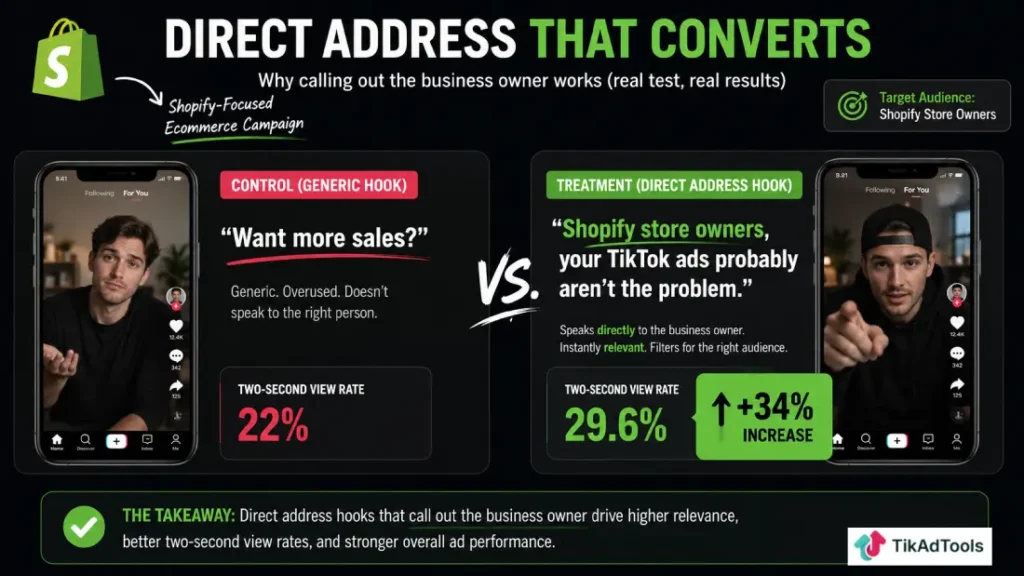
For Shopify-focused eCommerce campaigns, the strongest direct address hooks consistently called out the business owner directly instead of the customer.
One of the best-performing openings we tested was: “Shopify store owners, your TikTok ads probably aren’t the problem.” That single line increased the two-second view rate by 34% compared to a generic “Want more sales?” opener because it immediately filtered for the exact audience we wanted and created instant relevance.
5. The relatable situation
Show a moment the viewer has already lived. Film it in a way that mirrors how TikTok content naturally looks. No polish. No music bed. Just a real moment.
Examples:
- A creator staring at a phone showing a low ROAS dashboard
- Someone refreshing their TikTok Ads Manager at midnight
- A desk setup with a cup of cold coffee and a blank script document
This format leans into UGC-style creative, which consistently outperforms produced content on TikTok.
When the first frame looks like something a user would post organically, resistance drops, and watch time rises. Pair this approach with UGC TikTok ads for the strongest native feel.
6. The visual proof open
Lead with the result before you explain it. Show the before-and-after transformation, the dashboard with the impressive numbers, or the product doing something surprising, before any voiceover or explanation lands.
This format works because it front-loads the payoff. The viewer sees the outcome first and stays to understand how it happened.
Examples:
- A TikTok Ads dashboard showing a strong ROAS number in the first frame
- A product demonstration where something unexpected happens in the second one
- A “this happened after 7 days” text overlay on a result shot
Hook rate vs. hold rate: know the difference
Hook rate measures who stops. Hold rate measures who stays.
Hold rate tracks the percentage of viewers who continue watching after the initial hook, typically defined as those who reach the 15-second mark. You calculate it by dividing 15-second video views by two-second video views.
A strong benchmark for hold rate is 25% or above. Below that, your content is stopping the scroll but failing to keep interest past the opening.
This framework makes creative decisions faster and removes guesswork from your testing process. For a complete look at which metrics move the needle, the TikTok ads metrics guide covers the full performance stack.
How to write a TikTok hook: a practical framework
Follow this structure for every hook you write:
- Pattern interrupt or direct trigger: the first visual or first word must create immediate relevance or curiosity.
- Value promise: tell or show the viewer what they will get by watching.
- Curiosity gap: leave something open that only the rest of the video can close.
A real example structure: “This $5 product [pattern interrupt] replaced my $200 routine [value promise]… here’s what actually happened [curiosity gap].”
Keep the hook under three seconds. Do not start with your logo. Do not start with an establishing shot. Do not build up to the interesting part; open with it.
For the visual layer, use on-screen text that reinforces your audio hook. A large share of TikTok users watch with the sound off.
Your hook needs to work without audio and with it. Tools like CapCut make it straightforward to add bold text overlays and captions that carry the hook visually, even when the audio is muted.
How to test TikTok hooks without wasting budget
Run three to five hook variations per ad group. Keep every other element, such as the offer, the product demo, and the CTA, identical. Change only the hook. This isolates the variable and gives you clean data.
What to test:
- Hook type (pattern interrupt vs. problem-first vs. bold claim)
- Audio vs. text-only vs. combined hook delivery
- Creator-led vs. product-led opening
- Direct address vs. general statement
Track hook rate at the two-second mark in TikTok Ads Manager. Flag any creative below 20%. Pause it and rebuild the opening before spending more.
Once you have a hook rate winner above 35%, test the hold rate to confirm the rest of the creative delivers. The TikTok ad hook generator can produce a first batch of variations across the six formats above when you need a starting point fast.
Most accounts see creative fatigue set in within two to three weeks on TikTok. Build the habit of rotating hook variations regularly, even for high-performing ads.
The creative itself may still work; a fresh hook can extend its life without rebuilding the entire video.
If you want to understand how testing fits into your broader campaign structure, the TikTok A/B test guide covers how to set up controlled experiments inside TikTok Ads Manager properly.
FAQs
What is a TikTok ad hook?
A TikTok ad hook is the first one to three seconds of your video ad. Its job is to stop the viewer from scrolling past. It can use a visual, a spoken line, on-screen text, or a combination. Without a strong hook, no one sees the rest of your creative.
What is a good hook rate on TikTok?
A hook rate of 30–35% is solid for most direct-response campaigns in 2026. Above 40% is considered elite and typically triggers algorithm rewards, including lower CPMs and broader distribution. Below 20% signals the opening needs a rebuild.
How long should a TikTok ad hook be?
Your hook should land within two to three seconds. That is the window TikTok uses to measure whether viewers stay or scroll. The core message or intrigue of your hook needs to hit before that threshold, not after it.
What are the best TikTok hook types for eCommerce?
The problem-first open and the visual proof format consistently perform well for ecommerce. The problem-first hook creates immediate relevance, while visual proof front-loads the result and builds desire before the viewer hears any claim. Both work well with UGC-style production.
Why does my hook rate keep dropping?
A declining hook rate usually signals creative fatigue, meaning the same audience has seen your opening too many times. It can also mean your first frame is too slow, too polished, or too similar to what competitors are running. Rebuild the first two seconds and test at least three new hook variations.
What is the difference between hook rate and hold rate?
Hook rate measures who watches past the first two seconds. Hold rate measures who stays through the core message, typically the 15-second mark. Hook rate tells you if you stopped the scroll. Hold rate tells you if your content kept the viewer once you had their attention. You need both metrics to diagnose creative performance accurately.
Conclusion
Your hook is not just an opening line. It is the mechanism that determines whether your ad gets seen, whether TikTok distributes it broadly, and whether your budget works or burns.
The strongest hooks in 2026 create immediate curiosity, speak directly to a real situation, and deliver the most interesting moment first, not last.
Pair that with a testing system built around hook rate and hold rate data, and you stop guessing what works and start knowing.
Write three hooks for every ad you launch. Measure the two-second view rate for each. Let the data tell you which one deserves your budget.
Ready to start running ads? Claim your TikTok ad credit and put your first hook to the test.