
Most TikTok ads fail before the second word is spoken. Not because the product is bad. Not because the budget is too small. The copy is doing the wrong job in the wrong format.
Writing copy for TikTok ads is not the same as writing for any other paid channel. The rules are different. The format is layered. What reads well on paper often falls flat on screen. Copy is one layer of the full creative package; it has to work with the visuals, not carry the ad alone.
If you have been adapting copy from other platforms and wondering why your TikTok ROAS keeps disappointing, that is the core problem. You are using the wrong framework for the medium.
Get Up to $6,000 in Free TikTok Ad Credits
TikTok offers ad credit incentives for new advertisers, helping you test campaigns with a lower upfront cost.
This guide covers the full TikTok ads copywriting system: the three copy layers that work together, the six formulas that consistently convert, a decision table to match each formula to your campaign goal, and a pre-publish checklist you can use on every ad you build.
Key takeaways
- TikTok ad copy works across three layers at once: the spoken script, on-screen text, and the caption, and most ads fail because only one layer gets any attention.
- Copy borrowed from other platforms tends to read as an ad, and both TikTok’s algorithm and its audience punish that instantly.
- Strong TikTok ad copy states the offer or the problem within the first few seconds, matching how people actually scroll the feed.
- Six proven formulas, including AIDA and PAS, cover most campaign goals, but the formula should follow the objective rather than the other way around.
- A pre-publish checklist that checks all three copy layers together catches more weak ads than any single edit pass.
Quick Answer
TikTok ads copywriting means writing three aligned layers, the spoken script, the on-screen text, and the caption, so they read like native TikTok content instead of a traditional ad. Pick the formula (AIDA, PAS, or another) to match your campaign goal, and make sure the copy earns attention in the first few seconds before it tries to do anything else.
What is TikTok Ads copywriting?
TikTok ads copywriting is the practice of writing persuasive, platform-native text for paid TikTok placements across three distinct layers: the spoken script, on-screen text overlays, and the caption. Effective TikTok ad copy works within the first few seconds, mirrors organic content in tone, and drives one clear action. Results vary based on offer type, audience awareness level, and how well all three layers are aligned.

The 3 layers every TikTok ad needs to work together
Most guides treat TikTok ad copy as a single thing: the script. That framing misses two of the three disciplines that actually determine whether an ad converts.
Your spoken script, your on-screen overlays, and your caption are not the same channel. Each one reaches your viewer differently. Each one does a different job. When all three are aligned, your ad compounds. When even one is off, the whole creative leaks.
Layer 1: the spoken script (your core persuasion)
The spoken script is the engine. It carries your hook, your argument, and your call to action in sequence. Every word needs to earn its place because spoken copy has no second chance. Viewers do not rewind.
Write your script for the ear, not the eye. Short sentences. Conversational contractions. Natural pauses are built in with punctuation. A line like “You have been overpaying for skincare, and this is exactly why” lands cleanly when spoken and loses nothing in delivery.
Keep your spoken script between 21 and 34 seconds for most ad formats. According to TikTok for Business, video ads in that duration window saw a 280% lift in conversion rate compared to ads that ran shorter or longer.
Layer 2: text overlays and where they land on screen
Text overlays reinforce your spoken script. They are not a transcript. Use them to emphasize one key phrase per scene: a stat, a price, a product name, or the single benefit you most want retained.
Placement matters more than most advertisers account for. TikTok’s UI places interactive elements, your CTA button, profile icon, and caption text, in the lower portion of the screen, while navigation tabs occupy the top.
TikTok doesn’t publish one fixed pixel number for this, since the safe margin shifts with caption length and any add-ons attached to the ad. TikTok ad specs by format covers how the safe zone scales for your specific placement before you finalize it. As a general rule, key text and logos placed in the outer top and bottom bands of a 1080×1920 frame compete for attention and often get partially obscured.
Keep overlay text in the visible center band of the screen. Use a maximum of seven words per overlay. Choose font weights that are readable at mobile size without covering your subject. According to TikTok’s creative best practices for performance ads, they recommend displaying 5 to 10 words per second when using on-screen text.
Layer 3: caption copy as an audience-targeting signal
TikTok’s algorithm reads your caption. It uses the text to categorize your content and decide which users to show it to. According to TikTok’s official algorithm documentation, as referenced by Hootsuite’s Social Media Blog, the platform uses video information signals, including captions, hashtags, and sounds, to match content with relevant interest and behavioral categories.
Structure your caption in three parts: a hook sentence that includes your primary keyword, one supporting sentence explaining the offer, and three to five specific hashtags. A caption like “Skincare routine for dry skin that actually works in winter. Full breakdown in the link. #dryskin #skincaretips #winterskin” gives the algorithm clear context and gives your viewer a reason to act.
How to write a TikTok ad hook in the first seconds
Your hook needs to interrupt a viewer who is actively trying to scroll past you within the first three seconds. That is the real constraint. According to TikTok for Business, 90% of ad recall impact is captured within the first six seconds, which means your opening visual and first spoken word carry most of the weight. Separately, TikTok’s own campaign data shows that 63% of all successful TikTok ads convey their main message within the first three seconds.
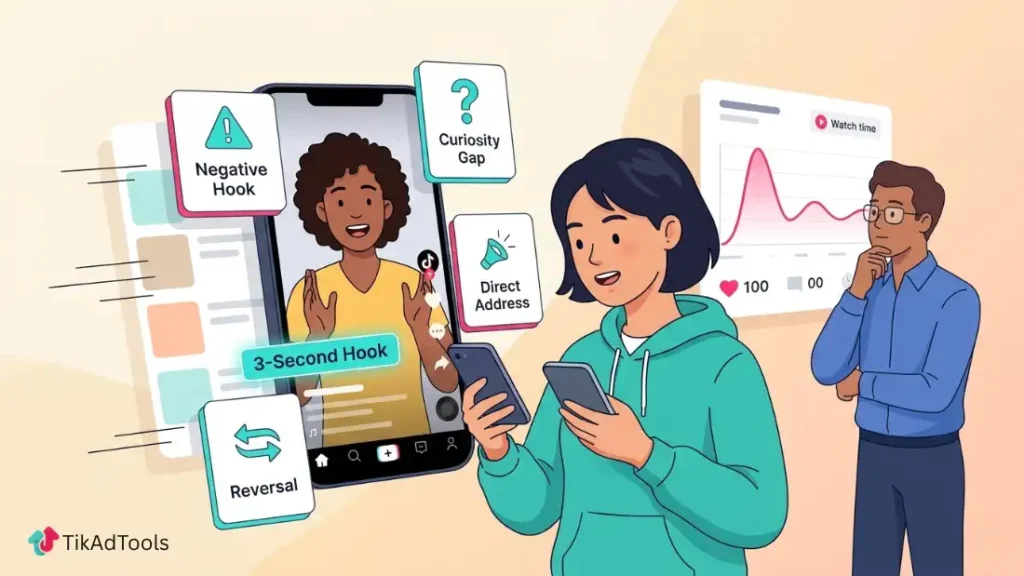
The goal is cognitive pattern-interruption: say or show something the brain cannot categorize quickly. That brief pause is your entry point.
Here are four hook archetypes that consistently create that interruption:
- Negative hook: lead with what does not work, like “This is why your TikTok ads keep failing.” Counterintuitive openings outperform positive claims because they trigger a self-referencing check in the viewer’s brain.
- Curiosity gap: withhold the most important part, like “We ran 300 TikTok ads and the winner surprised everyone.” The viewer needs the resolution, and that need drives watch time.
- Reversal: start at the outcome and work backwards, like “I now spend $40 a month on skincare. Three years ago, I was spending $300. Here is what changed.” The contrast creates immediate investment.
- Direct address: speak to one specific person in one specific situation, like “If you sell physical products on TikTok and your ROAS is under 2x, watch this.” Specificity signals relevance.
Test one hook archetype per creative. Do not mix archetypes in the same ad. Clean, single signals are far easier to iterate on when you review performance.
The 6 TikTok Ads copywriting formulas (with script skeletons)
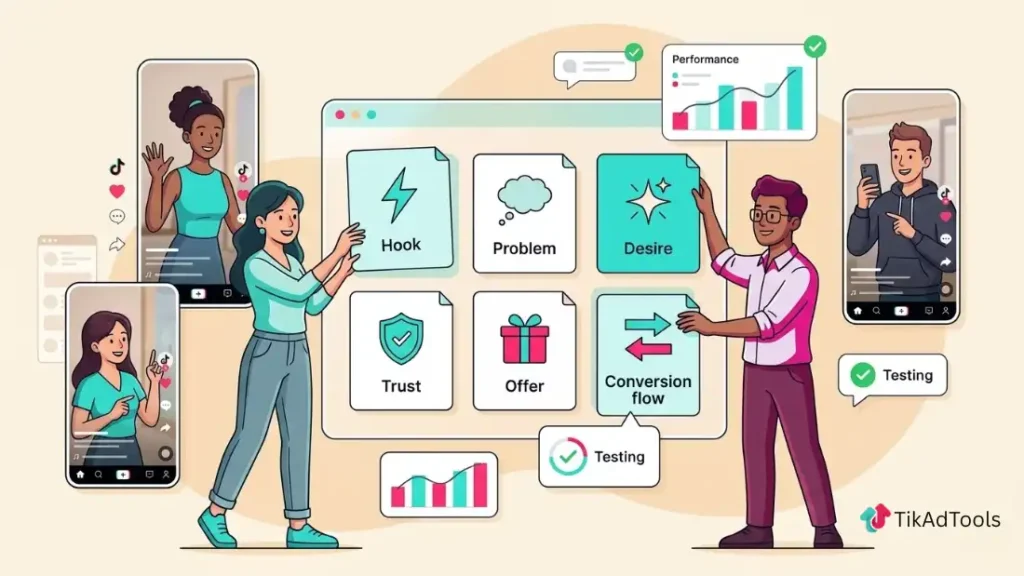
1. AIDA: for cold audiences who don’t know you yet
What it is: Attention, Interest, Desire, Action. The oldest direct-response framework, rebuilt for short-form video.
Script skeleton: Hook that captures attention (one statement or visual) + interesting claim that builds curiosity + proof or benefit that creates desire + single clear CTA.
Example: “This moisturizer sold out four times in 2024. Here is why dermatologists keep recommending it for sensitive skin. Try it for 30 days or your money back.”
When it works best: Cold traffic. Low brand awareness. New product launches.
2. PAS: for warm audiences already feeling the problem
What it is: Problem, Agitation, Solution. Meets the viewer where their frustration already lives.
Script skeleton: Name the problem clearly + make the pain of that problem vivid and specific + introduce your product as the direct fix.
Example: “You keep waking up with dry, tight skin even after moisturizing. You have tried changing your routine, and nothing sticks. This product fixes moisture retention at the barrier level, not just on the surface.”
When it works best: Retargeting. Warm audiences. High-consideration products.
3. The skeptic script: for offers in saturated, burned-out niches
What it is: Acknowledge the skepticism upfront. Disarm it before the viewer can voice it internally.
Script skeleton: Open by naming the doubt + validate the skepticism with honesty + present your differentiator as proof, not as a claim.
Example: “Yes, this is another collagen supplement ad. And yes, most of them are a waste of money. The difference here is third-party lab testing. Here are the actual numbers.”
When it works best: Saturated categories. Trust-deficit audiences. Any offer where the product category already has a credibility problem.
4. HVO (hook–Value–Offer): lean and fast for high-intent buyers
What it is: A stripped-down three-part structure for audiences already in purchase mode.
Script skeleton: Strong specific hook + one concrete value statement (not a list, one thing) + direct offer with clear terms.
Example: “Our analytics dashboard cuts reporting time by 6 hours per week. Built for DTC brands running paid ads. Free for your first 30 days.”
When it works best: Bottom-of-funnel campaigns. High-intent audiences. Simple, clear offers.
5. The life hack frame: native-feeling for discovery-mode impulse buys
What it is: Disguise the ad as a tip or personal discovery. Match the format of organic content exactly.
Script skeleton: Open as if sharing a personal find + frame the product as the method, not the subject + close with a low-friction nudge.
Example: “I stopped buying $40 candles after I found this. Same scent throw, same burn time, twelve dollars. Link is in bio.”
When it works best: Impulse purchases. Lifestyle products. Audiences not actively searching for a solution.
6. The reversal (“don’t buy this”): pattern interrupt built on earned trust
What it is: Open by actively advising against a purchase, then earn the right to reverse that advice with honesty.
Script skeleton: Anti-CTA opener + honest qualification criteria + invitation to the right buyer only.
Example: “Do not buy this course if you are just starting out. It is built for people already running ads who want to cut wasted spend. If that is you, it pays for itself in week one.”
When it works best: Premium offers. Sophisticated buyers. High-ticket, high-trust products.
Match the formula to your campaign goal
| Campaign Goal | Audience Awareness Level | Best Formula |
|---|---|---|
| Brand awareness or new product | Cold, unaware | AIDA |
| Retargeting site visitors | Warm, problem-aware | PAS |
| Competing in a crowded niche | Skeptical, ad-fatigued | Skeptic Script |
| Direct conversion, simple offer | High intent, solution-aware | HVO |
| Lifestyle or discovery purchase | Passive, scrolling | Life Hack Frame |
| Premium or high-consideration offer | Warm, trust-sensitive | Reversal |
Use this table as a starting point, not a rigid rule. Your audience’s actual awareness level depends on how much prior exposure they have had to your brand and your category. If you are unsure, start with PAS for retargeting and AIDA for cold traffic. Both are forgiving formats for first tests, where you are still learning the audience.
The TikTok ad copy generator can draft a first pass in any of these six formulas so you have a starting script to edit rather than a blank page.
Writing TikTok ad CTAs that feel native (not salesy)
Your CTA is the last thing a viewer hears. It is also the most skipped part of most creative briefs.
A CTA that sounds like an ad confirms what the viewer already suspected: this content is not for them, it is trying to sell them something. The goal is a CTA that sounds like the natural next step, not a closing pitch.
Here is how to structure your CTA by offer type, paired to the formulas above:
- DTC products (AIDA, Life Hack Frame): Tie the CTA to the result, not the action. Instead of “Shop Now,” use “Get Yours Before the Restock Sells Out” or “Find Your Shade” using the link.
- Apps and SaaS (HVO, AIDA): Lead with the trial or the cost of inaction. “Start Free” consistently outperforms “Download Now” for low-friction installs.
- Lead generation (PAS, Skeptic Script): Make the CTA feel like relief. “Get the Free Checklist” or “See if You Qualify” reduces the perceived commitment and lowers resistance.
- TikTok Shop (Life Hack Frame, Reversal): Use social proof inside the CTA itself. “Join 12,000 People Who Switched” or “See Why It’s TikTok Shop’s Top Pick This Week” converts better than a generic action verb.
One rule applies across every format: one CTA per ad. Two CTAs split attention and reduce click-through on both.
The TikTok ad copy review checklist
Before any ad goes live, run it through these ten points across all three copy layers.
- Hook lands in the first three seconds. Your opening word or phrase creates a pattern interruption without requiring any context.
- Script is written for the ear. Read it out loud. If it sounds stiff or formal, rewrite it.
- One formula, one ad. You have not mixed frameworks inside the same script.
- Overlays stay in the safe zone. Check the current specs for your format rather than reusing a fixed pixel number from an old export.
- Overlays are seven words or fewer. One key phrase per scene, not a running subtitle track.
- Caption opens with the primary keyword. Your first caption line signals the category clearly to the algorithm.
- Caption uses three to five specific hashtags. No generic tags. Category-specific and symptom-specific only.
- The formula matches your audience awareness level. Cross-reference the decision table before you publish.
- CTA is appropriate. You are not using a generic “Shop Now” where a benefit-led CTA would convert better.
- All three layers tell the same story. Your script, overlay, and caption are reinforcing each other, not ignoring each other.
Frequently asked questions about TikTok Ads copywriting
What is the best copywriting formula for TikTok ads?
There is no single best formula because the right choice depends on three variables: your campaign goal, your audience’s awareness level, and your product type. For cold traffic with no prior brand exposure, AIDA is the most forgiving starting point. For retargeting warm audiences, PAS consistently outperforms. We recommend using the decision table in this guide to match the formula to each specific campaign before you write a single word.
How do you write a TikTok ad script?
Start with your hook, which must create a pattern interruption in the first three seconds. Then choose the copywriting formula that matches your audience’s awareness level and build the body of your script around that structure. Keep your total script between 21 and 34 seconds, write every line for spoken delivery rather than reading, and close with one benefit-led CTA that fits your offer type. Always read the finished script out loud before you record.
How long should a TikTok ad caption be?
TikTok displays the first 100 characters of your caption before the viewer needs to tap “more,” so your first line must do the full job on its own. Structure your caption as three parts: a keyword-rich hook sentence, one supporting sentence about the offer, and three to five specific hashtags. You do not need a long caption. You need a focused one that gives both the viewer and the algorithm exactly what they need in the first line.
How do I know which TikTok ad copywriting formula to use for my product?
The fastest way to decide is to assess where your target audience sits on the awareness scale. If they do not know your brand yet, start with AIDA or the Life Hack Frame. If they are already aware of the problem your product solves, PAS will meet them where they are. If your product is in a saturated category where the audience has seen many competing claims, the Skeptic Script is your strongest option. When in doubt, run AIDA for cold traffic and PAS for retargeting as your first split test.
Should I use hashtags in TikTok ad captions, and do they actually help?
Yes, but their primary function is targeting, not reach. TikTok’s algorithm uses the hashtags in your caption to categorize your ad and match it to relevant interest clusters, particularly when you are running broad targeting. Use three to five specific, category-relevant hashtags rather than generic ones like #fyp. A tag like #dryskinroutine signals far more useful audience context to the algorithm than a high-volume tag with no niche meaning.
Can I use the same ad copy for TikTok and Instagram Reels?
You can use the same script structure, but you should not copy it verbatim. TikTok rewards conversational, first-person, friend-to-friend tone, while Reels audiences are slightly more tolerant of polished, brand-forward language. More critically, the caption functions differently on each platform: TikTok captions are an algorithmic targeting signal, while Instagram captions do not influence ad delivery in the same way. Adapt the tone and caption strategy for each platform, even when the core script is the same.
Conclusion
TikTok ad copy fails when it is treated as a single discipline. You are not writing one thing. You are writing three: a spoken script, a visual overlay system, and a caption that works for both the algorithm and the viewer.
The six formulas in this guide cover the full range of what your campaigns will need. AIDA and HVO for cold and high-intent audiences. PAS and the Skeptic Script for retargeting and trust recovery. The Life Hack Frame and the Reversal for the ads that need to feel like content before they feel like an offer.
Match the formula to the awareness level. Align all three copy layers. Write a CTA that earns the click rather than demanding it.
The brands that win on TikTok in 2026 are not the ones spending more. They are the ones building ads where every word, overlay, and caption line is doing an intentional, specific job. That is exactly what this guide is built to help you do.