
Most seasonal TikTok campaigns don’t lose money on timing. Key timing can produce more value than the creative itself.
Advertisers launching in the week of Black Friday get crushed by learning phase costs and watch their ROAS tank while competitors clean up. The offer was fine, but the clock was the problem.
Table of Contents
Get Up to $6,000 in Free TikTok Ad Credits
TikTok offers ad credit incentives for new advertisers, helping you test campaigns with a lower upfront cost.
TL;DR
- Launch seasonal campaigns at least six weeks before the peak so the algorithm finishes learning before costs spike.
- Q4 CPMs climb hard, so warm audiences early and save aggressive direct-response budget for the final two weeks.
- The post-holiday “Q5window in January stays cheap and buyer-ready, and almost nobody runs ads into it.
Quick Answer
TikTok seasonal ads are campaigns built around peak shopping moments like Black Friday, the December holidays, Valentine’s Day, or back-to-school. The trick isn’t the offer; it’s the timeline. Launch roughly six weeks out to clear the learning phase, build warm audiences during the run-up, then scale spend into the final high-intent window when buyers are ready.
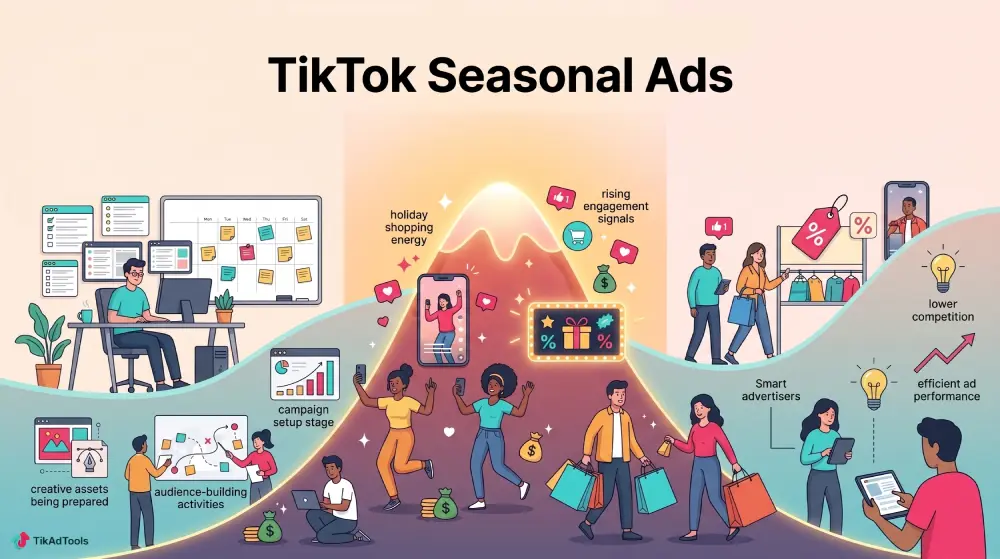
What Makes Seasonal Ads Different From Everyday Campaigns
Seasonal ads compete in a market where everyone shows up at once. That’s the whole difference.
In a normal month, your CPM is set by your audience and your creative. During Q4, it’s set by demand. Every advertiser in your category is bidding for the same eyeballs in the same two-week window, so prices spike whether your ads are good or not.
That changes how you plan. You’re not just writing a holiday hook. You’re racing a calendar where the cheapest impressions disappear right when the most buyers arrive.
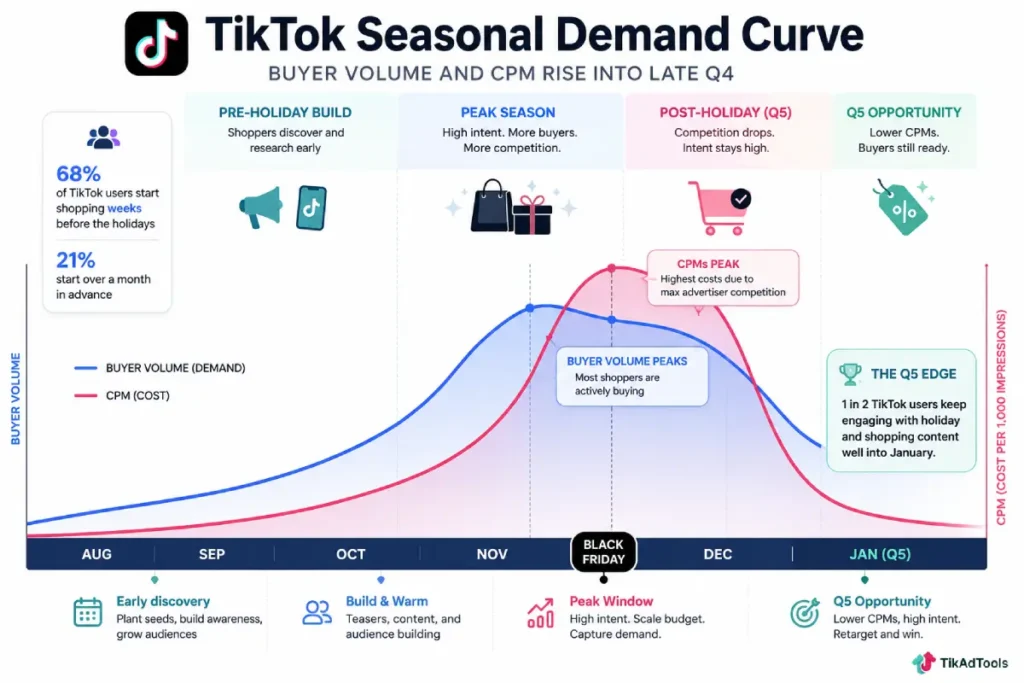
TikTok itself frames the season in three phases. Around 68% of users start shopping weeks before the holidays, and 21% start over a month in advance. If you wait for the peak to launch, those early shoppers already bought from someone else.
When Should You Launch Seasonal TikTok Ads?
Start six weeks before the event. Not the week of.
This isn’t a marketing preference; it’s math. Your campaign needs to clear the TikTok ad learning phase before peak demand hits, and that phase eats time and budget. TikTok says volatility usually starts declining after about 25 results or seven days in the learning phase.
Picture the bad version. You launch a Black Friday campaign on November 25. Days one through five run hot and expensive while the algorithm figures out who converts. By the time it stabilizes, the sale’s over, and you paid premium CPMs for your worst-performing days.
Now flip it. You launch in mid-October with awareness and teaser content. The algorithm learns on cheaper traffic, builds a clean audience, and by Black Friday your campaign already knows who buys. You scale into the peak instead of starting cold inside it.
The run-up isn’t filler either. The weeks before major shopping events are when you plant seeds with teasers, countdowns, and sneak peeks, which lowers acquisition costs once sales begin. Treat October as audience-building, not waiting.
If you’re getting new advertiser credit, this is the season to put it to work. TikTok regularly runs promotions where new accounts can claim ad credits to test campaigns before committing real budget, which takes the sting out of those early learning-phase days.
How Much Do Seasonal TikTok Ads Cost?
More than you’re used to, but the timing of your spend matters more than the total.
CPMs rise across all of Q4 as demand stacks up. The mistake is spending evenly across the whole period instead of front-loading cheap awareness and back-loading expensive conversion budget.
TikTok stays comparatively efficient against other platforms even at peak. During the 2025 holiday window, TikTok CPMs remained relatively efficient, making it a strong period to capture upper- and mid-funnel attention from shoppers. That’s your cue to use TikTok for discovery, not just last-click closing.
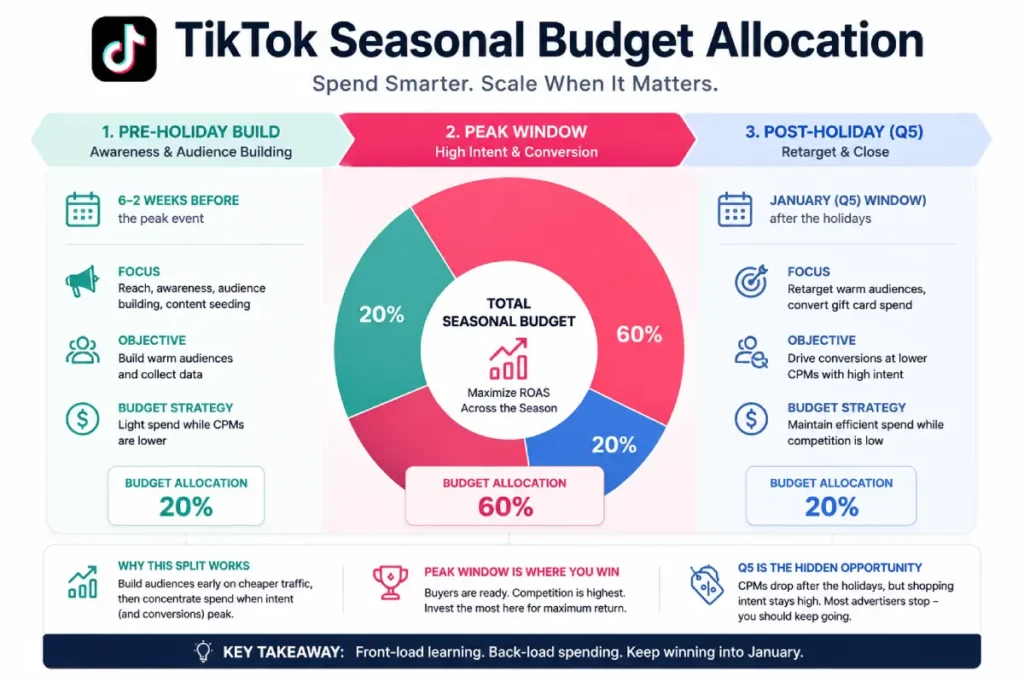
The smarter play is splitting your seasonal budget by phase. Spend lightly on awareness in the run-up when impressions are cheap, then concentrate your aggressive spend in the final stretch when intent is highest.
If you want a deeper framework, our breakdown of TikTok ad budget strategy maps spend to campaign objective.
Keep an eye on rising frequency too. When everyone targets the same shoppers, the same people see your ad over and over, and TikTok ad frequency creeps up fast inside small seasonal audiences. Watch it weekly during the peak, not after.
Building Seasonal Creative That Survives the Whole Run
Seasonal creative burns out faster than evergreen creative. You’re showing the same offer to the same people for weeks, so fatigue sets in early.
Plan for it. Map your assets by phase before launch: teaser, launch, reminder, and last call. That way, you’re swapping in fresh angles on a schedule instead of scrambling when performance drops.
Watch the early signals so you replace ads before they crater. Creative fatigue shows up as falling view rates and climbing CPM long before sales drop, and seasonal campaigns hit that wall in days, not weeks.
For production speed, lean on creators. Spark Ads let you turn an organic creator post into a paid ad without rebuilding it, which is the fastest way to keep fresh creative flowing during a busy season. Our guide to Spark Ads walks through the authorization steps.
If you’re editing in-house, a fast vertical-video tool matters more in season than any other time. Tools like CapCut let you cut a teaser, a launch ad, and a last-call reminder from the same footage in an afternoon, which keeps your refresh schedule on track.
The Q5 Window Almost Everyone Skips
The season doesn’t end on December 26. The advertisers who keep spending into January quietly win the cheapest buyers of the year.
TikTok calls it “Q5,the stretch after the holidays when ad costs drop but shopping intent stays high. In TikTok’s own Q5 breakdown, 75% of users say they shop the same amount or more after the holidays, while CPMs fall across the board. Demand stays. Competition leaves.
That gap is the opportunity. CPMs fall once the big spenders pull out, so your dollar stretches further against an audience that’s still in buying mode and sitting on gift cards.
Retargeting carries this window. Everyone who engaged but didn’t buy during the peak is a warm, ready audience in January, and a tight TikTok retargeting setup turns that leftover intent into cheap conversions.
Setting Up Seasonal Budget and Schedule
Don’t run a seasonal campaign on a flat daily budget. The whole point is concentrating spend when it pays.
Use scheduling to your advantage. Ad scheduling lets you push more budget into the hours and days your audience actually converts, which matters more during a peak when every wasted impression costs more.
Protect your learning phase like it’s the campaign. Avoid pausing campaigns, changing targeting, swapping creative, or adjusting bids during learning, because each reset triggers a new learning phase. In season, a reset on November 20 can wipe out your whole Black Friday.
Build retargeting audiences early so they’re ready for the peak and Q5. Start collecting engaged viewers and site visitors weeks before the sale, not the day you decide to retarget.
Frequently Asked Questions
What counts as a seasonal TikTok ad?
A seasonal TikTok ad is any campaign built around a fixed shopping moment, like Black Friday, Christmas, Valentine’s Day, back-to-school, or a regional shopping festival. The defining trait is a hard deadline. Demand and competition both spike inside a narrow window, which changes how you budget and time the campaign.
How early should I launch a Black Friday TikTok campaign?
Launch about six weeks out. You want the algorithm to finish learning on cheaper pre-peak traffic so it’s optimized before the expensive window opens. Use the run-up for awareness and teaser content, then scale conversion budget into the final two weeks.
Are TikTok ad costs higher during the holidays?
Yes. CPMs rise across Q4 because every advertiser bids for the same audiences at once. TikTok still tends to stay efficient versus other platforms, so the fix is timing your spend, with cheap awareness early and concentrated conversion budget at the peak.
Should I keep running TikTok ads after the holidays?
Yes, and most advertisers don’t. The “Q5window in January keeps high shopping intent while CPMs drop as competitors pull out. Retarget everyone who engaged during the peak but didn’t buy, since they’re warm and often spending gift money.
How do I stop seasonal creative from burning out?
Plan multiple creative angles before launch and rotate them on a schedule. Watch view rate and CPM for early fatigue signals, then swap in fresh ads before sales fall. Spark Ads make fast creative refreshes easier during a busy season.
Final Thoughts
Seasonal TikTok ads reward the advertiser who shows up early and stays late. Launch before the rush, spend hardest when intent peaks, and keep going into January when everyone else quits. Get the timeline right, and the offer takes care of itself.