
If you’ve run TikTok ads and compared the results to your Meta or Google campaigns, the ROAS probably looked disappointing. The numbers tend to be lower, and it’s easy to conclude that TikTok just isn’t a conversion platform.
But that reaction usually misses what TikTok actually does inside a customer journey.
TikTok is a discovery platform. People aren’t searching for your product; they’re watching content, and your ad lands in the middle of that.
That difference in user mindset directly changes how ROAS behaves, how you should measure it, and what a profitable result looks like.
In this guide, you’ll learn:
- What realistic TikTok ad ROAS benchmarks look like across industries in 2026
- Why TikTok ROAS consistently reads lower than Meta and Google, and what’s actually happening
- How to calculate the specific ROAS your business needs to be profitable
- The most common reasons ROAS drops and how to fix each one
- Proven strategies to improve your return in 2026
Get Up to $6,000 in Free TikTok Ad Credits
TikTok offers ad credit incentives for new advertisers, helping you test campaigns with a lower upfront cost.
Table of Contents
Key Takeaways
- The average ROAS for TikTok ads falls between 1.4x and 2.0x across most industries, which is lower than Meta (~2.2x) and Google (~4.5x) by design, not by underperformance.
- Platform-reported ROAS understates TikTok’s real contribution. TikTok for Business research found the platform drove 788% more conversions than last-click attribution captured.
- Your personal break-even ROAS, based on your gross profit margin, matters far more than any industry benchmark.
- Creative is the biggest performance variable on TikTok. It outweighs targeting, bid strategy, and budget by a significant margin.
What is a good ROAS on TikTok Ads?
A good ROAS on TikTok ads in 2026 is typically 2.5x or higher, but the number that actually matters is your break-even point. Divide 1 by your gross profit margin to find it. A 40% margin means you need at least 2.5x just to cover costs. Anything above that is profit. Industry averages only become useful once you know your own floor.
What is ROAS and how does TikTok calculate it?
Return on ad spend measures how much revenue you generate per dollar spent on advertising:
ROAS = Total Revenue / Total Ad Spend
Spend $1,000 and generate $3,500 in tracked sales, and your ROAS is 3.5x. TikTok Ads Manager calculates this automatically based on conversion events tracked through the TikTok Pixel or Events API, within an attribution window that defaults to 7-day click plus 1-day view.
The ROAS figure inside your dashboard only reflects conversions TikTok can directly attribute within that window. Purchases made after the window closes, or through a different channel following TikTok exposure, don’t appear in the number.
That gap is why platform-reported TikTok ROAS often looks smaller than the platform’s actual revenue contribution.
Why TikTok ROAS runs lower than other platforms
TikTok sits earlier in the purchase journey than Google or Meta. On Google Search, users are actively looking for what you sell.
On TikTok, your ad appears while someone watches content with no purchase intent at all. You’re creating desire rather than capturing it.
That difference in user mindset is the primary reason platform-reported ROAS reads lower on TikTok.
At roughly 4.5x for Google Ads, 2.2x for Meta, and 1.4x for TikTok. These reflect each platform’s role in the customer journey, not a flaw in how TikTok performs. (Source)
The attribution gap makes this more pronounced. A user sees your TikTok ad, waits three days, searches your brand name on Google, and converts. Google receives full credit and TikTok gets none.
TikTok for Business research using incrementality testing found the platform drove 788% more conversions than last-click attribution recorded. That’s a significant gap and a strong reason to look beyond dashboard ROAS before pulling TikTok budget.
Post-purchase surveys (“How did you hear about us?”) and incrementality tests that measure true lift from TikTok are the most practical ways to see the platform’s full contribution to revenue.
Average TikTok Ads ROAS: 2026 benchmarks by industry
TikTok ROAS varies more by vertical than on almost any other ad platform. The table below draws on eCommerce benchmark data from Triple Whale’s report, which aggregates performance across thousands of active advertisers:
| Industry | Average TikTok ROAS |
|---|---|
| Beauty & Cosmetics | 0.74 |
| Fashion & Apparel | 2.49 |
| Electronics | 1.68 |
| Health & Wellness | 0.72 |
| Food & Beverage | 0.49 |
| Home & Garden | 1.97 |
| Sports & Outdoors | 1.39 |
| Pets & Animals | 0.08 |
The spread comes down to how well each category fits the platform. Fashion & Apparel lead because it is visually demonstrable in a short video, products are often impulse-priced under $50, and TikTok’s creator ecosystem generates large volumes of authentic review content that drives purchases.
Pets and food categories score lower partly because purchases in those verticals often happen through routine or offline behavior rather than a direct ad click.
Across optimizing brands in their dataset, the average TikTok ROAS is approximately 2.21, with a slight year-over-year decline reflecting a more competitive auction as advertiser adoption has grown.
How to calculate your break-even ROAS
Industry benchmarks give you context, but your break-even ROAS tells you the truth.
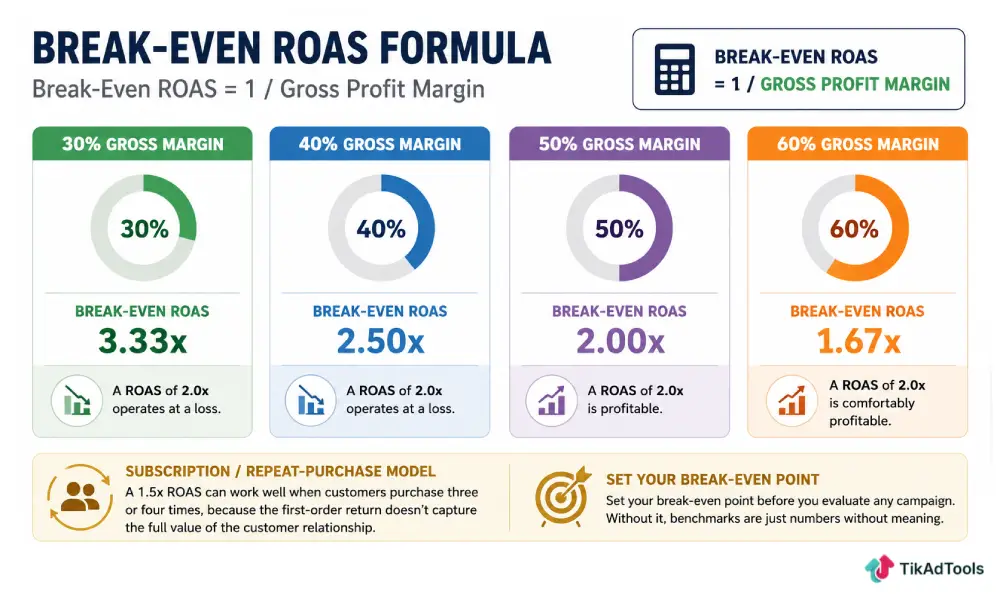
The ROAS formula: Break-Even ROAS = 1 / Gross Profit Margin
A 40% gross margin means you need 2.5x ROAS to break even on ad spend. At 50% margin, that floor drops to 2.0x. Any campaign above your break-even point is generating real profit. Below it, you’re losing money on every sale, regardless of where the number falls relative to industry data.
A few scenarios show why this matters in practice:
- 40% margin: Break-even at 2.5x. A ROAS of 2.0x looks close to average benchmarks but is operating at a loss.
- 60% margin: Break-even at 1.67x. A 2.0x ROAS is comfortably profitable.
- Subscription or repeat-purchase model: A 1.5x ROAS can work well when customers purchase three or four times, because the first-order return doesn’t capture the full value of the customer relationship.
Set your break-even point before you evaluate any campaign. Without it, benchmarks are just numbers without meaning.
TikTok ad formats and their impact on ROAS
Not every TikTok ad type delivers the same return. The format you use affects both the conversion path and what creative expectations look like.
TikTok GMV Max Ads
TikTok Shop GMV Max Ads lure users to buy without leaving the app, removing the external landing page from the purchase path entirely. That shorter route to checkout typically improves conversion rates compared to campaigns that send traffic to an outside website.

Spark Ads
Spark Ads boost existing organic posts rather than serving standalone ad creative. Because those posts already carry real engagement signals such as likes, comments, and shares, they tend to generate stronger trust than a cold brand ad.

Love & Pebble, a beauty brand, demonstrated this in practice. By running TikTok Shop Ads with creator-led Spark content, they shortened the path from awareness to purchase and improved both ROAS and total return, as documented in a TikTok for Business case study.
The CPC for Spark Ads runs slightly higher than standard in-feed placements, but the stronger conversion signal often makes the unit economics work out favorably.
Standard In-Feed Ads
Standard in-feed is where most accounts start and where the majority of creative testing happens. Creative quality, audience fit, and offer strength drive most of the ROAS variance here. It’s the format with the most optimization levers, which makes it both the most work and the most controllable.
Retargeting campaigns
Retargeting ads consistently produce the highest ROAS of any campaign type on TikTok because the audience already knows your product.
Website visitors from the past 30 to 60 days, video viewers who watched 75% or more of a piece of content, and TikTok Shop visitors who didn’t complete a purchase are all strong retargeting pools.
Retargeting alone can’t scale most accounts, but layered over prospecting, it raises the blended account ROAS meaningfully.
Why your TikTok ROAS is low: how to diagnose it
Low ROAS on TikTok almost always traces to one of a few root causes. Identifying the right one before you make changes saves a significant amount of budget.
The creative isn’t holding attention. TikTok distributes ads based on engagement signals. If the video doesn’t hook viewers in the first three seconds, delivery slows, CPMs climb, and ROAS drops.
Signs: a low hook rate (fewer than 25% of viewers watching past 3 seconds), flat engagement, and rising CPM. The fix is more creative variations, not changes to targeting or bidding.
Creative fatigue. Even strong ads burn out quickly on TikTok. The algorithm finds your best-fit audience fast, and once that pool saturates, you’re paying to reach people who’ve already seen the content multiple times. If you haven’t refreshed creatives in two to three weeks, fatigue is likely a factor.
Learning phase interference. TikTok’s algorithm takes 3 to 7 days to stabilize ad delivery before ROAS figures become reliable. Making significant changes during that window, whether to budget, targeting, or creative, resets the process.
Avoid evaluating a new campaign before day 7, and hold major adjustments until after the learning phase completes.
A weak post-click experience. All TikTok traffic lands on mobile. If your landing page loads slowly, doesn’t reflect the ad’s message, or isn’t built for a small screen, conversions suffer regardless of how the ad itself performs.
Strong CTR paired with low ROAS almost always points to a problem that lives downstream from the click.
How to improve your TikTok Ads ROAS in 2026
1. Make creative your primary optimization lever
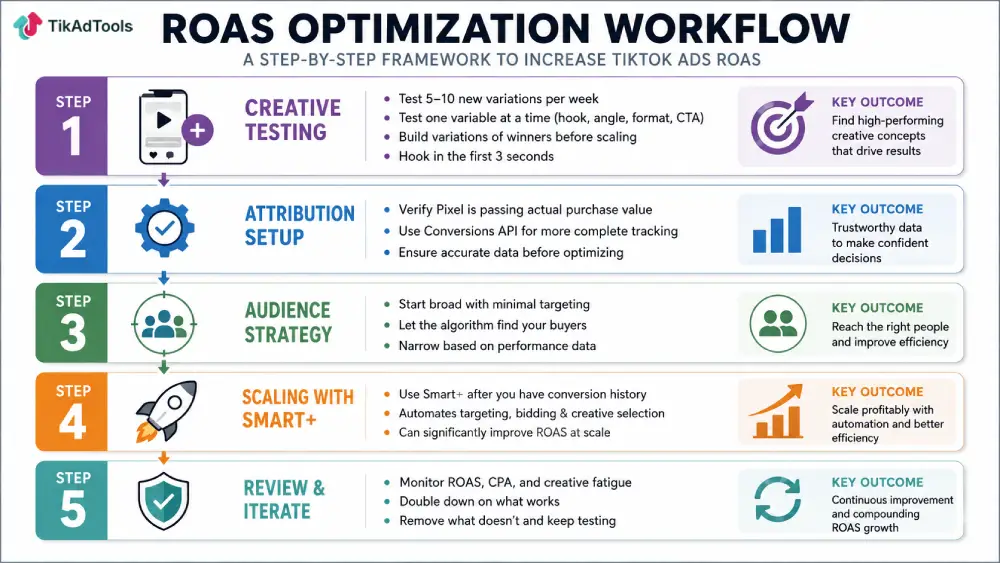
The fastest route to better TikTok ROAS is testing more creative angles more frequently. Aim for 5 to 10 new video variations per week during active optimization.
Test one variable at a time: hook style, messaging angle, video format, or call to action. Keep everything else constant so you can identify what actually drove the change in results.
When an ad performs well, don’t immediately scale the budget on that single asset. Build variations of the winning concept first, changing the hook, adjusting the format, or testing a different offer angle. This extends the concept’s useful life and avoids the ROAS drop that comes when one creative fatigues.
Strong TikTok hooks tend to follow a few reliable structures: a direct problem statement, a bold visual claim, or a curiosity-driven opening line. The first three seconds determine whether the rest of the ad runs.
2. Use native, creator-style content
Lo-fi, creator-style video consistently outperforms polished brand production on TikTok. A product demo filmed on an iPhone often beats a studio shoot because it fits the platform’s aesthetic and reads as a peer recommendation rather than advertising.
The script, hook, and offer still need to be sharp. What changes is the visual treatment, which should feel like something a real user would post.
3. Start with broad targeting
Over-segmenting audiences before the algorithm has data to work with is a common mistake. TikTok’s targeting system is capable of finding your buyers when given enough room to operate.
Start broad, using a few interest signals or a customer lookalike audience, then narrow based on what the performance data shows. Assumptions made before launch are often wrong in ways that become clear only after real delivery.
4. Move to Smart+ once you have conversion history
TikTok’s Smart+ campaigns automate targeting, bidding, and creative selection. They work best when your Pixel has meaningful purchase data to learn from. New accounts are better off building that baseline through standard campaigns first.
Once the conversion history is in place, Smart+ can improve efficiency significantly. James Allen, a jewelry brand, saw a 127% increase in conversions and a 91% improvement in ROAS after switching to Smart+ campaigns with advanced measurement.
5. Verify attribution before drawing any conclusions
If your Pixel isn’t passing purchase values correctly, your ROAS data is wrong before any optimization begins.
Check that the purchase event fires with your actual order value, not a static number. For higher-volume accounts, the Conversions API (server-side tracking) captures events that browser-level Pixel misses, especially on iOS, where tracking restrictions reduce Pixel coverage.
Getting attribution right is less about chasing a higher ROAS number and more about ensuring you’re measuring what’s actually happening.
TikTok minimum ROAS bidding: what it is and when to use it
Minimum ROAS is a bid strategy that sets a floor on acceptable return before TikTok’s algorithm will spend your budget.
It differs from Target ROAS, which tries to hit a specific number. Minimum ROAS simply tells the system not to serve an ad unless the expected return clears your defined threshold.
TikTok’s official guidance recommends setting the minimum based on your actual ROAS from the past 7 days for campaigns targeting the same market and optimization goal. Set it too high and budget delivery stalls. Set it too low, and the strategy adds no real guardrail.
Minimum ROAS bidding makes the most sense for accounts with established conversion history and a clear profitability floor to protect.
New campaigns that are still collecting data are better off starting with Lowest Cost bidding to give the algorithm room to learn. Our TikTok ROAS calculator can help you check whether your current numbers clear your break-even point before you decide whether to raise or lower a floor.
For TikTok Shop advertisers using the Highest Gross Revenue bid strategy, TikTok recommends waiting for 10 purchases before reviewing results or adjusting the ROAS floor.
TikTok ROAS vs. Meta vs. Google: setting realistic expectations
| Platform | Typical Median ROAS | Primary Funnel Role |
|---|---|---|
| Google Search Ads | ~4.5x | High-intent capture |
| Meta (Facebook/Instagram) | ~2.12x | Interest + retargeting |
| TikTok Ads | ~1.4x | Discovery + awareness |
Google’s higher ROAS reflects users who are already looking for what you sell. You’re fulfilling demand, not creating it. Meta sits in the middle, effective for both prospecting and retargeting with a mature conversion infrastructure. TikTok’s lower median reflects its discovery-first format, not a weakness in the platform’s advertising capability.
These channels also affect each other. A user commonly encounters a brand on TikTok, sees a retargeting ad on Meta a few days later, and converts on a branded Google search.
In that scenario, platform reporting overcredits Google and gives TikTok nothing. Pulling TikTok budget because the Ads Manager ROAS looks lower than Meta can quietly reduce the audiences that make downstream retargeting work.
A blended Marketing Efficiency Ratio (total revenue divided by total ad spend across all channels combined) gives a more accurate picture of what each channel contributes than comparing individual platform ROAS figures side by side.
FAQs
What is the average ROAS for TikTok ads in 2026?
The average ROAS for TikTok ads falls between 1.4x and 2.0x across most ecommerce industries. Brands actively optimizing with strong creative and proper attribution typically report between 2.0x and 3.0x. Top-performing accounts in visual verticals like beauty and fashion can push above 3x. These are platform-reported figures that don’t account for conversions TikTok influenced but couldn’t directly attribute within its measurement window.
Why is my TikTok ROAS lower than my Facebook ROAS?
TikTok primarily drives discovery. Most users have no purchase intent when they encounter an ad on the platform. Facebook and Instagram have more mature conversion infrastructure, broader retargeting audiences built up over many years, and generally warmer intent signals. A lower TikTok ROAS in Ads Manager is expected and normal. Before cutting budget, use post-purchase surveys or incrementality testing to understand what TikTok is actually contributing to total revenue.
How do I find my break-even ROAS for TikTok?
Use this formula: Break-Even ROAS = 1 / Gross Profit Margin. Once you have that number, add a 20 to 30% buffer above it as your actual campaign target, since you want profit margin, not just breaking even. If your gross margin is 40%, aim for at least 3x rather than the 2.5x floor. Subscription brands or products with strong repeat purchase rates can accept a lower initial ROAS because customer lifetime value makes the numbers work further down the line.
What causes low ROAS on TikTok ads?
The most common causes are creative that fails to hold attention past the first three seconds, creative fatigue from running the same ads too long without refreshing, learning phase disruption from making changes before the algorithm has stabilized, and a landing page that isn’t converting mobile traffic. Check your hook rate and creative refresh cadence before adjusting targeting or bids.
Does TikTok Shop improve ROAS compared to standard campaigns?
Generally yes, for physical product brands in visual categories. TikTok Shop removes the external landing page from the purchase path, which typically improves conversion efficiency. GMV Max became the default campaign type for TikTok Shop Ads in mid-2025. Brands selling beauty, apparel, home goods, or consumables tend to see the strongest benefit because the in-app purchase experience fits naturally with how people discover products on TikTok.
What is TikTok’s Minimum ROAS bid strategy?
Minimum ROAS tells TikTok’s algorithm not to spend unless the expected return meets a floor you define. TikTok recommends setting it based on your actual 7-day ROAS from comparable campaigns targeting the same market and goal. It works best once you have established conversion history. New accounts with limited pixel data are better served starting with Lowest Cost bidding to collect baseline performance data first.
Conclusion
TikTok ROAS rarely tells the full story on its own. The platform drives discovery and shapes purchase decisions that frequently show up in other channels’ attribution reports.
That doesn’t make your dashboard number irrelevant; it means you need more than that number to make good decisions.
Calculate your break-even point before evaluating any campaign. Focus most of your optimization energy on creative, because that’s where the biggest performance swings happen on TikTok.
Set up attribution properly so you’re measuring something real. And look at blended performance across channels before pulling budget based on a single platform’s reported figure.
The brands building profitable TikTok ad programs aren’t doing anything complicated. They test more creative, measure more honestly, and set expectations based on how the platform actually works.
For the broader optimization process ROAS fits into, the TikTok ads optimization guide covers creative, targeting, and budget decisions stage by stage.
Sources