
Most TikTok ad accounts don’t have a targeting problem. They have three tired creatives running past the point where CPA makes sense, and no plan for what comes next. That’s not a testing problem either. It’s a supply problem, and TikTok’s own creative data explains exactly why it kills accounts.
This is a practitioner’s rundown of TikTok ad creative: what TikTok itself recommends, what the numbers actually say, and where most accounts fall short of both.
Table of Contents
Get Up to $6,000 in Free TikTok Ad Credits
TikTok offers ad credit incentives for new advertisers, helping you test campaigns with a lower upfront cost.
TL;DR
- TikTok’s own research shows 63% of the highest-CTR ads deliver their key message in the first 3 seconds, not sometime in the video.
- Nielsen found creative quality drives 47% of a brand’s total sales lift from advertising, more than targeting or placement combined.
- TikTok Ads Manager’s own guidance is 3 to 5 creatives per ad group and 3 to 5 ad groups per campaign, and most accounts run fewer.
- Lo-fi, UGC-style production beats polished studio ads on every brand metric TikTok has published data on.
- Creative fatigue is a volume problem. You fix it by producing more, not by tweaking the ad you already have.
Quick Answer
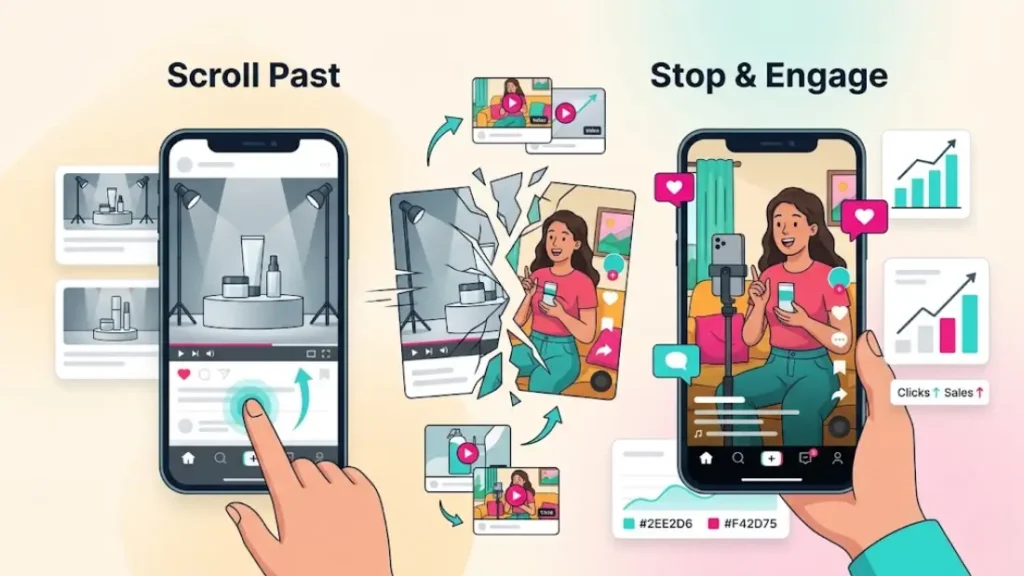
TikTok ad creative works when it hooks viewers in the first 3 seconds, looks native to the feed instead of like a commercial, and gets refreshed before fatigue sets in. TikTok’s own data backs all three, and the accounts that ignore them are the ones asking why their CPA won’t come down.
Why the first 3 seconds decide everything
TikTok’s own research found that 63% of the highest-CTR ads highlight their key message or product within the first three seconds. Not the first ten. Not after a logo intro. The first three.
The same research found vertically shot videos get a 25% higher 6-second watch-through rate than anything shot horizontally and cropped.
One in three of the top-performing ads by view-through rate also break the fourth wall, meaning the creator talks straight to camera instead of narrating over B-roll.
If you’re still writing scripts that build up to the offer, that’s the habit to break first. The TikTok ad hooks breakdown covers formats that front-load the message without sounding like a sales pitch. If writing five hook variations by hand is eating your afternoon, the hook generator speeds up the first draft.
Creative quality is doing more work than your targeting
Nielsen’s research, cited directly by TikTok for Business’s Performance 101 guide, found that creative accounts for 47% of a brand’s sales lift from advertising. That’s more than targeting, placement, and bid strategy combined.
TikTok’s own Performance Fundamentals data backs that up with specifics. Lo-fi, phone-shot production drove a 76% increase in brand uniqueness, a 33% lift in consideration, a 32% lift in likability, and a 12% lift in purchase intent, compared to polished studio ads.
That’s the opposite of what most brands assume. A $50 phone shoot with good lighting will usually beat a $5,000 agency spot on this platform. The UGC ads guide walks through how to shoot creative that looks native without looking cheap.
What TikTok’s official creative best practices actually say for 2026
TikTok’s own creative best practices documentation is more specific than most people realize. It recommends introducing your product or offer in the first 3 seconds, using text overlays at 5 to 10 words per second so viewers can actually read them, and closing with a clear CTA that tells the viewer what to do next.
TikTok-first creative, meaning ads that use native features like text overlays and captions instead of imported TV spots, catches attention for 74% of viewers and drives 3.3x more action than off-platform-style ads, according to TikTok’s Creative Best Practices blog. CTA cards specifically add a 45% lift in recall and a 19% lift in likability over a spoken CTA alone.
Keep your text inside the safe zone too. TikTok’s UI covers the bottom and right edges of the frame with buttons, captions, and the progress bar, so key copy centered in the middle of the screen is the safest bet. The TikTok CTA guide has specifics on wording that gets clicks instead of getting scrolled past.
How to actually use TikTok Creative Center for research
Open the TikTok Creative Center and filter by your industry, not your competitor’s name. You want pattern recognition across the category, not a single brand’s playbook.
Pull the top 10 ads from the last 30 days and watch the first 3 seconds of each one twice. Once for the hook itself, once for how it’s shot. Note whether the hook is a bold claim, a visual surprise, or a direct question, since those three formats cover most of what performs.
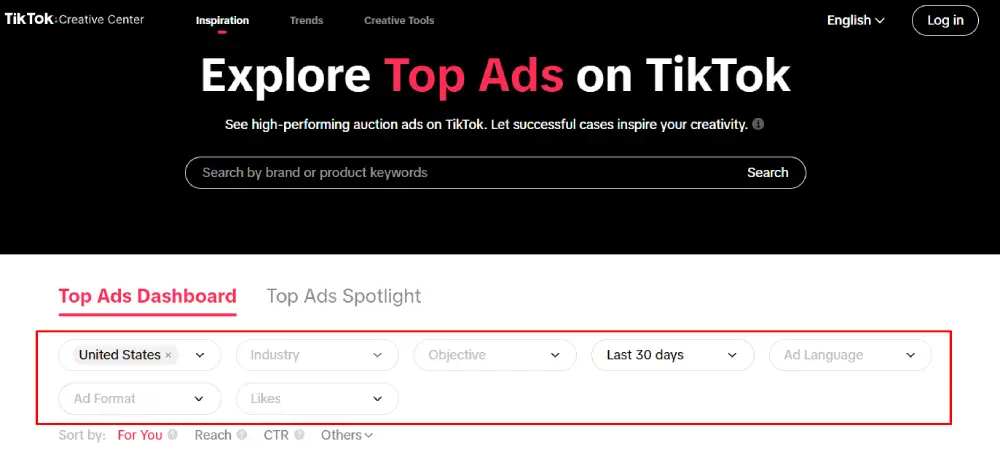
The competitor ads finder does the pulling for you if you’d rather skip the manual scroll. Either way, treat Creative Center as a pattern library, not a place to find one ad to copy.
The 3-to-5 creative rule most accounts ignore
TikTok’s own Ads Manager guidance is direct: run 3 to 5 unique creatives per ad group, and 3 to 5 diversified ad groups per campaign. Fewer than 3 creatives in an ad group is one of the specific triggers TikTok’s system flags as a fatigue risk.
Most accounts don’t hit this. They launch with one hero ad, watch it perform, and don’t build the next 4 until performance has already dropped. By then you’re producing under pressure instead of ahead of it.
Set up your A/B test structure before you need it, not after CPA spikes. If building variations by hand is the bottleneck, the creative generator can produce enough raw variants to keep an ad group stocked.
Creative fatigue is a volume problem, not a tweaking problem
When an ad’s daily new-user reach starts dropping, and delivery flattens out, that’s fatigue. Swapping the thumbnail or changing a word in the caption won’t fix it.
TikTok’s guidance is to add fresh creatives to the existing ad group rather than build a new one from scratch, since a new ad group loses the learning phase progress the old one already earned.
The real fix is keeping a pipeline running before you need it, not scrambling once CPA climbs. The creative fatigue guide covers the specific signals to watch in Ads Manager, and how to analyze ad performance covers what to check before you decide a creative is actually done.
Trends worth following in 2026
TikTok’s Symphony Assistant, built into Ads Manager’s creative flow, generates script suggestions and rough cuts to speed up the first draft of a new ad. It’s not a replacement for a real hook, but it’s a fast way to get past a blank page when you need your fourth or fifth variant of the week.
Beyond that, the trend that actually matters hasn’t changed: TikTok keeps rewarding native-feeling, fast-paced, sound-on creative over anything that looks imported from another platform. If you’re editing on your phone, CapCut stays the fastest way to hit that pacing without a full production setup.
A quick note for verticals like gaming
Gaming and app creative work a little differently. The hook usually comes from gameplay footage itself, not a talking-head UGC format, since the mechanic is the product.
The 3-second rule still applies exactly the same way. Show the core loop or the payoff moment immediately, not after a studio logo. If you’re running install campaigns, the TikTok app install guide covers creative specifics for that objective.
Where to go deeper on each part of the creative process
This guide covers the framework. For the specifics of each piece, editing your footage, shooting in the right vertical specs and format (9:16 vertical video specifically), writing the script and captions, building the 15-second cut, managing how often people see it, and understanding why people actually buy each have their own dedicated breakdown, along with what to put on the landing page the ad sends people to.
Sources
- TikTok for Business: Creative Best Practices
- TikTok for Business: Performance Fundamentals
- TikTok Ads Help Center: Creative Best Practices
FAQ
Does TikTok ad creative need captions?
Yes. A large share of TikTok’s audience scrolls with sound off some or all of the time, and TikTok’s own guidance recommends text overlays at 5 to 10 words per second to carry the message either way. Auto-captions are a fine starting point, but a written hook line usually reads clearer than auto-generated speech-to-text.
Can I reuse the same creative on Meta ads?
You can reuse the raw footage, but not the edit. TikTok rewards native pacing, vertical framing, and on-screen text placed for TikTok’s specific UI, and a Meta-cut ad usually looks foreign the moment it hits the TikTok feed.
What file specs does TikTok require for ad creative?
TikTok ads run in 9:16 vertical format, and file requirements vary slightly by placement and objective. Check current specs before upload since TikTok updates these periodically, and don’t assume last year’s export settings still match.
Does TikTok’s algorithm actually penalize ads that look like ads?
Not directly through a ranking penalty, but indirectly through behavior. Viewers scroll past anything that reads as a commercial before the algorithm even gets a completion or watch-time signal to work with, so a polished, brand-forward opener quietly starves its own distribution.
How much should a TikTok ad creative cost to produce?
Less than most brands assume. TikTok’s own data shows lo-fi, phone-shot ads outperform expensive studio production on brand recall and purchase intent, so the budget is better spent on producing more variants than polishing one.
How often should I be shooting new TikTok ad creative?
Enough to always have a fresh variant ready before the current one shows fatigue signs, not after. Treat creative production as a standing weekly task tied to your ad group size, not a one-time project you revisit only when performance drops.
Conclusion
None of this is complicated. Hook fast, look native, keep enough creatives in rotation that one tired ad can’t sink your CPA, and refresh before the account forces your hand. Get the supply problem solved, and the rest of the account gets a lot easier to manage.