
TikTok advertising costs real money, and most guides give you ranges without explaining what actually moves those numbers.
Whether you’re researching TikTok ads pricing, comparing TikTok ads cost, or trying to estimate your first campaign budget, understanding the factors behind those numbers matters more than any single benchmark.
If you have searched “TikTok ads cost” or wondered how much it costs to advertise on TikTok, and landed on five different answers from five different sources, you are not alone.
The real cost depends on your industry, your creative quality, your objective, and how well you understand the auction system behind the platform.
This guide gives you specific 2026 benchmarks for CPM, CPC, and CPA. It breaks down minimum budget requirements, ad format pricing, influencer costs, and the exact levers you can pull to spend smarter.
Table of Contents
Get Up to $6,000 in Free TikTok Ad Credits
TikTok offers ad credit incentives for new advertisers, helping you test campaigns with a lower upfront cost.
Key takeaways
- TikTok ads cost $4.80 to $9.16 CPM and $0.20 to $2.00 CPC for standard self-serve In-Feed campaigns in 2026.
- The minimum budget is $50 per day at the campaign level and $20 per day at the ad group level, per TikTok’s official budget documentation.
- Creative quality is the single biggest cost lever. Stronger engagement lowers your CPM directly.
- TikTok’s ads budget strategy covers exactly how to size your daily budget by CPA and campaign type.
- New advertisers can offset early costs with TikTok’s ad credit offer, which matches your spend dollar for dollar up to $6,000.
TikTok ads cost in 2026
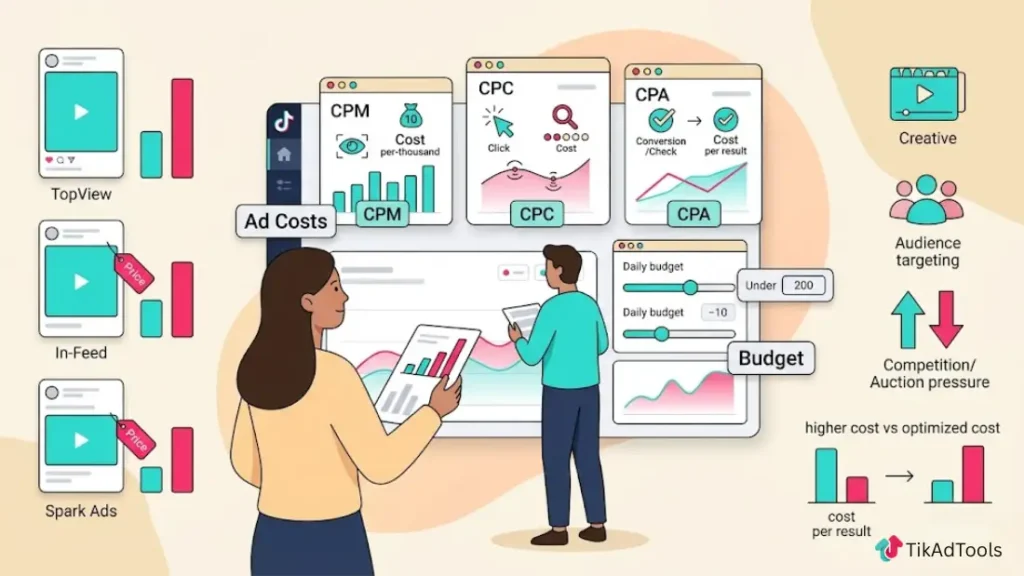
TikTok ads cost between $4.80 and $9.16 CPM (cost per 1,000 impressions) and $0.20 to $2.00 per click for standard self-serve In-Feed campaigns. The minimum daily budget is $50 at the campaign level and $20 at the ad group level. Results vary based on your industry, creative quality, and the campaign objective you choose.
How TikTok’s auction system sets your ad costs
TikTok does not charge a fixed rate. Your cost is determined in real time through an auction-based system, similar to Meta and Google Ads.
Every time a user scrolls past an ad placement, TikTok runs an instant auction. You compete against every advertiser targeting the same audience at the same moment. The winner is not always the highest bidder.
TikTok weighs three things together: your bid amount, your ad quality score, and your estimated action rate.
This is why two advertisers with identical bids pay very different CPMs. The one with stronger creative and higher engagement pays less, while advertisers with weaker creative pay a premium to reach the same people.
Understanding this is foundational for controlling your TikTok advertising cost and improving long-term campaign efficiency.
Average TikTok ad costs in 2026
TikTok runs on an auction system, so there is no fixed TikTok ads price for every advertiser. What you actually pay depends on your creative quality, objective, industry, and targeting.
These figures are an average of thousands of advertising campaigns on TikTok. Treat them as your starting baseline, then measure against your own campaign data.
| Metric | Range |
|---|---|
| CPM | $4.80 to $9.16 |
| CPC | $0.20 to $2.00 |
| CPA | $15 to $80+ |
| CPV (recommended bid) | $0.10 to $0.30 |
| CTR | 0.61% to 0.84% |
| Conversion Rate (eCommerce) | 0.46% to 1.92% |
Sources: Lebesgue, WebFX, and Coupler.io
The CPM and CTR ranges above reflect the real spread between average and top-performing creatives competing in the same auction. Your ad quality is the single biggest variable inside every one of these ranges.
What impacts TikTok ads cost
No single factor drives your TikTok ad cost in isolation. Here is the complete breakdown of the four that matter most.
Audience Targeting and Competition
The narrower your audience, the more you pay. Targeting “women aged 18 to 24 interested in skincare in New York City” puts you in direct competition with every beauty brand chasing the same segment. That competition raises your CPM quickly.
Broad targeting typically delivers a 20 to 35% lower CPM than narrow interest-based targeting. Start broad, then narrow only after you identify which audiences convert.
Creative Performance and Engagement Rates
This is the single biggest cost lever you have. TikTok rewards ads that get watched, shared, and completed. Higher engagement reduces your delivery cost directly.
Spark Ads consistently deliver 20 to 30% lower CPMs than standard in-feed ads because they carry existing social proof. UGC-style creative outperforms polished brand video in almost every tested vertical.
A weak creative does not just underperform. It costs you more per impression compared to an ad with stronger engagement signals.
Industry and Niche Differences
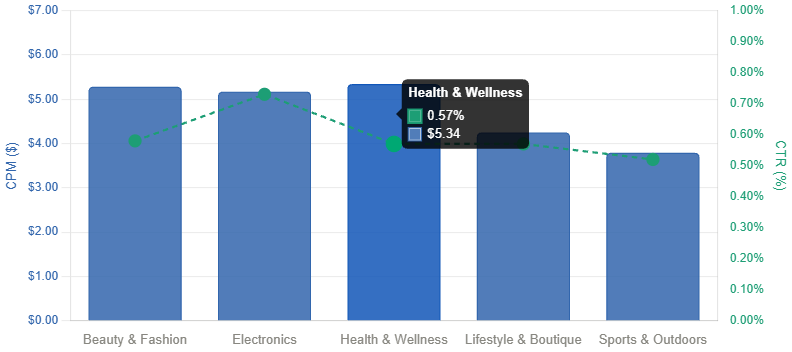
Your vertical sets the floor and ceiling on your costs. Here is a comparison across common industries:
| Industry | Avg. CPM | Avg. CTR |
|---|---|---|
| Beauty and Fashion | $5.28 | 0.58% |
| Electronics | $5.17 | 0.73% |
| Health & Wellness | $5.34 | 0.57% |
| Lifestyle & Boutique | $4.25 | 0.57% |
| Sports & Outdoors | $3.79 | 0.52% |
Source: Triple Whale
Bidding Strategy and Optimization Goals
Per TikTok’s official budget and bidding FAQ, TikTok offers three primary bid strategies:
- Lowest Cost (automatic): TikTok spends your full budget to get the most results. Best for new campaigns with no historical data.
- Cost Cap: You set a target CPA, and TikTok tries to stay at or below it. More control, but it can restrict delivery early in the learning phase.
- Bid Cap: You set a maximum bid per result. Use only when you have confirmed your exact CPA tolerance from past campaigns.
Most advertisers starting out should use Lowest Cost first. Add bid constraints only after the algorithm has collected enough conversion data.
Minimum budget for TikTok ads: find your actual starting needs
TikTok sets two official minimums, confirmed in TikTok Ads Manager’s budget documentation:
- Campaign level: $50 per day (or $500 total minimum campaign budget)
- Ad group level: $20 per day
These are platform thresholds. Meeting the minimum keeps your campaign running. It does not mean your campaign will learn, optimize, or exit the learning phase.
Per TikTok’s own learning phase documentation, volatility starts to decline around 25 campaign results per ad group, or 7 days, whichever comes first. Separately, TikTok’s budget best practices size a healthy daily budget around reaching 50 conversions, using a multiple of your target CPA that depends on your campaign type: 10x CPA for deep-funnel conversions like Purchase, 50x CPA for shallow events, 20x CPA for app installs. See the TikTok ad learning phase guide for the full mechanics behind both figures.
For most advertisers running a standard purchase-conversion campaign, that means a daily budget of roughly 10 times your target CPA. The TikTok ads budget strategy covers the full sizing method by campaign type.
Regional note: If you are running campaigns in Brazil, Vietnam, or Europe, the USD-equivalent minimums are broadly similar, but local currency thresholds can differ. Always confirm the current figure inside your TikTok Ads Manager account before launching.
How much should you spend on TikTok ads
Small Businesses ($300 to $1,000/Month)
At this level, run one ad group with one audience and two to three creatives. Do not spread the budget thin across multiple ad groups.
A $700 monthly budget gives you roughly $23 per day. That technically clears the $20 ad group minimum, but it will not generate enough data for meaningful optimization. If possible, concentrate spending into a shorter test window at $50 per day rather than spreading $23 across a full month.
Growing Brands ($1K to $5K/Month)
At $2,000 to $3,000 per month, you can fund two to three ad groups at $50 per day each. This is where real testing begins.
Use Campaign Budget Optimization (CBO) to let TikTok shift spend toward the best-performing ad group automatically. Test at least three creative variations per ad group and let them run for at least seven days before making decisions.
Scaling Advertisers ($5K+)
At $5,000 per month and above, structure separate campaigns by objective: one for awareness, one for conversions, one for retargeting.
At this level, creative refresh becomes your primary cost management tool. Plan for three to five new creative variations per week. Without consistent fresh creative, CPMs rise steadily as your audience becomes oversaturated.
TikTok creative production cost
You cannot run TikTok ads without creative, and creative carries its own cost structure that most advertisers underestimate.
- DIY or in-house UGC runs $0 to $200 per video, mostly your own time and basic equipment.
- A freelance UGC creator typically charges $150 to $500 per video.
- An agency-produced ad runs $1,000 to $5,000 or more per video.
The data consistently shows that native-style, creator-format videos outperform expensive agency production on TikTok.
We recommend budgeting 20 to 30% of your total media spend for creative production. Treat creative as a direct line item in your media plan, not a side cost.
Micro-influencer pricing for TikTok campaigns
Micro-influencers (creators with 10,000 to 100,000 followers) are one of the most cost-efficient channels within TikTok advertising costs overall.
Per Influencer Marketing Hub’s TikTok cost data, typical 2026 rates for sponsored TikTok posts break down as follows:
- Creators with 10K to 50K followers charge $100 to $500 per post.
- Creators with 50K to 100K followers charge $500 to $1,500 per post.
- Creators with 100K to 500K followers charge $1,500 to $5,000 per post.
Micro-influencers deliver higher engagement rates than mega-creators. Their audiences are more targeted and less fatigued by sponsored content.
For music promotion, product launches, and niche verticals, five to ten micro-influencers at $200 each often outperform one large creator at $2,000.
Always negotiate Spark Ads authorization when contracting influencer content. This lets you run their organic post as a paid ad, combining creator authenticity with your targeting precision, without producing a separate asset.
TikTok ads cost by ad format
| Ad Format | Avg. CPM | Min. Spend | Best For |
|---|---|---|---|
| In-Feed Ads | $4 to $10 | $20/day (ad group) | Performance, conversions, traffic |
| Spark Ads | $4 to $10 | $20/day (ad group) | UGC amplification, brand trust |
| TopView Ads | $50,000 (min.) | $50,000+/day | Mass brand awareness at launch |
| Branded Effects | $45,000(start) | $50,000 to $150,000/day | Large-scale exclusive placements |
| Branded Hashtag Challenge | Varies | $150,000+ flat fee | Viral engagement campaigns |
Source: TikTok, WordStream
For the vast majority of advertisers, In-Feed Ads and Spark Ads are the practical options available through self-serve. TopView and Branded Effects are reservation buys managed directly through a TikTok sales rep. If you are not on an enterprise budget, focus your energy on maximizing performance within In-Feed and Spark formats. Run your own numbers with the Ad Cost Calculator before committing to a format.
How to track TikTok ad cost metrics
Accurate tracking requires more than reading summary numbers in TikTok Ads Manager. If you’ve paused a campaign or closed an account, TikTok’s ads refund policy covers what you can and can’t get back.
Here is what to monitor actively:
- CPM: Check daily. A rising CPM signals creative fatigue or audience saturation before other metrics catch up.
- CPC: A CPC above $1.50 on standard In-Feed Ads usually means weak creative or a targeting set that is too narrow.
- CPA: Your primary conversion metric. Compare it to your target CPA every 72 hours during the first two weeks.
- Hook Rate: The percentage of viewers who watch past the first two seconds of your video ad. Below 30% means your opening is not stopping the scroll before the message lands.
- ROAS: Your efficiency measure for eCommerce. Pause any ad group with ROAS below 1.0 for 72 consecutive hours.
Install both the TikTok Pixel and the TikTok Events API together. The Events API captures conversions that the Pixel misses due to ad blockers and iOS privacy restrictions. Running Pixel only means your cost-per-result data is incomplete.
Tips to reduce TikTok advertising costs
- Use Spark Ads over standard In-Feed Ads wherever possible. Creator-backed content earns stronger delivery efficiency at lower CPMs.
- Refresh creative every two to three weeks. Ad fatigue is the fastest way to inflate your CPC over time.
- Launch awareness campaigns in January and February. Q4 CPMs spike 40 to 60% as holiday competition intensifies.
- Use broad targeting for top-of-funnel campaigns. Let TikTok’s algorithm identify your best audience rather than forcing a narrow interest stack from day one.
- Set campaign budget to No Limit when first launching. Budget caps can restrict delivery before the algorithm finds its best window.
- Test three to five creative variations per ad group simultaneously. TikTok will naturally concentrate spend on the best performer, lowering your blended CPA.
FAQs about TikTok ads cost
How much is a TikTok ad?
TikTok ads cost between $4.80 to $9.16 CPM and $0.20 to $2.00 CPC for standard self-serve In-Feed campaigns in 2026. Your actual cost depends on your industry, bidding strategy, and creative quality.
How much to advertise on TikTok as a beginner?
TikTok requires a minimum of $50 per day at the campaign level and $20 per day at the ad group level. These are platform thresholds that keep your campaign active.
Are TikTok ads cheaper than Facebook ads?
TikTok generally delivers 25 to 40% lower CPMs than Facebook for awareness and traffic objectives in 2026. However, Meta typically produces lower CPAs for retargeting campaigns because its pixel has more historical conversion data.
How much is TikTok ads for a small business each month?
If you are a small business, aim for at least $700 to $1,000 per month to collect any meaningful data. Ideally, $1,500 to $2,000 per month lets you fund one to two ad groups properly and test creative variations.
What is a good CPM for TikTok ads in 2026?
A good CPM for TikTok ads in 2026 is between $4 and $8 for In-Feed and Spark Ads targeting broad audiences.
How does TikTok ad cost compare to Instagram in 2026?
TikTok and Instagram have comparable CPMs for most verticals in 2026, ranging from $5 to $12. According to Socialinsider’s 2026 benchmark data, TikTok’s engagement rate of 3.70% is nearly 8x higher than Instagram’s 0.45%, making it more efficient for new audience discovery.
Conclusion
TikTok ad costs are never fixed. Your creative quality, targeting choices, bidding strategy, and campaign structure ultimately determine what you pay.
The platform sets a framework, but your creative quality, targeting choices, and budget structure determine where you land within it.
We have covered the 2026 benchmarks that matter: CPMs between $4.80 and $9.16 CPM, CPCs from $0.20 to $2.00, and minimum budgets that only work when properly funded.
You now understand why broad targeting costs less than narrow targeting, why Spark Ads consistently outperform standard In-Feed on efficiency, and why the $20 daily minimum rarely translates into real optimization.
The most important takeaway from this guide is not a number. It is this: on TikTok, your creative is your bid. If your video stops people from scrolling, your costs drop. If it does not, no budget increase will fix it. Solve the creative first, then scale the budget.
Sources