
Your beauty clinic’s TikTok ad can get rejected for a reason that has nothing to do with your creative. It’s the treatment itself. TikTok’s healthcare policy isn’t one global rulebook, it’s a different rulebook for almost every country, and most clinics find that out after their campaign gets flagged.
Get the policy right first. Everything else, the formats, the hooks, the targeting, only matters once your clinic is actually eligible to run the ad.
Table of Contents
Get Up to $6,000 in Free TikTok Ad Credits
TikTok offers ad credit incentives for new advertisers, helping you test campaigns with a lower upfront cost.
TL;DR
- TikTok’s healthcare ad policy is set market by market. What’s allowed for a cosmetic clinic in Canada isn’t automatically allowed in the UK, Australia, or anywhere else.
- TikTok updated its US and Canada cosmetic surgery rules in March 2026, but every aesthetic ad still needs sales rep approval, 18+ targeting, and clear risk disclosure.
- Botox is explicitly excluded from the “aesthetic treatments” category across the UK, EU, and several other markets, even where fillers are allowed.
- In-Feed, Search, and Spark each cover a different part of the funnel. Running only one format is the most common gap we see.
- TikTok’s platform minimum is $50/day per campaign and $20/day per ad group, which already puts a single-location clinic near $1,500 a month before any strategy decisions.
Quick Answer
TikTok ads can work for beauty clinics, but eligibility depends entirely on your market and the exact procedure you’re advertising. TikTok’s healthcare and pharmaceuticals policy lists different rules for the US, Canada, the EU, the UK, and dozens of other countries, and treatments like Botox are blocked in markets where dermal fillers are fine. Check your specific market before you build a campaign around a treatment TikTok might not let you run.
Can beauty clinics even advertise on TikTok?
It depends on where your clinic operates and what you’re advertising. TikTok’s healthcare policy treats “cosmetic clinics,” “aesthetic treatments,” and “cosmetic surgery” as three separate categories, and each one has its own market-by-market approval rules.
Here’s what we found across a handful of major markets:
| Market | Cosmetic clinics | Cosmetic surgery | What’s specifically excluded |
|---|---|---|---|
| US & Canada | May be allowed | May be allowed since the March 2026 update | Botox not listed either way, sales rep approval required |
| Canada (detail) | Allowed examples include fillers and microdermabrasion | Allowed if it complies with local law and targets 18+ | Requires local certification |
| UK, Ireland, Germany, France, Netherlands, Spain, Italy, and similar markets | “Aesthetic Treatments” may be allowed (fillers, skin boosters, PRP, chemical peels, cosmetic dentistry, hair restoration) | Elective, reconstructive, and weight-loss surgery not allowed | Botox explicitly not allowed |
| Australia | Not allowed | Not applicable | Rhinoplasty, fillers, and microdermabrasion listed as prohibited |
| New Zealand | Not allowed | Not applicable | N/A |
That table covers the markets we could confirm directly. It’s not exhaustive, and TikTok updates these tables often enough that you should check your own market’s current rules before you launch, not after.
What changed in March 2026
TikTok loosened its cosmetic surgery rules for the US and Canada in March 2026. Ads for cosmetic surgery and related aesthetic procedures may now run in those two markets, but only under strict conditions.
Every clinic in this category needs the following, without exception:
- Approval from a TikTok sales representative before the ad goes live
- Age targeting restricted to the appropriate audience, typically 18+
- Proof that the medical institution is licensed by local regulators
- Clear disclosure of medical risks and recovery time in the ad itself
- No before-and-after imagery that exaggerates results or relies on body shaming
If your clinic is outside the US or Canada, this update doesn’t apply to you. Elective cosmetic surgery is still not allowed in most of the markets we checked, the UK and EU among them.
Botox is handled differently than fillers
This is the detail most clinics miss. Across the UK, EU, and several other markets, TikTok’s “Aesthetic Treatments” category explicitly lists dermal fillers, skin boosters, PRP injections, chemical peels, cosmetic dentistry, and hair restoration as examples of what may be allowed. Botox is listed right next to that same example set as not allowed.
So a clinic running injectable ads in London can advertise lip filler and get flagged for the exact same creative built around Botox. Check the treatment, not just the category, before you build the campaign.
The three TikTok ad formats for beauty clinics
Each format does a different job. Using only one is the gap we see most in clinic accounts.
In-Feed Ads run between organic content on the For You Page. They’re your broadest-reach format, and the right choice for introducing your clinic to people who’ve never heard of you. In-Feed placements work best when the first two seconds show a real result, not a service explanation.
Search Ads appear when someone types a specific query, and TikTok currently runs two distinct versions of this. The Search Ads Campaign is a dedicated keyword-based placement, while Automatic Search Placement extends an eligible In-Feed campaign into search results without keyword targeting.
TikTok’s own documentation is clear that Automatic Search Placement isn’t the same product as the keyword-based Search Ads Campaign, and availability for the dedicated Search Ads Campaign varies by market and objective. Confirm both are actually available to you before you plan a strategy around them.
Spark Ads let you boost an existing organic post as a paid placement, keeping its original likes, comments, and share count. In one comparison TikTok’s own Spark Ads material describes, a profile-landing-page setup produced a 37% lower cost per acquisition and a 69% higher conversion rate than the standard alternative. That’s a specific result from a specific comparison, not a universal Spark Ads guarantee, so treat it as a strong data point rather than a promise.
Writing hooks that actually get watched
Lead with the result, not the service name. “She had her lips done in 45 minutes, here’s the result” earns more watch time than “we offer professional lip filler treatments.” TikTok’s Creative Center reports a 25% higher CTR for cinematography-style content compared to CGI creatives in its beauty and personal care benchmark. That figure covers the beauty and personal care category broadly, not clinic ads specifically, but the underlying lesson holds. Real footage tends to beat polished production.
A simple structure for the first ten seconds:
- Open on a visible result or a question your patient is already asking themselves
- Name the treatment and anchor it to a realistic outcome
- Close with a soft, compliant CTA before the ten-second mark
Before you write your next batch of hooks, run them through a hook generator to see a few directions fast, then check each one against your market’s before-and-after rules before you film it.
Creator content vs. clinic-direct content
Both work, and they typically work at different points in the journey.
| Factor | Creator-led ads | Clinic-direct ads |
|---|---|---|
| Trust signal | Peer recommendation | Professional authority |
| Common use | Cold-audience awareness | Warmer, closer-to-booking audiences |
| Compliance | Creator has disclosure duties, but the advertiser is still accountable | Fully clinic-controlled |
That compliance row matters more than it looks. TikTok’s commercial content disclosure rules require any paid promotion to have the disclosure setting turned on, and a creator’s missing label doesn’t shift legal responsibility away from the clinic that paid for it. Hiring a creator doesn’t outsource your compliance risk.
Compliance, split into three layers
Most clinics treat “TikTok compliance” as one thing. It’s actually three separate layers, and mixing them up is where mistakes happen.
Layer 1: TikTok’s own ad policy. This covers eligibility by market and treatment, sales rep approval for aesthetic and surgical categories, and creative restrictions on before-and-after imagery. Run your draft through a compliance checker before submission, and expect the aesthetic and surgical categories specifically to need a TikTok sales rep, not just a self-serve Ads Manager submission.
Layer 2: Advertising law. In the US, the FTC’s Endorsement Guides, revised in 2023, require that testimonials reflect what consumers can generally expect, or that the ad clearly disclose when a result isn’t typical. There’s no blanket rule that every before-and-after photo must carry a specific disclaimer, but the underlying claim still has to be substantiated.
Layer 3: Medical privacy law. Any patient appearing in a before-and-after or testimonial needs documented consent that specifically covers social media advertising use, not just standard treatment consent. If you’re a US clinic and considering HIPAA-covered patient data for retargeting, that’s a separate legal question worth a real conversation with counsel before you upload anything.
Uploading your patient list to build a lookalike audience isn’t a routine ecommerce move here. Confirm your data-sharing terms and privacy notices cover advertising use before you touch that list.
Targeting: age first, then everything else
Age restrictions come before interest targeting, not after. Most markets in TikTok’s aesthetic and cosmetic clinic categories require 18+ targeting as a baseline eligibility condition, and that applies before you even get to audience strategy. (source)
Once age targeting is set, layer in the rest:
- Interest and behavior signals. Stack beauty, skincare, and wellness interests with recent engagement behavior, not just a broad interest tag.
- Custom Audiences from your patient list. Lookalike audiences built from a customer file tend to outperform interest targeting once you have enough data, though “90 days” isn’t a fixed rule, treat it as a testing checkpoint instead.
- Household income, where you can use it. This filter is available in the US only, so don’t build a global targeting plan around it.
- Geographic radius. Start with your actual service area and travel-time realities, not a fixed number. A Manhattan clinic and a rural clinic need very different radii.
Run your targeting plan through a targeting planning tool before launch so you’re not guessing at overlap between your interest, behavior, and lookalike layers.
Budget: what TikTok actually requires
TikTok’s platform minimum is $50 per day at the campaign level and $20 per day per ad group. Do the math and that floor already puts a single active campaign near $1,500 a month before you’ve made a single strategy decision.
There’s no published, verified TikTok benchmark for cost-per-lead by treatment type. Any specific dollar range you see for Botox or laser resurfacing leads, including in earlier drafts of guides like this one, should be treated as directional at best. Track your own numbers from week one instead of anchoring to someone else’s table.
What you should actually watch, in order:
- Cost per lead
- Cost per qualified lead (matches your treatment and service area)
- Cost per booked consultation
- Cost per attended consultation
- Treatment conversion rate
A cheap lead that never shows up isn’t cheap. It’s a wasted booking slot. Build your reporting around attended consultations, not just raw CPL, and your budget conversations with a practitioner will get a lot easier.
If you’re still setting up your first campaign, a budget planner can help you model the daily minimums against a realistic testing window, and TikTok’s own ad platform is where that budget actually gets spent once your account is approved.
Building a funnel that gets to a booking
A single ad doesn’t book a patient. A structured sequence does.
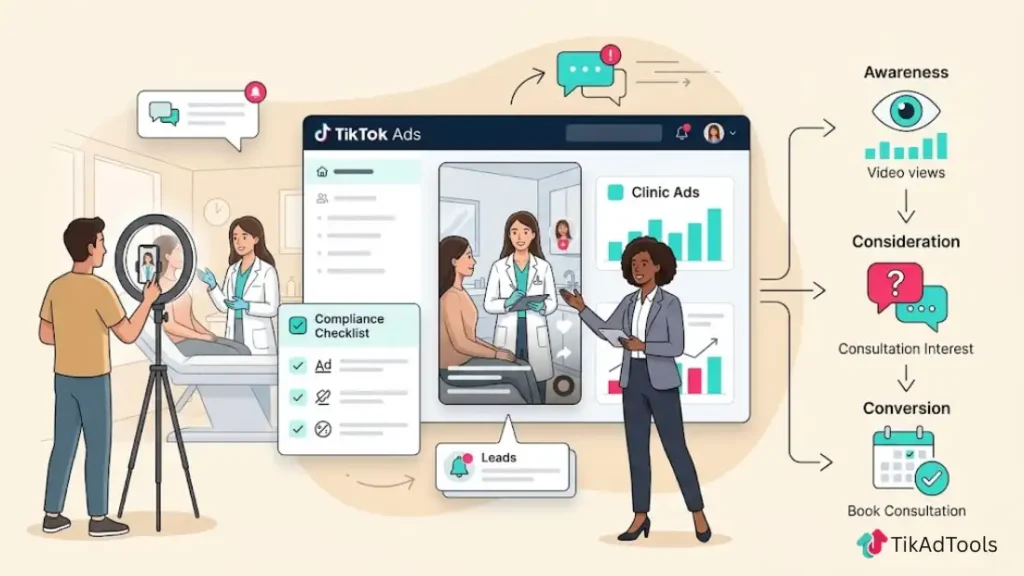
Stage 1: Cold awareness. Run In-Feed and Spark Ads with result-first hooks. You’re buying attention here, not conversions, so don’t force a booking CTA too early.
Stage 2: Warm consideration. Retarget viewers who engaged with your video content. Show practitioner credentials and real testimonials with proper consent, and send them to a landing page that matches the ad exactly.
Stage 3: High-intent decision. Retarget landing page visitors with a direct booking CTA. TikTok’s Lead Generation objective lets someone submit a consultation request without leaving the app, which removes a real friction point.
One published case study worth noting: a Vietnam-based clinic used TikTok’s direct messaging ads and reported 2.5 times more conversations than click-based campaigns, with roughly one in five of those conversations turning into a booked service. That’s one clinic’s result, not a formula every account will replicate, but it’s a useful signal for how much friction reduction matters at the decision stage.
Mistakes that waste clinic budget
- Repurposing Instagram Reels. TikTok’s pacing and audio culture are different enough that repurposed content usually underperforms.
- Skipping Search entirely. Most clinics run only In-Feed and never test a Search placement, missing a pool of people actively looking for a treatment.
- No retargeting layer. Every dollar goes to a cold viewer, and the people who almost booked never get a second touch.
- Treatment claims TikTok won’t allow. Words like “guaranteed” or “permanently removes” get ads rejected regardless of how good your creative is.
- Letting creative run too long without a refresh. There’s no fixed expiration date, but performance decay is real once frequency climbs and a small local audience has seen the same ad repeatedly.
Frequently asked questions
Can beauty clinics advertise on TikTok?
Yes, but eligibility is set per market and per treatment, not as one universal rule. Some markets allow cosmetic clinics and specific aesthetic treatments, others exclude the category entirely, and the aesthetic and surgical categories typically require approval from a TikTok sales representative.
Is Botox treated the same as dermal fillers on TikTok?
No. In the UK, EU, and several other markets, TikTok’s aesthetic treatments category lists fillers, PRP, and chemical peels as examples of what may be allowed, while Botox is listed as not allowed in that same category.
How much does TikTok advertising cost for a beauty clinic?
TikTok requires a $50 daily minimum at the campaign level and $20 daily minimum per ad group, which puts a single active campaign near $1,500 a month at the floor. There’s no verified TikTok-published benchmark for cost per lead by treatment, so track your own numbers rather than anchoring to a generic range.
Can I use before-and-after photos in beauty clinic ads?
Sometimes, and it depends on both TikTok’s market-specific imagery rules and the FTC’s endorsement guidance in the US. Any patient shown needs documented consent that specifically covers advertising use, separate from standard treatment consent.
What’s the difference between TikTok Search Ads and automatic Search placement?
Search Ads Campaign is a dedicated, keyword-targeted placement with market-specific availability. Automatic Search Placement extends an eligible In-Feed campaign into search results without keyword targeting, and TikTok treats them as two distinct products.
Do I need TikTok’s approval before running aesthetic treatment ads?
For the aesthetic treatment and cosmetic surgery categories specifically, yes. TikTok requires advertisers to work with a sales representative to confirm eligibility before those ads can run, which is a different process than a standard self-serve Ads Manager submission.
Final thoughts
Compliance isn’t the boring part of this, it’s the part that decides whether any of the rest matters. Check your market’s rules, confirm your exact treatment is eligible, get the right consent and disclosures in place, and then build the funnel around it.