
Most kids-product brands get one thing wrong before they’ve spent a single dollar. They read “TikTok requires 18+ targeting” somewhere, panic, and build a compliance strategy around a rule that doesn’t exist the way they think it does.
TikTok doesn’t ban kids products. It restricts specific things, in specific markets, under specific conditions, and the real rulebook is a lot more workable than the panicked version. Here’s what actually applies, and what to build around it.
Table of Contents
Get Up to $6,000 in Free TikTok Ad Credits
TikTok offers ad credit incentives for new advertisers, helping you test campaigns with a lower upfront cost.
TL;DR
- TikTok allows ads for toys, baby gear, and kids products, but in dozens of markets they must be restricted to audiences 18 and older, and creative can’t use childish appeals.
- TikTok doesn’t ban targeting under-18 users outright. It strips out detailed targeting (interests, income, gender) for anyone under 18 and only allows generic targeting like age, language, and location.
- Product GMV Max has been the only supported campaign type for TikTok Shop Sales objective since July 2025. Video Shopping Ads still exist, but only under the Showcase destination.
- COPPA 2.0 isn’t law yet. The Senate passed its version in March 2026, the House passed a different version on June 29, 2026, and the two chambers still need to agree on final text.
- TikTok’s own learning phase guidance says volatility typically settles after about 25 results or 7 days.
Quick Answer
Yes, you can advertise kids products on TikTok. In the US, Canada, Australia, and roughly 45 other markets, ads that could appeal to under-13 audiences must target adults 18 and older and avoid childish creative. Outside that specific rule, TikTok’s under-18 restrictions work by removing detailed targeting options, not by banning kids products from the platform entirely.
Most of what trips brands up isn’t the policy itself. It’s confusing three separate things: TikTok’s under-18 targeting rules, its market-specific policy for products that appeal to young children, and COPPA.
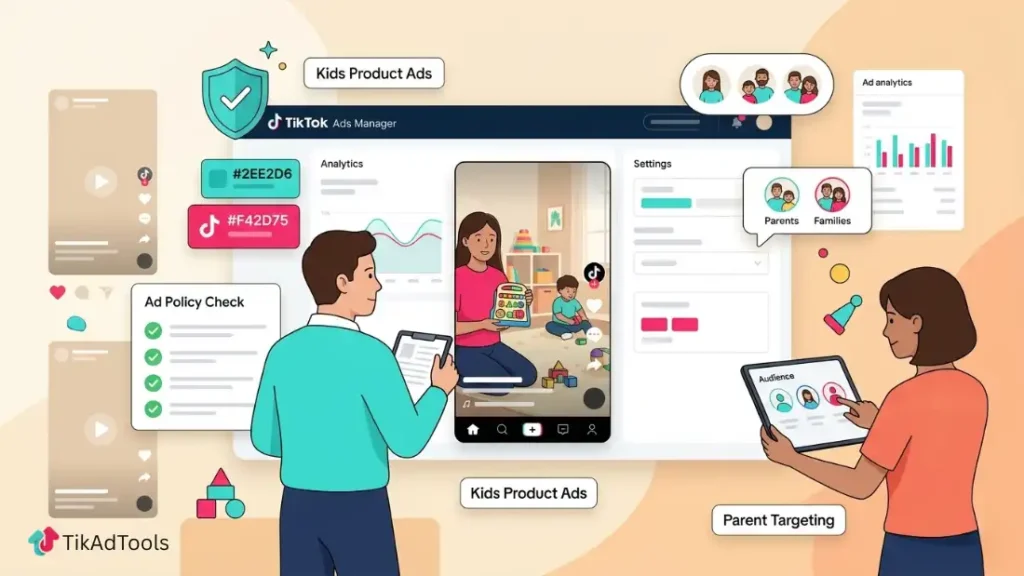
Can you run TikTok Ads for kids products?
You can. Toys, baby gear, children’s clothing, learning apps, and similar products are all fine to advertise.
The catch is narrower than most guides make it sound. TikTok doesn’t require every kids-product campaign worldwide to hit an 18+ minimum. It requires that in a specific list of markets, ads that could appeal to children under 13 get restricted to adults and skip the childish creative approaches, according to TikTok’s Teen Safety and Wellbeing policy.
That list covers the US, UK, Canada, most of the EU, and most of Latin America, roughly 50 markets in total. Outside those markets, or for products that don’t specifically appeal to under-13s, the rules work differently.
Product types generally allowed:
- Toys and games
- Baby gear and nursery products
- Children’s clothing and footwear
- Educational materials and learning apps
- Children’s books
Who’s actually seeing these Ads: parents, not kids
You’re building this campaign for the adult buyer, not the child user. That’s true of every kids’ product category, and it shapes your targeting from the first ad group you build.
Why 18+ targeting matters here
TikTok’s advertising restrictions for people under 18 apply across North America, Latin America, the EEA, Switzerland, and the UK. When your audience includes anyone under 18 in those regions, two campaign objectives disappear entirely: Lead Generation and Sales – TikTok Shop.
Detailed targeting options also drop out for under-18 users specifically. Gender, spending power, household income, interests and behaviors, and zip code all stop applying to that slice of the audience, even in a mixed-age campaign.
Generic options still work no matter who’s in the audience: age, language, country or city, and device (minus device price). If your primary goal genuinely is reaching a mixed or under-18 audience, TikTok points advertisers toward Auction Reach, Reach & Frequency, and TopView, since none of those formats depend on detailed targeting.
Who’s actually buying
Pew Research Center’s most recent Social Media Use survey found that 63% of US adults aged 18 to 29 use TikTok, the highest adoption rate of any adult age bracket on the platform, according to the Pew Research Center. Millennial and Gen Z parents are the ones scrolling, discovering, and buying.
They respond to a real person talking about a real product, not a polished ad. Keep that in mind before you shoot anything.
Building a parent-first audience
Start with a minimum age of 18 in every ad group. Layer in interests like baby care, parenting, and family lifestyle to bias toward adult buyers.
For keywords, TikTok’s keyword moderation guidelines classify baby and child products as “partially open.” Here’s exactly what that means:
| Allowed keywords | Not allowed |
|---|---|
| Toys, school bag, textbook, cartoons | Kids, teens, young children |
| Baby supplies, baby food, milk powder | Any direct reference to a minor user |
Skip words like “toddler” or “newborn” as standalone targeting keywords. They read as references to minor users, which is exactly what TikTok filters out.
TikTok’s rules for kids products: what’s actually restricted
The single biggest myth in this space is that TikTok requires every kids-product campaign to hit 18+ everywhere. It doesn’t. What it actually restricts depends on the market, the audience, and whether the ad could appeal to a child under 13.
The 18+ creative rule, by the numbers
TikTok’s advertising policy says ads promoting products that may appeal to children under 13 can run, but only under two conditions: the ad must be restricted to audiences 18 and older, and it can’t use particularly childish creative approaches. This rule applies specifically in the US, UK, Canada, most of the EU, and most of Latin America.
Here’s a cleaner way to think about it than a blanket age table:
| Situation | What happens |
|---|---|
| Ad could appeal to under-13s, running in a listed market | Must target 18+, no childish creative |
| Kids product ad running outside that market list | Standard under-18 targeting rules apply instead |
| Audience includes actual under-18 users | Detailed targeting drops for them, generic targeting still delivers |
| Under 16 in Australia, under 14 in Florida, Quebec, Indonesia, or South Korea | No ads delivered at all, TikTok isn’t available to them |
What your creative can and can’t show
You can’t show minors in content that risks sexual, physical, or emotional harm. You also can’t urge or pressure teens to buy something, or encourage them to talk a parent into a purchase.
Here’s the part most guides get wrong: TikTok doesn’t ban children from appearing in kids-product ads outright. Product demonstrations, like showing how a diaper fits, are explicitly listed as an allowed use case. The actual line is about context and exploitation, not the mere presence of a child on screen.
What COPPA and COPPA 2.0 actually require
This is the section where most kids-product guides get sloppy, and it’s the one with real legal stakes. Get the distinction between TikTok’s ad policy and federal privacy law wrong, and you’re building your compliance plan on the wrong foundation.
COPPA today
COPPA applies to operators of websites or services directed at children under 13, or operators who have actual knowledge they’re collecting personal data from users under 13. Selling a children’s product doesn’t automatically pull you into COPPA’s scope.
What does matter: whether your landing page, email capture, or retargeting pixel is directed at children or knowingly collecting data from them. TikTok managing its own platform-level compliance doesn’t cover your landing page or your email list.
COPPA 2.0’s real status as of August 2026
COPPA 2.0 is not law. Here’s exactly where it stands.
The Senate passed its version, S.836, by unanimous consent on March 6, 2026. The House passed a different version on June 29, 2026, folding its own COPPA 2.0 language into a broader bill called the KIDS Act, which cleared the floor 267-117.
The two chambers now have to reconcile real differences before anything reaches the president’s desk. The House version defines “children” as under 14 and “teens” as 14 to 17, adds a “knew or should have known” standard for platforms, and restricts individually targeted advertising to minors.
Treat this as a compliance direction to watch, not a rule to follow today. If your landing pages or email capture touch users in the 13 to 17 range, it’s worth reviewing your data practices now, but don’t tell your team COPPA 2.0 is already in effect.
What the TikTok-ByteDance case actually shows
The DOJ and FTC jointly sued TikTok and ByteDance on August 2, 2024, alleging the platform let millions of under-13 users create accounts and collected their data without parental consent. That case is about TikTok’s platform-level obligations.
It doesn’t establish a separate rule that every kids-product advertiser’s landing page is automatically subject to COPPA. Your own legal exposure depends on your own data practices, not TikTok’s.
The best ad formats for kids and baby products
Not every format fits this category equally well. Here’s how the main ones actually perform for parent-focused campaigns.
In-Feed Ads sit natively in the For You feed and autoplay with sound. They work well for mid-funnel discovery, especially a real parent showing how a product works in a real home.
Spark Ads let you boost an organic post from a creator, keeping the original likes and comments intact. If a parent creator already posted about your product, this is the fastest way to add paid reach without losing the social proof.
TopView and Reach campaigns put your ad in front of users the moment they open the app. TikTok specifically recommends these formats, along with Auction Reach and Reach & Frequency, for advertisers reaching audiences that include under-18 users, since none of them rely on detailed targeting.
Product GMV Max is now the default and only supported campaign type for the Sales objective with TikTok Shop as your sales destination, a change TikTok rolled out in July 2025. It automates creative selection, audience settings, and bidding across the TikTok feed, search, the Shop tab, and Pangle, and it pulls in eligible organic and affiliate content automatically.
Video Shopping Ads haven’t disappeared. They still exist, but only when Showcase, not TikTok Shop, is set as your sales destination.
How to target parents without guessing
Reaching parents without accidentally including minors takes a deliberate audience build. Don’t lean on TikTok’s default broad targeting for this category.
Custom Audiences: useful, not a guarantee
Upload your customer email list to build a custom audience in Ads Manager. This gives you a real starting point built from people who already bought from you.
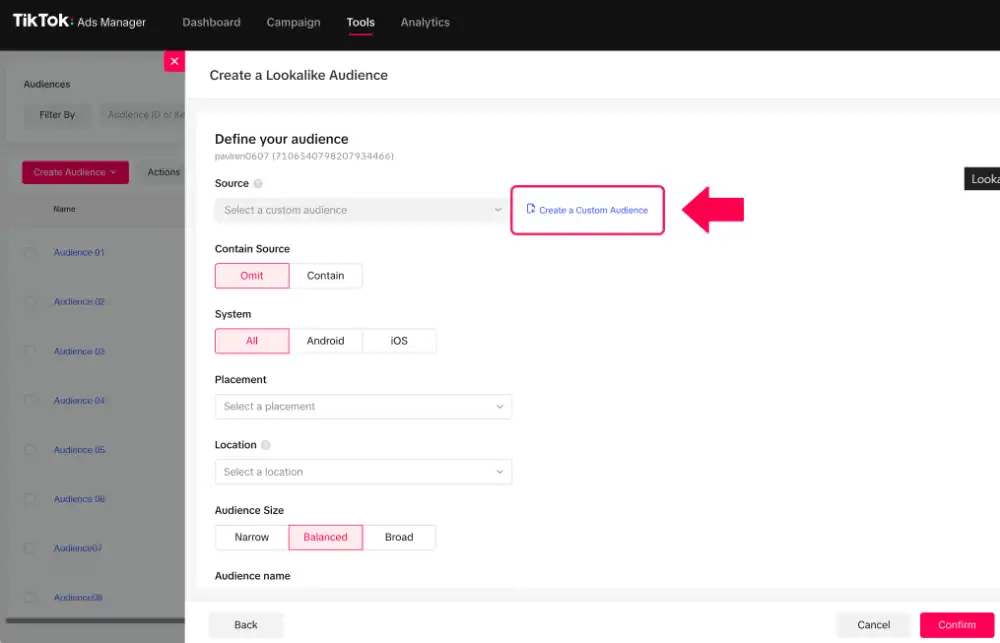
But be precise about what that list proves. A customer list for a stroller or a toy doesn’t verify that every matched user is an adult. It’s a strong signal, not confirmed age data, so pair it with a minimum age of 18 on the ad group itself.
Lookalikes and interest layering
Build a lookalike audience at 1% similarity from that customer list, and set the minimum age to 18 on the lookalike ad group too. A lookalike finds users who resemble your seed audience across TikTok’s modeling, which helps, but it won’t guarantee every match is a parent.
Layer in interest categories for parenting, baby and toddler gear, and family lifestyle on top. Combined with your custom audience and lookalike, this narrows delivery toward the people actually making the purchase decision.
Creative that keeps your Ads live
TikTok rewards content that looks native to the platform, and that matters even more in a policy-sensitive category like this one.
Film your first creative like a parent recommending a product to another parent. No studio lighting, no script that sounds like a commercial voiceover. Show the product working in a real home within the first few seconds.
Avoid content that pressures a child to ask a parent for a purchase, or that implies a product will make a child more popular. Those are explicit TikTok policy violations, not just bad practice.
If your hook references a specific outcome, like solving a sleep problem, be ready to back it up. Health and performance claims about children’s products draw extra scrutiny, and an unsubstantiated claim is a fast way to get an ad rejected.
Influencers and UGC: getting disclosure right
Influencer content works well for this category, but the compliance responsibility is yours, not just the creator’s.
FTC disclosure rules
Under the FTC’s 2023 Endorsement Guides, a disclosure has to be clear and conspicuous, which the FTC now defines as “unavoidable.” A caption buried under a “see more” link doesn’t count, and neither does a hashtag like #sponsored dropped into a wall of other tags.
For video, the disclosure needs to appear in the video itself, spoken or as an on-screen label, not just in the description. The FTC has also said a platform’s built-in disclosure toggle, TikTok’s included, might not be enough on its own to satisfy the requirement.
Use TikTok’s commercial content disclosure setting and have the creator add their own clear, on-screen disclosure. Treat them as two separate obligations, not one box to check.
Picking creators
Parent and family creators are your safest, most scalable channel for this category. Their audiences are adults who share the parenting experience, which lines up with who you’re actually trying to reach.
Kids creators carry more risk here. Their audiences skew younger, which works against the exact targeting approach this category requires.
Selling directly through TikTok Shop
TikTok Shop lets a parent go from seeing your ad to checking out without leaving the app, which can meaningfully shorten your funnel for visual, demonstrable products.
To open a TikTok Shop in the US, you’ll need a registered business, valid ID, and a US bank account, with exact requirements depending on your seller type in Seller Center. Children’s products still need to meet applicable US product safety requirements, including CPSC rules and, depending on the product, mandatory testing and labeling standards.
Once your Shop is live, Product GMV Max is your path to paid TikTok Shop sales, since it’s the only supported campaign type for that objective. Connect your catalog through TikTok’s native Shopify integration or its WooCommerce plugin so orders sync into your existing fulfillment flow without a separate inventory system.
What TikTok Ads actually cost for this category
Budget planning here should follow TikTok’s own math, not a flat number pulled from a blog post.
Minimum budgets
TikTok’s budget documentation sets a $20 daily minimum at the ad group level and a $50 daily or lifetime minimum at the campaign level. That’s the floor, not a recommendation for what actually produces useful data.
Budgeting off your own CPA
TikTok’s budget best practices give a formula instead of a flat number. For a deep conversion campaign, like optimizing for purchases, the recommendation is 10 times your current CPA. If you don’t have a current CPA yet, TikTok suggests starting around $200.
| Campaign type | Recommended minimum budget |
|---|---|
| Deep conversion (Add to Cart, Purchase) | 10x current CPA, or ~$200 with no CPA history |
| Shallow conversion (Page View) | 50x current CPA/CPR, or ~$100 with no history |
| App install campaign | 20x current CPA, or ~$200 with no history |
The learning phase, correctly explained
TikTok’s own learning phase guidance says performance volatility typically starts to decline after about 25 campaign results or 7 days, whichever comes first. There’s no documented rule requiring 50 conversions to exit learning.
Avoid pausing the campaign, making unnecessary edits, or setting an unreasonable budget during this window. Those are the actions TikTok specifically flags as disruptive to the learning phase, not simply the passage of time.
Common mistakes that quietly hurt these campaigns
Most underperforming kids-product campaigns aren’t failing on creative. They’re failing on structure.
Using Automatic Audience without checking age settings. Go into every ad group and set the minimum age manually. Then use the Audience Breakdown report in Ads Manager to confirm the age distribution your ads actually reached.
Filming ads that look like TV commercials. A logo-first, studio-lit ad reads as an interruption on TikTok. Film it like an honest recommendation instead.
Skipping the policy review before every launch. Review TikTok’s ad policies before each campaign, not just your first one. Policies get updated, and a rejected ad still burns impressions before it’s caught.
Is TikTok worth it for kids product brands in 2026?
For most visual, demonstrable products with a clear parent buyer, yes. The platform rewards products that show their value in the first few seconds, which most toys, gear, and learning products can do.
If your product needs a long explanation or an extended consideration period, TikTok probably isn’t your best top-of-funnel channel on its own. Use it to build awareness and feed a retargeting funnel elsewhere instead of expecting cold-traffic conversions from day one.
Final action checklist
- Set every ad group’s minimum age to 18.
- Upload your customer email list to build a seed custom audience.
- Build a 1% lookalike from that list, with minimum age 18 applied.
- Pick your format: In-Feed for discovery, Spark Ads for creator UGC, Product GMV Max if your TikTok Shop is live.
- Film 3 native-style creatives with a real parent, a real home, and a demonstration hook in the first few seconds.
- Review TikTok’s ad policies before submitting anything for approval.
- Budget using the 10x current CPA formula, and let the campaign run through the learning phase before making changes.
Frequently asked questions
Can you advertise kids’ products on TikTok?
Yes. Toys, baby gear, clothing, and educational products are all allowed. In roughly 50 specific markets, including the US, UK, and Canada, ads that could appeal to children under 13 must target adults 18 and older and avoid childish creative approaches.
What are TikTok’s rules for advertising to minors?
TikTok removes detailed targeting options, like interests, income, and gender, for any audience that includes people under 18 in North America, Latin America, the EEA, Switzerland, and the UK. Generic targeting, like age and location, still works for that audience.
Does COPPA apply to my TikTok ads?
COPPA applies if your service is directed at children under 13, or if you have actual knowledge you’re collecting data from users under 13. It’s tied to your own data practices, your landing page and pixel setup, not simply the fact that you sell a children’s product.
Is COPPA 2.0 law yet?
No. The Senate passed its version in March 2026, and the House passed a different version on June 29, 2026. The two chambers still need to reconcile their bills before anything can be signed into law.
What’s the best TikTok ad format for a kids product brand?
In-Feed Ads with native, parent-focused creative are the best starting point. If you have existing creator content, Spark Ads add social proof fast. Once your TikTok Shop is live, Product GMV Max is the most efficient path to direct sales.
How much should I budget for kids product ads on TikTok?
Skip flat numbers and use TikTok’s own formula: roughly 10 times your current CPA for a purchase-optimized campaign, or about $200 if you have no CPA history yet. Let the campaign run through the learning phase, about 25 results or 7 days, before making changes.
Final thoughts
Kids product ads on TikTok work when you stop treating “18+ only” as a blanket rule and start treating it as one piece of a bigger picture that includes market-specific policy, real targeting mechanics, and privacy law that’s still moving through Congress. Get the audience and structure right, and the rest gets a lot easier.