
Beverage brands have a problem most categories would envy: their product is inherently satisfying to watch.
A slow pour, condensation running down a cold can, or a first-sip reaction- that’s free dopamine for the viewer, and TikTok’s algorithm knows it.
But watching and buying are two different things. Most beverage brands get attention on TikTok and can’t convert it.
They’re running the wrong creative, aiming at the wrong audience, or structuring campaigns in a way that burns budget without generating data.
This guide covers what actually works, backed by real campaigns and brand results.
You’ll find a breakdown of three beverage brands that used TikTok to grow significantly, what their creative looked like, and how to build your own campaign structure from there.
Get Up to $6,000 in Free TikTok Ad Credits
TikTok offers ad credit incentives for new advertisers, helping you test campaigns with a lower upfront cost.
Table of Contents
TL;DR
- TikTok beverage ad spend grew 40% in 2024, and brands running UGC-style creatives consistently outperform polished brand ads.
- 7 Brew’s first TikTok campaign hit a 16.4% higher ad recall lift than industry benchmarks using native-style content and Spark Ads.
- Liquid Death built a $1.4 billion brand largely on TikTok with under $2 million in total annual content spend by treating ads as entertainment.
- The first 3 seconds of your beverage ad determine almost everything: hook, product, identity, in that order.
- Pair in-feed UGC with Spark Ads to blend organic reach with paid distribution.
Quick Answer
TikTok ads work for beverage brands when the creative fits the platform, not the brand style guide. Short UGC-style videos, strong visual hooks using the product, and social proof from real users consistently outperform traditional brand ads. The brands winning on TikTok right now are treating the platform like entertainment, not advertising.
Why TikTok is built for beverage brands
Beverages are inherently visual. A pour shot, a condensation bead, or a first sip reaction- these things work instantly on video.
TikTok’s algorithm rewards content that keeps people watching. Beverage content, done right, does exactly that. A slow pour, an unexpected flavour combo, or a “you need to try this” moment — these are natural thumb-stoppers.
That’s not luck. It’s category advantage. You’re selling something people consume daily, something tied to mood, lifestyle, and identity. That’s exactly what TikTok’s audience engages with.
According to TikTok’s economic impact report, food and beverage is the highest-contributing sector from SMB use of TikTok, supporting $6.4 billion in GDP and 73,000 jobs in 2023 alone.
Case study 1: 7 brew’s first TikTok campaign
7 Brew is a drive-thru beverage brand with 300+ locations. They ran their first major TikTok campaign during summer, historically a slow season for the category.
The approach was simple: native-style content guided by TikTok’s own platform experts, blending organic videos with Spark Ads and UGC formats.
The results were hard to argue with. According to the official TikTok for Business case study, the campaign delivered a 16.4% higher ad recall lift and a 1.7% greater awareness lift compared to industry benchmarks. It also added over 57,953 new followers and hit an average watch time of 29.48 seconds per user.
That’s not a brand with a massive budget. That’s a brand that ran the right creative in the right format. The takeaway: you don’t need to outspend your competitors. You need to out-native them.
Case study 2: Liquid Death’s entertainment-first model
Liquid Death sells canned water. That product should not be interesting. But the brand reached $333 million in annual revenue by 2024 and a $1.4 billion valuation by treating every ad like a comedy sketch. (source)
Their social media head confirmed they generated over 30 billion earned media impressions in 2024 on a total content spend of under $2 million. That number includes every production dollar and talent fee.
The brand runs two versions of the same creative intentionally: a polished version for Instagram and a filmed version for TikTok to appear more organic. They know the platform demands native content, and they don’t fight it.
The “Small Cans” campaign they ran for a smaller product size hit 30 million views across TikTok and Instagram, with a 3:1 ratio of shares to likes in the first 48 hours.
Shares are their primary KPI because they signal the content was genuinely worth passing on.
If you’re running beverage ads that look like ads, you’re already behind.
Case study 3: Prime Hydration’s TikTok launch model
Prime Hydration launched without traditional advertising. The entire strategy ran through TikTok, YouTube, and Instagram, driven by creators sharing the product with their audiences before the brand ever ran a paid ad.
The result was $250 million in retail sales in its first year, even with widespread supply shortages. By 2023, it had crossed $1.2 billion in annual sales.
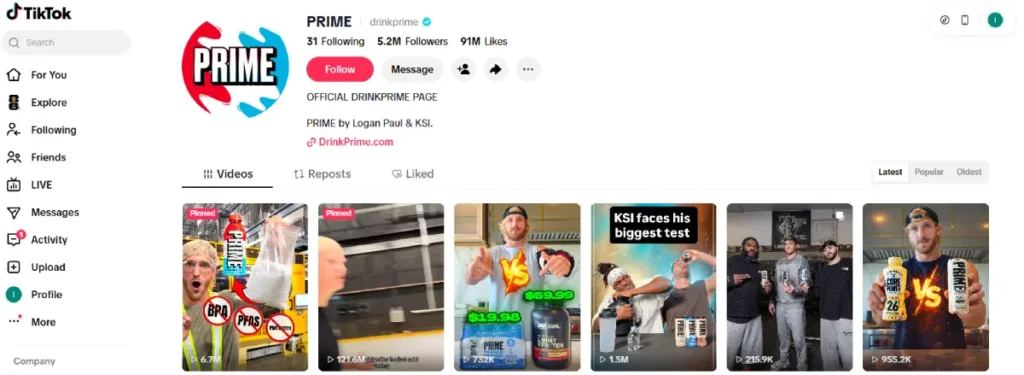
The mechanism was straightforward: co-founders KSI and Logan Paul had massive existing audiences on TikTok and YouTube.
Every drop, flavour reveal, and challenge created immediate content. Fans picked it up and ran with it. The UGC compounded from there.
What brands miss about this model is that the paid ads came after organic proof. They used TikTok to build social proof first, then amplified winning content into paid distribution. That order matters.
What creative actually works for beverage Ads on TikTok
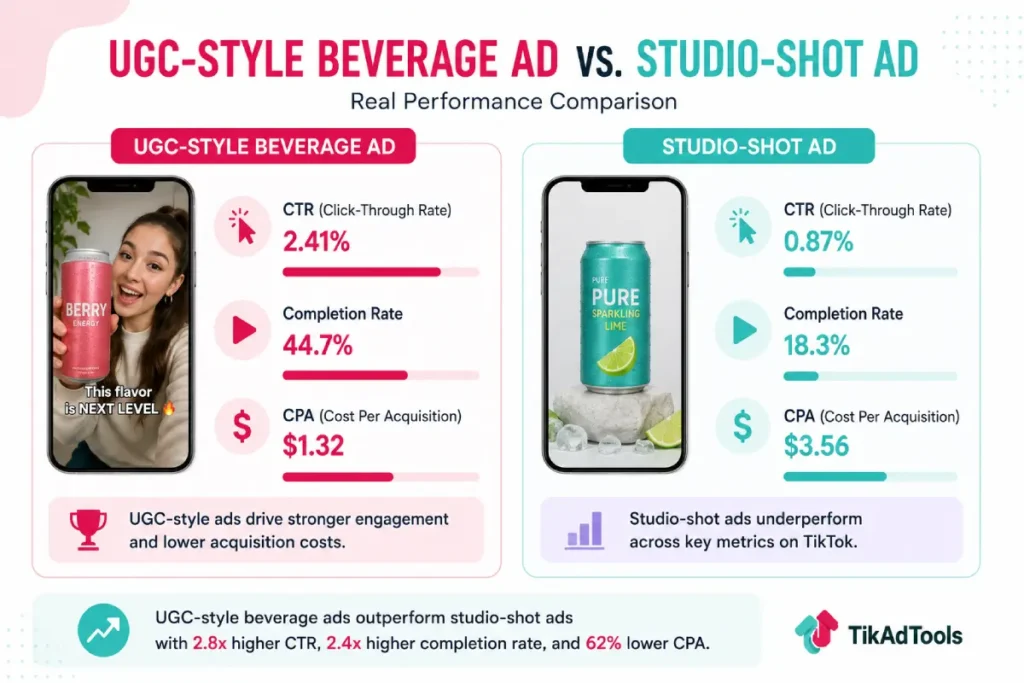
Stop trying to look premium. TikTok viewers scroll past polished studio ads faster than anything else on the platform.
What works is UGC-style video: someone holding the product, reacting to it, explaining why it’s different. Testimonials, first sips, flavour reactions, “I found this at [store]” formats.
These drive higher trust and lower CPAs than any studio shoot. 92% of consumers trust UGC more than traditional advertising, and creatives shot on mobile have a 63% higher chance of outperforming studio-shot creatives on purchases and checkouts. (source)
Action-oriented CTAs overlaid on screen increase conversion rates by over 18%. Don’t hide them. “Shop now,” “Try it here,” or “Only at [retailer]”: these should be visible early, not saved for the end.
Cut every 2 to 3 seconds. Static shots lose viewers on TikTok. A pour shot from one angle, then close up on the label, then a reaction, then the CTA. That’s a beverage ad that holds attention.
How to structure a beverage ad campaign on TikTok
Most beverage brands run everything in one campaign and wonder why results plateau. The structure is the problem.
Run three separate ad groups: one for cold audiences using interest and behavioural targeting, one for warm audiences who’ve watched your videos or visited your page, and one retargeting campaign for people who’ve clicked but haven’t purchased.
Each group needs different creative. Cold audiences need the hook and the product. Warm audiences need social proof. Retargeting audiences need urgency and a direct offer.
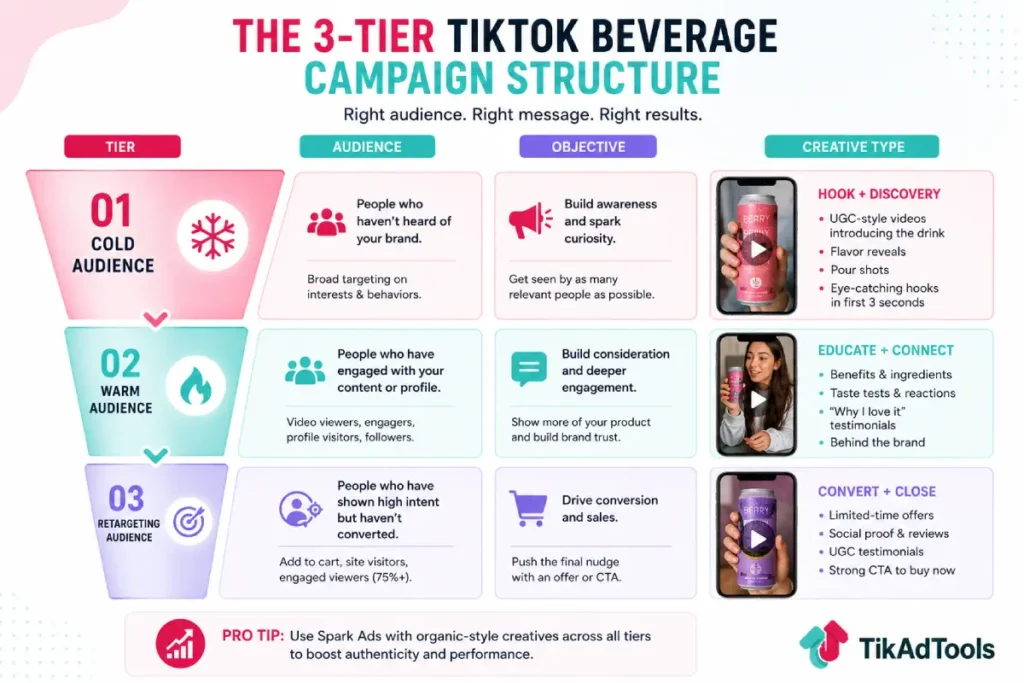
Don’t run the same video across all three. That’s where frequency eats your budget without converting.
Targeting that actually works for beverage brands
Beverage categories sit in a wide interest pool. “Health and wellness,” “food and drink,” and “fitness” are all legitimate starting points, but they’re broad.
Go one level deeper. If you’re selling an energy drink, target by behavioural interest: users who engage with gym content, sports creators, or supplement brands.
If you’re selling a premium water or functional beverage, look at wellness lifestyle audiences, not just “beverage.” Use the TikTok Audience Interest Finder to identify niche interest clusters your competitors aren’t targeting.
Beverage is a competitive category. Narrow targeting pools with a strong hook often outperform massive broad audiences with generic creative.
Lookalike audiences built from your purchaser list consistently outperform interest-only targeting once you have enough conversion data. Don’t skip this step.
The hook problem most beverage brands have
Beverage ads that open on a product shot of the bottle with background music don’t stop anyone from scrolling.
Your first 3 seconds need to create curiosity or identity. Not “here’s our product.” Something like: “This is the only drink I actually finish at the gym.” Or “I’ve tried 40 energy drinks. This one’s different.” Or just a genuine first-sip reaction with no intro at all.
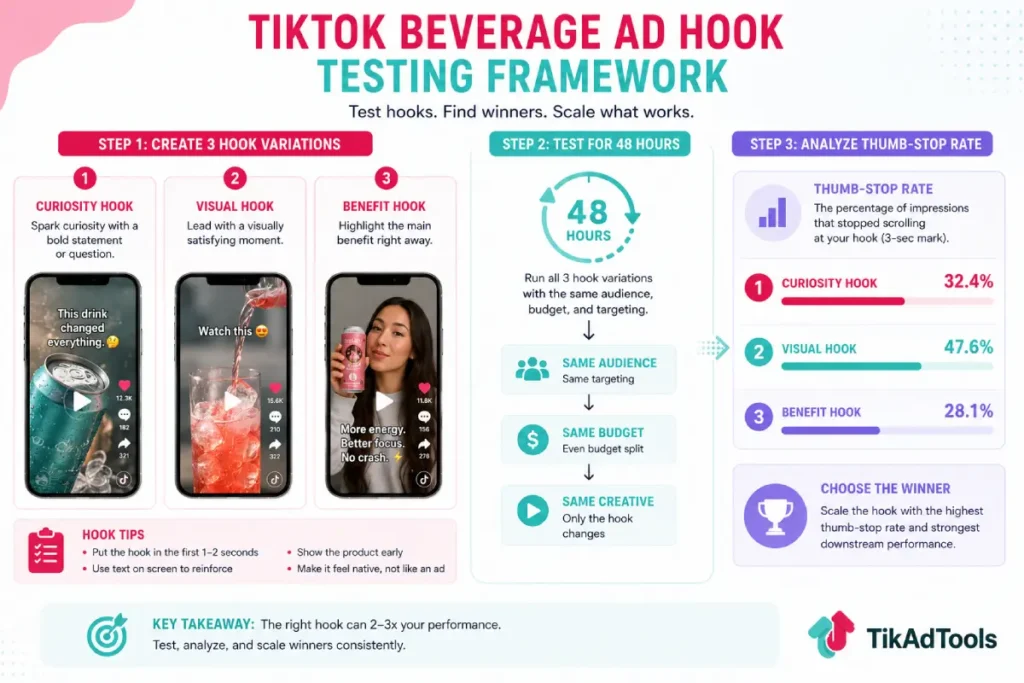
The best-performing hooks for beverages on TikTok right now are: personal opinion (strong POV), surprising claim, and visual pattern interrupts like unusual flavour combos or unexpected product placements.
Test at least 3 hook variations per piece of content. Same body, different opening 3 seconds. You’ll find 1 that outperforms the others by 40 to 70% on thumb-stop rate. Scale that one. Check the TikTok ad hook generator to build variations fast.
Does the stanley playbook still work?
Stanley went from $73 million in revenue in 2019 to over $800 million by 2024. TikTok was the engine. The #StanleyCup hashtag pulled billions of views. Influencers showcased collections. Limited drops sold out in minutes.
It worked because the product became a lifestyle symbol, not just a drinkware item. That’s the lesson, not the limited editions.
Beverage brands can apply the same principle: make your product represent something. A vibe, a routine, a community.
When TikTok users post with your product unpaid because it’s part of their identity, your paid ads get dramatically cheaper.
That’s why Stanley’s paid spend stayed manageable while organic content did the heavy lifting. Paid amplified what was already working.
What ad format to use for beverage brands
In-Feed Ads are your baseline. They run in the FYP and look like organic content. This is where most beverage campaigns should start.
Spark Ads are the upgrade. You take an existing organic post, yours or a creator’s, and put budget behind it.
The social proof (likes, comments, shares) stays on the ad. 7 Brew’s campaign used Spark Ads as a core part of their strategy, and it showed in the results.
TikTok Shopping Ads are worth testing if you’re selling DTC. They pull product catalogue data and allow in-app checkout. For beverage brands with an ecommerce component, this removes friction from the conversion path.
Don’t run TopView or Brand Takeover unless you have the budget to justify it. In-Feed and Spark Ads deliver better ROI for most beverage brands at most spend levels.
How to measure whether your beverage Ads are working
Most brands look at ROAS first. That’s not wrong, but it’s incomplete for beverage, where repeat purchase and brand awareness drive long-term revenue.
Track these metrics in order: 6-second view rate (are people staying past the hook?), completion rate (is the content holding?), CTR (is the offer compelling?), and then conversion rate at the landing page.
If your 6-second view rate is low, the problem is the hook. If CTR is low but completion is high, the problem is the CTA or the offer. Fix the right thing.
For a full breakdown of what to track and how, the TikTok ads reporting guide covers this in detail.
FAQs
How much should a beverage brand spend to start on TikTok ads?
Start with a minimum of $50 to $100 per day to give TikTok’s algorithm enough data to exit the learning phase. Split your initial budget across 3 to 4 creative variations so you can identify a winner before scaling.
Do beverage brands need a creator for TikTok ads?
Not necessarily, but creator-style content outperforms brand-shot content on TikTok. If you don’t use a creator, your internal videos should be filmed on a phone, not a studio camera; the format signals authenticity to the algorithm and the viewer.
Can small beverage brands compete with big ones on TikTok?
Yes. TikTok’s algorithm is content-first, not budget-first. A small brand with a strong hook and genuine product story can outperform a major brand running overproduced studio ads. The platform rewards relevance over spend.
What’s the best ad type for a beverage brand launching a new flavour?
Spark Ads on a creator’s genuine reaction video is the most effective format for a new flavour launch. The reaction creates social proof, the paid distribution gets it in front of new audiences, and the comment section does a lot of the selling for you.
How often should a beverage brand refresh its TikTok ad creative?
Every 2 to 3 weeks minimum. Beverage ads on TikTok show creative fatigue faster than most categories because the audience is high-frequency. If your CTR drops more than 20% from its peak, it’s time for a new creative batch.
Should beverage brands run TikTok ads to amazon or their own website?
Test both, but keep them in separate campaigns so you can compare performance cleanly. DTC landing pages give you better data and margin. Amazon gives you trust and conversion rates. Most brands find Amazon converts better for cold audiences, and DTC works better for warm retargeting.
Final thoughts
Beverage is one of the strongest categories on TikTok. The product is visual, consumption is emotional, and the community angle is built-in. Get the creative right, structure your campaigns properly, and test hooks relentlessly. That’s the whole playbook.