
TikTok ads for app installs can cut your cost per install significantly compared to other major platforms. But most new campaigns fail in the first week.
An incomplete setup is the root cause. You skip the measurement layer, pick the wrong optimization goal, or change something before the algorithm has had any time to learn.
In this guide, you are going to learn the full process of running TikTok ads for app installs: from pre-launch checklist to CPI reduction, in clear steps that you can act on today.
Whether you’re launching your first campaign or scaling an existing TikTok app advertising strategy, you’ll find practical steps you can apply immediately.
Table of Contents
Get Up to $6,000 in Free TikTok Ad Credits
TikTok offers ad credit incentives for new advertisers, helping you test campaigns with a lower upfront cost.
How TikTok app install Ads work
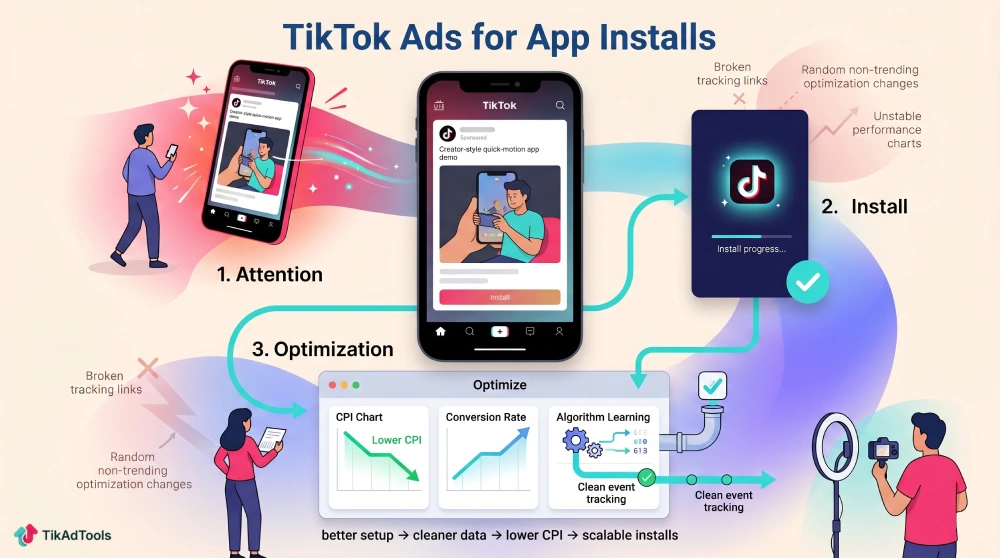
TikTok app install ads send users directly to your app’s page on the Apple App Store or Google Play. You create a campaign under the App Promotion objective, connect your app, choose an optimization goal, and run video ads in the TikTok feed. Results vary based on creative quality, OS target, and budget size, but the system works best after the campaign collects at least 50 installs and exits the learning phase.
Why TikTok is one of the best channels for app installs in 2026
An Adjust meta-analysis cited by TikTok for Business shows TikTok drives 19% more assisted app installs compared to other major platforms. In the U.S. alone, that figure rises to 15% more assisted installs than competing channels.
The cost advantage is real, and it differs by vertical. Here is how TikTok’s CPI compares to other platforms, according to the same Adjust study:
| App Vertical | CPI vs. Other Platforms |
|---|---|
| Education | 40% lower |
| Entertainment | 50% lower |
| Health & Fitness | 65% lower |
| Finance | 56% lower |
On top of that, TikTok for Business reports that TikTok-driven app installs generate 59% more in-app engagement during the first week compared to other platforms. That matters for retention and lifetime value, not just download volume.
TikTok’s For You Page surfaces content based on user behavior, not follower count. Your app can reach high-intent users without any existing audience behind it.
What you need before launching your first campaign
Do not create your campaign before this setup is complete:
- TikTok Ads Manager account live at ads.tiktok.com
- Mobile Measurement Partner (MMP) connected: AppsFlyer, Adjust, or Branch
- TikTok SDK or Events API integrated inside your app
- App store listing is live on iOS or Android
- Three to five video creatives ready before you spend a dollar
Your MMP is not optional. It handles cross-platform attribution, fraud detection, and post-install event tracking. Without it, you cannot see what your users do after installing, and you cannot optimize for quality.
How to set up a TikTok app promotion campaign: quick guide
- Open TikTok Ads Manager and click “Create Campaign.”
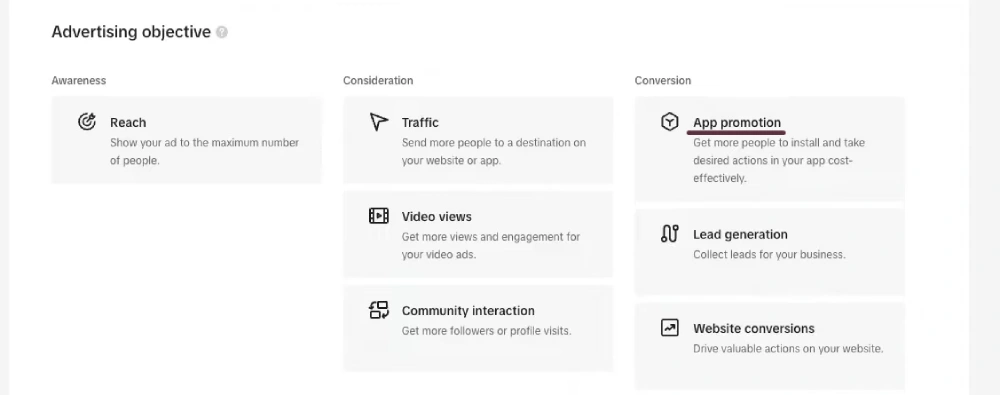
- Select App Promotion as your objective. This campaign type is specifically designed for TikTok ads for apps that aim to drive installs from the App Store or Google Play.
- Choose App Install as the campaign type
- If targeting iOS users, toggle on the iOS 14+ Dedicated Campaign switch
- Connect your app using its App Store or Google Play URL
- Set your daily budget at 20 times your target CPI per ad group
- Choose Maximum Delivery as your bid strategy
- Select Install as your optimization goal for new campaigns
- Upload your video, write your ad copy, and set your CTA button
- Publish, then wait 72 hours before reviewing or making any edits
For a complete hands-on setup guide, read our guide on how to run TikTok ads.
iOS vs Android: how your campaign setup changes
iOS and Android need separate campaign structures when running TikTok ads for app install campaigns because attribution and optimization behave differently across operating systems. Running them together muddies your data and limits what you can optimize.
For iOS: Enable the iOS 14+ dedicated campaign toggle before launch. Without it, SKAdNetwork will not track your installs properly.
SKAdNetwork 4.0 controls iOS attribution, which means delayed reporting and limited breakdowns by age and geography.
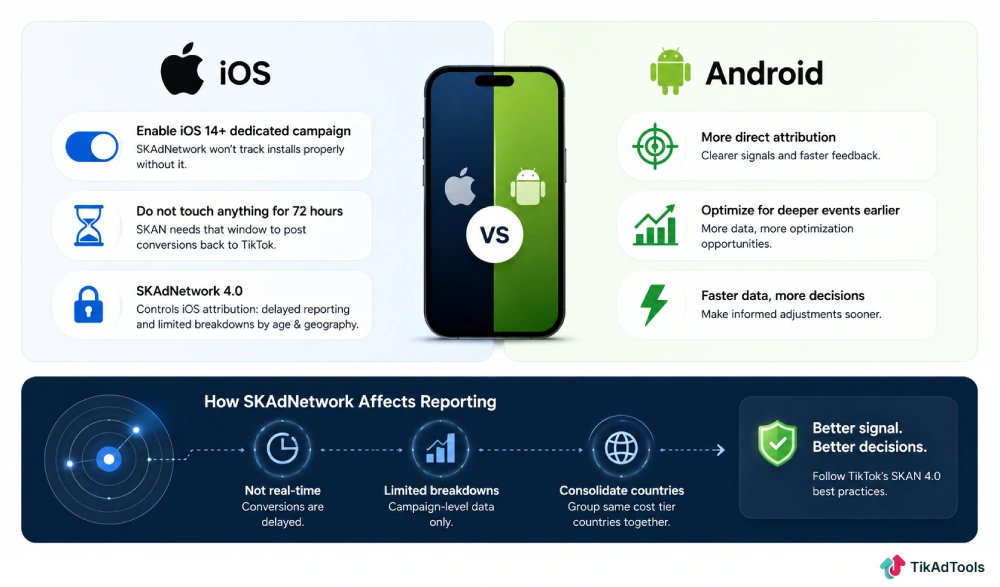
Do not touch anything in the first 72 hours. SKAN needs that window to post conversions back to TikTok.
For Android: Attribution is more direct, and you can optimize for deeper in-app events earlier in the campaign. If you want faster data and more room to make decisions, start with Android.
How SKAdNetwork affects reporting
SKAN does not deliver real-time data. Conversions are delayed, and campaign-level breakdowns are limited. To improve signal quality, consolidate countries in the same cost tier into one campaign, as TikTok recommends in its SKAN 4.0 guidance.
Targeting strategy: how to reach high-intent app users on TikTok
Start broad, ads that reach a “fairly broad” audience, defined as over 80% of potential users in a country, achieve 15% lower CPA and 20% higher conversion rates on average compared to narrower targeting. (Source)
The algorithm is better at finding your users than most manual interest builds, especially early in a campaign. Hold off on adding interest layers or custom audiences until you have real install data to guide those choices.
On Pangle: Pangle extends your reach across partner apps and can produce lower CPIs. But the traffic behaves differently from TikTok feed traffic. Always run Pangle in a separate ad group. Mixing it with your feed placement makes both harder to read and act on.
How to create TikTok app install Ads that drive downloads
According to TikTok for Business research, 50% of a campaign’s success comes down to creative quality. That one fact should shift how you allocate your time before launch.
Your video has to grab attention in the first three seconds. Lose viewers there, and nothing else in the ad matters.
What consistently works for app install ads:
- Spark Ads: Boost existing organic TikTok posts as paid ads. They keep native engagement, including likes, comments, and shares, and tend to outperform standard In-Feed ads
- Phone-in-hand demos: Show someone using your app live on camera. Screen recordings alone do not perform as well
- UGC-style creative: Real people talking about the app outperforms polished brand video almost every time
- Smart Creative: Upload multiple videos, headlines, and CTAs. TikTok’s system tests combinations automatically and shifts spend away from ads showing fatigue
Plan to refresh creatives every two to four weeks. Ad fatigue shows up in rising CPMs before you see it in your CPI, so catch it early.
Budget, bidding, and the Learning Phase explained
Understanding TikTok Ads CPI is just as important as setting your budget because even small improvements in cost per install can significantly improve campaign profitability.
Your budget controls how fast the algorithm learns. Set it too low, and the campaign stalls in the learning phase indefinitely.
Daily budget formula for app installs:
(Target CPI x 50) / 7 = Recommended daily budget per ad group
If your target CPI is $3.00, your daily ad group budget should be at least $21.43. A minimum daily budget of 20 times your target cost-per-action to give the delivery system enough room to optimize.
Bid strategy: Start with Maximum Delivery. It spends your full budget and gathers conversions quickly. Move to Cost Cap once you have 50 or more installs and a known baseline CPI.
The learning phase: Your campaign needs 50 conversions before TikTok’s algorithm stabilizes delivery. Do not pause, relaunch, or edit campaigns in the first 72 hours. Each change resets the learning clock. When scaling, increase budgets by 15 to 20% every two to three days. Large single increases trigger a fresh learning phase and can spike your CPI temporarily.
How to track and measure app install performance on TikTok
Connect both the TikTok SDK and the Events API to your app. According to TikTok’s Performance Fundamentals, advertisers using both tools capture 19% more events and see 15% better CPA than those relying on the SDK alone.
Your tracking setup should include three core events:
- Install event: fires when the app opens for the first time
- Registration event: fires when a user completes sign-up
- Purchase or subscription event: fires on monetization actions
Do not judge your campaign on CPI alone. Track Day 1 and Day 7 retention, ROAS, and lifetime value (LTV). A $3.00 CPI with 40% Day 7 retention will consistently outperform a $1.50 CPI with 90% churn when you look at the full revenue picture.
How to lower your CPI on TikTok: proven optimization strategies
CPI drops when three things are working together: creative stays fresh, event signals get stronger, and your campaigns stay stable.
1. Refresh creatives on a set schedule: Ad fatigue raises CPMs, and rising CPMs drive up CPI. Smart Creative automates rotation and extends how long your ad groups stay efficient before you need to rebuild.
2. Move to App Event Optimization: Once you have baseline install data, switch from optimizing for installs to optimizing for higher-value events like registration or first purchase. Better signals help the algorithm find users who are actually worth the spend.
The Checkmate case study from TikTok for Business shows what is possible: after switching to creator-led assets and AEO, Checkmate recorded a 43% increase in CTR and an 18% drop in CPI.
3. Let campaigns run: Pausing and relaunching resets the learning phase every time. Campaigns that run continuously with stable, gradually increasing budgets produce lower CPI over time than accounts that keep interfering.
Common TikTok app install campaign mistakes to avoid
These are the issues we see come up most often, across accounts of all budget sizes:
- Targeting too narrow on day one: The algorithm needs space to find your users. Broad targeting consistently outperforms manual interest stacking in the early phase
- Mixing Pangle with TikTok feed in one ad group: Traffic quality differs across placements. Keeping them separate keeps your data clean and your optimization decisions accurate
- Editing campaigns in the first 72 hours: Every change resets the learning phase. Get your setup right before launch, then wait
- Skipping the iOS 14+ dedicated campaign toggle: Without it, SKAdNetwork does not track your iOS installs, and you are flying blind on attribution
- Staying on install optimization after you have data: AEO finds higher-quality users at a better long-term CPI once the algorithm has enough signals to work with
Frequently asked questions about TikTok Ads for app installs
Are TikTok ads good for app installs?
Yes, TikTok is one of the most cost-efficient channels for user acquisition right now. According to an Adjust meta-analysis cited by TikTok for Business, TikTok drives 19% more assisted app installs compared to other major platforms, with even stronger performance in markets like the U.S. and Canada. Your results will depend on your app category, creative quality, and how well your campaign is structured.
How much does it cost to run TikTok app install ads?
Cost varies by app vertical, geography, and OS. According to the Adjust meta-analysis cited by TikTok for Business, education apps achieve 40% lower CPI and health and fitness apps see 65% lower CPI on TikTok compared to other platforms. You need a minimum daily budget of around 20 times your target CPI per ad group to give the algorithm enough data to exit the learning phase.
Do I need a mobile measurement partner for TikTok app install campaigns?
Yes. An MMP like AppsFlyer, Adjust, or Branch is essential for accurate attribution, fraud detection, and post-install event reporting. Without one, you cannot see what users do after installing your app, and you have no way to optimize for user quality beyond raw install count.
What is a good CPI for TikTok app install campaigns?
There is no single answer. CPI depends on your app vertical, target country, OS, and how deep you optimize. TikTok consistently delivers lower CPIs than competing platforms across verticals, but a low CPI only means something if retention holds. We recommend tracking Day 7 retention and LTV alongside CPI, because a cheap install with high churn is not a win by any measure.
How long does the TikTok app install learning phase take?
TikTok needs at least 50 conversions before the algorithm stabilizes delivery. How long that takes depends on your daily budget and your current CPI. Do not make any edits in the first 72 hours after launch, or after any subsequent change, because each edit resets the clock. Budget your campaign to collect those 50 conversions within the first 7 to 10 days for the best results.
Should I run iOS or Android app install campaigns on TikTok first?
Start with Android if you want faster data and more optimization flexibility. iOS campaigns require the iOS 14+ dedicated toggle and operate under SKAdNetwork, which delays reporting and restricts what attribution data you can see. Get your Android campaigns stable first, then build a separate iOS campaign structure once you know your baseline performance.
Conclusion
TikTok ads for app installs work when you give the platform what it needs: the right pre-launch setup, a budget large enough to clear the learning phase, and creative that earns attention in the first three seconds.
Whether you’re managing a single TikTok ads app campaign or scaling multiple apps, consistent optimization is what lowers CPI over time.
Start with your setup, connect your MMP, integrate the Events API alongside your SDK, and have your creatives ready before you spend anything.
Structure your campaign correctly, give it 72 hours of breathing room, and then let data drive your next move. Once you have installed volume, switch to AEO, keep your creatives rotating, and scale your budget gradually.
CPI does not improve because you pushed harder. It improves because the foundation was right from the start.