
Most TikTok ad budgets are built around one goal: get a new customer. Once that customer buys, the ad account often stops paying attention to them, and that’s where a lot of long-term revenue quietly leaks away.
TikTok ads can do more than acquire. Used correctly, they keep existing customers engaged, bring them back for a second and third purchase, and turn buyers into a source of the content that attracts new ones.
Table of Contents
Get Up to $6,000 in Free TikTok Ad Credits
TikTok offers ad credit incentives for new advertisers, helping you test campaigns with a lower upfront cost.
Key takeaways
- Retention-focused TikTok campaigns run on Customer File audiences and purchase-event exclusions, not the same targeting used for prospecting.
- Excluding recent purchasers from acquisition campaigns and building a separate repeat-purchase campaign are two different actions; both are needed.
- Post-purchase content like unboxing videos, reviews, and user-generated content feeds back into prospecting and improves trust signals for new buyers.
- A typical repeat-purchase window depends on the product category, and campaigns should match that window rather than using a single default.
- TikTok’s ads budget strategy allocates a small, deliberate share of spend to retention, not the majority.
Why customer retention needs its own TikTok ad strategy
Acquiring a new customer typically costs more than keeping an existing one, and TikTok’s own auction reflects that. A Customer File audience built from people who already bought is small, warm, and inexpensive to reach compared to cold prospecting at scale.
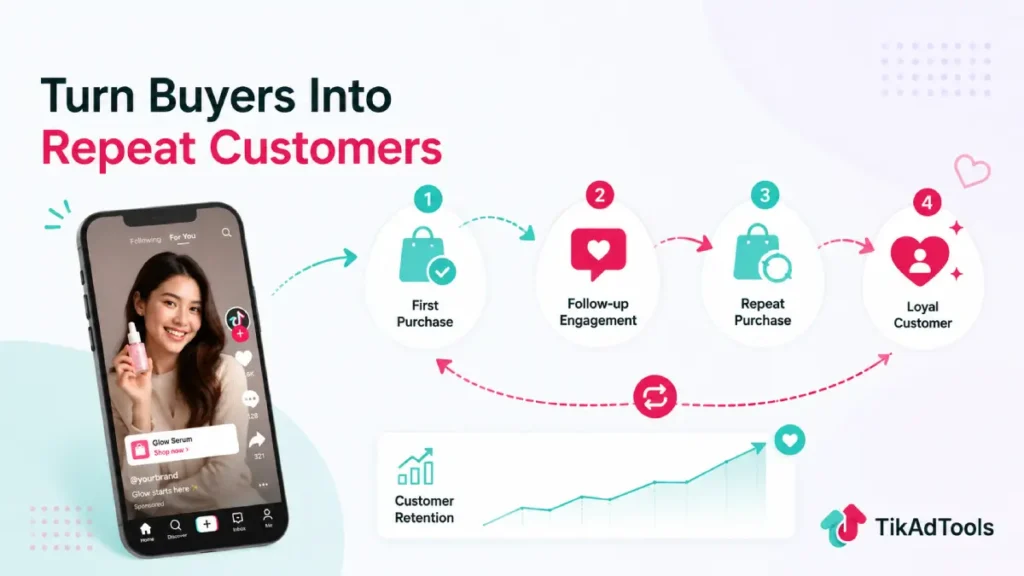
Retention campaigns also serve a different purpose than TikTok retargeting ads. Retargeting recovers people who showed interest but didn’t buy. Retention keeps people who already bought engaged so they buy again. Both use Custom Audiences, but the audience source, the message, and the goal are different.
Building a Customer File audience for repeat purchases
A Customer File audience is built by uploading a list of existing customers, typically emails or phone numbers, directly into TikTok Ads Manager. TikTok matches the list against its user base to create a targetable audience.
Segment this list before uploading rather than treating all customers the same. A customer who bought once 90 days ago needs a different message than one who bought last week. Common useful segments include first-time buyers past their typical repurchase window, customers who bought a starter or trial-sized product, and customers who haven’t purchased in longer than their category’s normal cycle.
Match rates for Customer File audiences depend heavily on list quality and how recently the data was collected. TikTok doesn’t publish an official match-rate figure, so treat any specific percentage quoted elsewhere as an estimate, not a guarantee. Clean and deduplicate the list before uploading, and refresh it regularly so the audience reflects your actual current customer base.
Excluding recent purchasers from prospecting and retargeting
Every acquisition and retargeting campaign should exclude people who purchased within your typical repeat-purchase window. Showing a first-purchase discount to someone who already bought at full price damages trust and wastes budget that could reach an actual new customer.
Build a CompletePayment audience with a lookback window that matches your product’s realistic repurchase cycle, then add it as an exclusion at the ad group level across every prospecting and retargeting campaign. Review this exclusion periodically since a stale lookback window either keeps excluding people who are ready to buy again or stops excluding people who just bought.
Using post-purchase content to build a retention loop
Content collected after a sale, unboxing videos, reviews, and customer-submitted footage, does two jobs at once. It gives existing customers a reason to stay engaged with the brand, and it becomes some of the strongest top-of-funnel creative for reaching new customers, since prospective buyers trust real customer content more than brand-produced ads.
Requesting this content is most effective shortly after delivery, when the product is fresh, and the customer’s experience is top of mind. A short, specific ask, “show us your first impression,” performs better than a generic request for feedback.
Note that this is a general content-collection practice, not a TikTok-published rule; TikTok’s own Post Purchase Survey documentation covers a related but different feature, a checkout-page survey for discovery-channel attribution (“how did you hear about us”), not a UGC-solicitation program.
Feed the best of this content back into prospecting campaigns rather than only using it for organic posts. It closes the loop: acquisition creates customers, customers create content, and that content improves acquisition.
For a single, time-boxed offer tied to one specific purchase rather than the ongoing relationship, TikTok’s ads post-purchase upsell strategy covers that narrower tactic.
Structuring a repeat-purchase campaign
Set the campaign objective to Website Conversions or Catalog Sales depending on whether you’re promoting a specific product or your full catalog. Use the Customer File audience segmented by purchase recency as the targeting source, and exclude anyone who has already repurchased within the campaign’s target window.
Creative for this audience should assume familiarity with the brand. Skip the introduction and go straight to the offer, a replenishment reminder, a complementary product, or a loyalty incentive. This is not the place for brand-awareness messaging.
Keep the daily budget modest. A repeat-purchase audience is a small slice of your total customer base, and overspending against it quickly runs into frequency fatigue.
TikTok’s ads budget strategy covers how to size a daily budget against a small, defined audience like this one. The Ad Retargeting Builder can help structure a repeat-purchase segment alongside your standard retargeting audiences.
How retention fits into your overall TikTok ad budget
A practical split used by performance marketers puts the large majority of spend toward prospecting, a smaller share toward retargeting warm, non-converted traffic, and the smallest share toward retention. Retention campaigns don’t need much daily spend to be effective, since the audience itself is limited by how many customers you have.
Watch frequency on retention campaigns closely. Because the audience is small, individual customers can see the same ad many times in a short window, which erodes goodwill instead of building it. Refresh retention creative on a similar cadence to retargeting creative, roughly every 2 to 3 weeks.
Common mistakes that undermine TikTok retention campaigns
Treating retention and retargeting as the same audience is a common one. Retargeting audiences include people who never bought; retention audiences are exclusively past customers. Mixing them muddies the message and the exclusion logic.
Forgetting to update the Customer File list regularly is another. An outdated list misses recent customers and keeps showing ads to people who unsubscribed or churned long ago.
Using acquisition-style discounts on repeat customers can also backfire, since a loyal customer offered the same “first purchase” discount as a stranger can feel undervalued rather than rewarded.
Frequently asked questions
Can I use TikTok ads to bring back customers who haven’t purchased in a while?
Yes. Build a Customer File audience segmented specifically to people who haven’t purchased within your category’s normal repeat-purchase window, and use a win-back offer or a reminder of what they bought previously rather than a generic prospecting message.
How is a retention campaign different from a retargeting campaign on TikTok?
Retargeting reaches people who showed interest, visited a product page, watched a video, or engaged with an ad, but didn’t buy. Retention reaches people who already completed a purchase. Both rely on Custom Audiences, but the source list, message, and exclusion logic differ.
What’s the minimum audience size for a TikTok retention campaign?
The same platform-wide minimum applies: TikTok requires at least 1,000 users in a Custom Audience for it to be eligible for ad delivery, per TikTok’s custom audience documentation. A small customer base may need to combine multiple purchase segments to clear that threshold.
Should retention campaigns use the same creative as acquisition campaigns?
No. Acquisition creative needs to introduce the brand and the product. Retention creative can skip that step entirely and go straight to the specific offer, since the audience already knows the brand and has already made a purchase decision once.
Conclusion
TikTok advertising doesn’t have to stop the moment someone buys. A dedicated retention approach, built on Customer File audiences, purchase exclusions, and a post-purchase content loop, turns a single sale into a longer customer relationship and a source of creative that keeps feeding the rest of the funnel.
Sources