
It depends far more on your product’s margin than on TikTok Shop itself. The platform’s 6% referral fee is genuinely cheaper than Amazon’s, and the platform is growing fast. But most of the roughly 475,000 active US sellers are still doing under $100,000 a year, and the sellers who do well share a specific profile, not just being early.
This piece walks through the real costs, who TikTok Shop actually works for, and how to check your own numbers before you commit.
Table of Contents
Get Up to $6,000 in Free TikTok Ad Credits
TikTok offers ad credit incentives for new advertisers, helping you test campaigns with a lower upfront cost.
Key Takeaways
- TikTok Shop’s referral fee is a flat 6% of the order value in the US (5% for select jewelry sub-categories and pre-owned goods), confirmed directly on TikTok’s own Seller University page. New sellers get a promotional 3% rate for 30 days after their first sale, provided that first sale happens within 60 days of onboarding.
- That’s meaningfully cheaper than Amazon’s typical 15-30% referral fees, the biggest structural reason TikTok Shop looks attractive on paper.
- US TikTok Shop GMV hit $15.1 billion in 2025 and is projected to top $20 billion in 2026. Dashboardly separately reports 128% year-over-year sales growth platform-wide, a different metric than the US GMV figures above, not a rate implied by them.
- The number most “worth it” articles skip: of the roughly 475,000 active US shops Dashboardly tracked, only 77 crossed $10 million in annual GMV and about 1,033 crossed $1 million. An estimated 470,000-plus are still doing under $100,000 a year.
- Dashboardly’s own seller data points to a specific profile that does well: gross margins of 30% or higher, prices in the impulse-buy range (roughly $15-35), and enough operational slack to handle a sudden 10x demand spike.
- Before you commit, run your actual product cost and expected fees through the Shop Fee Calculator and Shop Profit Calculator rather than relying on someone else’s average.
What TikTok Shop actually costs you
TikTok Shop charges a flat 6% referral fee (5% for jewelry), plus optional creator commissions and fulfillment costs if you use TikTok’s own logistics.
Per TikTok’s official Referral Fee policy, TikTok’s own Seller University page confirms the core fee: a 6% referral fee per qualified order in the US, calculated on the buyer-paid amount plus platform discount minus tax. Select jewelry sub-categories and pre-owned goods carry a lower 5% rate.
New sellers also get a temporary, lower 3% promotional rate for 30 days after their first sale, provided that first sale happens within 60 days of onboarding, per TikTok’s own Seller University terms.
If an order gets refunded or returned, TikTok refunds the referral fee back to you, minus a refund administration fee equal to 20% of that referral fee, capped at $5 per SKU as of May 2025. That cap matters for higher-priced items: without it, high refund rates on expensive products would eat a disproportionate chunk of your margin.
Beyond the referral fee, sellers typically also account for payment processing, affiliate and creator commissions, and fulfillment if they use TikTok’s logistics. TikTok Shop’s integrated payment gateway carries its own processing cost on top of the referral fee, separate from the percentage above.
If you run TikTok Shop’s affiliate program to get creators promoting your products, you set the commission rate yourself, typically 10-20% per Dashboardly’s fee stack, optional but how most viral TikTok Shop growth actually happens.
Fulfillment through TikTok’s own logistics is also optional; self-fulfillment avoids it, while Fulfilled by TikTok pricing starts around $3.58 per item, per Dashboardly, plus a separate return-handling fee.
None of these additional costs are fixed the way the referral fee is. They depend entirely on your setup, which is exactly why a generic “TikTok Shop costs X%” answer doesn’t tell you much on its own. TikTok Shop Fees Explained covers a full worked-example breakdown of these fees.
TikTok Shop vs. Amazon: the fee comparison that gets sellers interested
TikTok Shop’s 6% referral fee is far cheaper than Amazon’s typical 15-30%, though optional creator commissions narrow that gap in practice.
The number that draws most sellers to TikTok Shop in the first place is the fee gap. Amazon’s referral fees typically run 15-30% depending on category, roughly two and a half to five times TikTok Shop’s flat 6%. On paper, that’s a large margin advantage, and it’s the comparison Dashboardly leads with in its own 2026 breakdown.
In practice, the gap narrows once you add TikTok Shop’s optional creator commissions. Sellers who lean on the affiliate program to drive sales typically pay creators 10-20% on top of the referral fee, per Dashboardly’s fee data, to get them promoting a product at all.
A TikTok Shop sale driven by a creator affiliate can end up costing a similar total percentage to an Amazon sale, just structured differently: platform fee plus creator cut instead of one bundled Amazon referral fee.
The honest comparison isn’t “6% beats 15-30%.” It’s that TikTok Shop gives you more control over where that cost goes, platform fee versus creator incentive, while Amazon bundles it all into one number.
What sellers are actually making, not just the GMV headlines
Most active TikTok Shop sellers earn under $100,000 a year; only 77 of roughly 475,000 US shops crossed $10 million in GMV, per Dashboardly’s 2026 data.
Growth numbers get most of the attention: TikTok Shop’s global GMV hit $64.3 billion in 2025 and is projected to reach $112 billion by the end of 2026, with the US portion alone growing from $15.1 billion toward a projected $20 billion-plus, per Dashboardly’s 2026 data. Those figures describe the platform’s growth, not any individual seller’s odds.
Dashboardly, which tracks profit data across thousands of active TikTok Shop stores, breaks US sellers into four tiers for 2025-2026:
Mega sellers, $10 million or more in annual GMV, number 77 shops and typically run 15-25% net margin. Power sellers, between $1 million and $10 million, number roughly 1,033 shops at 20-35% net margin. Growing sellers, between $100,000 and $1 million, number in the thousands at 15-30% net margin. Early-stage sellers, under $100,000, make up an estimated 470,000-plus shops with highly variable margins.
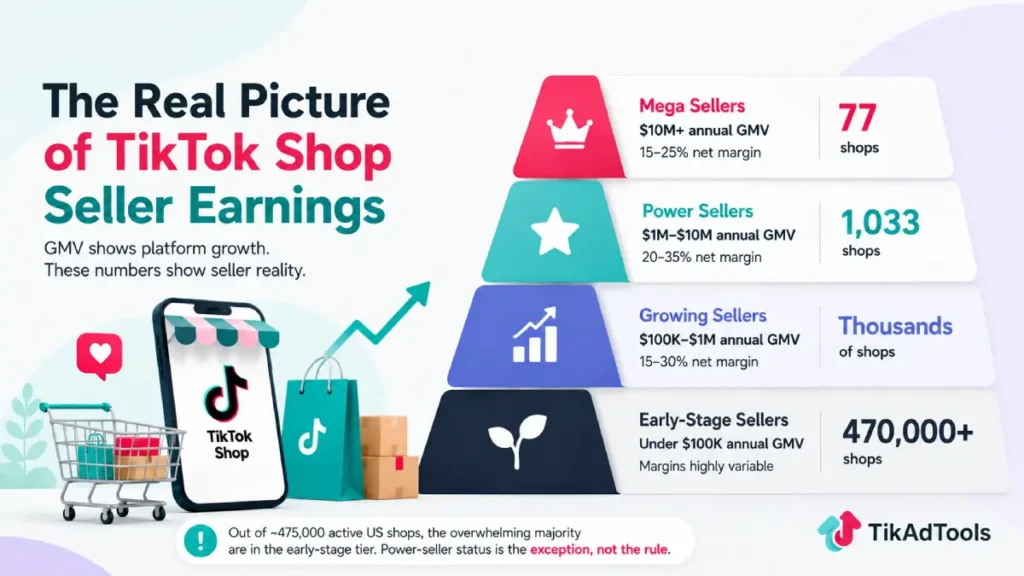
That last row is the one that matters most. Out of roughly 475,000 active US shops, the overwhelming majority are still in the early-stage tier. Reaching power-seller status is the exception, not the default outcome, even though the platform’s overall growth numbers look enormous. GMV measures the platform’s size. It doesn’t measure what any individual seller keeps.
Who TikTok Shop actually works for
TikTok Shop works best for sellers with 30%+ margins, products priced $15-35, and the operational capacity to handle sudden demand spikes.
Dashboardly’s own seller data, drawn from real profit tracking rather than a generic industry guess, points to a specific profile of seller that tends to do well:
A gross margin of 30% or higher gives you room to absorb the referral fee, optional creator commissions, refund costs, and still turn a profit. Pricing in the impulse-buy range, roughly $15-35, is what Dashboardly calls the sweet spot for TikTok Shop conversion: low enough for impulse buying, high enough to hold a margin after fees.
Operational capacity for demand spikes matters too, since a creator’s video going viral can push orders up 10x or more within days, and sellers who can’t fulfill that fast enough turn a good problem into refunds and account-health penalties instead of profit.
A product suited to video demonstration also helps: beauty is the standout category, accounting for roughly $2.49 billion, about 42% of total US TikTok Shop sales, per Dashboardly, while home and kitchen gadgets, health and wellness products, and pet products also perform well because they demonstrate clearly in short videos.
Fashion and accessories sell in volume too, but Dashboardly flags higher return rates, 15-25%, in that category specifically, which eats into the same margin advantage.
Separately, Printify’s 2026 guide notes that TikTok Shop’s audience skews Gen Z and Millennial, so brand fit with a younger buyer matters as much as the product category itself.
If your product doesn’t fit that profile, for example, a high-margin but high-consideration purchase, or a low-margin commodity item, TikTok Shop’s cost structure works against you regardless of how fast the platform is growing.
Run your own numbers before you decide
TikAdTools’ Shop Fee Calculator and Shop Profit Calculator turn these industry averages into your specific product’s real numbers in a few minutes.
Every figure above is a range, an average, or someone else’s seller tier. Your actual product has its own cost basis, your own likely margin, and your own realistic view of whether you can handle a demand spike. The Shop Fee Calculator takes your product price and category to show the exact referral fee and estimated total platform cost per order. The Shop Profit Calculator takes your product cost, price, and expected fees to show your real per-order profit margin, before you list a single item.
Running your numbers through both replaces someone else’s average with your actual answer.
What this means for your next move
If your numbers work, list your first products, consider the affiliate program for early traction, and plan to add TikTok Ads once you have sales data.
Organic reach alone rarely gets a new shop enough visibility to test whether a product will move, which is why most sellers lean on the affiliate program early. Once you have initial sales data, most sellers who want to scale past what organic and affiliate content can reach turn to TikTok’s paid ads, most commonly GMV Max, which run through a standard TikTok Ads account, the same account type covered throughout this site.
If you don’t have one yet, TikTok’s new-advertiser ad credit applies to accounts that haven’t run a paid campaign before, so it’s worth checking before you create one. Use the Ad Credit Eligibility Checker to see where you stand.
And before you list anything, it’s worth knowing what gets a listing flagged in the first place: why TikTok Shop products get frozen or stuck under review covers the most common triggers so you can avoid them from day one.
Frequently asked questions
Is TikTok Shop worth it in 2026?
For sellers with strong margins and the right product, yes. TikTok Shop’s 6% referral fee undercuts Amazon’s typical 15-30%, and it tends to work best for products with 30%+ margins, prices in the $15-35 range, and sellers who can handle sudden demand spikes.
How much does TikTok Shop actually cost sellers?
The core cost is a flat 6% referral fee on qualified orders in the US (5% for select jewelry sub-categories and pre-owned goods, 3% promotional for new sellers for 30 days after their first sale), confirmed on TikTok’s own Seller University page.
How many TikTok Shop sellers actually make good money?
Very few. Of roughly 475,000 active US shops, only 77 crossed $10 million in annual GMV and about 1,033 crossed $1 million, per Dashboardly’s 2026 breakdown.
Is TikTok Shop cheaper than Amazon?
The base referral fee is lower, 6% versus Amazon’s typical 15-30%. In practice, the gap narrows once you add TikTok Shop’s optional creator commissions (10-20%, per Dashboardly), since that cost isn’t part of the base referral fee the way Amazon’s bundled fee is.
What kind of products do best on TikTok Shop?
Beauty leads by a wide margin, roughly 42% of total US TikTok Shop sales, per Dashboardly. Home and kitchen gadgets, health and wellness, and pet products also perform well because they demonstrate clearly in short videos.
Conclusion
The fee structure genuinely favors TikTok Shop over Amazon. The seller-tier data says most active sellers are still small, not because the platform failed them, but because margin, price point, and fulfillment readiness decide the outcome more than timing does.
Before you decide, run your actual product through the fee and profit calculators above. That answer will tell you more than any platform-wide average.
Sources