
For most product-based and visually demonstrable businesses, yes. But “yesisn’t the useful part of that answer. The useful part is knowing whether it’s worth it for your specific budget, your specific product, and your specific numbers, not the industry average.
Most articles on this topic give you one verdict for every business. This one gives you the real 2026 cost data, tells you honestly who should wait, and then points you to the actual calculators to run your own numbers before you spend a dollar.
Table of Contents
Get Up to $6,000 in Free TikTok Ad Credits
TikTok offers ad credit incentives for new advertisers, helping you test campaigns with a lower upfront cost.
Key Takeaways
- TikTok’s platform minimum is $50/day per campaign and $20/day per ad group, but most advertisers need $1,500 to $5,000/month to get past the algorithm’s learning phase and see reliable data.
- Triple Whale’s full-year 2025 ad benchmark data (not TikTok’s own marketing figures) puts average CPM at $13.26, with a platform-wide median ROAS near 2.21x. Your actual numbers will vary by industry, sometimes significantly.
- TikTok works best for visually interesting physical products sold to an 18-35 audience prone to impulse buys. It’s a weaker fit for pure B2B, older demographics, or businesses with no capacity to produce video.
- Before you spend anything, run your numbers through TikAdTools’ free calculators. A generic industry benchmark isn’t a substitute for your own math.
What “worth it” actually depends on
Whether TikTok ads are worth it depends on three things: can you reach your audience there, can you afford a real test budget, and can you produce ongoing video creative.
Get a yes on all three, and the odds favor you. Get a no on any one, and the generic industry verdict doesn’t apply to your business no matter what it says.
That’s why a single blanket answer is close to useless. What matters is your numbers, not the average business’s numbers.

2026 cost benchmarks
TikTok’s platform minimum is $50 a day, but a realistic 2026 testing budget runs $1,500 to $5,000 a month, with CPMs typically between $4.80 and $9.16 for standard self-serve campaigns.
Start with what’s official. According to TikTok’s own Ads Manager documentation, the platform enforces a minimum daily budget of $50 at the campaign level and $20 at the ad group level. That’s the floor TikTok requires to let a campaign run at all, not a recommendation.
In practice, that floor is too low to learn anything useful. Most 2026 cost analyses put the realistic starting budget at $1,500 to $5,000 per month, enough to support two or three ad groups and give TikTok’s algorithm enough spend to exit its learning phase.
Beyond the platform minimums, actual cost per result varies by source and by industry. TikTok’s ads cost benchmarks, sourced to Lebesgue, WebFX, and Coupler.io, put standard self-serve CPM at $4.80 to $9.16 and CPC at $0.20 to $2.00. Triple Whale’s separate full-year 2025 benchmark study, which spans a broader mix of account types, reports a higher average of $13.26 CPM alongside a platform-wide median ROAS of 2.21x, a reminder that “average CPM” varies significantly depending on which accounts and formats a study samples.
A commonly cited target for eCommerce specifically is 2.5x ROAS or better. Triple Whale’s data puts conversion rates around 2.01% and CTR at roughly 1.77%.
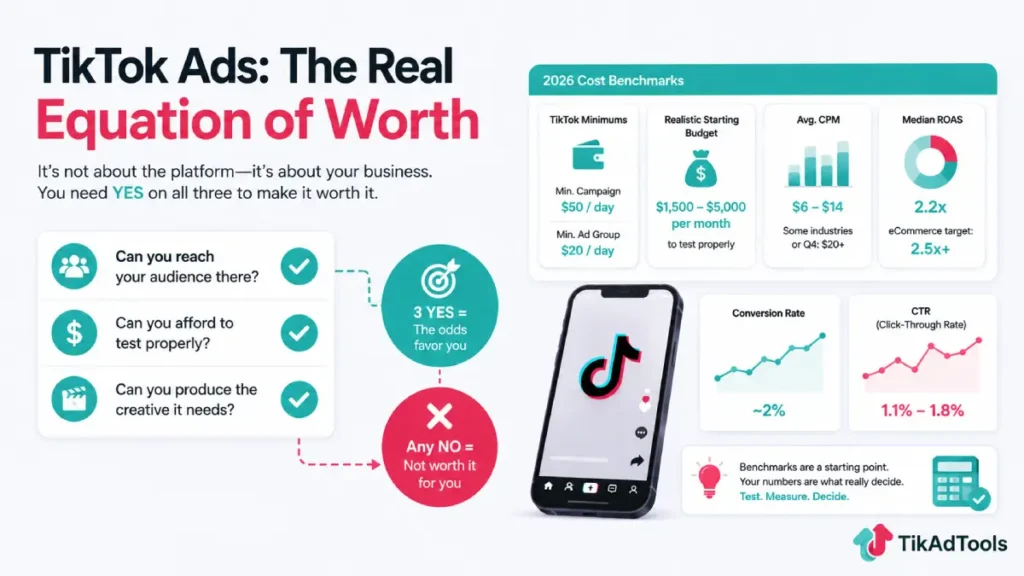
The spread between these numbers is real, not a rounding error. Ad cost data is self-reported by different platforms tracking different advertiser samples, so treat any single number as a rough anchor, not a guarantee. This is exactly why running your own numbers through a calculator built for your specific budget and product matters more than memorizing an industry average.
Run your own numbers before you decide
TikAdTools’ free Ad Cost, Ad Budget, ROAS, and ROI calculators model your actual campaign numbers before you spend anything, instead of relying on an industry-wide average.
This is the part most “is it worth it” articles skip. The Ad Cost Calculator estimates what your specific budget actually buys in reach and clicks. The Ad Budget Planner figures out how to split a monthly budget across campaigns and the testing phase. The ROAS Calculator works out what return you’d need to hit to make your specific product or margin worth it. The ROI Calculator shows the full picture once creative production costs are factored in, not just ad spend.
Running your product’s actual margin and price point through these takes a few minutes and gives you a far more useful answer than any industry-wide “yes, it’s worth it” verdict, including this article’s.
Who TikTok ads are genuinely worth it for
TikTok ads work best for visually interesting physical products sold to an 18-35 audience that makes fast, lower-consideration purchase decisions.
You’re in a strong position if:
- You sell a physical, visually interesting product. Beauty, apparel, gadgets, home goods, and food all perform well because the format rewards products that are satisfying to watch.
- Your audience skews 18-35. This is TikTok’s core demographic and where targeting is most efficient.
- Your customers make relatively fast, lower-consideration purchase decisions. Impulse-friendly price points convert better than long sales cycles.
- You can produce or commission short, native-feeling video regularly. TikTok creative fatigues fast, often within a week or two, so this isn’t a one-and-done format.
If you’re also weighing this against a broader-reach platform, TikTok Ads vs Facebook Ads breaks down where each one wins on audience, targeting depth, and retargeting.
Who should wait
TikTok ads are a weaker starting point for pure B2B businesses, older-skewing audiences, and any business that can’t produce ongoing video creative.
Being honest about this matters more than selling you on the platform. If your customers already search for what you sell, TikTok Ads vs Google Ads covers why capturing existing demand often fits Google better than creating new demand on TikTok.
TikTok ads are a weaker starting point if:
- You’re a pure B2B business with a long, multi-stakeholder sales cycle. TikTok can still build awareness, but it’s rarely where a B2B deal closes.
- Your core customer base skews meaningfully older than TikTok’s core user base.
- You have no realistic way to produce ongoing video content. A single polished ad won’t sustain a campaign here the way it might on other platforms.
- Your margins are thin enough that even the low end of the CPM range above doesn’t leave room for a testing phase.
If two or more of these describe your business, it’s worth testing a smaller budget first rather than committing to the $1,500-5,000/month range mentioned earlier.
Is TikTok Ads Manager itself worth learning?
Yes. TikTok Ads Manager is free to set up and follows a familiar campaign structure; the real learning curve is creative strategy and targeting, not the interface.
This is a different question from “is advertising on TikTok worth it,and it deserves its own answer. The interface follows a familiar campaign-then-ad-group-then-ad structure if you’ve used Meta or Google Ads before. The learning curve is mostly about the platform’s creative expectations (native-feeling, fast-paced video), not the software itself.
Where it takes real time to learn: audience targeting through TikTok’s interest categories, understanding the learning phase and why performance looks unstable in the first week, and setting up the Pixel correctly for conversion tracking. None of that is difficult, but it isn’t instant either.
Budget a real afternoon to get comfortable with the Ads Manager dashboard before your first campaign goes live, not just the ten minutes it takes to click through account setup.
The real cost most people miss
Ad spend is only part of the budget; TikTok’s fast creative fatigue means ongoing video production cost is often the bigger, less obvious expense.
Because TikTok creative fatigues quickly, a sustainable campaign needs a steady stream of new video, not one ad running for months. Factor the time or cost of producing that content into your decision, not just the media spend from the calculators above. For a full breakdown of platform costs beyond the benchmarks above, see TikTok Ads Cost in 2026.
How to actually find out if it’s worth it for your business
Check your ad-credit eligibility, run your numbers through the ROAS and ROI calculators, plan your budget, then launch your first test with a lower upfront cost.
- Check your eligibility for TikTok’s new-advertiser ad credit with the Ad Credit Eligibility Checker. New accounts can currently get up to $6,000 in matched ad credit, which directly changes the math on a first test. Full details: TikTok Ads Credit guide.
- Run your product’s numbers through the ROAS and ROI calculators linked above, using the cost benchmarks above as your starting assumptions.
- Use the Ad Budget Planner linked above to map out a realistic first-month budget, factoring in creative production, not just ad spend.
- If the numbers hold up, claim your ad credit and create your account to start your first test with a lower upfront cost.
If a limited budget is the main constraint, the best ad platform for a small budget compares TikTok’s real minimums against Facebook and Google’s, and which ad platform is right for your business walks through the full decision framework if TikTok alone doesn’t settle it.
Frequently asked questions
Are TikTok ads worth it in 2026?
Yes, for most businesses selling a visually engaging physical product to an 18-35 audience, provided you can sustain a real testing budget (typically $1,500-5,000/month) and produce ongoing creative. For pure B2B, older demographics, or businesses without video capacity, it’s a weaker starting point. Run your own numbers through the calculators above rather than relying on a generic answer.
Is TikTok Ads Manager worth learning?
Yes, and it’s less difficult than people expect if you’ve used another ad platform before. The account is free to create, and the campaign structure is familiar. The real learning curve is in creative strategy and audience targeting, not the software interface itself.
What’s a good ROAS for TikTok ads?
Around 2.21x platform-wide, per Triple Whale’s 2025 full-year data, with 2.5x or better commonly cited as a solid target for eCommerce specifically. Benchmarks vary by source and industry though, so use the ROAS Calculator linked above to see what ROAS you’d actually need to hit for your product’s margin.
How much budget do I need to find out if TikTok ads are worth it for me?
Plan on $1,500 to $5,000 a month for a realistic testing budget, per most 2026 cost guides, well above TikTok’s bare $50/day platform minimum, which is rarely enough to gather useful data. The Ad Budget Planner linked above can help you size this to your actual situation.
Is TikTok worth it for small businesses specifically?
Often, yes, especially for small businesses selling visually interesting products, since TikTok’s cost per impression tends to be more accessible than more saturated platforms. The same conditions apply though: you need a real testing budget and a way to produce creative regularly. Claiming the new-advertiser ad credit mentioned above can meaningfully lower the cost of that first test.
Conclusion
TikTok ads are worth it for a specific, identifiable type of business, not for every business equally. Rather than take this article’s word for it, or anyone else’s, run your actual numbers through the calculators above. If they hold up, claiming your ad credit before you create your account is the single highest-leverage step you can take to lower the cost of finding out.
Sources