
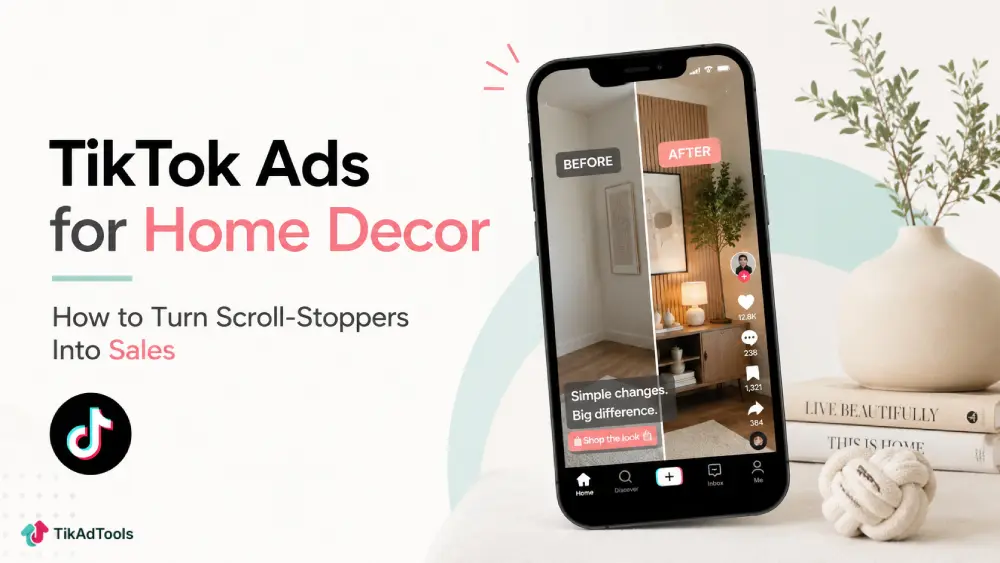
A room transformation. A before-and-after reveal. A product you didn’t know you needed until you watched someone use it for twelve seconds.
This is how home decor sells on TikTok, and it’s why brands in this category are pulling results that traditional paid channels can’t touch.
This guide breaks down exactly how to run TikTok ads for home decor, what content formats work, and what a real-world campaign actually looks like when it’s done right.
Table of Contents
Get Up to $6,000 in Free TikTok Ad Credits
TikTok offers ad credit incentives for new advertisers, helping you test campaigns with a lower upfront cost.
Key takeaways
- 33% of TikTok users who are aware of TikTok Shop say they would purchase home decor through the platform; the buying intent is already built in.
- Transformation content, before-and-afters, room reveals, and product-in-use videos consistently outperform static or purely promotional creative in the home decor category.
- Spark Ads built from creator content are the highest-performing ad format for home decor brands because they feel like recommendations, not ads.
- 73% of furniture and home decor shoppers discover brands or products online, according to a Kantar Furniture Consumer Journey Study. TikTok is increasingly where that discovery starts.
- Dynamic Product Ads let home decor brands retarget catalog browsers automatically, making them ideal for high-SKU inventories.
Quick Answer
TikTok ads work for home decor brands by combining visual transformation content with precise interest targeting and creator amplification. The best formats are Spark Ads using genuine creator room reveals, In-Feed Ads with a strong visual hook showing the product in context, and Dynamic Product Ads for retargeting shoppers who’ve already browsed your catalog. Start with $30–$50 per day, test three creatives, and scale the one that earns the highest hook rate and view-through.
Why #HomeTok is a buying channel, not just an inspiration feed
TikTok’s home decor community, known as #HomeTok, has grown from a niche corner of the platform into one of its most commercially active spaces.
Users don’t just watch room makeovers for fun. They save products, follow links, and buy things they saw in someone’s living room ten minutes ago.
TikTok describes itself as where home-buying decisions actually happen, shoppers are finding design ideas, product reviews, and decor tips in real time, and often from people who look just like them.
That peer-level trust is what sets TikTok apart from Pinterest or Google Shopping. It’s not aspirational imagery; it’s someone in a real apartment showing you how they did it.
For home decor brands, this means your ad doesn’t need a massive production budget. It needs a real room, a real transformation, and content that makes someone think, I could do that.
The 3 ad formats that work best for home decor
Spark Ads: turn creator content into your best-performing ad
Spark Ads let you put paid distribution behind an existing organic TikTok, your own post, or a creator’s.
For home decor, this is the most powerful format because the content looks native. It blends into the feed the way a friend’s room reveal would.
The strongest approach is partnering with home decor creators who already have an engaged following in your niche.
Let them style your product authentically in their own space, then amplify that content as a Spark Ad. The creator’s voice carries the weight, your budget carries the reach.
For a full breakdown of how Spark Ads work and how to set them up, the TikTok Spark Ads guide covers the setup in detail.
In-Feed Ads: lead with the transformation
In-Feed Ads autoplay in the TikTok feed. For home decor, the hook must be visual and immediate. Don’t open with your brand name or a price point.
Open with the transformation, show the empty corner before, then cut to the finished, styled space.
The pattern interrupt here isn’t a crazy stunt. It’s a contrast. A blank, forgettable wall in the first frame, then a stunning accent piece or gallery wall two seconds later. That visual payoff stops the scroll every time.
Pair your visual hook with bold on-screen text that names either the problem (“Your bedroom looks boring”) or the result (“How I transformed my living room for under $150”). Sound-off viewers need that text layer to stay engaged.
For a deeper look at writing hooks that stop the scroll, the TikTok ads hooks guide covers the formats with the highest watch-through rates.
Dynamic Product Ads: retarget catalog browsers automatically
If your brand carries multiple SKUs, furniture, textiles, lighting, and accent pieces, Dynamic Product Ads are worth setting up from the start.
They pull from your product catalog and automatically serve personalized ads to users who’ve already viewed or interacted with your products.
Someone who spent 30 seconds on your throw pillow page but didn’t buy can see that exact pillow, styled in a beautiful room, the next time they open TikTok. No manual ad creation required. The algorithm does the matching.
This pairs especially well with the TikTok retargeting ads strategy for re-engaging warm audiences who are close to converting.
What content actually sells home decor on TikTok
The content formats that drive the most conversions in this category share one thing: they show the product living in a real space, solving a real problem.
The most consistent performers:
- Room transformations, before-and-after videos with a clear narrative arc. Show the problem (dated, cluttered, or bare space), then the solution.
- “I bought this and here’s what it looks like in my actual home.” Raw, phone-filmed reactions outperform polished lookbooks every time.
- Styling tutorials show three ways to use the same product in different room types. This increases perceived value and widens the relevant audience.
- Product close-ups in motion, fabric texture, ceramic finish, and the way a light fixture catches the light. Home decor is tactile; motion video approximates that feeling better than any static image.
TikTok notes that today’s design trends aren’t set by professionals; they’re discovered through content shared by everyday users.
Audiences favor real homes, lived-in looks, and creative solutions over curated perfection. That’s your brief. Ditch the staging and show real rooms.
Real-world case study: Dremel Blueprint
When Dremel launched its Blueprint line of compact DIY tools in January 2025, it faced a challenge familiar to many home improvement brands: it needed to reach a new audience, renters, beginners, and women who’d never considered power tools part of their lifestyle.
Rather than running traditional product ads, Dremel partnered with TikTok creators already embedded in the DIY home decor space.
The creators showed real projects, shelving units, accent walls, furniture refinishing, and using Blueprint tools in their own homes.
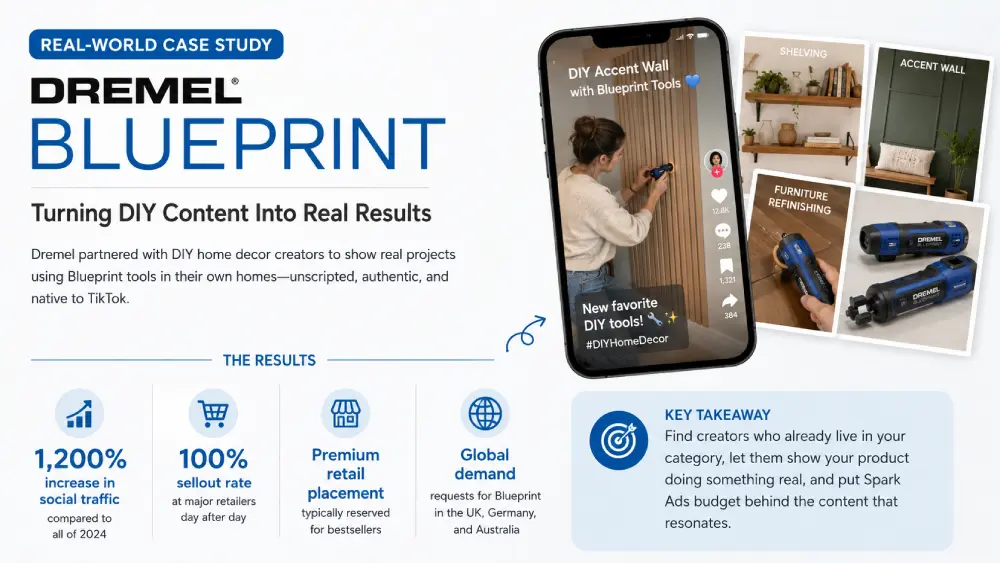
The content was unscripted, phone-friendly, and completely native to how TikTok content already looked in the #DIYHomeDecor community.
The campaign produced a 1,200% increase in social traffic compared to all of 2024, a 100% sellout rate at major retailers day after day, and premium retail placement typically reserved for established bestsellers.
International audiences began commenting and requesting Blueprint availability in the UK, Germany, and Australia.
The key was creator selection. Dremel worked with creators who were already associated with DIY keywords and home improvement content, not just anyone with a large following. Authenticity drove the conversion, not celebrity reach. (source)
The takeaway for home decor brands of any size: find creators who already live in your category, let them show your product doing something real, and put Spark Ads budget behind the content that resonates.
Targeting strategy for home decor brands
TikTok’s targeting options for home decor are genuinely strong.
Start by layering:
- Interest targeting: home decor, interior design, DIY, home improvement, furniture
- Behavioral targeting: users who engage with home content, follow home creators, or have interacted with similar products
- Lookalike audiences: built from your customer list or pixel-tracked website visitors
- TikTok Shop browsing behavior: if you’re selling via TikTok Shop, target users who’ve browsed similar product categories
Keep your audience wide enough for the algorithm to optimize. Over-constraining targeting is one of the most common mistakes home decor brands make when starting out on the platform.
For the full breakdown of how to structure your targeting without narrowing your reach too much, the TikTok ads targeting guide covers every layer.
If you’re running an ecommerce store, integrating your product feed with TikTok Ads is straightforward via Shopify. It connects your catalog directly and powers Dynamic Product Ads without manual setup.
Budget guidance
Start with $30–$50 per day. Run three creative variations, same product, different hooks, for seven to ten days.
Track hook rate (two-second views) and view-through rate. Pause anything under 20% hook rate and rebuild the opening. Once you have a clear winner, scale gradually and rotate new creatives before fatigue sets in.
Home decor is a visually competitive category on TikTok. Creative refresh matters more here than in most niches; your audience sees a lot of content every day. Plan to introduce new creatives every two to three weeks to keep performance stable.
New to TikTok Ads Manager? Claim your TikTok ad credit to reduce your initial testing cost and get your first campaign live.
FAQs
Do TikTok ads work for home decor brands?
Yes, home decor is one of TikTok’s strongest-performing product categories. The platform’s visual format is a natural fit for transformational content, and the #HomeTok community has strong purchase intent. According to YouGov’s 2024 TikTok report, 33% of TikTok users aware of TikTok Shop say they’d buy home decor through the platform.
What type of content performs best for home decor on TikTok?
Before-and-after room transformations, creator-led product styling videos, and raw “here’s what it looks like in my actual home” reviews consistently outperform polished, studio-produced content. Authenticity and a real space matter more than production quality.
What is the best TikTok ad format for home decor?
Spark Ads built from genuine creator content deliver the best results because they look organic in the feed. For retargeting browsers who haven’t converted yet, Dynamic Product Ads are the most efficient format for brands with a wide product catalog.
How much should a home decor brand spend on TikTok ads?
Start with $30–$50 per day during a 7–10 day testing phase. This gives TikTok’s algorithm enough data to optimize delivery without committing significant spend before you’ve identified which creative works.
How do I target the right audience for home decor on TikTok?
Layer interest targeting (home decor, DIY, interior design) with behavioral signals and a lookalike audience built from existing customers. Avoid over-constraining your audience; give the algorithm room to find buyers by keeping targeting broad enough to allow optimization.
Can small home decor brands compete with large ones on TikTok?
Absolutely. TikTok’s algorithm rewards content performance, not brand size. A small brand with an authentic creator partnership and a compelling room transformation can outperform a well-funded competitor running polished, over-produced ads. Dremel’s Blueprint launch, reaching audiences who’d never bought power tools before, proves the model works at any scale.
Conclusion
Home decor sells itself on TikTok, if you let it. The platform’s users already want what you’re selling. They’re watching room reveals for hours, saving products to wishlists, and clicking links from creators they trust.
Your job isn’t to interrupt that behavior. It’s to become part of it. Lead with transformation. Work with creators who already live in your niche. Put a budget behind what the data tells you is working.
Whether you’re a solo Etsy seller or a growing furniture brand, the playbook is the same: show a real space, a real product, and a real result.
Start your first home decor campaign and put your products in front of the buyers already looking for them.