
DIY content already wins on TikTok. The hard part is turning that organic momentum into paid results.
Running TikTok ads for DIY products should be the easy mode of advertising, since the audience is already there to watch people build things. Most accounts still get it wrong.
The product isn’t the problem. The setup is.
Table of Contents
Get Up to $6,000 in Free TikTok Ad Credits
TikTok offers ad credit incentives for new advertisers, helping you test campaigns with a lower upfront cost.
TL;DR
- DIY products convert when the ad shows the build, not the finished result.
- Start at 20 to 30 dollars per day per ad group and give each test a full week.
- Native, hands-on UGC beats polished studio footage almost every time.
Quick Answer
TikTok ads for DIY products work best when the creative looks like a real project video, not a commercial, because people are already on the platform to watch others make things. Lead with the process, keep budgets steady throughout the learning phase, and target by behavior and interest rather than age or gender.
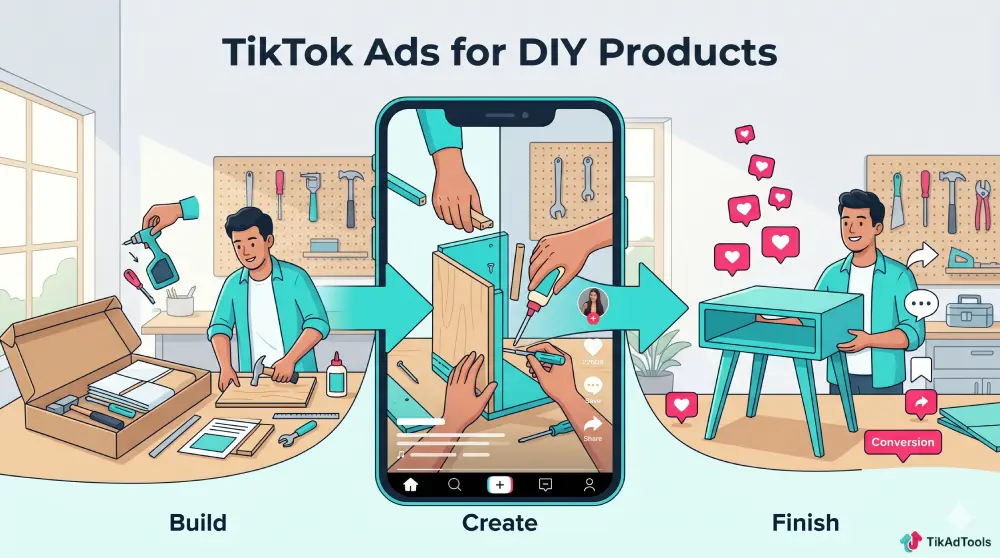
Why DIY products sell so well on TikTok
DIY thrives here because the platform rewards watch time, and a good build keeps people watching to the end.
A satisfying transformation is hard to scroll past. That’s free attention most product categories have to fight for.
The reach backs it up. TikTok ads reached 1.9 billion users, according to Statista. Your DIY buyer is somewhere in that pool, already saving project videos and looking for the next thing to make.
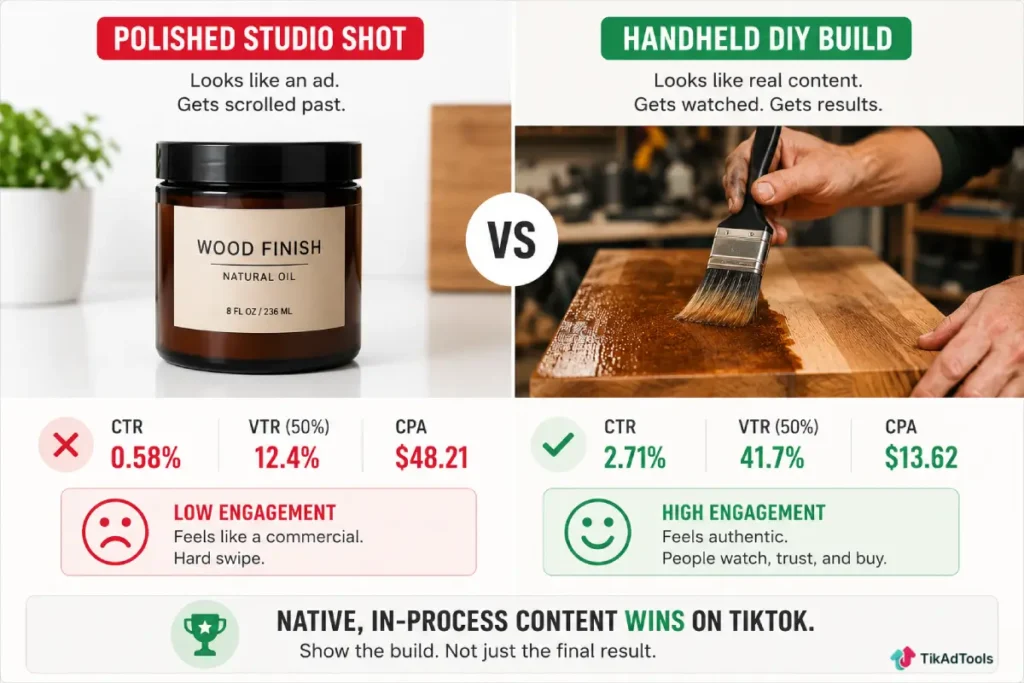
The catch is the format. A glossy product shot dies on the For You page. The brands winning with UGC-style ads film the messy middle of the project, not just the clean reveal at the end.
What kind of DIY ad creative actually converts
Show the build, not the box. The ads that convert open mid-project, with hands already working. Nobody stops scrolling for a logo on a white background.
Your first two seconds decide everything. Open on the most satisfying moment: the pour, the first cut, the color change, then earn the rest of the watch. Weak hooks are the number one reason DIY ads stall before they spend.
Keep the editing simple and native. A free editor like CapCut handles almost everything you need, and the rough handheld look actually outperforms studio polish in this niche. People trust a video that looks like they could’ve shot it themselves.
Voiceover beats text-only too. Talk through the steps like you’re showing a friend across the table. It builds trust and keeps the project feeling real instead of staged.
One more thing. Always show the result, but don’t lead with it. The payoff lands harder when people watched you get there.
How much should you budget for TikTok DIY Ads?
Start at 20 to 30 dollars per day per ad group. That’s enough to feed the algorithm signal without draining your account while you figure out what works.
Give every test a full week before you touch it. The learning phase needs roughly 50 conversions to stabilize, and DIY products often carry a longer consideration window than a quick impulse buy. Kill a campaign on day two, and you’ve thrown away data you already paid for.
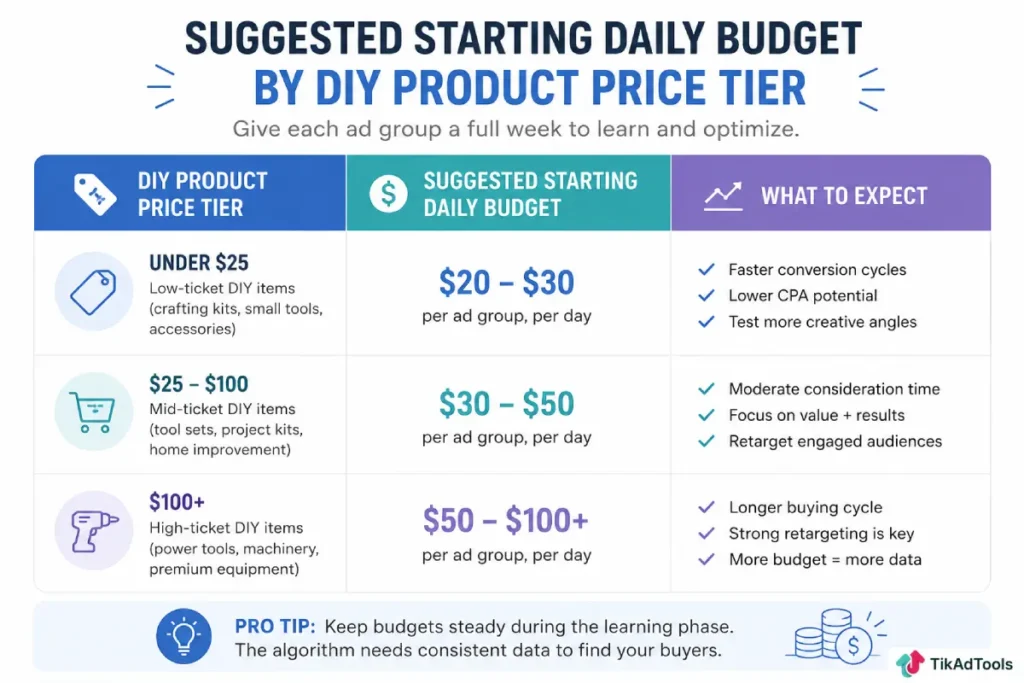
Plan spend around your margins, not a vanity number. A 40-dollar candle kit and a 400-dollar power tool need completely different budgets and patience. Public TikTok ad cost benchmarks are a useful floor, but your unit economics set the ceiling.
New to the platform? Grab any available TikTok ad credit before your first campaign so early testing costs less out of pocket.
Targeting DIY buyers without wasting spend
DIY is a behavior, not an age group. A 22-year-old making resin coasters and a 55-year-old building a deck both want what you sell. Target by age alone and you waste spend on both ends of that range.
Start broad and let the algorithm find buyers. TikTok’s system is good at this once you feed it real conversion data. Layer interests like home improvement, crafting, or woodworking only to nudge it, not to box it in.
Retargeting is where DIY budgets earn their keep. Anyone who watched half your video or more showed real intent. Build a custom audience from that group and serve them a tighter, product-focused follow-up.
Don’t over-segment early. Splitting a small budget across ten micro-audiences starves every one of them. Get one ad group profitable first, then split.
Common mistakes DIY brands make
The biggest mistake is judging ads too early. DIY has a slower buying cycle than fashion or food, and pulling the plug on day two means you never gave the data a chance.
The second is riding one creative until it dies. DIY audiences burn through content fast, especially when the same build keeps showing up. Rotate three to five videos at a time and refresh weekly.
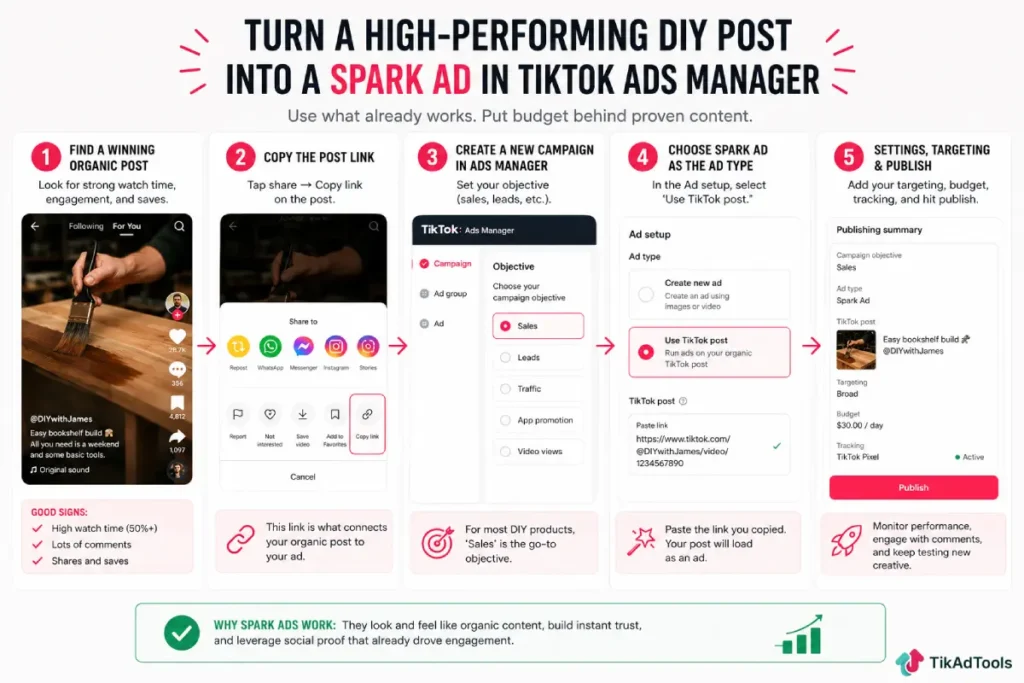
The third is ignoring your own organic wins. If a regular post takes off, run it as a Spark Ad instead of building something from scratch. The proof of concept already exists, so put money behind it.
The fourth is treating comments as noise. DIY viewers ask process questions constantly. Answer them, and use the most common ones as your next ad’s hook.
FAQs
Do DIY ads need professional video production?
No. Native, phone-shot footage usually beats studio work in this niche because it matches what people already watch on TikTok. A clear hook, steady hands, and decent lighting matter far more than a fancy camera. Save the production budget for more creative volume instead.
What’s the best ad format for DIY products?
In-feed ads and Spark Ads carry most DIY campaigns. In-feed slots into the For You page like organic content, and Spark Ads let you promote a post that’s already proven it can hold attention. Both keep the native feel that DIY buyers respond to.
How long should a DIY TikTok ad be?
Aim for 21 to 34 seconds for most builds. That’s long enough to show a satisfying start-to-finish project and short enough to keep completion rates high. If a project genuinely needs more time, speed up the slow middle and slow down the payoff.
Can small DIY brands compete with big ones?
Yes, and authenticity is the edge. A founder filming a real build in a garage often outperforms a polished brand video, because it reads as honest. Smaller brands also move faster on trends, which matters more than budget on TikTok.
Is TikTok Shop or my own store better for DIY products?
Both work, and many brands run them together. TikTok Shop shortens the path to purchase and suits lower-priced kits, while a Shopify store gives you more control over branding and upsells for higher-ticket tools. A common setup sends cold traffic to Shop and warmer, retargeted traffic to your own site.
Final thoughts
DIY products are built for this platform. Show the work, fund the test long enough to actually learn something, and let the algorithm find your buyers instead of guessing at demographics. Get those three right and everything after is just iteration.