
Most TikTok ads get skipped in under two seconds. Not because the product is bad, but because the ad looks like an ad.
That is the core problem with traditional paid creative on TikTok. The platform was built for raw, real, unpolished content. When you drop a studio-produced spot into that feed, users feel it immediately, and they scroll past it. UGC is one of the clearest wins available in TikTok ads creative right now.
UGC TikTok ads fix this by matching the native feel of the platform. Real people, real reactions, real language. And the performance data backs it up.
In this guide, you will learn exactly what UGC ads on TikTok are, why they outperform branded creative, how to source and brief creators, and how to build a campaign that actually converts.
Whether you are running your first TikTok ad or trying to fix a creative that is not performing, this is the complete playbook.
Table of Contents
Get Up to $6,000 in Free TikTok Ad Credits
TikTok offers ad credit incentives for new advertisers, helping you test campaigns with a lower upfront cost.
Key Takeaways
- UGC ads work because they match the platform’s native, unpolished feel; a studio-produced spot reads as an ad within the first two seconds and gets scrolled past.
- UGC can run as boosted Spark Ads from a real creator’s account or as a dark post from the brand’s own ad account, and that choice affects both cost and creative control.
- Results depend more on how real the content feels than on production budget; a well-briefed creator usually beats a polished agency edit.
- Sourcing the right creator matters more than the script itself; briefs should give direction, not a word-for-word read.
- Treat UGC as an ongoing supply, not a one-off shoot, since even a winning ad needs fresh variants behind it before it fatigues.
Quick Answer
UGC TikTok ads are paid ads built from real creator or customer content instead of studio production, and they typically outperform branded creative because they match how organic TikTok content looks and sounds. You can run them as Spark Ads boosted from a creator’s account or as dark posts from your brand’s ad account, and which format wins usually comes down to how native, not how polished, the footage feels.
What are UGC TikTok Ads?
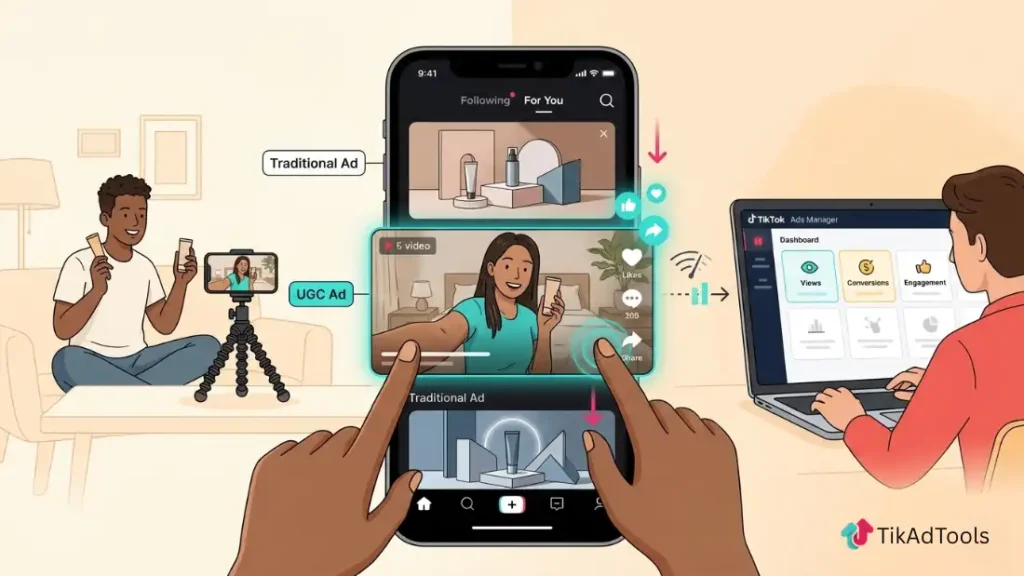
UGC TikTok ads are paid advertisements that use content created by real users or creators, rather than a brand’s internal production team. The video feels organic and native to the platform, which increases trust and watch time. These ads can run as Spark Ads (boosted from a real creator account) or as dark posts (run from the brand’s ad account). Results vary based on product category, audience, and creative quality.
Why UGC ads outperform traditional TikTok creatives
Traditional branded video ads struggle on TikTok for one specific reason: the platform’s audience has trained itself to detect and skip anything that feels promotional. UGC-style content bypasses that reflex because it looks exactly like what users already watch.
The data behind the 4x CTR advantage
According to the TikTok Marketing Science Global Retail Path to Purchase Study, conducted by Material, TikTok users are 1.5x more likely to immediately go out and purchase something they discovered on the platform compared to users on other platforms. The study also found that TikTok leads competing platforms at every stage of the retail journey, from discovery through to post-purchase engagement.
Nielsen’s Trust in Advertising Study, which surveyed more than 40,000 consumers across 56 countries, found that 88% of consumers trust recommendations from people they know above all other advertising channels.
UGC taps directly into that trust mechanism. When someone who looks like your target customer explains why they bought your product, it carries more weight than any brand-written script.
Generated 19K likes and achieved a 24% CTR (Source: TikTok Top Ads Spotlight)
Generated 181K likes with a achieved a 36% CTR (Source: TikTok Top Ads Spotlight)
We consistently see this play out in ad account data: brands switching from studio-produced video to UGC creative report CTR improvements of 2x to 4x, particularly in the DTC, beauty, and fitness verticals.
Why TikTok’s algorithm rewards UGC-style content
TikTok’s algorithm measures video completion rate and engagement to decide whether to push a video to more users. UGC-style content earns higher completion rates because it does not pattern-match to what people mentally label as an ad.
According to TikTok For Business creative guidelines, the platform explicitly recommends content that feels “native, authentic, and community-driven.” Ads that follow this principle receive better delivery at lower CPMs.
The result: you spend less to reach more people, and more of those people actually watch the whole ad.
Types of UGC TikTok Ads (and when to use each)
Not all UGC TikTok ads are the same format. Choosing the right type for your goal makes a significant difference in how your campaign performs.
Spark Ads vs. Dark Ads: which one should you run?
Spark Ads vs. Dark Ads is one of the most common questions we see from brands running UGC on TikTok, and the answer depends on your goal.
| Format | What It Is | Best Use Case |
|---|---|---|
| Spark Ads | Boosted posts run from a creator’s real TikTok account | Building trust, social proof, and comment visibility |
| Dark Posts | Ads run from your brand’s ad account, no public post | Testing creative variations, scaling fast |
| Whitelisted UGC | Creator grants ad access, brand runs the ad | Best of both: creator authenticity + brand control |
Use Spark Ads when you want the social proof of comments and likes to work in your favor. A video showing 4,200 comments and 80,000 likes reads as validated to a cold audience.
Use dark posts when you are testing multiple creative hooks and do not want messy comment sections splitting your signal.
Whitelisted UGC is the format we recommend for most scaling brands. You get the creator’s handle and credibility, full creative control, and the ability to run it as a standard TikTok ad.
Testimonials, unboxings, and problem-solution formats
These are the three creative formats that consistently perform across industries:
- Testimonials: A creator speaks directly to the camera about a result they got using your product. Works best for beauty, supplements, and SaaS.
- Unboxings: Authentic first-reaction videos showing your product being opened. Works best for DTC physical goods, accessories, and gifts.
- Problem-Solution: The creator opens with a relatable frustration, then presents your product as the fix. Works in nearly every category.
Start with the problem-solution format if you are new to UGC TikTok marketing. It maps directly to how purchase decisions happen: the viewer recognizes their problem, sees the solution, and clicks through.
How to source UGC content for TikTok Ads
You have two paths for sourcing UGC for TikTok ads, and most brands that scale use both.
Path 1: Organic creators already talking about your brand. Search your brand name and product category on TikTok. If users are already posting content, those videos are your highest-trust UGC asset. You can reach out to those creators directly and request permission to run the content as a paid ad, or set up a formal whitelisting agreement.
Path 2: Paid UGC creators. These are freelance creators who produce ad-ready content in a UGC style for a fee. You can find them on platforms like Billo, Insense, and Fiverr. Rates vary widely: $50 to $150 per video for newer creators, $300 to $800 or more for experienced UGC creators with a proven track record in performance advertising.
When choosing paid UGC creators, prioritize content style over follower count. You are not paying for their audience. You are paying for their ability to make a video that feels native on TikTok. Review their past work and look specifically at hooks, pacing, and how they hold attention in the first three seconds.
For your first campaign, order three to five videos from different creators with different hooks. You will not know which one performs until you test it. The TikTok UGC finder can shortlist creators who already fit your product category from either path.
How to brief a UGC creator for high-converting ads
A good brief gives your creator everything they need and nothing that suffocates them. This is where most brands fail. They either send nothing or send a 10-page document that kills authenticity.
The loose script framework: hook, sell, CTA
Give every creator this three-part structure, but do not write their lines for them.
- Hook (0-3 seconds): Open with a bold statement, a surprising result, or a direct address to the viewer’s problem. Example direction: “Start the video mid-action. Say something that makes someone stop scrolling.”
- Sell (3-25 seconds): Explain the product in natural, conversational language. Cover one or two specific benefits. Show the product being used, not just talked about.
- CTA (last 3-5 seconds): Direct verbal call to action. Tell the viewer exactly what to do next. Example: “Click the link and use code [X] for 15% off.”
Giving creative freedom without losing brand control
Your brief should specify what the creator must include and what they must avoid. Nothing more.
Must include:
- Product name (spoken at least once)
- Key benefit you want highlighted (pick one)
- Verbal CTA with your offer
Must avoid:
- Competitor mentions
- Claims you cannot substantiate
- Specific pricing unless pre-approved
Do not write a script. Do not dictate transitions or music choices. The creator knows what sounds real on TikTok. Your job is to point them at the right target, then get out of the way.
The anatomy of a high-performing UGC TikTok ad
When we look at the structure of UGC ads that consistently hit a sub-$20 CPA, a clear pattern emerges. Every element earns its place, and nothing is accidental.
The first 3 seconds: why the hook decides everything
According to TikTok For Business creative best practices, 90% of an ad’s recall impact is captured within the first six seconds, and the first three seconds are critical for determining whether a viewer keeps watching or scrolls away. If your hook fails, your entire ad budget is wasted.
The strongest hooks fall into these categories:
- Bold result statement: “I lost 12 pounds in 6 weeks using this one thing.”
- Direct call-out: “If you have dry skin, stop what you are doing.”
- Visual pattern interrupt: Starting mid-action, showing an unexpected image, or using on-screen text that creates a gap the viewer wants to close.
Test at least three different hooks on every piece of UGC creative you produce. The body of the ad matters much less than most people think. In many cases, swapping just the first three seconds of a video can double your CTR.
Editing UGC footage for direct-response performance
Raw creator footage almost always needs light editing before it is ad-ready. Here is what to focus on:
- Add captions: according to TikTok For Business research, the presence of captions in ads leads to a +58% uplift in recall, a 95% increase in brand affinity, and a +31% improvement in likeability. Even on a sound-on platform, on-screen text reinforces the message and keeps viewers engaged.
- Cut any dead time: remove pauses, filler words, and any moment where the energy drops, and keep cuts tight.
- Place key benefit text on screen during the sell section. This reinforces the spoken message without overpowering the UGC feel.
- Use native TikTok fonts and text styles: avoid heavy motion graphics or lower thirds that scream “this is an ad.” Do not over-produce the edit. The rougher, native feel is what makes UGC ads work. Edit for clarity, not for polish.
How to launch your UGC TikTok ad campaign step by step
Follow this sequence when you are ready to go live with your first TikTok UGC ad campaign:
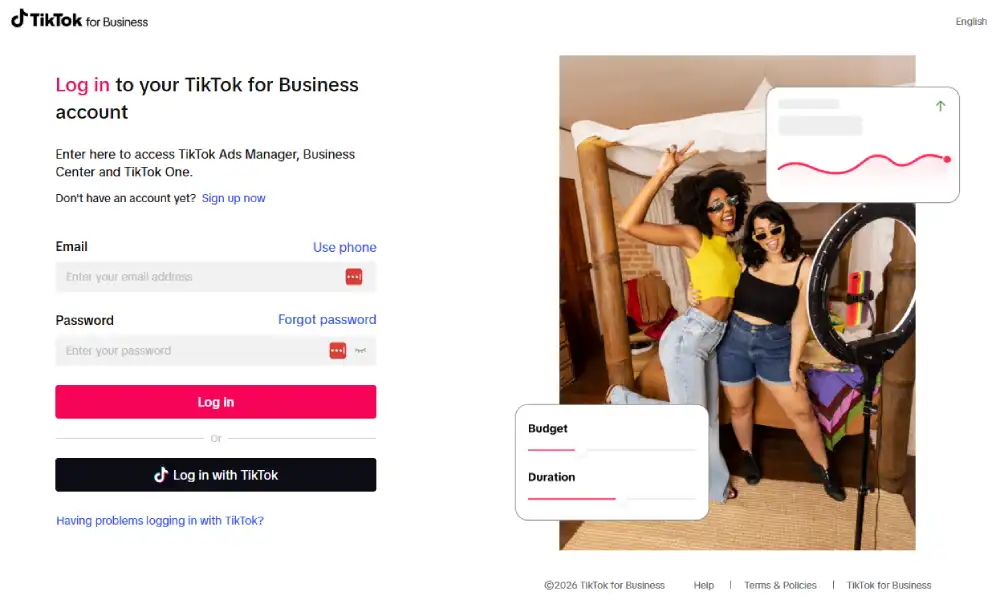
- Set up your TikTok Ads Manager account and connect your product catalog if you are running a DTC store.
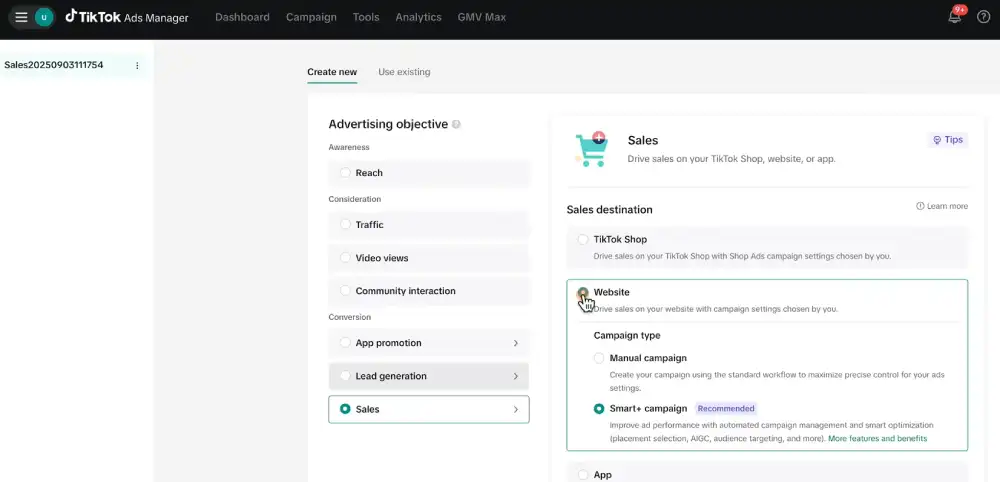
- Choose your campaign objective. For most UGC ads, use “Website Conversions” if you want purchases, or “Traffic” if you are building a retargeting pool.
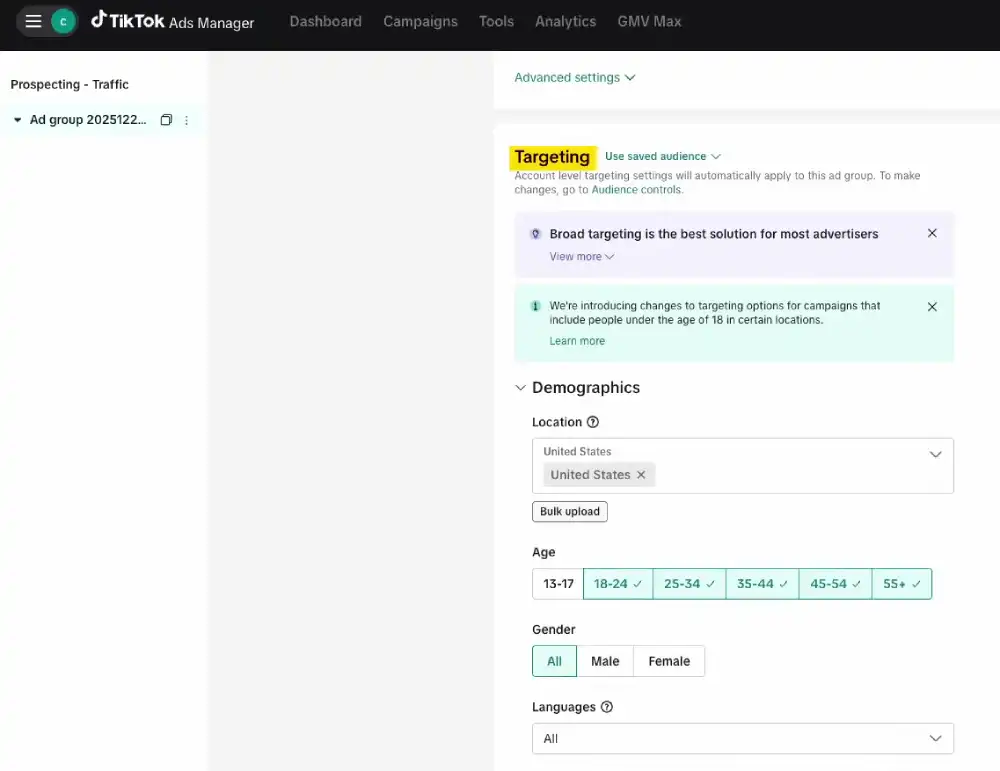
- Build your ad group. Set your audience targeting. For cold traffic, start broad and let TikTok’s algorithm find your buyers. Age, gender, and one or two interest categories are enough.
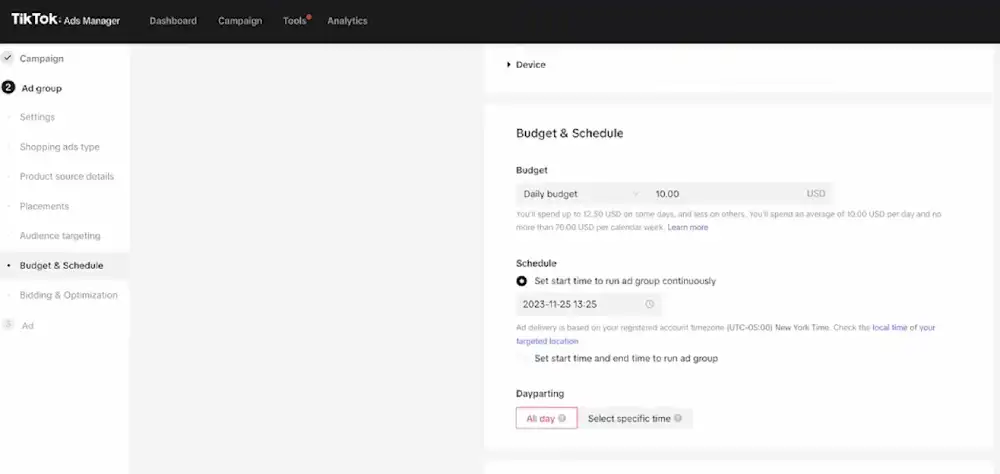
- Set your daily budget. Start with $50 to $100 per day per ad group. TikTok’s own learning phase documentation puts the exit point at roughly 7 days or 50 optimization events, whichever comes first, so give the campaign that long before you judge performance.
- Upload your UGC creatives. Load three to five different videos into the same ad group. TikTok will automatically allocate more spend to whichever creative performs best.
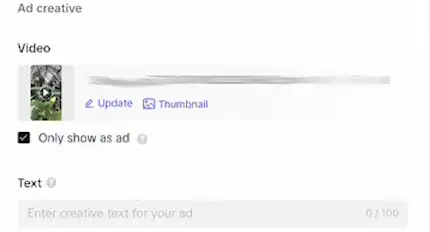
- Write your ad copy. Keep it short. One sentence that reinforces the hook. Your video does the heavy lifting.
- Set your landing page. Match the message on your landing page to the hook in your UGC video. Mismatched messaging kills conversions even when your ad performs well.
- Go live and monitor for the first 48 hours. Do not touch targeting or budget during the learning phase.
How to measure and scale what’s working
Once your campaign is live, you need to know which numbers to watch and when to act on them.
Key metrics: CTR, CPA, watch time, and hook rate
| Metric | What It Measures | Benchmark to Target |
|---|---|---|
| CTR (Click-Through Rate) | How many viewers click after watching | 1.5%+ signals strong UGC performance (platform average: 0.84%) |
| CPA (Cost Per Acquisition) | What you pay per conversion | Varies by product price point |
| Video Completion Rate | Percentage who watch to the end | 25-40% is strong for most ad lengths |
| Hook Rate | Percentage who watch past 3 seconds | 30%+ is a healthy benchmark |
Hook rate is the metric most advertisers overlook. It tells you whether your opening three seconds are doing their job. A low hook rate means your audience is bailing before they even hear your pitch. According to a multi-account analysis by Tuff Agency, the average hook rate across TikTok ad accounts is 30.7%, with top-quartile creatives reaching 40 to 45%.
When to kill a creative vs. swap the hook
This is a judgment call that trips up a lot of advertisers.
Here is a clean decision framework:
- Low hook rate, decent completion rate: Swap only the first three seconds. Keep the body of the ad.
- Good hook rate, low CTR: Your ad is watchable but not persuasive. Revise the CTA or the core benefit claim.
- High CPA after 50+ conversions: Kill the creative and replace it entirely. The audience is exhausted.
- Strong performance on all metrics: Scale slowly. Increase the daily budget by 20% every two days to avoid shocking the algorithm.
Do not make decisions on fewer than 1,000 impressions. The data is not statistically meaningful below that threshold.
Common UGC TikTok ad mistakes (and how to avoid them)
These are the patterns we see most often from brands that are spending money on TikTok UGC but not getting results:
- Choosing creators based on follower count: you are buying creative output, not an audience. A creator with 2,000 followers who knows how to hook a viewer is more valuable than a creator with 200,000 who cannot.
- Only testing one hook: one hook is not a creative strategy, it is a coin flip. Always test at least three variations before drawing conclusions.
- Over-scripting the creator: when you write every line, the creator becomes a spokesperson, and the ad loses the authenticity that makes UGC work. Give direction, not a script.
- Sending traffic to a generic homepage: your landing page must reflect the specific promise made in your ad. If your UGC ad promises a 30% discount, your landing page should show that offer immediately.
- Pulling the plug too early: TikTok’s algorithm needs time to find your buyers. Pausing or editing a campaign within the first 48 to 72 hours resets the learning phase and wastes your budget.
- Ignoring creative fatigue: TikTok audiences burn through creative faster than other platforms. If your best-performing ad starts to see CTR decline after two to three weeks, refresh the hook or replace the creative.
Is UGC TikTok marketing right for your brand?
UGC TikTok ads are not the right fit for every product or brand. Knowing where this approach works and where it does not will save you wasted budget and time.
UGC TikTok ads work well when:
- Your product has a visible result or transformation
- Your target audience is between 18 and 44 and active on TikTok
- You can explain the product’s benefit in under 30 seconds
- Your price point allows for direct-response conversion (typically under $150)
UGC TikTok ads are a harder fit when:
- Your product requires long consideration cycles (B2B software, complex financial products)
- Your target audience does not use TikTok regularly
- Your product cannot be shown in use on camera
- You need strict legal approval on every creative asset before it goes live
If your product fits the first category, TikTok UGC ads are one of the most cost-effective paid acquisition channels available right now. If it does not, you may get better ROI from a channel better suited to longer sales cycles.
FAQs
What is UGC on TikTok?
UGC on TikTok stands for user-generated content: videos made by real users or paid creators rather than a brand’s production team. On TikTok, UGC ads are designed to blend in with organic content on the For You Page. Brands use this format because it matches TikTok’s native style and earns higher trust from viewers.
How much do TikTok UGC creators cost?
Rates vary based on experience and deliverables. On platforms like Billo and Insense, you can expect to pay $50 to $150 per video for newer UGC creators and $300 to $800 or more for experienced creators with a performance track record. You do not pay for their audience reach. You are paying for the quality and credibility of the content itself.
Are UGC TikTok ads effective?
Yes, when executed correctly. According to the TikTok Marketing Science Global Retail Path to Purchase Study 2021, TikTok users are 1.5x more likely to purchase products they discover on the platform compared to other channels. Effectiveness depends on product category, hook quality, landing page alignment, and how much you test. UGC is not a shortcut. It is a creative strategy that requires iteration.
What is the difference between a Spark ad and a regular TikTok UGC ad?
A Spark Ad is boosted directly from a creator’s real TikTok account, which means the post’s organic engagement (likes, comments, shares) stays visible to everyone who sees the ad. A regular UGC ad runs as a dark post from your brand’s ad account with no public social proof. Spark Ads build credibility through visible engagement. Dark posts give you more testing flexibility and cleaner data.
How do you brief a UGC creator for TikTok ads?
Give your creator a three-part direction: a hook approach (not a script), the one key benefit to highlight, and a verbal CTA with your offer. Specify what must be included and what must be avoided. Do not write their lines for them. The goal is to point the creator in the right direction and let their natural delivery create the authenticity your ad needs.
How many UGC videos do you need to launch a TikTok ad campaign?
Start with three to five videos featuring different hooks. Testing multiple hooks from day one gives you real performance data quickly and reduces the risk of betting your entire budget on a single creative. Once you identify your top performer, you can scale that ad and use it as a benchmark for all future creative production.
Conclusion
The reason UGC TikTok ads work is not magic. It is a match. The format matches the platform’s culture, the algorithm’s preferences, and the viewer’s expectations. When your ad looks like the content someone was already watching, they watch it.
We covered a lot of ground here. You now understand why UGC outperforms traditional creative on TikTok, what formats to use, how to source and brief creators without losing authenticity, and how to build and measure a campaign that can actually scale.
The biggest thing holding most brands back is not budget or access to creators. It is the unwillingness to test enough. Three hooks, five creators, honest data, and a landing page that matches your promise. That is the entire formula.
Start small, test seriously, and scale what the data tells you to scale. That is how you build a UGC TikTok ad system that works beyond the first campaign.
Sources