
Your profile shouldn’t look like a billboard. That’s exactly why TikTok dark post ads exist. You can launch 20 creative variations to a cold audience this week, and not a single one appears on your public timeline.
Most advertisers call these TikTok dark ads or non-Spark ads. They’re built inside TikTok Ads Manager, they run in the For You feed, and they stay invisible to anyone who isn’t in your target audience.
The catch is that they behave differently from Spark Ads once they go live. Get that difference wrong, and you’ll either waste budget or muddy your test data.
Here’s how dark posts actually work, and when they beat the alternative. If you’re still new to TikTok ads generally, the TikTok Ads for Beginners guide covers the fundamentals first. Dark posts are a more advanced tactic once you have those basics down.
Table of Contents
Get Up to $6,000 in Free TikTok Ad Credits
TikTok offers ad credit incentives for new advertisers, helping you test campaigns with a lower upfront cost.
TL;DR
- A dark post is a non-Spark TikTok ad that runs in-feed but never lands on your profile.
- TikTok’s own data shows Spark Ads beat non-Spark on engagement (+142%), completion rate (+30%), and conversion rate (+43%).
- Run dark posts when you need creative control, clean A/B tests, or you have no organic content worth boosting.
Quick Answer
A dark post TikTok campaign is an ad built inside TikTok Ads Manager that runs in the For You feed but never appears on your public profile. It’s the same thing as a non-Spark ad. You get full creative control and clean testing, but you skip the inherited likes and comments that Spark Ads carry over from an existing organic post.
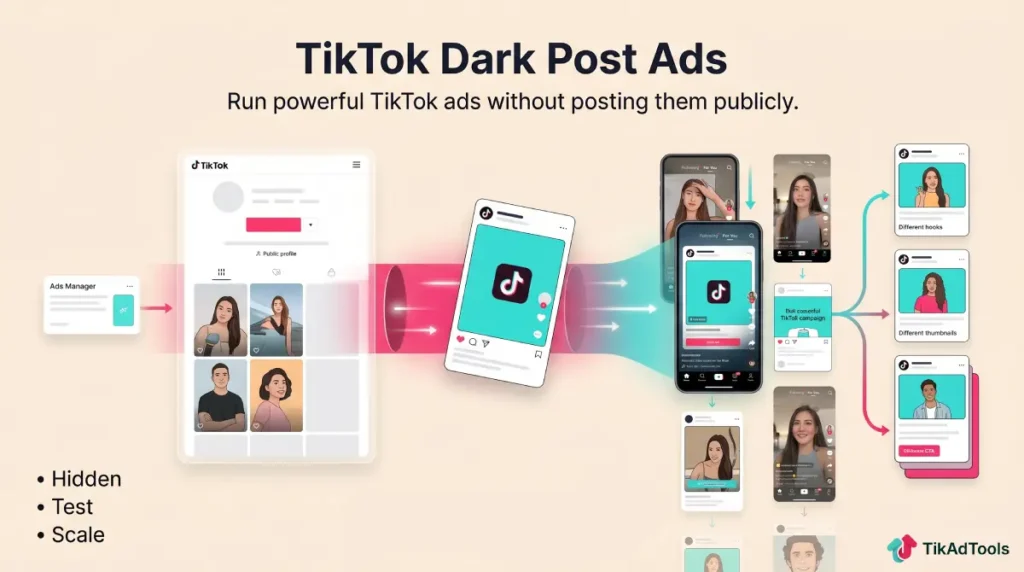
What is a TikTok dark post?
If you’re wondering what a TikTok dark post is, it’s simply a non-Spark ad created inside TikTok Ads Manager that appears only to your selected audience instead of on your public profile.
A dark post is an ad that exists only in the auction, not on your timeline. You build the video in Ads Manager and serve it only to the people you target. No follower of yours sees it in their feed unless they match your audience.
For years, advertisers did this with Custom Identity, a standalone display name and logo set inside Ads Manager.
TikTok is retiring that. Since January 2026, all new campaigns must be linked to a real TikTok account, per TikTok’s Ads Manager documentation.
So a dark post today works a little differently. You link an account, push a fresh video through Ads Manager, and hide that ad from your profile.
You still get full creative control and zero profile clutter; you just route it through a verified identity instead of a fake one.
Are dark posts native Ads on TikTok?
Yes. A dark post is a native in-feed format. It appears in the For You feed with a Sponsored label, in the same 9:16 vertical frame as organic content, and it can be liked, commented on, and shared like any other video.
The difference is social context, not placement. A Spark Ad shows up already carrying thousands of views and real comments. A dark post starts at zero, every time, because there’s no organic post feeding it history.
So the format is native. The credibility is not pre-loaded. That gap is exactly why creative quality matters more on dark ads than almost anywhere else on the platform.
How to dark post on TikTok
If you’re wondering how to dark post on TikTok, the process is straightforward. The setting that makes an ad “dark” lives at the ad level rather than the campaign level. You build a normal campaign and ad group, then handle two things at the creative stage.
First, link your TikTok account and select it as the ad identity, since new campaigns can’t run on a standalone logo anymore.
Then push a new video straight through Ads Manager instead of pulling an existing organic post.
This keeps the creative fully under your control without boosting anything already on your profile.
We set up a dark post test for a skincare offer with five hook variations. We linked the brand’s TikTok account, pushed each cut as a new video through Ads Manager, and kept every one of them off the public profile.
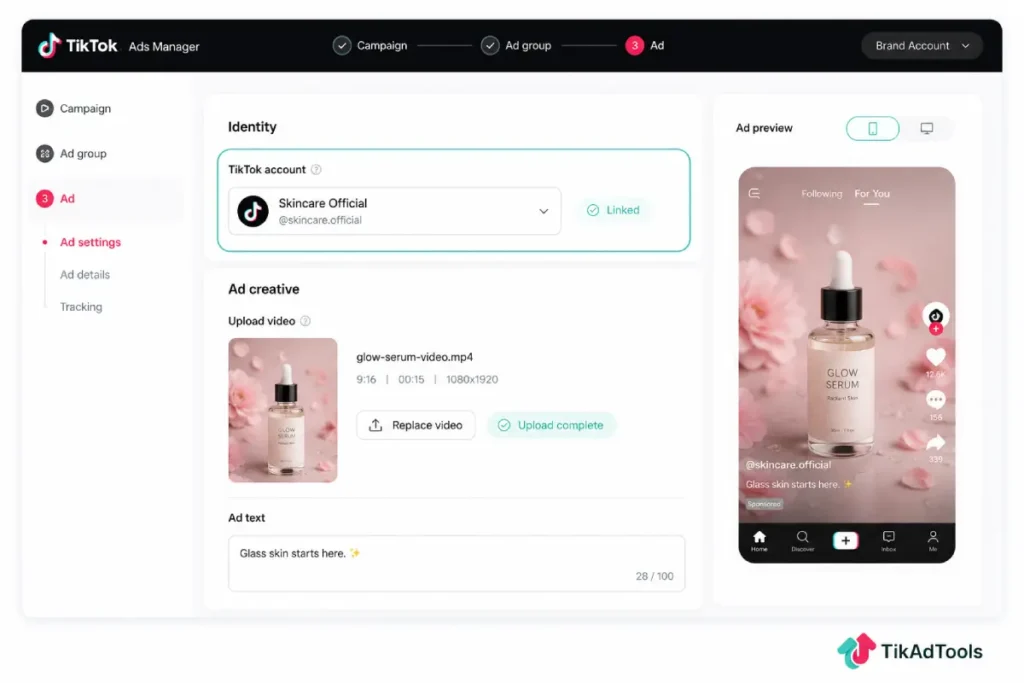
Took about eight minutes per variation once the campaign shell was built inside TikTok Ads Manager.
The toggle that hides it is called “Show through ads only.” Turn it on and the pushed video runs as an ad but never appears in the For You feed, search, or your profile page, and it’s on by default for newly created ads, per TikTok’s Ads Manager help docs. That’s what turns a pushed video into a true dark post.
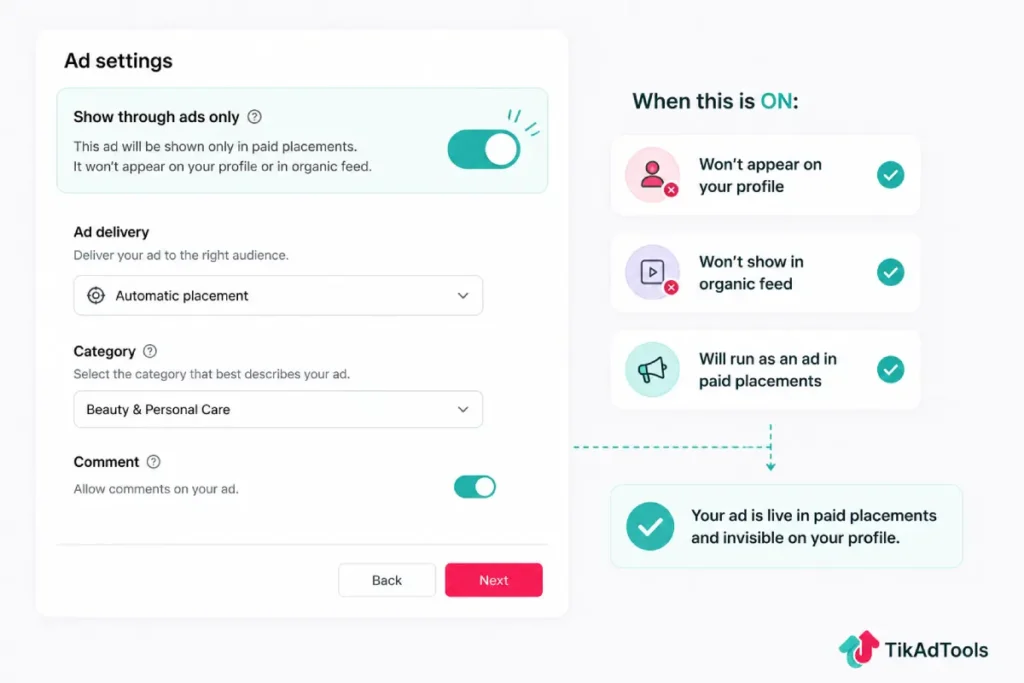
We double-checked that toggle before launch on every variation. With it on, none of the five creatives showed up on the brand account, so the client’s profile stayed clean while we burned through test budget in the background.
If you want to see how the creative reads before it spends a dollar, run it through a TikTok ad preview generator first.
Dark posts have no organic comments to soften a weak hook, so the first two seconds carry everything.
Dark post vs Spark Ads: what the data actually shows
On TikTok’s own metrics, Spark wins the headline numbers. TikTok’s internal comparison reports Spark Ads running a +30% completion rate, +142% engagement rate, +43% conversion rate, and a 4% lower CPM than non-Spark ads, according to TikTok Ads Manager’s Spark Ads documentation. Those gains come from inherited social proof, not magic.
So why run dark at all? Because those numbers describe averages across blended objectives, not your specific direct-response offer.
A clean dark post can pull a higher click-to-site rate on a hard offer, because there’s no profile to click into and no comment section pulling attention away from the CTA.
Across the five-variation skincare test, our best dark post hit a 1.9% CTR cold, with no inherited engagement at all.
The same creative as a Spark Ad got more comments, but those comments included three “is this a scam” replies that the dark version never had to fight. For a cold-traffic offer, the clean ad converted cheaper.
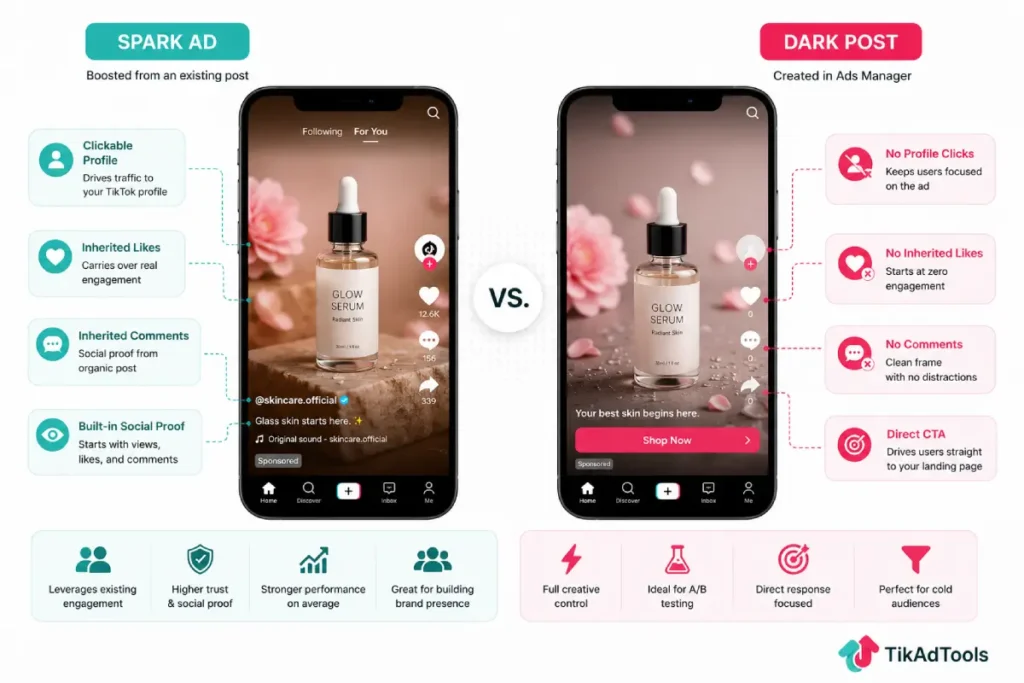
The honest read is that this isn’t Spark vs non-Spark as good vs bad. It’s proven social proof vs full control.
Most accounts that scale well end up running both, and Spark Ads handle the warm, authentic side while dark posts handle the cold, high-volume testing side.
When to run dark posts instead of Spark
Dark posts win the moment you need to test fast. You can launch a dozen hooks, captions, and edits without a single one cluttering your profile or waiting on a creator’s authorization.
That makes them the natural format for a structured TikTok ad A/B test, because nothing carries inherited engagement to skew the read.
They also win when you have no organic presence to boost. A brand-new account has no proven posts, so there’s nothing to Spark.
Building dark ads on TikTok through Ads Manager lets you advertise from day one without publishing anything to your profile first.
The third case is precision. Dark ads only reach the audience you target, which makes them clean for tight TikTok ad targeting and for retargeting campaigns where you don’t want the offer leaking to your whole follower base. Aggressive, short-term promos that don’t fit your evergreen content belong here too.
Scale matters before you write any of this off
TikTok ads reached 1.59 billion users in January 2025, which DataReportal puts at 28.6% of the world’s internet users, according to DataReportal.
The size cuts both ways. A huge addressable audience means weak creative gets exposed fast, and a dark post has no comment section to carry it.
The creative has to do the work alone, which is the whole reason testing volume matters.
Frequently asked questions
Are TikTok dark ads and non-Spark ads the same thing?
Yes. TikTok dark ads, dark posts, and non-Spark ads all describe advertisements created inside TikTok Ads Manager that run in-feed without appearing on your public profile.
What’s the difference between TikTok promote and Spark ads?
Promote is TikTok’s in-app boosting tool that turns one of your existing organic videos into an ad with a few taps, using simplified goals like more views or more website visits. It runs from your profile and keeps the video public.
Do dark posts hurt my organic follower count?
No. Dark posts run separately from your organic profile, so they don’t touch your follower count or your timeline. The trade-off is that any follows or engagement they earn don’t build a lasting social asset the way Spark Ad engagement attributes back to a real post.
Why is my dark post CPM higher than my Spark ad CPM?
TikTok’s algorithm rewards content that already shows engagement, and a dark post starts cold with none. Spark Ads inherit a head start in engagement signals, which can pull CPM down, while a fresh non-Spark ad has to earn its delivery from scratch.
Can I run dark posts and Spark ads in the same campaign?
Yes, and many advertisers do. A common setup uses dark posts to test creative cheaply, then converts the winning hook into a Spark Ad on an organic post to add social proof at scale.
Do dark posts work without a TikTok Business account?
You need a TikTok Ads Manager account and, since January 2026, a linked TikTok account for new campaigns. You don’t need any public organic posts, though.
Final thoughts
Whether you call them TikTok dark ads or non-Spark ads, they give advertisers complete creative control for testing, scaling, and protecting their public profile.
Dark posts aren’t the budget version of Spark Ads; they’re the control version, and the accounts that scale cleanest use both for what each does best. If you’re starting from zero, build your test framework on dark posts first, then graduate the winners.
New advertisers can stretch that testing budget further by claiming a TikTok ad credit before the first campaign goes live.