
TikTok Travel Ads: What Actually Drives Bookings
Your travel campaign isn’t underperforming because Bali isn’t appealing enough. It’s underperforming because you built it like every other travel ad on the platform.
A polished 30-second brand video. A broad audience with no real plan behind it. A Traffic objective picked because it sounded like the safe choice. Two weeks in, you’ve spent real money and you’re staring at a view count instead of a booking count.
None of that is a creative problem. It’s a setup problem, and it’s fixable.
Table of Contents
Get Up to $6,000 in Free TikTok Ad Credits
TikTok offers ad credit incentives for new advertisers, helping you test campaigns with a lower upfront cost.
TL;DR
- TikTok reports that 66% of users find it the most helpful source of travel inspiration, and 60% say they’ve visited a destination they first discovered there.
- Traffic isn’t a bad objective. It’s the wrong one when your real goal is bookings, not clicks.
- Fairly broad audiences beat narrow ones on TikTok, with 15% lower CPA and 20% higher conversion rates in TikTok’s own testing.
- TikTok now runs a dedicated Travel Ads format built on your booking catalog, not just standard In-Feed video.
- 50 conversions is TikTok’s real signal that a travel campaign has cleared the learning phase, not a fixed number of days.
Quick Answer
TikTok travel ads work when the objective matches what you’re actually selling. Run Video Views or Traffic for discovery, then retarget engaged viewers with a Conversions or Lead Generation campaign built around a real offer. If you’re selling catalog-based inventory like hotels, flights, or packages, TikTok’s dedicated Travel Ads format is built for exactly that.
How travel buyers actually use TikTok
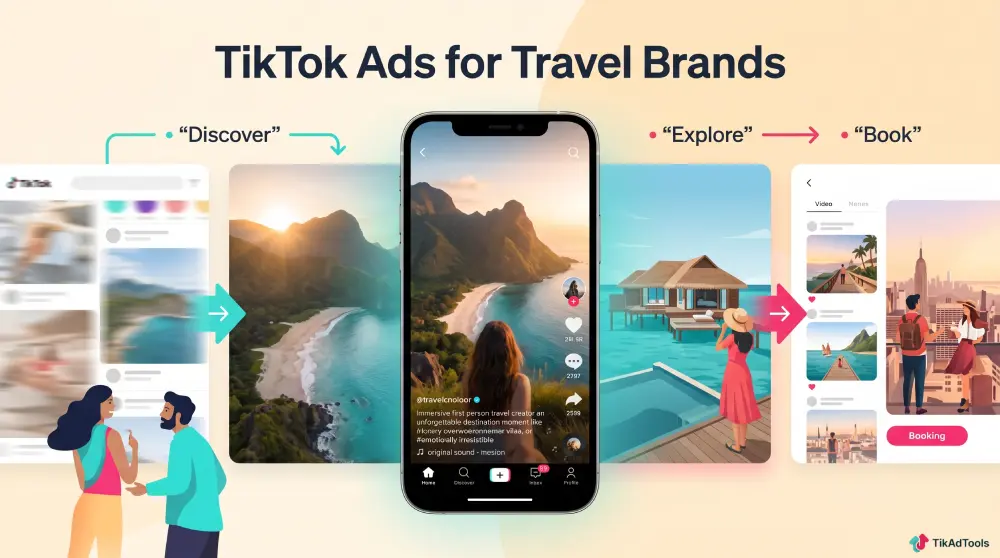
People don’t open TikTok planning to book a flight. A lot of them end up doing something close to it anyway.
TikTok’s own research backs this up. Sixty-six percent of surveyed users say TikTok is the most helpful source of travel inspiration they have, and a similar share have actively searched the app for something travel related they wanted to do or visit. Sixty percent agree they’ve visited a new destination specifically because they discovered it on TikTok.
That last number is the one that matters. It’s not just awareness. It’s changing where people actually go.
The hook has to earn the stop
Generic “beautiful place” footage doesn’t do much on its own anymore. Specificity does the work now.
“The quietest beach in Bali” tends to beat “travel to Bali” for click-through on a well-built hook. That’s a pattern worth testing, not a guarantee, so run it against your own account data before you treat it as fact.
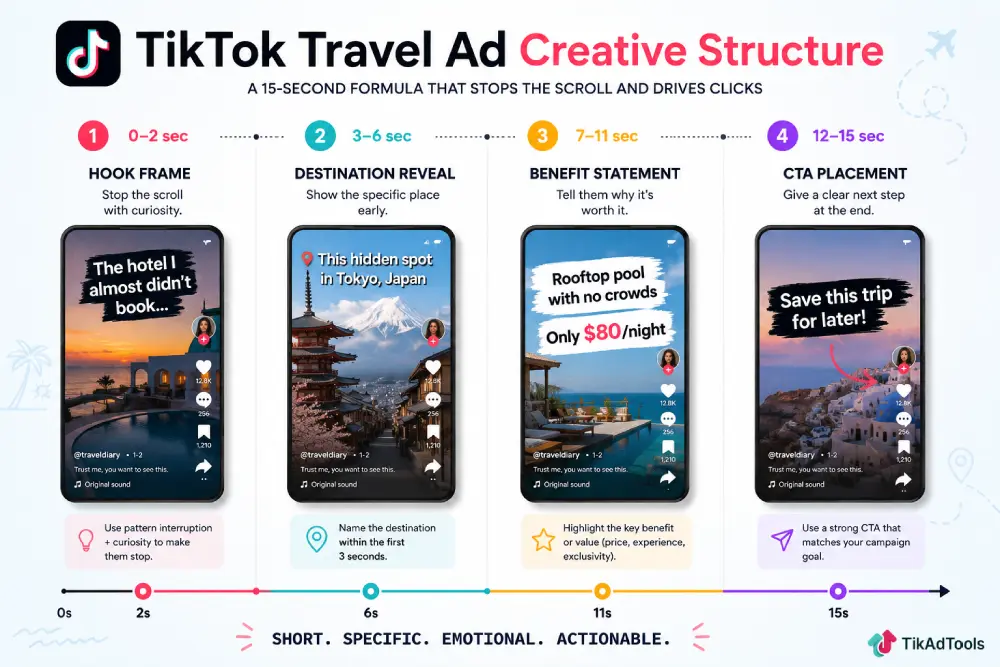
Pair the specific angle with a real detail in the first three seconds. A price, a location callout, or a season works better than a tagline.
Picking the right objective for travel campaigns
Don’t default to Traffic just because it feels like the obvious starting point. Traffic is built to send people to a website or app, and TikTok is explicit about that when you choose your campaign objective.
The real question isn’t which objective is “best.” It’s which one matches the action you actually need.
| Your goal | Objective to run |
|---|---|
| Destination or itinerary page visits | Traffic |
| Building an awareness pool to retarget later | Video Views |
| Bookings, purchases, or quote requests | Conversions |
| Tours, packages, or quote-based sales | Lead Generation |
When traffic actually fits
Traffic works when your KPI genuinely is website visits, not a downstream booking.
That covers a few common travel use cases:
- Landing page or itinerary research content
- Early-funnel audience building before you have conversion data
- Destination-page traffic for content or SEO goals
When conversions or lead generation wins
If bookings are the actual goal and you have enough volume to feed the algorithm, a conversion-aligned objective outperforms Traffic on the metric that pays your bills.
For tours, agencies, and quote-based products, Lead Generation using TikTok’s native Instant Form keeps the whole flow inside the app, which cuts the friction that kills off-app forms.
Hotels, airlines, and higher-ticket experiences often do better running Video Views first to build an engaged pool, then retargeting that pool with a Conversions campaign. It’s one workable structure, not the only one that works.
What TikTok travel Ads and smart+ travel Ads actually are
This is the part most travel guides skip, and it’s the biggest gap in most travel ad setups right now. TikTok runs a dedicated ad format called Travel Ads, built specifically around your existing travel catalog instead of one-off video creative.
Travel Ads pull from your hotel, flight, or package catalog and surface swipeable travel cards under the video, showing price, rating, and a call to action pulled directly from your inventory data. TikTok’s creative guidelines for Travel Ads note that these cards appear two seconds into the video and can display up to 10 items per ad.
Expedia Group’s CMO has pointed to this format specifically for meeting travelers “in key moments” across its Expedia, Vrbo, and Hotels.com brands. If you’re running more than a handful of properties or packages, catalog-based Travel Ads scale far better than manually building one ad per destination.
Smart+ Travel Ads automate targeting and bidding on top of that same catalog structure. It’s worth testing against a manually built campaign once you have enough conversion history to compare the two fairly.
Targeting that works for travel campaigns
Broad targeting outperforms narrow targeting on TikTok more often than most advertisers expect, and this isn’t a travel-specific quirk. It’s how the platform’s algorithm generally performs best.
TikTok’s own testing found that audiences reaching over 80% of a country’s potential users achieve 15% lower cost per action and 20% higher conversion rates than narrower setups. (Source) Start wide with light interest targeting, then narrow based on what the data actually shows.
Pull your audience insights after your first broad campaign has real conversion volume. Use that data to identify which interest clusters actually drove bookings before you build a second, tighter campaign around them.
Retargeting engaged viewers
This is where most travel brands leave money behind. Someone who watched most of your best travel video and didn’t click is still a warm lead. They just weren’t ready yet.
Build a custom audience from video engagement using TikTok’s watch-percentage thresholds, which include 25%, 50%, 75%, and 100% completion, each with adjustable lookback windows from 7 to 180 days. Test more than one threshold rather than assuming 50% is automatically the right cutoff for your video length.
Once that pool exists, hit it with a tighter offer and a real deadline. This kind of two-step retargeting structure consistently pulls more bookings than a single cold campaign ever will.
Creative that actually converts
Travel converts best when it feels like a recommendation from someone who’s actually been there, not a brand asking for your card details. That’s not a universal rule, but it’s the pattern that shows up most often in travel accounts that work.
The first frame matters as much as the first line of audio. Pattern interruption beats polish: an unexpected angle, a close-up, or text that creates real curiosity in the first few seconds.
Spark Ads built on genuine traveler UGC tend to feel more native than brand-produced footage, since they carry the organic post format straight into the paid feed. TopView and Brand Takeover can work for high-budget awareness pushes, but most travel advertisers get more out of solid In-Feed and Spark creative at a fraction of the cost.
Use CapCut to cut travel footage fast in native vertical format. If you’re working without a dedicated editor, Pippit AI can turn raw travel footage into a working script and rough cut to start from.
Budget and the Learning Phase for travel campaigns
Travel is a high-consideration category. A $20 a day test won’t tell you much in a week, and it shouldn’t be expected to.
TikTok’s platform minimums are $50 a day at the campaign level and $20 a day at each ad group. Treat those as the floor that keeps a campaign eligible to run, not as a real testing budget.
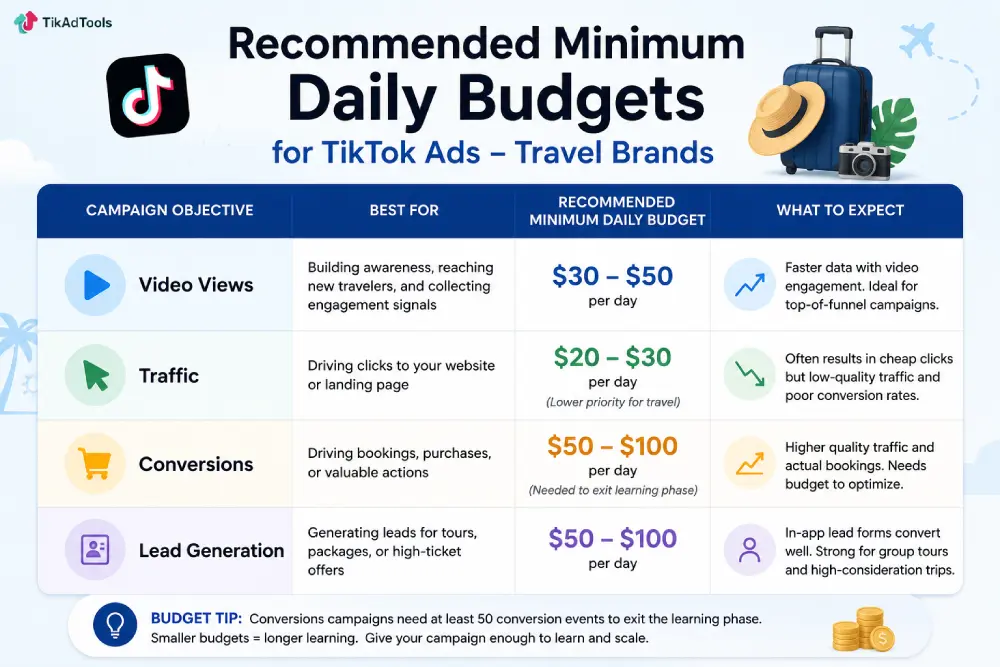
The number that actually matters is conversion volume, not calendar days. TikTok is direct about this: reaching 25 conversions is the clearest signal that an ad group has cleared the learning phase, and an ad group that can’t reach roughly 25 conversions in its first 7 days is unlikely to clear it at all.
Build your testing budget backward from that number instead of guessing:
Testing budget ≈ target CPA × desired conversion volume
If your target CPA is $50 and you want 25 conversions to gauge early performance, plan for roughly $1,000. That’s a starting formula, not a rule TikTok enforces, so adjust it to your own numbers using a budget planner once you have a target CPA to work from.
New accounts can also offset early testing costs through TikTok’s ad credit programs for first-time advertisers, which softens the risk of that initial spend.
Tracking bookings the right way
None of the objective or targeting advice above matters if your tracking is broken. A website Conversions campaign needs a working TikTok Pixel, and the Events API adds a server-side layer that holds up better when browser tracking gets blocked.
Travel bookings often happen days after the first TikTok interaction, so a same-day view of performance will make a working campaign look weak. Build your reporting around attributed and assisted bookings, not just last-click conversions, and use a UTM link builder so booking sources stay clean once traffic reaches your site or booking engine.
The seasonality gap most travel campaigns ignore
Travel demand moves with school holidays, weather, and destination-specific peak season, and that shifts CPMs and booking behavior all year. A campaign that performs in March can look completely different by July.
Build your seasonal calendar around your specific destinations, not a generic retail promo calendar. Booking windows for a ski trip and a summer beach package don’t move together, and treating them the same wastes budget on both.
Benchmarks worth tracking beyond CTR
A strong CTR on a booking campaign can still hide a weak result. A sensational hook can pull clicks from people who were never going to book.
Track the full path instead of one metric in isolation:
- CPM and CPC for baseline delivery cost
- Landing page view rate, to catch a broken redirect or slow load
- Lead or booking conversion rate, not just click volume
- Cost per acquisition against your actual target
- Revenue per lead or ROAS, since that’s the number that pays for the next campaign
Compare these across campaigns using consistent reporting rather than judging a single week in isolation.
TikTok travel Ads FAQs
What TikTok ad format works best for travel brands?
In-Feed Ads are the standard starting point for most travel advertisers. If you’re running catalog-based inventory like hotels or packages, TikTok’s dedicated Travel Ads format usually outperforms generic In-Feed creative because it surfaces real pricing and availability.
Can small travel businesses compete with big brands on TikTok?
Small operators can absolutely hold their own here. A niche, specific angle from someone who actually knows one destination can outperform a broad “book your dream vacation” message from a bigger name, though results still depend heavily on offer and execution.
How much budget do you need to test TikTok travel ads?
There’s no universal number. Calculate it as your target CPA multiplied by the number of conversions you want to see, and treat anything below TikTok’s $50 campaign-level minimum as untestable.
How long before a travel campaign shows real results?
Watch conversion volume, not the calendar. An ad group that’s struggling to reach 20 conversions after 10 days is unlikely to stabilize, regardless of how many weeks have passed.
Should travel brands use TikTok lead generation ads?
Yes, especially for group tours, packages, or anything priced too high for an impulse purchase. TikTok’s Instant Form loads inside the app, which cuts the drop-off you’d normally see sending someone to an external booking form.
What’s the real difference between Travel Ads and regular In-Feed ads?
Regular In-Feed ads run one piece of creative per ad. Travel Ads pull directly from your catalog, showing swipeable cards with live pricing and availability under the same video, which scales far better once you’re managing more than a few destinations or properties.
Final thoughts
Get the objective, the targeting, and the tracking right, and the destination mostly sells itself from there. If you’re ready to put a real testing budget behind it, TikTok Ads Manager is where that setup actually happens.