
Picking an ad platform isn’t about finding the “best” one. It’s about matching a platform to your goal, your audience, your budget, and what you can actually produce.
TikTok, Facebook, and Google Ads all work, for different businesses, in different situations. The right answer depends on inputs specific to your business, not a universal ranking.
This guide walks through those inputs one at a time, so you can land on a platform based on your own answers instead of someone else’s opinion.
Table of Contents
Get Up to $6,000 in Free TikTok Ad Credits
TikTok offers ad credit incentives for new advertisers, helping you test campaigns with a lower upfront cost.
Key Takeaways
- Start with your goal. Are you capturing demand that already exists, or creating demand among people who weren’t looking?
- Your audience’s age, your product type, and your ability to produce video all narrow the choice further.
- TikTok’s self-serve costs run $4.80-$9.16 CPM and $0.20-$2.00 CPC in 2026, per TikAdTools’ own cost benchmarks.
- No single platform fits every business. Most brands that scale eventually run more than one, but start with the one that matches where your audience already is.
- Use the decision matrix below to get a starting recommendation, then confirm it against your own numbers with the Ad Cost Calculator.
The three platforms, briefly
Before weighing the decision factors, here’s what each platform actually does.
TikTok Ads puts short-form video directly in the For You feed. It’s built around discovery: reaching people who weren’t looking for your product, but stop scrolling when they see it.
Facebook Ads runs across Facebook, Instagram, Messenger, and the Meta Audience Network. It supports the widest range of ad formats and has the deepest targeting and retargeting infrastructure of the three.
Google Ads puts your business in front of people actively searching for what you sell. It captures existing intent rather than creating new interest.
What to consider when choosing an ad platform
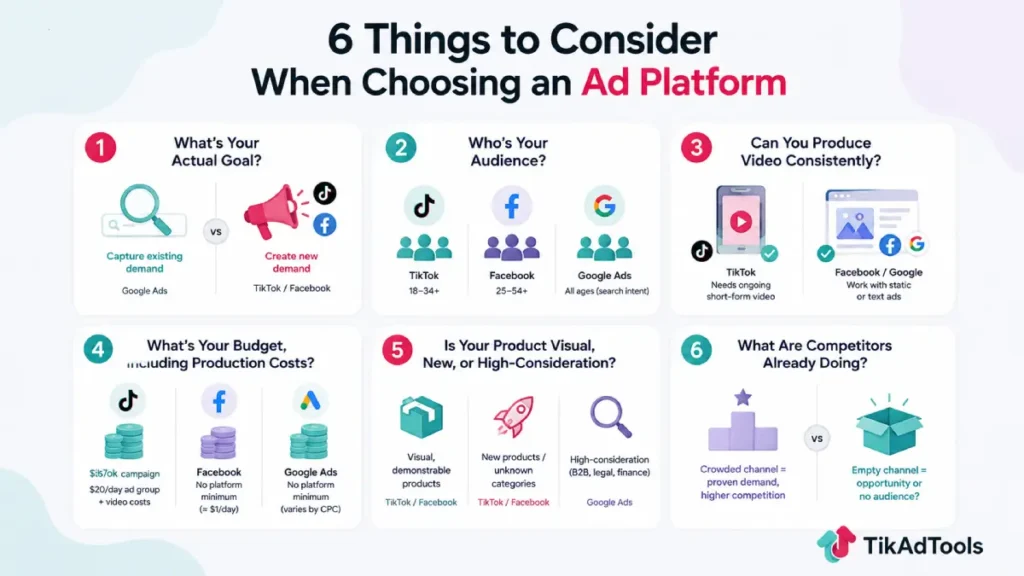
These six factors, in order, will get you to a starting recommendation faster than any platform-by-platform comparison.
1. What’s your actual goal?
Decide whether you’re capturing demand that already exists or creating demand that doesn’t exist yet, since that single distinction points toward Google on one side and TikTok or Facebook on the other.
If people already search for your product category, Google Ads puts you in front of that existing intent.
If you’re introducing something new, or your product needs to be seen to be understood, TikTok or Facebook create that awareness instead of waiting for a search.
2. Who’s your audience?
Match your customer’s age range to where each platform’s core audience actually sits.
TikTok’s largest single age segment is now 25 to 34, per Exploding Topics’ TikTok demographics data, though the broader 18-to-34 range still makes up most of its audience, and older segments are growing.
Facebook’s audience skews slightly older than TikTok’s, with strong engagement extending well into the 45–54 range, per LocaliQ’s Facebook Advertising Benchmarks, though 25-to-34-year-olds remain the single largest segment on both platforms.
Google Ads isn’t age-driven the same way. It follows search behavior, so it works across age groups as long as your customer searches before buying.
3. Can you produce video consistently?
TikTok requires a steady supply of short, native-feeling video, not a single polished ad you set and forget.
If you can’t commit to shooting and editing new clips on a rolling basis, TikTok’s ad performance will suffer regardless of how well you target it.
Facebook and Google both support static image and text-based formats, so a lack of video capacity is less of a blocker on either one.
4. What’s your budget, including production costs?
Compare each platform’s minimum spend and factor in what it costs to create content for it, not just the media budget.
TikTok requires $50 per day at the campaign level and $20 per day at the ad group level, confirmed in TikTok’s own daily budget documentation, plus ongoing video production costs if you outsource that work. TikAdTools’ own cost benchmarks cover what moves that spend up or down beyond the platform floor.
Facebook has no fixed platform minimum and can start as low as roughly $1 per day, giving you more room to test at a small scale.
Google Ads has no official platform-wide minimum either. Your real floor depends on your industry’s cost per click and how many clicks you need for usable data.
5. Is your product visual, new, or high-consideration?
Visual, demonstrable products (beauty, food, fashion, fitness, gadgets) tend to perform well on TikTok and Facebook, where seeing the product in action drives the decision.
New products in categories people don’t know to search for yet also favor TikTok or Facebook, since Google Ads has nothing to capture until search demand exists.
High-consideration purchases, B2B software, legal services, financial products, tend to favor Google Ads, where buyers actively research before committing.
6. What are competitors in your space already doing?
Check where competitors in your exact category are already advertising successfully before ruling a platform out.
A crowded channel isn’t automatically a bad one. It can signal proven demand, but it also means higher competition for the same attention.
An empty channel can mean an opportunity, or it can mean the audience genuinely isn’t there. Confirm which one it is using your own audience data before assuming either.
Decision matrix: match your situation to a platform
Use this table as a starting point, then confirm with a small test rather than committing your full budget to the first answer.
| Your Situation | Likely Best Fit |
|---|---|
| Customers already search for what you sell | Google Ads |
| Visual product, audience under 35, can produce video | TikTok Ads |
| Need retargeting or lookalike audiences from a customer list | Facebook Ads |
| Launching something new, no existing search demand | TikTok or Facebook |
| High-consideration B2B or professional service | Google Ads |
| Local or service-based business needing lead forms | Facebook Ads |
| Small test budget, want the lowest cost per impression | TikTok Ads |
What each platform costs in 2026
Once a platform looks like a fit, confirm it’s affordable for your budget before committing.
| Platform | CPM | CPC | Minimum budget |
|---|---|---|---|
| TikTok Ads | $4.80 – $9.16 | $0.20 – $2.00 | $50/day campaign, $20/day ad group |
| Facebook Ads | $14.19 (ecommerce avg.) | $0.70 (traffic), $1.92 (lead gen) | ~$1/day |
| Google Ads | Varies widely | $1.16-$6.75 by industry, avg. $2.69 | No official platform minimum |
These figures aren’t directly comparable unit-for-unit, since CPM and CPC measure different things and Google’s higher CPC reflects buyer intent the other two don’t capture at the impression level. Per Stackmatix’s TikTok vs Google Ads comparison, cost per result in the funnel matters more than any single benchmark column above.
What matters more than any single number is cost per result in your funnel: cost per lead, cost per sale, cost per install.
Run your own budget through the Ad Cost Calculator linked above before committing spend to any platform.
If you’re still unsure, TikTok is the cheapest way to test
TikTok’s low daily minimum and its new advertiser ad credit make it the least expensive platform to test, even as a secondary channel alongside Facebook or Google.
If your product has any visual quality at all, a small TikTok test can answer the “is this audience even here” question before you commit a bigger budget elsewhere.
Check your ad credit eligibility first, since TikTok’s new advertiser incentive program terms limit it to accounts with no prior paid activity.
Can you run more than one platform?
Yes, and most brands that scale past their first successful test eventually do.
A common pattern: TikTok or Facebook builds top-of-funnel awareness, and Google captures the branded or category search that awareness generates days or weeks later.
The tradeoff is real. Running two or three channels multiplies your creative workload and the time needed to monitor each one.
If your budget or time is limited, pick one platform using the factors above, run a focused test, and expand once you see results.
Frequently asked questions
How do I know if TikTok Ads or Facebook Ads is right for my business?
Match your audience’s age to each platform’s core demographic. TikTok’s largest segment is 25 to 34, per Exploding Topics, while Facebook’s most active range is 25 to 54, per Meta’s own reporting.
Should I choose Google Ads or TikTok Ads first?
Choose based on whether your customer already searches for what you sell. If yes, start with Google Ads, since it captures that existing intent.
What ad platform is best for a small budget?
TikTok Ads typically offers the lowest cost per impression of the three, at $4.80-$9.16 CPM, and its new advertiser ad credit lowers the effective cost further for a first test.
Can I test TikTok, Facebook, and Google Ads all at once?
Testing all three at once with a small budget usually spreads spend too thin to produce usable data on any of them.
Do I need a big budget to advertise on TikTok?
No. TikTok’s minimum is $50 per day at the campaign level and $20 per day at the ad group level, confirmed in TikTok’s own documentation.
Conclusion
Work through the factors in order: your goal, your audience, your video capacity, your budget, your product type, and what competitors are already doing.
Each one narrows the choice a little further, and by the end you’ll have a platform that fits your specific business, not a generic ranking.
If you’re still unsure after working through the list, TikTok’s low cost to test makes it a reasonable low-risk starting point, or second channel, for almost any business willing to try short-form video. If budget size is the real constraint, the best ad platform for a small budget compares real minimums across all three platforms directly.
Sources
- TikAdTools: TikTok Ads Cost in 2026
- LocaliQ: Facebook Advertising Benchmarks
- Stackmatix: TikTok vs Google Ads: Complete Platform Comparison
- TikTok’s official daily budget documentation
- TikTok’s official new advertiser incentive program terms
- Meta’s Q4 and full-year 2024 earnings report
- Exploding Topics: TikTok demographics