
If your TikTok ads keep burning budget without driving sales, you’re not alone. As more brands pile onto the platform, costs have climbed, and easy wins are getting harder to find.
The good news: a few targeted creative and targeting fixes can lift performance fast.
This guide breaks down the TikTok ads best practices that actually work in 2026, based on what is converting right now for direct response and brand campaigns.
You will learn how to:
- Hook viewers in the first three seconds
- Build a creative that feels native to the For You feed
- Pick the right ad format for each funnel stage
- Set up bidding, budgets, and targeting without overspending
- Refresh creatives before fatigue tanks your ROAS
- Track the metrics that actually predict revenue
The tactics below skip generic theory and focus on what moves the needle. Use them as a checklist before your next campaign launch.
Get Up to $6,000 in Free TikTok Ad Credits
TikTok offers ad credit incentives for new advertisers, helping you test campaigns with a lower upfront cost.
Table of Contents
Key takeaways
- Lead with a strong hook in the first three seconds, since most viewers decide whether to keep watching almost instantly.
- Native, creator-style content outperforms polished commercial-style ads on TikTok by a wide margin.
- Run three to five creatives per ad group and refresh them often to combat creative fatigue.
- Use Spark Ads to amplify organic posts and creator content for stronger trust signals and lower CPA.
- Match the ad format to the funnel stage: TopView for awareness, In-Feed for consideration, Spark Ads for conversion.
- Track ROAS, hook rate, and conversion lift, not just CTR, to see real campaign impact.
Quick answer
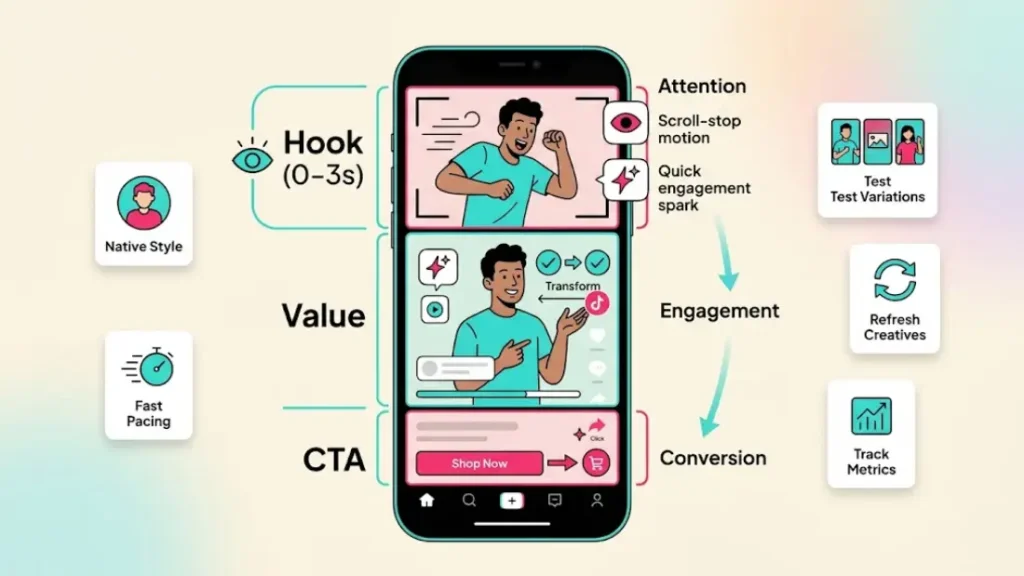
The best TikTok ads in 2026 hook viewers within three seconds, feel native to the platform, use sound and captions, and follow a clear hook, value, and call-to-action structure. Test three to five creatives per ad group, refresh them weekly, and pair Spark Ads with creator partnerships to lower CPA and lift ROAS.
What makes a TikTok ad convert in 2026
A TikTok ad converts when it feels like organic content, captures attention within three seconds, and gives viewers a clear reason to act. The For You algorithm rewards completion rate and engagement, so ads that look like polished TV commercials usually underperform. Native style, fast hooks, and direct CTAs win.
Three things matter most for conversion:
- The hook: The opening frame and first line decide whether viewers keep watching.
- Native style: Vertical 9:16 video, real people, raw lighting, on-platform editing.
- A clear next step: One CTA, written plainly, is repeated visually when possible.
If an ad fails on any of these, performance drops fast, no matter how strong the targeting is.
Hook viewers in the first three seconds
Use the first three seconds to stop the scroll. Open with movement, a surprising visual, a bold claim, or a question that pulls the viewer in. Skip logo intros, slow brand build-ups, and generic stock footage.
Strong hooks tend to follow a few patterns:
- Pattern interrupt: “I tried this for 30 days, and the results shocked me.”
- Bold result: “This skincare routine cut my breakouts in half.”
- Relatable problem: “If your skin still feels tight after washing, watch this.”
- Direct question: “Want to fix your sleep without expensive gadgets?”
Test at least three different hook variations per campaign. Even small changes to the opening line can double watch time and lift downstream conversions.
Make ads that feel native to TikTok
Polished commercials feel out of place on TikTok. The platform rewards authentic, creator-style content shot vertically with on-screen text and natural lighting. Reformatted ads from Instagram or YouTube usually flop.
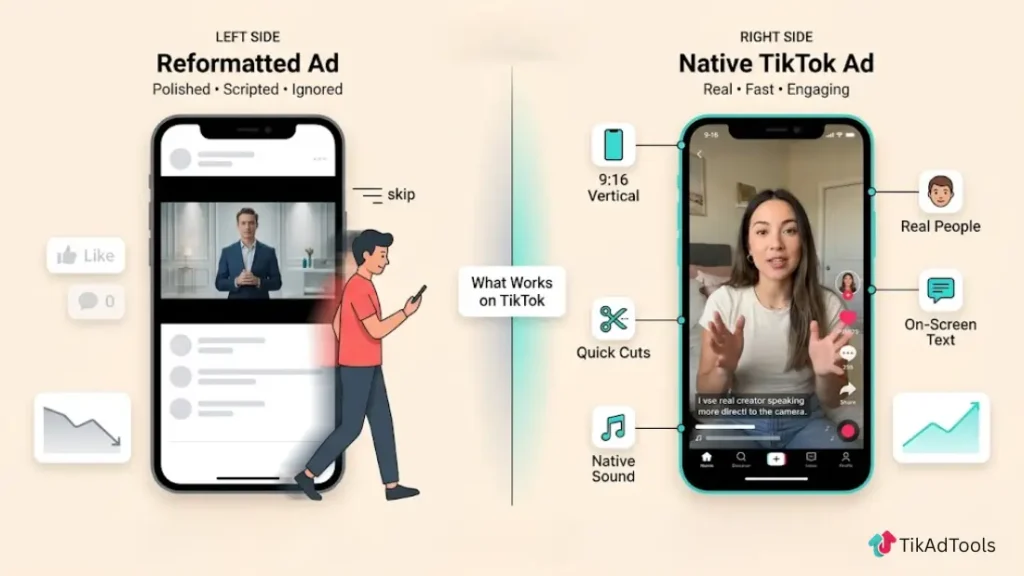
Native ads share a few traits:
- Vertical 9:16 aspect ratio
- Real people on camera, not voiceovers over stock
- Quick cuts, captions, and text overlays
- Sounds pulled from TikTok’s Commercial Music Library
- A casual, conversational tone
Ads built natively for the platform drive higher engagement and brand recall than ads reformatted from other channels. The lift shows up in attention, completion rate, and brand outcomes.
Lean into a sound-on strategy
Most TikTok users watch with the sound on, so audio is part of the creative, not an afterthought. Use voiceover, dialogue, music from the Commercial Music Library, or trending sounds approved for ads.
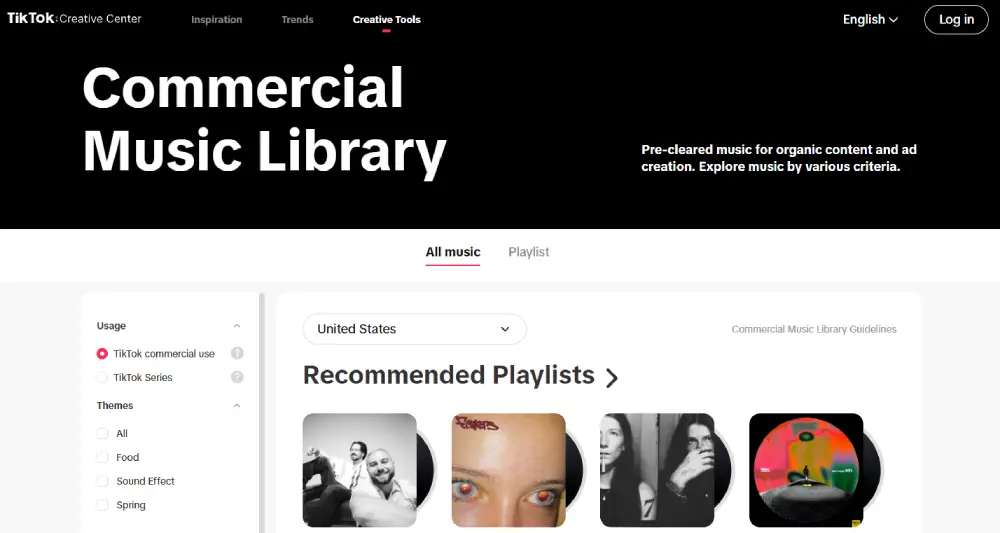
A few sound rules to follow:
- Always include captions, since some viewers still watch muted
- Match music tempo to your pacing and energy
- Use trending sounds when they fit your brand and offer
- Avoid copyrighted music that is not licensed for ads, since it can get your campaign rejected
Sound is one of the cheapest ways to lift completion rate. The right track or voice can hold attention through a full 15-second ad and cut your CPA in the process.
Choose the right ad format for your goal
TikTok offers several ad formats, and matching the format to your funnel stage is one of the highest-impact TikTok ads best practices you can apply. Use the table below as a quick reference.
| Ad Format | Best For | Typical Use Case |
|---|---|---|
| In-Feed Ads | Consideration and conversions | Product demos, offers, lead gen |
| Spark Ads | All stages, especially conversion | Boost organic posts and creator content |
| TopView | Awareness | Big launches, brand campaigns |
| Branded Hashtag Challenge | Engagement and community | UGC pushes, viral campaigns |
| Collection Ads | Ecommerce | Shoppable product catalogs |
Most direct response advertisers should start with In-Feed Ads and Spark Ads. They are the cheapest to test and tie cleanly to ROAS goals. Reserve TopView and Hashtag Challenges for moments when you have real budget for awareness pushes.
Use Spark Ads and creator partnerships
Spark Ads let you put paid spend behind organic posts, either yours or content from partner creators. Because the post still shows the original handle and engagement, it carries more trust than a standard branded ad.
To find creators, use the TikTok Creator Marketplace inside Ads Manager. Look for creators with strong native content style and engaged audiences, not just high follower counts. Engagement rate, comment sentiment, and audience overlap with your target customer matter more than reach.
Many DTC brands now run a hybrid model: brand-led In-Feed Ads for top-of-funnel reach plus creator Spark Ads for consideration and conversion. The combination usually lowers CPA while keeping creative volume high enough to outpace fatigue.
Should you use Broad or Narrow TikTok targeting?
For most accounts, broad targeting performs better than tight interest stacks. TikTok’s algorithm uses creative signals more than demographics to find buyers, so layering too many filters can starve the system of data and slow learning.
A simple targeting framework that works:
- Start with a wide age range and one or two broad interests tied to your product.
- Add one or two behavior signals, such as creators followed or hashtags interacted with.
- Exclude existing customers using Custom Audiences.
- Layer Lookalike Audiences once you have at least 1,000 conversions in your pixel.
Use Custom Audiences from your CRM, pixel events, and engagers to retarget warm users at the bottom of the funnel. Save tight targeting for retargeting layers, not prospecting.
Get bidding and budgets right
Bidding on TikTok rewards consistency. Frequent budget changes and bid swings reset the learning phase and tank performance, so plan your structure before you launch.
Best practice for new campaigns:
- Use Lowest Cost bidding while you gather data
- Set daily budgets at roughly 20 to 50 times your target CPA
- Avoid editing the campaign for the first three to five days
- Once stable, shift to Cost Cap or Bid Cap to control efficiency
For eCommerce, Value-Based Optimization helps the algorithm prioritize higher-value purchases instead of any conversion. It needs clean purchase event tracking through the TikTok Pixel or Events API to work properly.
Beat creative fatigue with a refresh system
Even strong TikTok ads burn out fast. CTR drops, CPMs climb, and ROAS slides within one to three weeks for most accounts. The fix is a steady creative pipeline, not a single hero ad.
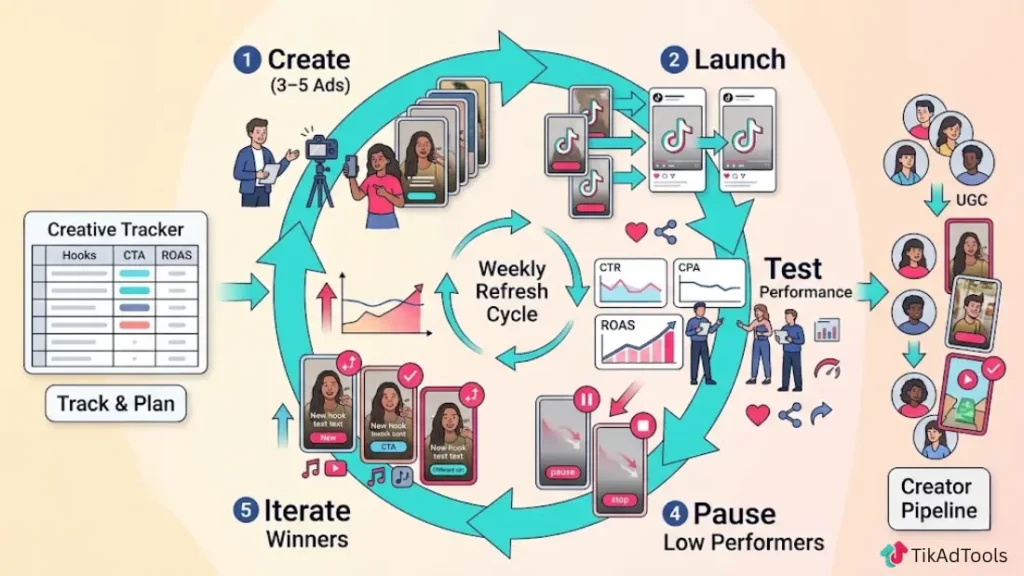
A simple weekly refresh system:
- Run three to five creatives per ad group
- Launch three to five new variations every week
- Pause anything below your CPA target after at least 100 impressions per audience
- Keep top performers running with small tweaks: new hook, new CTA, new music
If you cannot produce that volume in-house, the TikTok Creative Exchange and creator partnerships can fill the gap without blowing up your team’s bandwidth. A simple creative tracker spreadsheet (logging hook style, CTA, ROAS, and refresh date) works well as a low-cost planner here.
Use TikTok’s AI tools without losing your voice
TikTok now ships several AI tools inside Ads Manager, including Symphony Assistant for script ideas, Smart Creative for automated optimization, and the Creative Library for asset management. Used well, they speed up production. Used carelessly, they produce generic, off-brand ads.
Practical ways to use them:
- Symphony Assistant for first-draft scripts, you then rewrite in your voice
- Smart Creative is a fatigue management layer, not a replacement for a creative team
- Creative Library to store, tag, and analyze winners across campaigns
Always review AI-generated assets for brand voice, factual accuracy, and platform fit before launch. Treat AI as a junior assistant, not a creative director.
Measure what actually predicts revenue
CTR alone is a vanity metric on TikTok. A high CTR with a low conversion rate often signals misleading creative or a weak landing page. Track metrics that connect to revenue instead.
Focus on:
- ROAS (return on ad spend)
- Conversion rate by ad and creative
- Hold rate (percent watching past six seconds)
- Hook rate (percent watching past three seconds)
- New customer acquisition cost (NCAC)
Pair these with attribution from the TikTok Pixel, the Events API, and any third-party platform you use, such as Northbeam, Triple Whale, or Google Analytics 4. Cross-checking helps catch over-attribution from last-click models and gives you a more honest read on incrementality.
What TikTok ad mistakes quietly kill performance?
The most common TikTok ad mistakes are reusing TV or Instagram creative, narrow targeting, single-creative ad groups, frequent campaign edits, and ignoring sound. Each one chokes the algorithm, slows learning, and inflates CPA. Fixing these often improves ROAS within a week, even before adding new creative.
Other frequent issues:
- No clear CTA on screen or in voiceover
- Ads longer than 30 seconds with no payoff
- Ignoring trending sounds and culture
- Not using Spark Ads for creator content
- Skipping captions, which hurts mute viewers and accessibility
Audit your account against this list before assuming your creative is the problem. Many accounts find a 20 to 30 percent efficiency lift just by cleaning up structural issues.
How much should you spend on TikTok Ads?
A reasonable starting test budget is at least 20 times your target CPA, spread across three to five creatives over five to seven days. For most DTC brands, that lands between $1,500 and $5,000 for a useful first read. Smaller budgets can still work, but expect noisier data and slower learning cycles.
Once you find a winning creative, scale gradually. Increase daily budgets by 20 to 30 percent every few days rather than doubling overnight, which usually triggers another learning phase and undoes your progress.
FAQs
How long should TikTok ads be?
Most high-performing TikTok ads run between 9 and 21 seconds. Anything shorter often lacks payoff, while longer ads need a strong reason to hold attention. Always front-load the hook and CTA so the message lands even if viewers scroll early.
Do TikTok ads work for B2B?
Yes, but B2B brands should focus on educational and personality-driven content rather than direct sales pitches. Founders, employees, and niche thought leaders tend to perform better than polished corporate ads. Use Lead Gen Ads or warm retargeting to capture intent and follow up off-platform.
What is a good ROAS for TikTok ads?
A solid ROAS depends on your margins and category. For most DTC brands, a blended TikTok ROAS between 1.8x and 3x is healthy, especially when paired with strong organic and email programs. Subscription, beauty, and apparel brands often see higher numbers; commodity products usually see less.
Should you use Spark Ads or regular In-Feed Ads?
Spark Ads usually outperform standard In-Feed Ads because they pull engagement signals from the original organic post and feel more native. Use Spark Ads when you have strong organic content or creator partnerships. Use standard In-Feed Ads when you need fast iteration and do not have a partner post to amplify.
How often should you refresh TikTok ad creatives?
Plan to introduce three to five new creatives every week per active ad group. Most TikTok ads start losing efficiency within 7 to 21 days, depending on spend. A consistent refresh pipeline keeps CPA low and prevents your audience from going blind to your message.
Are TikTok ads still worth it in 2026?
Yes, for most consumer brands, TikTok ads remain one of the strongest paid channels for reach and conversion. Costs have risen, so creative quality and creator partnerships matter more than ever. Brands that treat TikTok as a creative-first channel still see strong returns.
Final thoughts
Strong TikTok ads in 2026 come down to native creative, fast hooks, smart format choices, and a steady creative refresh cycle.
The brands winning the platform are not the ones with the biggest production budgets. They are the ones treating each ad like a TikTok first and a campaign asset second.
Start with one or two of the practices above, run a clean test, and let the data tell you what to scale.
Build a simple, creative tracker that logs hook style, CTA, ROAS, and refresh date for every ad. That single habit will tighten your decisions and protect your budget more than any algorithm hack.