
Most advertisers waste their first TikTok budget because they set up their account wrong, not because their creative is bad.
The problem is almost always structural. You pick the wrong objective, pile everything into one ad group, and wonder why results are inconsistent.
Once you understand how TikTok organizes its ad system, every other decision becomes cleaner and more deliberate.
TikTok Ads Manager runs on three distinct levels: campaigns, ad groups, and ads. Each level controls something specific. Each level serves a different purpose.
By the end of this guide, you will know exactly what belongs at each level, how the levels interact, and how to avoid the structural mistakes that quietly drain ad budgets.
Table of Contents
Get Up to $6,000 in Free TikTok Ad Credits
TikTok offers ad credit incentives for new advertisers, helping you test campaigns with a lower upfront cost.
What is TikTok Ads Structure?
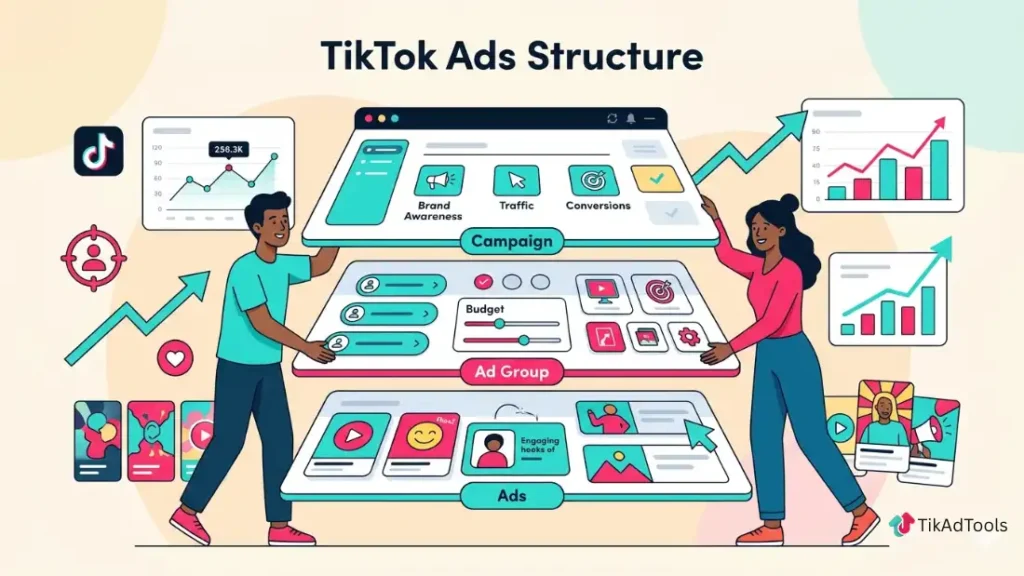
TikTok ads structure is a three-tier system inside TikTok Ads Manager that organizes your advertising from the highest level of strategy down to individual creative assets. The campaign level sets your objective and budget type. The ad group level controls your audience targeting, placements, schedule, and bids. The ad level holds your creative, copy, and call to action. Each tier must be configured correctly for the others to perform, but results will vary based on your objective, total budget, and industry vertical.
Why TikTok uses a 3-Tier ad hierarchy (and why it matters)
TikTok’s three-tier structure exists to give you methodical control over three fundamentally different variables: what you want to achieve, who you want to reach, and what they actually see.
These are not the same decision. Mixing them into one layer creates chaos in your data and in the algorithm’s learning process.
When your objective, audience, and creative live at separate levels, you can change one without disturbing the others. You can test five different audiences under a single campaign objective. You can run three creatives against the same audience without rebuilding your targeting from scratch every time.
This separation is the entire point of the hierarchy. It lets TikTok’s algorithm learn from a controlled environment. When we look at how platform algorithms optimize delivery, the cleaner the input structure, the faster the system identifies the right audience for your creative. A messy structure sends conflicting signals and extends the learning phase unnecessarily.
Think of it as a chain of command. The campaign sets the mission. The ad group defines the team and allocates resources. The ad executes the play. Break that chain at any point, and performance becomes unpredictable.
Level 1, campaign: where you set your objective and budget type
The campaign is at the top of your structure. Every choice you make here shapes everything below it.
At the campaign level, you choose one advertising objective. TikTok groups these into three categories: Awareness, Consideration, and Conversion. Awareness objectives include Reach and Video Views. Consideration objectives include Traffic, Lead Generation, and App Installs. Conversion objectives include Website Conversions, Catalog Sales, and App Event Optimization.
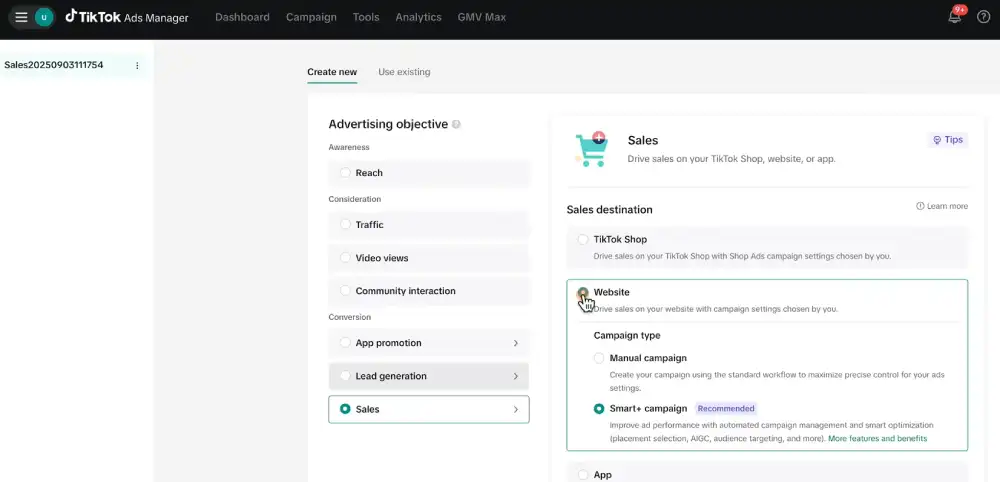
You cannot mix objectives inside one campaign. If you want to drive traffic and generate leads at the same time, those need separate campaigns. This is not a limitation. It is a feature. Keeping objectives separate prevents TikTok’s delivery algorithm from receiving conflicting optimization signals.
You also choose your budget type at this level. TikTok offers two options: Daily Budget and Lifetime Budget. Daily Budget sets a spending cap per day. The lifetime Budget sets the total spend across the full campaign flight.
When to turn on Campaign Budget Optimization (CBO)
Campaign Budget Optimization, commonly called CBO, changes how your budget flows through the structure. Instead of setting individual budgets at each ad group, you set one budget at the campaign level and let TikTok distribute it across your ad groups automatically.
According to TikTok for Business documentation, CBO is designed to identify the best-performing ad groups in real time and shift more spend toward them. This sounds efficient, and often it is. But CBO only works well when your ad groups are genuinely comparable, meaning similar audiences, similar bid strategies, and similar conversion goals.
If your ad groups target completely different audiences with different bid approaches, CBO can starve one group before it collects enough data to be evaluated fairly.
Turn CBO on when you are testing multiple audiences with the same objective and budget pool. Keep manual ad group budgets when your audiences need different spend levels by design.
Level 2, ad group: where targeting, placements, and bids live
The ad group is where your campaign strategy becomes specific and executable. This is where you define who sees your ads, where they appear, when they run, and how much you pay for each result.
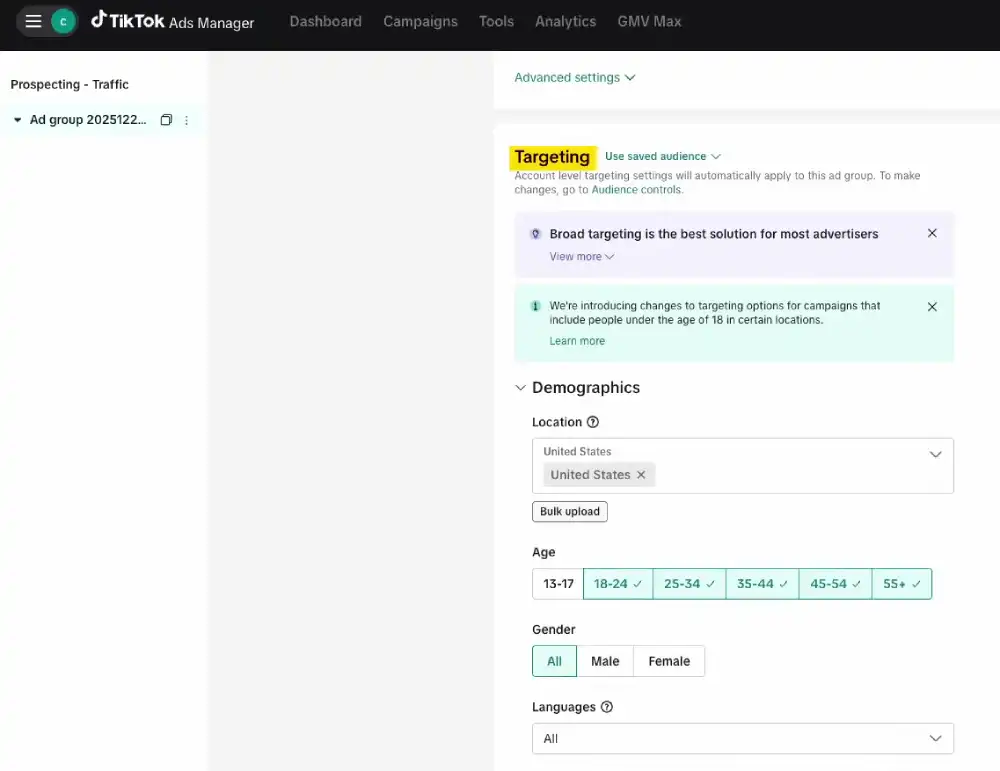
One campaign can contain multiple ad groups. Each ad group represents a distinct targeting or placement strategy. A single ad group holds one audience definition, one placement selection, one schedule, and one bidding approach. If you want to test two different audiences, you build two ad groups inside the same campaign.
You set your bid strategy at the ad group level. TikTok offers Lowest Cost, Cost Cap, and Minimum ROAS as primary options. Lowest Cost lets TikTok spend your budget to generate the most results at the lowest possible cost. Cost Cap tells TikTok to maintain a specific cost per result. Minimum ROAS sets a revenue return floor, primarily used in catalog and conversion campaigns.
Your ad delivery schedule lives here, too. You can run ads continuously or restrict delivery to specific hours and days.
Targeting options available at the ad group level
TikTok gives you a layered targeting toolset at the ad group level. You can define your audience using four primary methods.
Demographics: Target by age, gender, location, language, and device type.
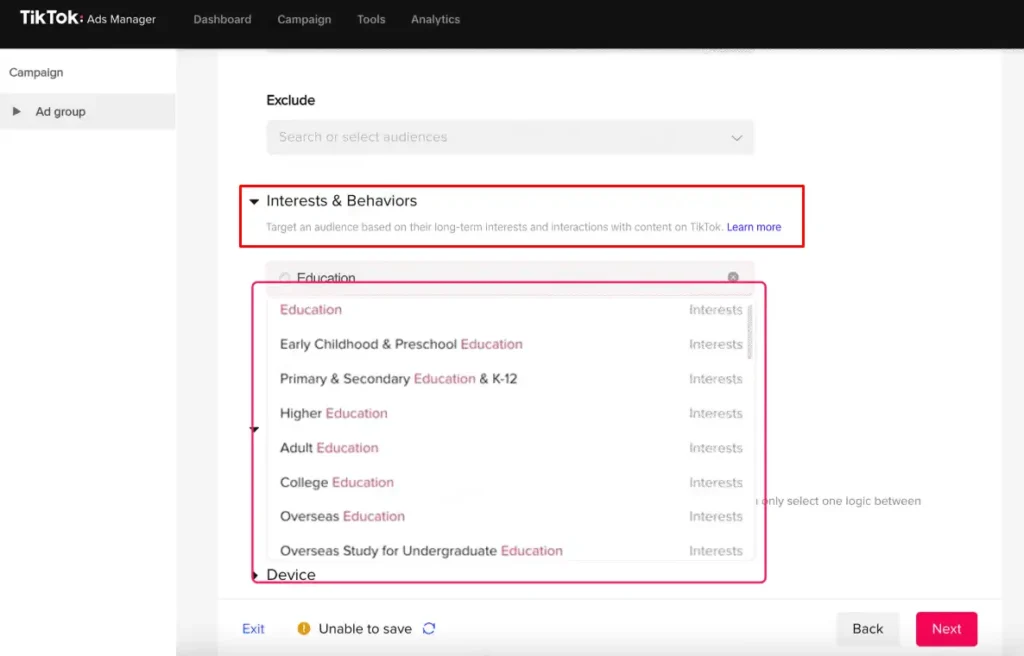
Interests and Behaviors: Reach users based on content categories they engage with or specific actions they have taken on TikTok recently, such as watching, liking, or sharing videos in particular verticals.
Custom Audiences: Upload your own customer data, retarget website visitors through the TikTok Pixel, or build audiences from app event data. Your Pixel must be installed and firing correctly before these audiences become usable. According to TikTok for Business, you need a minimum of 1,000 total matched users in a Custom Audience before you can use it in an ad group.
Lookalike Audiences: TikTok builds a new audience modeled on the behavioral patterns of your existing custom audience. According to TikTok’s official Lookalike Audiences documentation, the minimum source audience size for lookalike creation is 1,000 matched users.
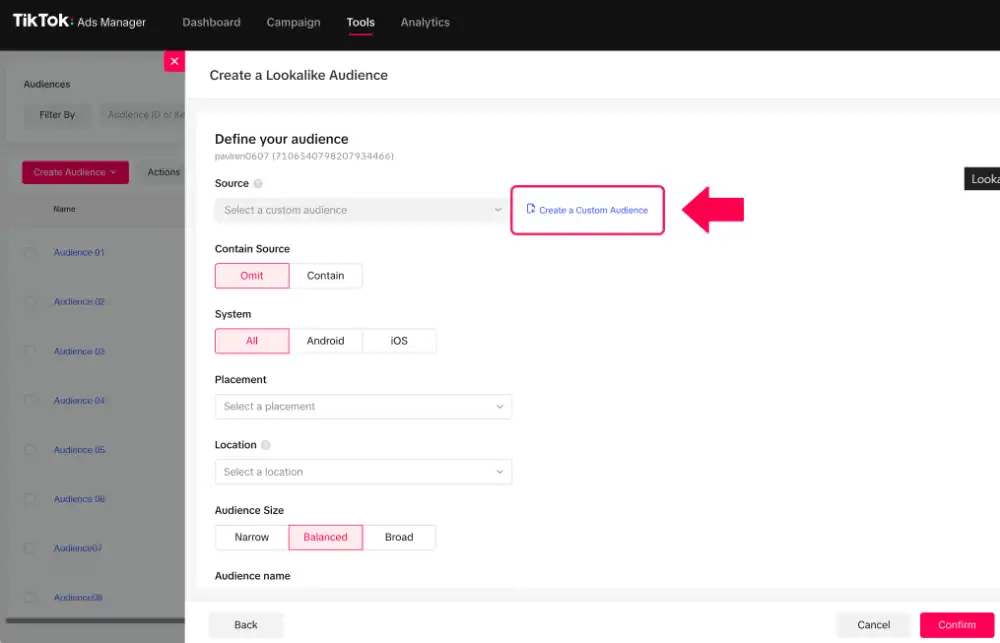
You can also run with minimal targeting and let TikTok’s algorithm find your audience automatically using the Broad Audience option. This works best when you have strong creative and a clean, verified conversion signal coming from your Pixel.
Placements include TikTok’s native feed and placements across TikTok’s partner apps through the Pangle network. You can select placements manually or enable automatic placement and let TikTok optimize across them.
Level 3, ad: where your creative either wins or loses
The ad is the most visible part of your structure, but it is the last decision you make, not the first.
Each ad group can contain multiple ads. According to TikTok for Business creative best practices, TikTok recommends uploading three to five ads per ad group so the algorithm has enough creative variation to optimize against. One ad per ad group starves the system of signal.
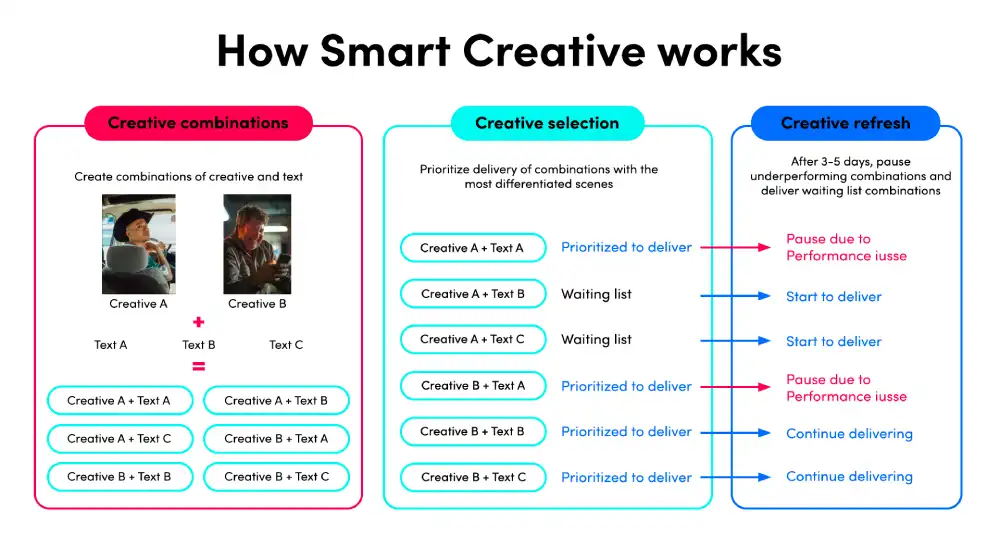
At the ad level, you control the following:
- Video or image creative: TikTok is a video-first platform. The native vertical, full-screen, sound-on format consistently outperforms static images for most objectives. According to TikTok for Business research published in their creative conversion study, in-feed video ads between 21 and 34 seconds received a 280% lift in conversion compared to videos outside that range.
- Ad copy and text overlay: Your character count is limited, so your copy must be direct and visually aligned with what the video shows.
- Call to action: You choose from pre-set CTA buttons, including Shop Now, Learn More, Sign Up, and Download. The CTA you choose should match the campaign objective you set at the campaign level.
- Destination URL: For traffic and conversion objectives, you link directly to your landing page here.
- Spark Ads toggle: Spark Ads let you boost an existing organic TikTok post as a paid ad unit. The post must come from an account you own or one that has been granted explicit permission. Spark Ads frequently generate higher engagement rates because they appear to come from a real creator profile rather than a brand ad account.
How all 3 levels work together: a practical example
Here is a realistic setup that shows you how all three levels connect in practice.
Scenario: You run an ecommerce brand selling running shoes. Your goal is to drive purchases directly from TikTok.
Campaign level: You create one campaign with the Conversions objective, set to optimize for Website Conversions. You set a Daily Budget of $100. CBO is off because you want to control the ad group’s spending manually.
Ad group level: You build two ad groups inside this campaign.
- Ad Group 1 targets a Lookalike Audience built from your past purchasers, ages 22 to 35, United States only. Automatic Placements is enabled. Bid strategy is Lowest Cost. Daily budget is $50.
- Ad Group 2 targets an Interest-based audience using the Fitness and Wellness category, ages 18 to 34, United States only. Same placement and bid settings. Daily budget is $50.
Ad level: Inside each ad group, you upload three video ads. Each video is in the 21 to 34-second range. Each video uses a different creative angle: one focuses on product features, one on lifestyle context, and one on a user testimonial format. All three link to the same product landing page with a Shop Now CTA.
Now TikTok can test your lookalike audience against your interest-based audience, and test three creative directions simultaneously, without those tests interfering with each other. That clean separation is the structural advantage working in your favor.
Smart+ and Search Campaigns: how they change the standard structure
TikTok introduced two campaign types that deliberately alter the standard three-tier model: Smart+ Campaigns and Search Campaigns.
Smart+ Campaigns reduce the need for manual ad group configuration. According to TikTok’s official Smart+ documentation, Smart+ uses TikTok’s AI to automate campaign and audience targeting, optimization, and creative delivery in a single campaign, across Web, App, Lead Generation, and Traffic objectives.
You give Smart+ your KPIs, creative assets, and target geography and language, and TikTok handles audience targeting, bidding, placement, and creative optimization from there, including automatically shifting budget toward your best-performing creative and pausing weak performers. Turning off Smart+-generated creative is possible, but the targeting and delivery automation itself isn’t split into separate manual-control tiers the way a standard campaign is.
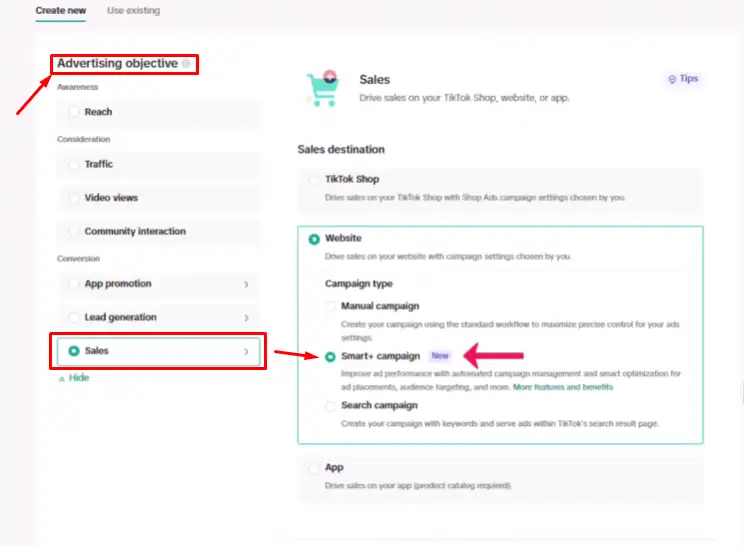
Smart+ works best when you have substantial pixel data, a verified conversion event with enough volume, and a strong variety of creatives available for the system to test. The core trade-off is time savings in exchange for less direct control over individual ad group variables. For new advertisers or those entering a new market, the standard structure gives you more diagnostic visibility and clearer feedback on what is actually driving performance.
Search Campaigns add a distinct layer to the standard structure: keyword groups. Inside a Search Campaign, you still work within campaigns and ad groups, but you also define keyword lists that determine when your ads appear inside TikTok’s search results. This is the closest TikTok has come to Google Search-style intent-based targeting.
Search Campaigns currently perform best for brands with strong name recognition or products people actively search for on TikTok, such as beauty products, food and beverage, and consumer electronics. For most direct-response advertisers, in-feed campaigns still drive the majority of conversion volume.
If you are building campaigns in 2026, the standard three-tier model remains your foundation. Smart+ and Search are real structural alternatives, but only when your pixel data and creative library are mature enough to support them.
5 common TikTok ad structure mistakes (and how to fix them)
- Running one ad per ad group. TikTok’s algorithm needs creative variation to optimize delivery. A single ad gives the system nothing to compare. According to TikTok for Business creative best practices, you should upload three to five video ads per ad group during the first four to seven days of a new campaign so the algorithm can identify your best performer.
- Setting your budget at the wrong tier. When you enable CBO, your budget belongs at the campaign level. When you do not use CBO, it belongs at the ad group level. Accidentally setting a campaign budget without activating CBO causes delivery errors or uncontrolled overspend. Confirm where your budget is set before you publish.
- Over-segmenting ad groups. Splitting your audience into too many small ad groups fragments your conversion data and slows the algorithm’s learning period. Per TikTok’s own learning phase documentation, volatility only starts to decline around 25 results, and TikTok’s budget guidance sizes a healthy daily budget around reaching 50 conversions. If your budget cannot support that across five ad groups, consolidate into two or three.
- Choosing the wrong campaign objective. Setting a Traffic objective when your actual goal is purchases tells TikTok to find people who click, not people who buy. These are measurably different user segments. The algorithm optimizes for exactly what you tell it to. Match your objective to the downstream action you actually want to drive.
- Ignoring the Spark Ads option. Many advertisers build net-new ad creatives when they already have organic TikTok content outperforming their paid assets. Spark Ads let you put paid budget behind your best organic posts without losing accumulated social proof, meaning your existing likes, comments, and shares stay visible on the ad. If you have organic content with strong engagement, test it as a Spark Ad before commissioning new production work.
Frequently asked questions about TikTok Ads Structure
How many ad groups can you have in one TikTok ad campaign?
TikTok Ads Manager does not publish a hard cap on ad groups per campaign in its standard documentation. In practice, most advertisers run two to six ad groups per campaign to keep budgets meaningful at each level. Running too many ad groups on a limited daily budget means no single ad group collects enough conversion data to exit the learning phase, which leads to unstable delivery across the board.
What is the minimum budget for TikTok ads?
According to TikTok for Business, the minimum daily budget at the campaign level must exceed $50 USD. The minimum daily budget at the ad group level must exceed $20 USD. For lifetime budgets, the ad group minimum is calculated by multiplying $20 by the number of scheduled days your campaign will run. These figures apply to standard auction ads and may vary by region, so you should verify current requirements directly inside your Ads Manager account before planning a campaign.
What is the difference between a TikTok campaign, ad group, and ad?
A campaign sets your advertising objective and defines whether you are optimizing for awareness, consideration, or conversion. An ad group sits inside the campaign and controls your audience targeting, placement, schedule, and bid strategy. An ad is the individual creative unit inside an ad group, containing your video or image, copy, CTA button, and destination URL. Each level controls a distinct part of the process, and they must align with each other to produce consistent results.
How does TikTok’s campaign structure compare to Google Ads?
Both TikTok and Google Ads use three tiers, but the logic at each tier differs significantly. Google’s Ad Group level includes keyword targeting, which drives search intent matching. Standard TikTok in-feed campaigns have no keyword layer, though Search Campaigns add limited keyword targeting. On Google, your ad copy and extensions carry heavy weight. On TikTok, the video creative itself is the primary performance driver, and the algorithm uses it as both a creative and an audience signal.
What happens to my ad groups when I turn on Campaign Budget Optimization?
When you enable CBO, TikTok’s system takes control of budget distribution across your ad groups. You can still apply minimum and maximum spend limits per ad group to prevent one group from absorbing the entire budget. However, the algorithm will actively redistribute spend toward the ad groups generating the strongest results for your campaign objective. Your individual ad group budget settings function as guardrails rather than fixed allocations.
Is TikTok’s Smart+ Campaign a replacement for the standard 3-level structure?
Smart+ is not a replacement. It is an alternative that reduces manual setup by letting TikTok handle targeting, bidding, placement, and creative decisions inside a single automated campaign. The standard three-level structure gives you more granular control, more diagnostic data visibility, and more ability to isolate and test specific variables. Smart+ is practical when you have mature pixel data and want to scale without managing multiple ad groups manually. For new advertisers or those entering a new market, the standard structure provides clearer feedback on what is actually working.
Where to go deeper on each part of the structure
This guide covers the three-level framework itself. Each piece of it, from funnel sequencing to tracking, has its own dedicated breakdown:
TikTok Ads Funnel and the Funnel Template guide cover how to sequence campaigns across TOFU, MOFU, and BOFU inside this structure. The TikTok Campaign Lifecycle explains what happens to a campaign after launch, from learning through retirement, and the Learning Phase guide covers that stage in depth. TikTok Ad Scheduling covers dayparting at the ad group level.
On the targeting side, TikTok Ads Targeting covers the full targeting toolset, TikTok Custom Audiences, TikTok Lookalike Audiences, TikTok Audience Insights, and the complete TikTok interests list go deeper on each targeting method.
On tracking, TikTok Attribution, the TikTok Conversion API, TikTok Pixel setup for eCommerce, and TikTok Ads and iOS tracking (ATT) cover how TikTok measures what your structure delivers.
Conclusion
TikTok ads structure is not a technical formality you complete once before moving on to creative. It is the foundation that determines how efficiently your budget works, how quickly the algorithm reaches the right audience, and how clearly you can read your own results.
The three levels each carry a specific responsibility that the others cannot cover. Your campaign sets the objective. Your ad group defines the audience and controls the mechanics of spend. Your ad delivers the message that either earns attention or loses it. When each level does its own job cleanly, the system runs with less waste, faster optimization, and more actionable data.
We covered why the hierarchy exists, what each tier controls in practice, how Smart+ and Search Campaigns alter the standard model, and where the most common structural errors occur. The same logic applies whether you are spending $50 per day or $5,000 per day. Budget scale changes the size of your results. Structure quality determines the reliability of them.
A strong creative inside a broken structure will consistently underdeliver. Get the foundation right first, and the creative has a real chance to work.
Sources
- TikTok’s official Campaign Budget Optimization documentation
- TikTok’s official Custom Audiences documentation
- TikTok’s official creative best practices
- TikTok for Business: creative conversion study
- TikTok’s official Smart+ Campaign documentation
- TikTok’s official Learning Phase documentation
- TikTok’s official Bidding and Budget guidance