
TikTok doesn’t allow paid political advertising, full stop. That’s a ban, not a restriction, and it applies to candidates, parties, elected officials, ballot measures, and issue advocacy alike.
Regulated industries like gambling, financial services, and alcohol sit in a different category entirely. TikTok allows ads in these spaces, but only through a certification or licensing process, with specific disclaimers and audience restrictions attached.
Mixing these two categories up is the most common mistake advertisers make. This guide covers each separately, building on the broader TikTok Ads policy overview, what’s actually banned versus what’s restricted-with-approval, and what TikTok requires in each case.
Table of Contents
Get Up to $6,000 in Free TikTok Ad Credits
TikTok offers ad credit incentives for new advertisers, helping you test campaigns with a lower upfront cost.
Key Takeaways
- TikTok bans paid political advertising entirely: candidates, parties, elected officials, ballot measures, and issue ads promoting or opposing government policy are all prohibited, with no certification path around it.
- Political figures and entities can’t advertise on TikTok at all, even for non-political products or causes.
- Government and intergovernmental entities are the narrow exception, but only after working directly with a TikTok sales rep and completing certification, and only for a limited set of approved categories.
- Regulated industries like gambling and financial services aren’t banned. They require certification or licensing, mandatory disclaimers, and audience restrictions before an ad can run.
- TikTok’s advertising policy index covers 19 distinct categories in total. Some, like gambling, financial services, and alcohol, follow the certification-and-restriction pattern; others, like suicide and self-harm, are zero-tolerance bans closer to how political advertising works.
Political Advertising: What’s Actually Banned
TikTok’s position on paid political advertising is absolute. Per its own politics, governments, and elections policy, paid political ads aren’t allowed across any monetization feature, including standard paid ads, compensated branded content, and tools like Promote.
The ban covers referencing, promoting, or opposing current executive, legislative, or judicial officials, current candidates or nominees for public office, political parties, and anyone currently holding a leadership position in one.
It also covers advocacy for or against elections, referenda, ballot measures, and government policy outcomes.
This extends to who can advertise, not just what an ad says. Political figures and entities, sitting officials, candidates, political parties, and PACs, can’t run ads on TikTok at all, even for something unrelated to politics.
Merchandise is covered too. You can’t sell or promote items featuring a prohibited individual, campaign slogans, or party symbols.
Additional restrictions apply on top of this baseline where local law requires it. In the EU, for example, TikTok doesn’t allow ads during election periods that could influence the outcome of that election, per the region’s Transparency and Targeting of Political Advertising Regulation.
The Narrow Exception: Governments and Election-Oversight Bodies
Two specific types of entities get a path to advertise that isn’t available to anyone else.
Government and intergovernmental entities can advertise, but only after working directly with a TikTok sales representative and completing certification.
Even then, they’re limited to promoting tourism, cultural or entertainment initiatives, public health and safety information, and employment or volunteer opportunities, all targeted only within their own home region.
Official entities responsible for overseeing elections or referendums get a separate, narrower allowance: ads limited strictly to the logistics of participating (registration, procedures, voter turnout), never advocacy for a candidate or outcome. These advertisers also can’t target by gender or age.
Everyone else advertising anything election-related, appeals for votes, voter registration drives, participation campaigns, stays banned regardless of intent.
Regulated Industries: Restricted, Not Banned
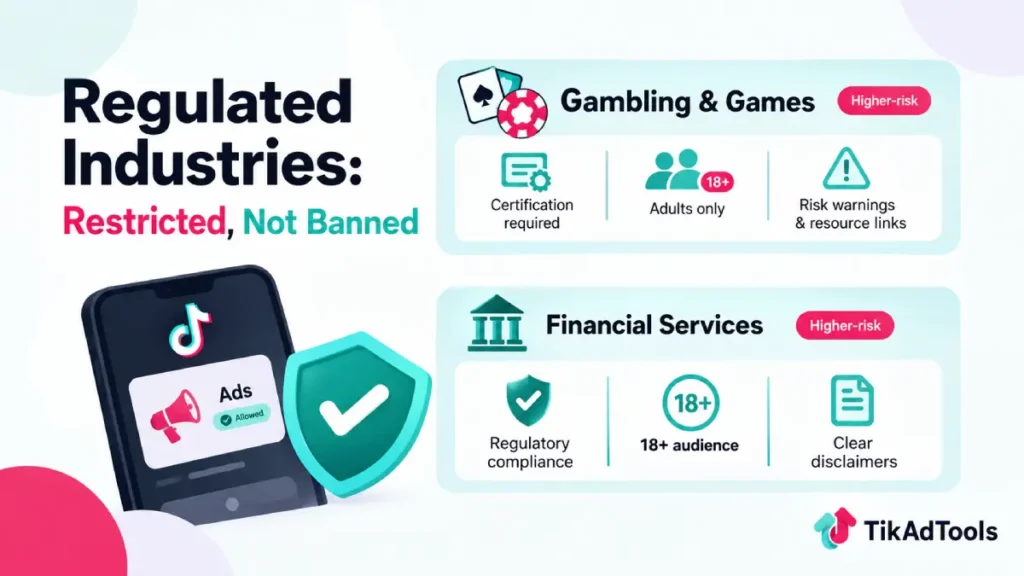
Gambling, financial services, alcohol, and several other categories work differently from the political ban. TikTok allows advertising in these spaces, but treats them as higher-risk and layers on certification, licensing, disclaimers, and audience limits before an ad can go live.
Gambling and Games
Gambling ads require going through TikTok’s certification process before they can run, per its gambling and games policy. Certification confirms your licenses and legal compliance in the specific market you’re targeting.
Beyond certification, gambling ads are restricted to markets where gambling is legal, can’t target minors, and need to promote responsible gambling practices, clear risk warnings, legally required disclaimers, and links to addiction resources where possible.
TikTok’s definition of “gambling” is broader than casinos and sports betting. It also covers gambling-adjacent categories like fantasy sports, mystery-box style purchases, sweepstakes, lotteries, and content that gives betting strategies or odds analysis.
Financial Services
Financial services ads, banking, insurance, investments, lending, debt relief, need enhanced transparency under TikTok’s financial services policy.
Requirements generally include compliance with local financial regulations, licensing by the relevant authorities, proper disclaimers, and restricting the audience to adults 18 and older.
Get-rich-quick offers, pyramid schemes, and too-good-to-be-true financial claims are explicitly named as not allowed, regardless of licensing status.
Other Regulated Categories
TikTok’s full advertising policies index covers 19 categories in total, and they don’t all work the same way. Alcohol follows the same license-and-disclaimer pattern as gambling and financial services, per TikTok’s own alcohol policy.
Other categories are closer to the political ban than to gambling. Suicide and self-harm content, for instance, is a zero-tolerance prohibition with no certification path, per TikTok’s suicide and self-harm policy. Most of TikTok’s adult content policy is an outright ban too, with only a couple of narrow, market-specific exceptions for things like dating apps.
Healthcare and pharmaceuticals sit in a third bucket: part ban, part restriction. TikTok’s own healthcare and pharmaceuticals policy states plainly that some healthcare-related content can’t be advertised at all, while other parts, like over-the-counter medicines or medical devices, can run if market-specific requirements are met.
Check the specific policy for your category before assuming it works like gambling or alcohol.
Common Mistakes to Avoid
Assuming a “restricted” category means “banned, but I can work around it with certification” is the reverse of how gambling and financial services actually work, certification is the legitimate path, not a workaround.
The opposite mistake is just as common: assuming political content just needs the right disclaimer or certification, the same way gambling and financial services do. It doesn’t. There’s no certification path that unlocks paid political advertising on TikTok, the ban has no exception for standard advertisers.
Running an ad for a legitimate, unrelated product from an account that also happens to belong to a sitting official or political party is another trap. The account-level restriction applies regardless of what the specific ad promotes, and it’s exactly the kind of issue that surfaces as an ad violation rather than a simple rejection.
If you’re advertising in a regulated category, run your setup through the Ad Compliance Checker before launch, certification and disclaimer requirements are easy to miss on a first campaign, and catching a gap before you spend is cheaper than catching it after a rejection.
Frequently Asked Questions
Can I run a political ad on TikTok if I get it certified first?
No. TikTok doesn’t offer a certification path for paid political advertising, unlike gambling or financial services. The ban applies regardless of certification, disclaimers, or targeting restrictions.
Are issue ads treated differently from candidate ads on TikTok?
No. TikTok’s policy explicitly covers advocacy for or against government policies, legislative outcomes, and ballot measures, not just ads that name a candidate or party.
Can a government agency advertise on TikTok?
Yes, but only after working directly with a TikTok sales representative and completing certification, and only for a limited set of approved categories like tourism, public health information, and employment opportunities within their own region.
Is gambling advertising banned on TikTok?
No. Gambling ads are allowed in markets where gambling is legal, once an advertiser completes TikTok’s certification process and meets age, geographic, and responsible-gambling requirements.
Does TikTok require special approval for financial services ads?
Yes. Financial services advertisers need to meet licensing and local regulatory requirements, include proper disclaimers, and restrict their audience to adults 18 and older, per TikTok’s financial services policy.
Conclusion
TikTok draws a hard line between two very different situations. Paid political advertising is banned outright, with no certification path for standard advertisers and only a narrow, heavily restricted exception for governments and election-oversight bodies.
Regulated industries like gambling and financial services are the opposite case: allowed, but gated behind certification, licensing, disclaimers, and audience restrictions specific to each category.
Check the specific policy for your industry before launching. Some categories, like gambling, financial services, and alcohol, run purely on certification. Others, like healthcare and adult content, mix outright prohibitions with narrow, conditional exceptions, so don’t assume every regulated category works the same way.
Sources
- TikTok’s official documentation: Politics, Governments, and Elections
- TikTok’s official documentation: Gambling and Games
- TikTok’s official documentation: Financial Services
- TikTok’s official documentation: TikTok Advertising Policies index
- TikTok’s official documentation: Alcohol
- TikTok’s official documentation: Suicide and Self-Harm
- TikTok’s official documentation: Adult Content
- TikTok’s official documentation: Healthcare and Pharmaceuticals