
Luxury brands keep bringing their TV ad mentality to TikTok. Slow piano. Cinematic wide shots. The product appearing at second 20. That’s not a TikTok ad. That’s a brand film stuck in the wrong format.
The brands winning in luxury on TikTok understand one thing: aspiration and nativeness aren’t opposites.
You can run a premium brand and still look like TikTok. If you don’t figure that out, your CPMs will stay high, and your results won’t justify the spend.
Here’s what the campaigns that actually convert are doing differently.
Table of Contents
Get Up to $6,000 in Free TikTok Ad Credits
TikTok offers ad credit incentives for new advertisers, helping you test campaigns with a lower upfront cost.
TL;DR
- Luxury TikTok ads fail when brands try to look elevated instead of native.
- High-end creative should open with desire, not brand identity or price.
- Funnel structure matters more than creative polish for luxury conversion.
Quick Answer
TikTok ads work for luxury brands when the creative is built for the platform, not repurposed from TV or Instagram. Pair aspirational native content at the top of the funnel with tight retargeting and a structured conversion layer underneath.
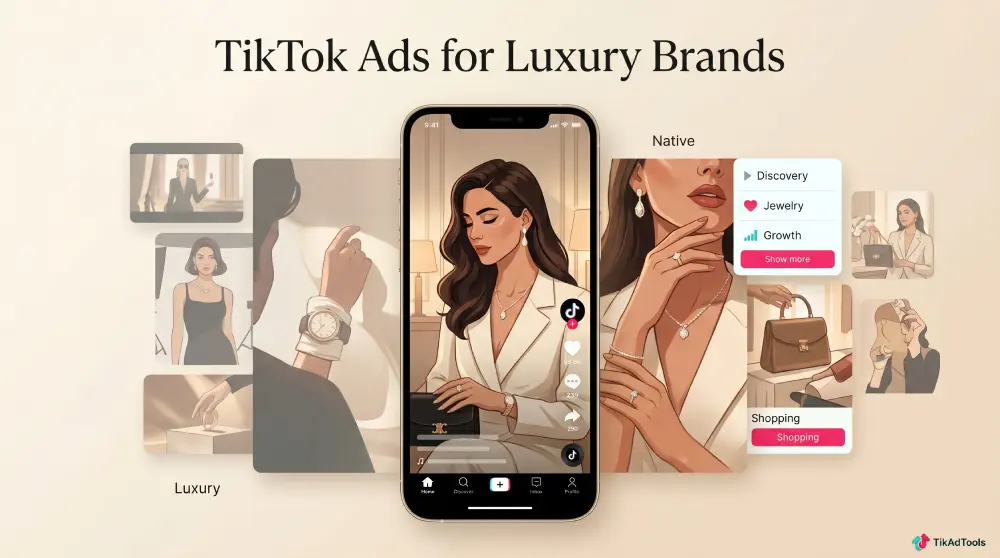
Why most luxury TikTok Ads fall flat
TikTok users scroll fast. Even high-income users. If your ad doesn’t stop the scroll in the first two seconds, you’ve already lost them regardless of how much your brand is worth.
Most luxury brands open with a logo, a tagline, or a slow pan across a product on marble. None of that stops a scroll. The hook has to create a feeling before it creates a brand impression.
The fix isn’t to look less premium. It’s to think like a creator, not a brand director.
The creative framework that works for luxury
Don’t open with your brand. Open with desire. Show the product being worn, unboxed, or applied in a way that makes the viewer want the experience before they even know what it is.
Your first three seconds should trigger aspiration, not recognition. That’s a hard mindset shift for most luxury marketing teams. It’s also non-negotiable on TikTok.
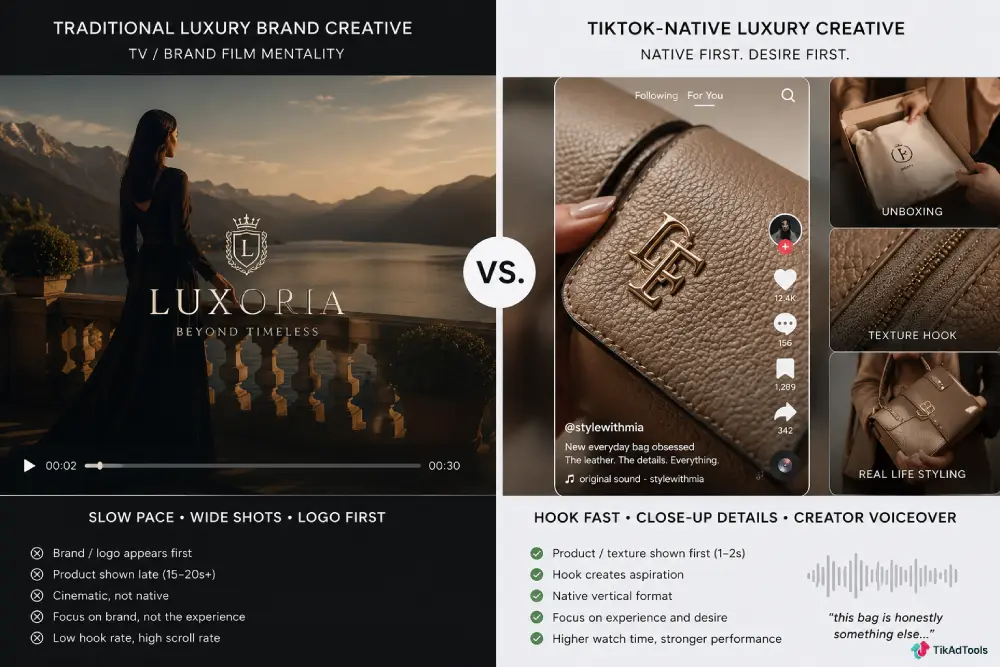
After the hook, lean into texture and detail. Luxury consumers respond to close-up material shots: leather grain, fabric weight, the embossed texture of packaging. TikTok’s vertical format handles close-up detail extremely well. Use it.
Sound design converts more than most luxury brands realize. Heels on marble. The zip of a jacket.
The thud of a high-end handbag placed on a table. These sounds signal quality without saying a word. Silence kills luxury ads on TikTok more reliably than weak visuals.
Campaign structure for high-end advertisers
Luxury on TikTok isn’t a single campaign. It’s a funnel with three layers, each running a separate objective.
Awareness layer: Use In-Feed Brand Awareness or TopView. Reach new users who fit your buyer profile. Run CPM bidding. Keep weekly frequency under 3 per ad group, or fatigue will cut performance before the algorithm learns.
Consideration layer: Retarget users who watched 75% or more of your awareness creative. This is a warm audience. Push them toward a product page, a lookbook, or a longer editorial video. Don’t skip this layer. Luxury buyers need multiple touchpoints before they’re ready to act.
Conversion layer: Retarget website visitors and high-engagement viewers from the consideration step. This is where you run TikTok conversion ads with product-specific creative. Not brand campaigns. Specific SKUs, specific offers, specific calls to action.
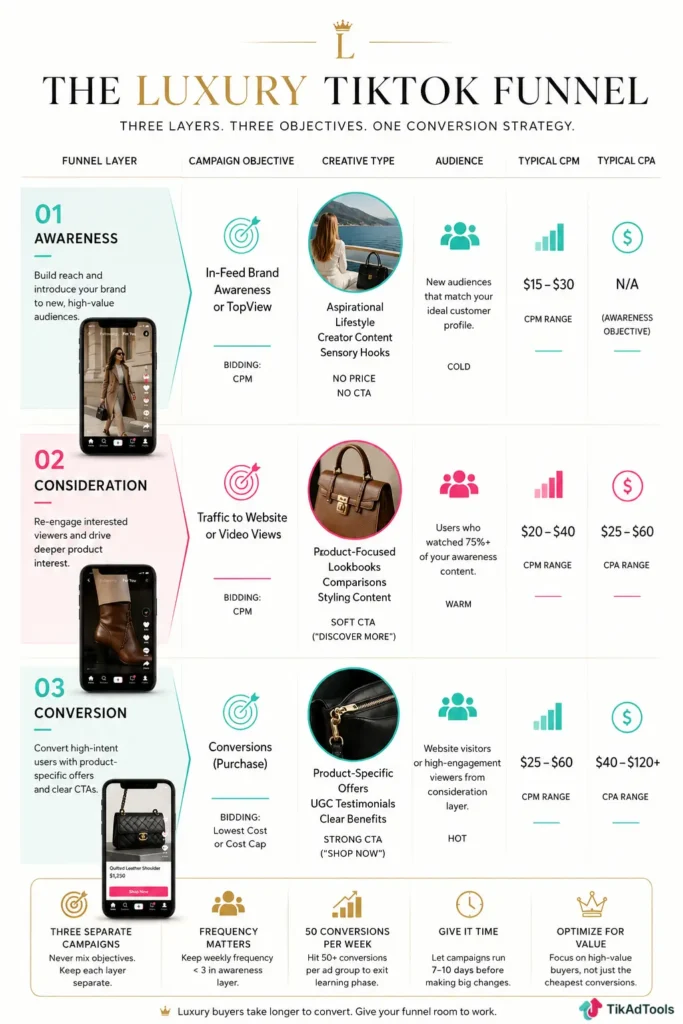
Run each layer in separate campaigns. Never mix objectives. Luxury buyers take longer to convert than DTC impulse buyers, and the funnel needs room to breathe.
Real-world case study: Fairfax & Favor on TikTok
Fairfax & Favor is a British luxury footwear and accessories brand. They run the kind of campaign most luxury brands are too cautious to try. The results prove they shouldn’t be.
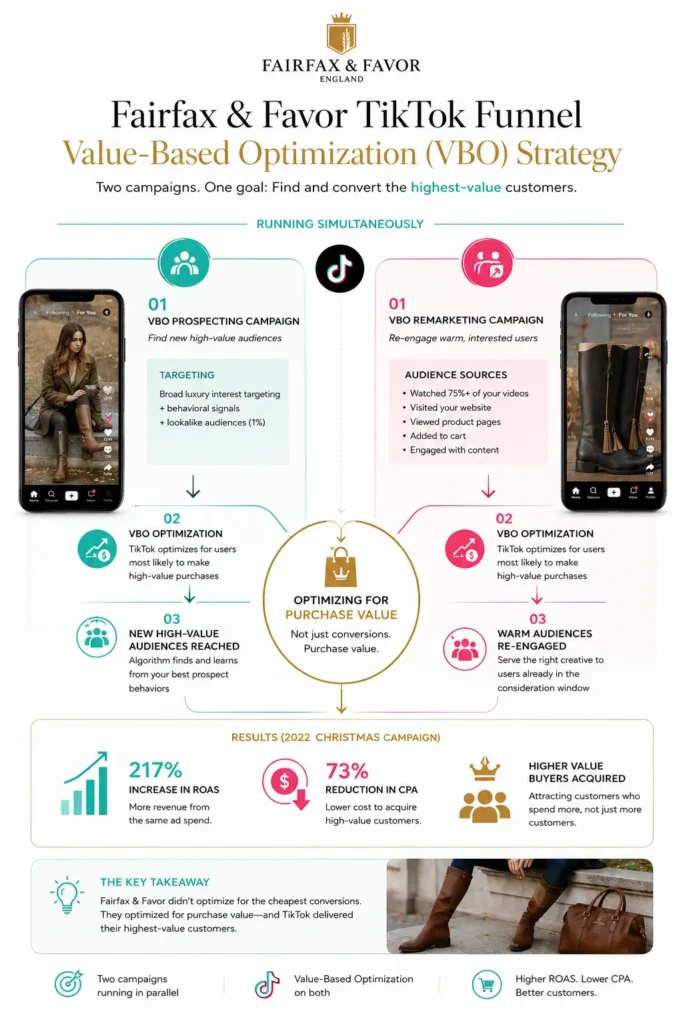
During the 2022 Christmas period, Fairfax & Favor partnered with their agency, Lane Media, to run a TikTok campaign specifically built to find and convert their highest-value customers.
The core tactic was Value-Based Optimization (VBO), a TikTok bidding approach that targets users based on purchase value rather than just conversion volume.
Instead of finding the cheapest conversions, VBO hunts for the highest cart-value buyers.
The campaign ran a prospecting layer alongside a remarketing layer simultaneously. Prospecting went after new audiences who matched their buyer profile. Remarketing hit users already in the consideration window.
Both layers ran with VBO active, so the algorithm was always optimizing for purchase value, not just purchase volume.
According to TikTok for Business, the campaign delivered a 217% increase in ROAS alongside a 73% reduction in CPA during the campaign period. (source)
The lesson here isn’t “use VBO.” It’s that luxury brands on TikTok should be optimizing for value, not just conversions.
Most luxury accounts run standard conversion campaigns and wonder why their average order value looks low.
The algorithm finds what you ask it to find. Ask it for high-value buyers, and that’s who it delivers.
How to target luxury audiences on TikTok
Broad targeting won’t work here. You need to layer interest signals, not stack them and hope. Start with the right categories, then add behavioral signals on top.
Interest categories to build from: Fashion and Style, Luxury Goods, Travel (target the luxury sub-category), Fine Dining, High-End Skincare and Beauty. Layer those with household income signals where your market makes them available.
Don’t skip Custom Audiences. If you have a customer email list, upload it and build a lookalike.
A 1% lookalike from a premium purchaser list outperforms cold interest targeting for most luxury verticals. The algorithm finds similar buyers better than manual interest stacking does.
Age targeting is worth a second look. According to DataReportal, the 25–34 age group now makes up 35.3% of TikTok’s global ad audience and is the platform’s largest demographic. The 35–44 bracket is at 16.4% and growing.
These users carry more immediate purchase intent for luxury than younger cohorts. Don’t exclude younger audiences entirely, though.
Gen Z’s aspirational behavior drives a lot of luxury discovery on the platform, even when the conversion takes longer.
What luxury brands get wrong with TikTok budgets
Most luxury brands underfund TikTok relative to Meta, then conclude the platform doesn’t work. That’s not a platform problem. It’s a budget problem.
TikTok’s official minimums are $50 per day at the campaign level and $20 per day at the ad group level. But those are floors, not performance thresholds.
For luxury, where CPAs run higher and purchase cycles are longer, you need to budget above those minimums to give the algorithm enough signal to learn.
TikTok’s algorithm needs at least 50 conversion events per ad group per week to exit the learning phase and optimize reliably.
If you’re not hitting that volume, shift your campaign objective to Add to Cart or Initiate Checkout first. Let the algorithm train on lighter signals before you push for full purchases.
Don’t pull budget after three days. Luxury campaigns on TikTok take longer to learn than fast-fashion or impulse DTC.
Give each campaign at least 7 to 10 days before making structural changes. If you’re new to TikTok advertising, check whether your account qualifies for ad credit through TikTok. New advertiser incentives cut the effective cost of the learning phase.
Should luxury brands use TikTok pulse?
Yes, for awareness objectives specifically. TikTok Pulse places your ads adjacent to top-performing organic content in relevant categories.
For luxury, the Fashion, Beauty, and Lifestyle categories give you brand-safe placement next to content that’s already pulling high-intent users.
The tradeoff is cost. Pulse inventory is more expensive than standard in-feed. But for a brand that needs to control where its creative appears, the premium is worth it.
Brand adjacency matters more in luxury than it does in performance-first DTC campaigns.
Use Pulse for awareness layers only. Don’t run conversion objectives through Pulse placements. The audience is cold, the inventory is premium, and the goal is impression quality, not immediate return.
Do luxury brands need different ad creative for each layer?
Yes, and most accounts underinvest here. Different funnel layers need different creative intent, not just different calls to action.
Awareness creative should feel organic and aspirational. Creator content, lifestyle shots, and sensory hooks work here. Don’t put a price or a CTA in these videos. You’re building desire, not asking for a transaction.
Consideration creative can be slightly more product-focused. A closer look at a specific item. A creator comparing two products. A styling video that naturally features the product in context.
Conversion creative needs a clear call to action. Show the product, state a benefit, give the viewer one place to go. This is where TikTok ads copywriting decisions become critical. A vague CTA on an awareness video is fine. A vague CTA on a retargeted conversion ad wastes your budget.
Don’t reuse awareness creative in your conversion layer. It sends the wrong signal to the algorithm and confuses an audience that’s already seen it.
FAQs
Do luxury brands need a big following on TikTok for ads to work?
No. TikTok paid ads run independently of your organic account. A brand with zero followers can run a fully functional paid campaign. Performance is driven by creative quality, targeting setup, and budget, not follower count.
What video length works best for luxury TikTok ads?
Keep performance-focused ads between 15 and 30 seconds. For brand awareness objectives, up to 60 seconds is workable if the content holds attention throughout. Long-form brand films repurposed from TV or Instagram rarely hold watch time in-feed and won’t justify their CPM cost.
Can luxury brands use TikTok Shop effectively?
It depends on price point. Accessible luxury in the $50 to $300 range performs well through TikTok Shopping Ads. Aspirational luxury above $500 typically performs better by directing traffic to a branded website experience where the buyer has more time and trust signals before committing.
What’s the most common creative mistake luxury brands make on TikTok?
Opening with a logo or brand name. Nobody stops scrolling for a logo at second one. Open with the product, the texture, the experience. Pull the viewer in first. By the time they find out who made it, they’re already interested.
How do luxury brands measure TikTok ad success beyond ROAS?
Track view-through attribution alongside click-based data. Luxury buyers often see an ad, don’t click immediately, and convert later through a direct visit or branded search. Pure click ROAS underestimates TikTok’s actual contribution. Set your attribution window to at least 7-day click and 1-day view inside TikTok Ads Manager to see the full picture.
Final thoughts
Luxury on TikTok works. It just works on TikTok’s terms, not your brand guidelines. Native creative at the top, structured retargeting underneath, and enough budget to let the algorithm learn. That’s the whole playbook.