
Most subscription apps burn their first TikTok budget chasing installs. The download numbers look great. The subscriber count barely moves.
That gap is where most TikTok campaigns for subscription apps fail. Not because TikTok can’t drive subscription revenue. Because the setup gets built for volume, not for revenue.
Table of Contents
Get Up to $6,000 in Free TikTok Ad Credits
TikTok offers ad credit incentives for new advertisers, helping you test campaigns with a lower upfront cost.
TL;DR
- TikTok’s App Promotion objective offers four delivery options: Click, Install, In-App Event (AEO), and Value. You move between them based on your event volume, not a fixed weekly number.
- SKAN 4.0 reports iOS conversions across three windows: 0 to 2 days, 3 to 7 days, and 8 to 35 days. Don’t judge an iOS campaign before day 35.
- Hard paywalls convert about 5 times better than freemium by Day 35, 10.7% versus 2.1%, per RevenueCat’s 2026 State of Subscription Apps report.
- About half of paid conversions happen on Day 0, so onboarding and paywall placement matter more than most teams assume.
- Budget minimums, bid multipliers, and audience exclusions should come from your own subscriber data, not a universal industry rule.
Quick Answer
TikTok ads work for subscription apps when you optimize toward trial or purchase events instead of installs, and read performance from 30 and 60 day cohorts instead of Day 7 revenue. Get the optimization event and the measurement window right, and TikTok becomes a legitimate second channel next to Meta.
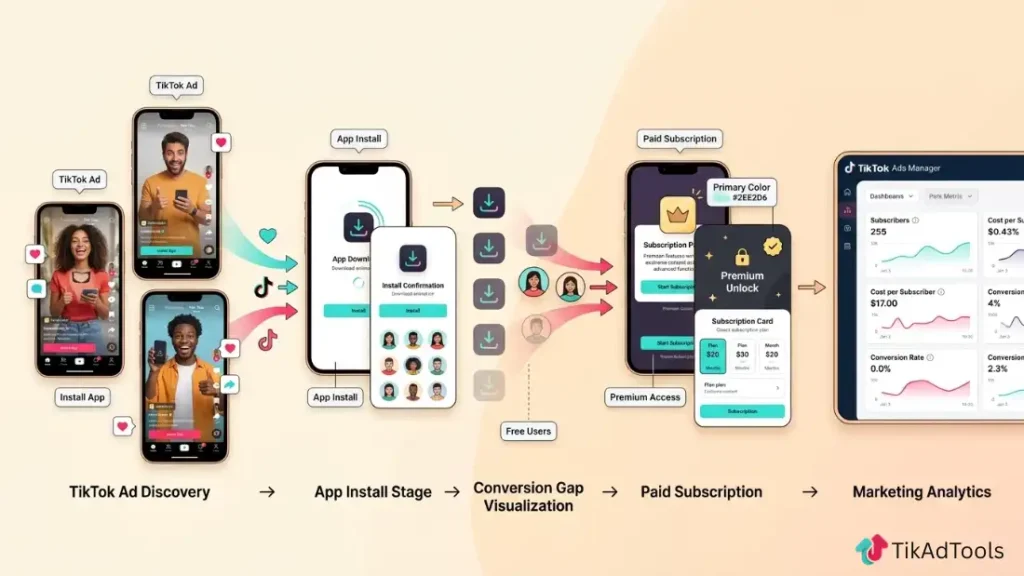
What are TikTok ads for subscription apps?
TikTok ads for subscription apps are paid placements built to drive installs, trial starts, and paid conversions, in that order. They work for subscription monetization only when the objective, the event you optimize toward, and your SKAN 4.0 setup all point at the same outcome.
Most teams get the ad format right and the objective wrong. That’s the gap this guide fixes.
Why TikTok is a viable channel for subscription growth
Skepticism about TikTok for subscription apps is fair. The platform skews young, and monetization journeys are long. Those concerns are real, but they’re manageable with the right setup.
Three things make TikTok worth testing for subscription acquisition right now:
- Distribution: TikTok for Business ranked third among non-gaming media sources for both iOS and Android installs globally in AppsFlyer’s Performance Index, based on 16.2 billion installs across 39,000 apps.
- Cost: Gupta Media’s tracker put TikTok’s average CPM at $6.21 in June 2025, and found TikTok running 49% to 53% cheaper than Meta during the 2025 holiday season.
- Creative speed: a 15-second In-Feed ad can’t waste time on branding, and that constraint tends to sharpen subscription messaging instead of diluting it.
Cheaper reach buys you room to test. It says nothing on its own about subscriber quality. For the full format-level breakdown against Meta, the TikTok vs Facebook ads guide covers it in full.
TikTok isn’t a replacement for Meta. It’s a legitimate second channel once your creative and optimization setup match how the platform actually works.
TikTok vs Meta for subscription apps
Picking between TikTok and Meta isn’t about which platform is universally better. It’s about which one fits your category, audience, and current CPAs.
| Factor | TikTok | Meta |
|---|---|---|
| Average CPM (2025) | $6.21 (Gupta Media, June 2025) | Ran 49% to 53% higher during the 2025 holiday period |
| iOS measurement maturity | SKAN 4.0, three windows, up to 41 days to fully mature | More established iOS attribution stack |
| Best-fit categories | Fitness, education, entertainment, story-driven products | Broader fit across categories |
| Optimization types | Install, AEO, Value (VBO) | Similar tiered structure, different naming |
| When to prioritize | Meta CPAs have plateaued; the team ships 4 to 6 new videos a month | Need more mature iOS reporting or a broader age range |
CPM tends to run lower on TikTok, per the Gupta Media figures above. SKAN 4.0 measurement is still less mature on TikTok than Meta’s iOS attribution stack, so factor that into how confidently you can read early iOS results on each platform.
Choosing the right TikTok ad format
The format decision should map to a stage in your funnel, not to whatever looks flashy in a case study.
| Format | Best for | Watch out for |
|---|---|---|
| In-Feed Ads | Core performance format, deep links to app store | None, this is your baseline |
| Spark Ads | Boosting a genuine creator or organic post | Needs creator permission and content worth amplifying |
| TopView Ads | Launch moments, seasonal pushes | CPMs run well above In-Feed, not a performance-first starting point |
In-Feed Ads are the baseline. They sit natively in the For You feed and support deep links to your app store listing, which makes this your core performance format for a new subscription app.
Spark Ads boost an organic post, either yours or a creator’s, with permission. This format is underused by subscription teams. When a creator posts a genuine review, turning it into a Spark Ad keeps the comment section and social proof intact while adding paid reach.
TopView Ads are the full-screen placement shown when someone opens the app. TikTok’s own regional rate cards put minimum daily spend for TopView in major markets well into six figures, which makes it a launch or brand-moment format, not a starting point for performance-first acquisition.
Start with In-Feed. Layer in Spark Ads once you have creator content worth amplifying, and save TopView for a specific moment rather than everyday spend.
How to set up your campaign for subscription revenue
Every setup decision, from objective to event mapping, affects whether the algorithm learns to find downloaders or subscribers.
- Pick your optimization type, not a threshold. Select App Promotion as your objective. Within it, TikTok gives you four delivery options: Click, Install, In-App Event (AEO), and Value.
- Structure ad groups by signal, not just temperature. Separate cold and warm audiences so acquisition and retargeting signals don’t mix in one ad group. Watch for overlap between the two pools, since heavy overlap just means you’re bidding against yourself.
- Choose a bid strategy that matches your data volume. Run Lowest Cost while you collect conversion events, typically the first one to two weeks. Once conversions are stable, test Cost Cap anchored to your own historical CPA, and don’t adjust your bid by more than 10% during the learning phase, which is what TikTok’s own guidance recommends.
- Map your full event chain. Connect your MMP (AppsFlyer, Adjust, or Singular) and define the chain: Install, Trial Start, Trial Converted, First Renewal. The TikTok attribution guide covers the MMP side in more depth.
- Get the SDK right, not the Pixel. For a native app, you’re working with the TikTok App Events SDK and your MMP’s postback setup, not the TikTok Pixel, which is a web tracking tool. Mixing the two up is a common setup mistake that quietly breaks event mapping.
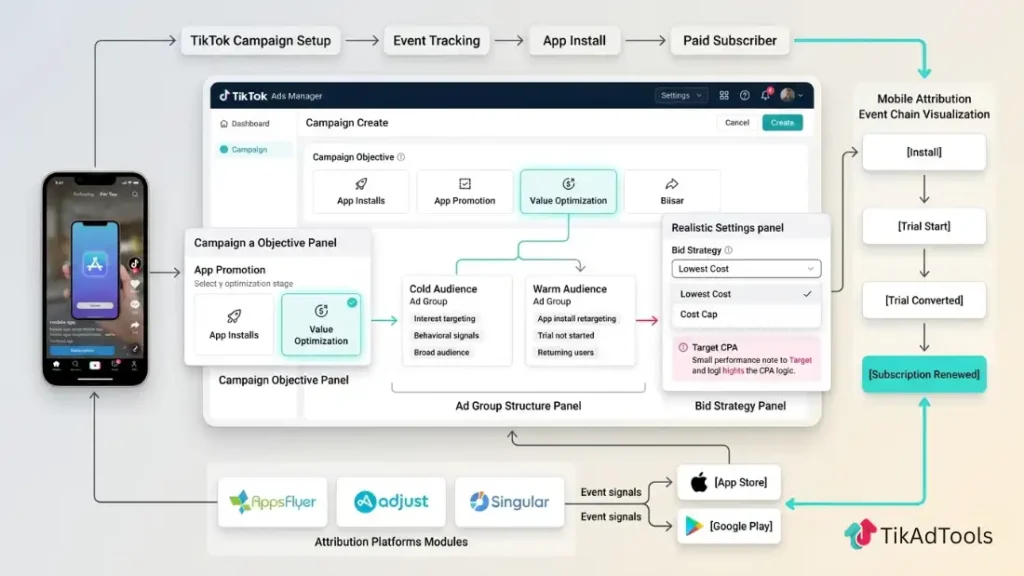
Which optimization type fits your event volume
| Your situation | Optimization type | Why |
|---|---|---|
| Little to no event volume yet | Install | Builds initial data and top-of-funnel reach |
| Some Trial Start volume, few Purchases | AEO on Trial Start | Deepest event you can reliably support |
| Steady Purchase or Subscribe volume | AEO on Purchase | More correlated with subscription intent than Trial Start alone |
| High, stable Purchase value data | Value-based Optimization | Targets users likely to generate higher purchase or ad revenue value; eligibility checked in Ads Manager |
Value-based Optimization has its own eligibility criteria that TikTok doesn’t reduce to one fixed weekly number. Check current eligibility inside Ads Manager for your specific account before you switch, since thresholds vary by setup.
Which optimization event actually drives subscribers
Install optimization finds the cheapest people to get through the door. That cohort has weak correlation with subscription intent.
Value-based Optimization tells TikTok to find users likely to generate higher purchase value, a real upgrade over install volume. It isn’t the same as understanding your 12-month LTV, though. If you’re only passing an initial purchase value, the algorithm has no visibility into renewals or refunds, so feed it those events too where your MMP supports it.
If you don’t have enough Purchase events yet, use AEO on Trial Start instead. Don’t treat that as a permanent default, though. If trial starts are cheap but trial-to-paid conversion is weak, you’re optimizing the wrong step, and it’s time to move deeper into the funnel.
Configuring SKAN 4.0 for a subscription funnel
SKAN 4.0 is Apple’s privacy framework for iOS attribution, and for subscription apps the schema needs real thought, not the MMP’s default template.
SKAN 4.0 attribution windows:
| Window | Timing | What it reports |
|---|---|---|
| Postback 1 | 0 to 2 days | Fine-grained conversion value where available |
| Postback 2 | 3 to 7 days | Coarse-grained conversion value |
| Postback 3 | 8 to 35 days | Coarse-grained conversion value |
TikTok reports SKAN 4.0 data across these three attribution windows. Postbacks in the second and third window can take up to 41 days to fully mature after a SKAN 4.0 transition, so evaluating an iOS campaign at day 10 gives you an incomplete picture.
Build your conversion value schema around your actual funnel:
- Install
- Onboarding complete
- Trial start
- Trial converted
- First renewal
Map that chain inside your MMP’s SKAN schema builder instead of leaving it on the app’s default.
Two SKAN limitations worth planning around:
- TikTok doesn’t provide age, gender, or geo breakdowns within SKAN reporting.
- If you need country-level performance, TikTok actually recommends consolidating countries into fewer campaigns to reduce privacy-withheld installs, the opposite of what most teams assume.
Expect discrepancies between your MMP and TikTok Ads Manager on iOS. TikTok’s own reporting guidance notes that MMPs report both SKAN-based and IDFA-based data, while TikTok’s dedicated iOS campaign reporting is SKAN-only, so treat any single number as a directional read, not a final one.
Targeting strategy for subscription intent
Targeting subscription intent is narrower than targeting install volume, and a few approaches are worth testing. None of them are guaranteed wins on their own.
- Interest stacking: layer your core category interest with a behavioral signal, like recent installs in your category, to narrow toward people with an existing pattern of paying for similar apps.
- Lookalike seeding: build a lookalike audience from your highest-LTV subscribers, people who’ve renewed at least once or twice. Test it against broad and interest-based targeting rather than assuming it wins by default, since results depend heavily on seed size and data quality.
- Age exclusions: review your own subscriber age distribution before excluding any cohort. A teenager whose parent is the actual payer behaves very differently from one with no payment method at all.
Before you upload any subscriber list for lookalike seeding, confirm you’re following your app’s consent and data-handling requirements. TikTok’s targeting policies already vary by market, so check current rules before assuming a cohort is off-limits everywhere.
Creative strategy that actually holds attention
Creative is where subscription campaigns win or lose. TikTok rewards native-feeling video that gets to the point fast, but that doesn’t mean polish is a liability.
Problem, agitate, solve, for cold traffic:
- Open on a specific problem, not your logo.
- Agitate it in one line.
- Introduce the app as the fix.
Save more polished, brand-forward creative for retargeting, where trust is already partly built.
Hooks get three seconds to earn the rest of the video. The strongest ones fall into a few patterns:
- An unexpected result.
- A direct challenge to a common assumption.
- A visual that shows the product doing something surprising in frame one.
Refresh creative when performance actually signals fatigue, not on a fixed calendar. Watch CTR alongside watch time and CVR together, since a CTR dip on its own can just as easily be seasonality. Our creative fatigue guide walks through the signals worth tracking.
If you’re using result-based claims like weight loss or income numbers, check them against current ad policy before you launch. Health and financial claims get flagged fast, and a rejected ad costs more time than a cautious first draft.
Free trial vs direct subscription: what 2026 data shows
Older advice says free trials “almost always” beat direct subscription. That’s too strong, and the newest data supports a more nuanced read.
Key numbers from RevenueCat’s 2026 State of Subscription Apps report:
| Metric | Hard paywall | Freemium |
|---|---|---|
| Day 35 download-to-paid conversion | 10.7% (median) | 2.1% (median) |
| Year-one retention | Nearly identical between the two models | Nearly identical between the two models |
| Trial length | Trial-to-paid conversion (median) |
|---|---|
| 4 days or fewer | 25.5% |
| 5 to 9 days | 37.4% |
| 17 to 32 days | 42.5% |
Freemium isn’t dead, it just monetizes on a longer curve, and year-one retention gaps between the two models largely close over time. The same report found close to half of all paid conversions happen on Day 0, with trial starts overwhelmingly landing the same day as install.
That puts more weight on your onboarding and paywall placement than on your ad targeting. If the funnel doesn’t build trust and show value in the first session, no amount of TikTok optimization fixes that downstream. Test both models, and trial length as its own variable, against your own category and price point instead of assuming one wins universally.
Budgeting and bidding for subscription LTV
Subscription budgeting works differently from one-time-purchase budgeting. You’re buying a cohort that pays out over months, not a single transaction.
Steps to build your budget:
- Start from your LTV, not your daily spend cap. If a subscriber generates $48 in LTV over 12 months and you want a 3-to-1 LTV-to-CAC ratio, your maximum CAC is $16.
- Check TikTok’s actual platform floor. Per TikTok’s own Budget and Bidding FAQ, the minimum is $50 at the campaign level and $20 at the ad group level.
- Build your real budget backward from your target CAC and expected event volume above that floor, not from a fixed multiplier like “20x CPA.”
- Run Lowest Cost during your first one to two weeks of data collection, then test Cost Cap anchored to your own historical CPA.
- Give payback time to play out. Judging performance at week 4 will make almost any subscription campaign with a 6-month payback look unprofitable.
You don’t need to fly blind for the full payback window, though. Lean on early retention curves and first-renewal signal as leading indicators instead.
Measuring TikTok performance for subscription apps
Measurement needs three layers together: in-platform metrics, MMP attribution, and cohort LTV. Any single layer alone gives you an incomplete picture.
| Layer | What it tells you | What it won’t tell you |
|---|---|---|
| In-platform metrics (CTR, IPM, completion rate) | Early creative and delivery signals | Whether installs turn into paying, retained subscribers |
| MMP attribution | Install-to-trial-to-paid conversion by cohort | Full picture on iOS, where SKAN and MMP figures diverge |
| Cohort LTV (30 and 60 day) | Whether the campaign actually pays back | Anything before the cohort window closes |
Treat any published CTR, IPM, or completion benchmark as a rough compass rather than a pass or fail line. These numbers move with vertical, geo, and objective, and your own account trend matters more.
Define CPA as cost per trial start or cost per purchase, not cost per install. A low CPI paired with a high trial-start CPA points to an install-to-trial problem, not an ad problem.
Pull 30 and 60 day cohort LTV by traffic source instead of judging campaigns on Day 7 revenue. A campaign that looks weak at Day 7 can look completely different by Day 60.
SKAN conversion values are aggregated and can involve modeling, not a clean per-user funnel. If 40% of installs reach a Trial Start value and only 5% reach Paid Subscriber, that gap is worth investigating, but treat it as a lead to check against your MMP data, not a confirmed diagnosis on its own.
Common TikTok ad mistakes subscription teams make
- Optimizing for installs instead of trial or purchase events. Still the most expensive mistake in the category. It buys volume, not subscribers.
- Judging campaigns on Day 7 revenue. This kills good campaigns before they’ve had time to pay back. Wait for 30 and 60 day cohort data before making a cut decision.
- Switching to Cost Cap before conversions are stable. This restricts delivery and stalls the algorithm’s ability to learn.
- Letting creative run past the point of fatigue. Wastes spend on tired assets if you’re not checking CTR against watch time and CVR together.
- Treating age exclusions as a permanent, universal rule. Leaves potential subscribers on the table in some categories instead of testing against your own subscriber data.
Is TikTok right for your subscription app?
Not every subscription app belongs on TikTok yet. Four factors decide it.
| Factor | Good fit | Weak fit |
|---|---|---|
| Category | Fitness, education, entertainment, personal finance | Niche B2B or narrow utility apps |
| Creative bandwidth | 4 to 6 new video concepts a month | One or two evergreen videos |
| iOS share | Solid MMP setup, tolerance for SKAN ambiguity | No MMP, need instant clean iOS data |
| Testing approach | Defined pilot with clear success criteria before spending | Open-ended spend with no cutoff |
If two or more of these fit, test TikTok with a defined pilot rather than a fixed calendar length.
Frequently asked questions
Do TikTok ads work for subscription apps?
Yes, when campaigns optimize toward trial or purchase events instead of installs. Results vary by category, with fitness, education, and entertainment apps typically seeing the strongest subscriber acquisition performance.
What’s the best TikTok ad format for driving app installs?
In-Feed Ads are the strongest starting format because they support deep links and connect directly to event optimization. Spark Ads work well as a secondary format once you have creator content worth amplifying.
How do I measure TikTok ad performance for a subscription app?
Track three layers together: in-platform KPIs, MMP attribution by cohort, and 30 to 60 day LTV reports. Day 7 revenue alone will make most subscription campaigns look worse than they actually are.
What optimization event should I use to get subscribers, not just downloads?
Move from Install to AEO targeting Trial Start or Purchase once you have enough weekly event volume for stable learning. Check current eligibility for Value-based Optimization directly inside Ads Manager, since thresholds vary by account and region.
Should I exclude teenagers from my subscription app targeting?
Only if your own subscriber data shows that cohort doesn’t convert or pay for your specific app. Categories like education or family apps sometimes see real value from younger users where a parent is the actual payer.
How much should I budget to test TikTok ads for a subscription app?
There’s no universal minimum that fits every app. TikTok’s platform floor is $50 per campaign and $20 per day per ad group, and your real testing budget should be built backward from your target CAC and expected event volume.
Final thoughts
TikTok can build real subscriber cohorts at a competitive cost, but only if you optimize toward the event that actually matters and give cohort data time to mature before judging it. Skip the invented thresholds, check your own numbers, and let the platform do what it’s actually good at.