
Your ad getting rejected is not just an inconvenience. It can stall a campaign, burn your budget, and in some cases, trigger a review of your entire account.
TikTok Ads Policies have become more specific, more strictly enforced, and more consequential than at any point in the platform’s history, and the policy landscape shifted again at the start of 2026.
Whether you are running your first TikTok campaign or managing spend for an established brand, the rules you operated under in 2024 are not the same rules you are working with now.
New disclosure requirements, updated identity verification mandates, stricter AI content rules, and a restructured ownership framework all changed what compliant TikTok advertising looks like.
This guide covers every layer of TikTok’s current ad policies: what is fully prohibited, what requires special approval, how the AI disclosure rules apply to paid campaigns, and what changed from 2023 through the June 2026 updates. Read it before you build your next campaign.
What are TikTok Ads policies?
TikTok’s advertising policies are a set of platform-wide rules that govern what advertisers can show, say, and promote across all paid placements on the app. The framework operates across three tiers: prohibited content (absolute bans with no exceptions), restricted categories (industries that can advertise but only with prior approval or specific conditions), and advertiser accountability standards (rules that place responsibility for compliance directly on the advertiser, not just the platform). Every ad you run on TikTok is evaluated against all three tiers simultaneously. According to TikTok’s official advertising policies, if your ad or landing page does not meet these requirements, your ad may be rejected, receive fewer impressions, or see its cost-per-impression increased.
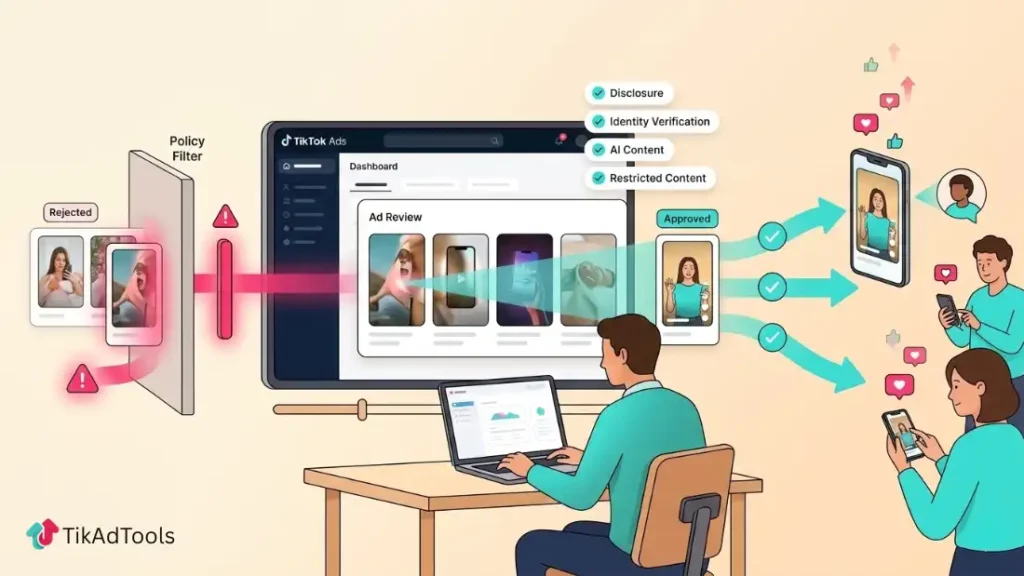
How TikTok’s ad policies have evolved – 2023 to 2026
Understanding where these rules came from tells you a lot about why they exist and where they are likely to go next. TikTok’s ad policies did not appear fully formed. They evolved year by year in response to regulatory pressure, industry standards, and specific platform problems. Here is how that progression looks across the last three years.
2023: the foundation – crypto bans, financial services restrictions, and format shifts
In 2023, TikTok’s advertising framework was still consolidating rules that had been introduced piecemeal in earlier years. The platform’s blanket restrictions on cryptocurrency and financial services advertising – which had been informally enforced since 2021 – were formalized into structured policy, with clear eligibility requirements for licensed financial entities seeking approval to advertise.
The biggest structural change of 2023 was a format consolidation. TikTok officially retired Collection Ads and Dynamic Showcase Ads effective April 3, 2023, according to TikTok’s Ads Manager documentation, shifting both into the Video Shopping Ads format under the Product Sales objective. This was not purely a cosmetic change. It meant any advertiser still running legacy ad types had to rebuild their campaigns, and it reflected TikTok’s push toward a native commerce experience rather than redirect-based shopping.
Early health claim restrictions also took shape in 2023. Broad phrases like “clinically proven” and before-and-after imagery for weight loss or skin transformation became increasingly flagged, establishing a precedent that would become full policy by 2025.
Also in 2023, TikTok launched its formal AI-generated content (AIGC) labeling rules and became the first video-sharing platform to implement C2PA Content Credentials, according to TikTok’s Newsroom announcement. The platform also joined the Partnership on AI as a launch supporter of its Synthetic Media Framework, establishing the technical foundation that mandatory disclosure rules would later build on.
2024: creator accountability and AI enforcement deepen
The story of 2024 on TikTok advertising is accountability. TikTok restructured its creator account classifications in November 2024, distinguishing between Official Accounts and Marketing Creator Accounts with clearer definitions around what each account type could and could not promote.
Age-gating enforcement also became significantly stricter in 2024. Categories like dating services, adult products, alcohol, and gambling faced tighter targeting restrictions, with TikTok applying automated age verification checks at the campaign level rather than relying solely on advertiser self-reporting.
2024 also saw TikTok expand its AIGC auto-labeling capabilities beyond content created with TikTok’s own AI effects. The platform deepened its C2PA implementation, enabling automatic labeling of AI-generated content uploaded from other platforms that carry C2PA Content Credentials metadata – a significant technical step toward broader transparency enforcement across the industry.
2025: the disclosure era – AI labels, commercial content, and live rules
2025 was the year TikTok moved from asking advertisers and creators to disclose to requiring it, with enforcement mechanisms attached.
On September 1, 2025, mandatory commercial content disclosure came into full effect. According to Bazaarvoice’s official TikTok enforcement guide, any account posting a promotional video without proper labeling receives an in-app notification within 2-3 hours of posting. If the creator does not properly disclose or appeal within 24 hours, according to TikTok’s commercial content disclosure help article, the content becomes ineligible for the For You feed and experiences limited reach. Repeated non-compliance can result in a temporary posting restriction or an account ban.
TikTok also introduced new restrictions on AI-generated and deepfake videos, mandatory live-streaming eligibility criteria, and off-platform promotion restrictions in 2025, according to Darkroom Agency’s 2025 TikTok policy guide. Specifically, only accounts with at least 1,000 followers could host livestreams. The account holder had to be 16 or older to go live, and 18 or older to receive virtual gifts during streams.
The FTC’s increasing enforcement of influencer disclosure rules in the U.S. directly influenced TikTok’s decision to formalize these requirements rather than leave them as community guidelines.
What’s different in 2026 vs. 2023: the biggest policy shifts at a glance
Here is a direct comparison of where TikTok’s ad policy stood in 2023 versus where it stands in 2026:
| Policy Area | 2023 | 2024 | 2025 | 2026 |
|---|---|---|---|---|
| Cryptocurrency advertising | Paid ads are fully banned. Branded content crypto promotion has been prohibited since July 2021 and formalized into policy | Still banned for paid ads in most markets. TikTok began building a conditional approval framework for licensed entities in select regions | Conditionally allowed in approved markets with prior approval, licensing, and age-gating to 18+ | Conditionally allowed with licensing, prior approval, and no guaranteed return claims. ICOs and DeFi promotions remain off-limits |
| AI content disclosure | September 2023: TikTok introduced the AIGC labeling toggle for creators to self-label content made with TikTok AI effects | May 2024: TikTok became the first video-sharing platform to implement C2PA Content Credentials, enabling auto-labeling of AIGC uploaded from other platforms like DALL-E 3 and Bing Image Creator | Mandatory labeling enforced. Auto-detection expanded. Invisible watermarking tested. Creator-labeled AI videos grew 36% to more than 8.7 million | Full mandatory enforcement. Applies to all paid ad creatives. Political AI content completely banned regardless of labeling |
| Custom Identity for advertisers | Available. Advertisers could run ads without linking to a verified account | Available. No announced changes | TikTok announced the phase-out in October 2025, with an “early 2026” deadline | Phased out in early 2026. All new campaigns must be launched from a verified TikTok profile |
| Commercial content disclosure | Encouraged via Community Guidelines. No enforcement mechanism in place | Built-in disclosure toggle available. Still voluntary in practice for most content | Mandatory from September 1, 2025. Accounts posting undisclosed promotional videos receive an in-app notification within 2 to 3 hours. Content becomes ineligible for the For You feed if not corrected within 24 hours | Mandatory with full enforcement. Repeated non-compliance can result in posting restrictions or account ban |
| Before-and-after imagery (health/weight loss) | Flagged inconsistently during ad review. No explicit policy clause | Enforcement tightened. Increasingly rejected during creative review, especially for supplements and skincare | Explicitly prohibited in all paid ads under the misleading content policy. Applies to all physical transformation claims | Prohibited across all paid ads and Spark Ads. Applies to weight loss, skincare, muscle gain, and hair growth claims |
| Live-streaming for commerce | Open to all accounts with no minimum follower requirement | Some eligibility criteria were introduced for TikTok Shop live features. Enforcement remained limited | Only accounts with at least 1,000 followers can host livestreams. Account holder must be 16 or older to go live, and 18 or older to receive virtual gifts | Same rules as 2025, fully enforced. Applies to all TikTok Shop live and standard livestream features |
| Off-platform ad data usage | In-app ad targeting only | In-app ad targeting only | In-app ad targeting only | January 22, 2026 ToS update explicitly extends to advertising outside of the app. TikTok may now customize ads users see on and off the platform |
| Get-rich-quick and deceptive financial claims | Restricted under general misleading content rules. Enforcement was inconsistent | Enforcement became more structured. Financial service ads are increasingly flagged for guaranteeing returns | Zero tolerance reinforced. Explicit prohibition on claims like “Get money in 10 seconds” added to policy documentation | Dedicated policy clause. Applies across all industries, not just financial services. Landing page claims reviewed alongside ad creative |
| Special Ad Categories (U.S. and Canada) | Housing, employment, and credit ads had basic targeting restrictions | Targeting restrictions applied but not standardized | Restrictions updated and standardized | Confirmed in the November 2025 update. Advertisers in housing, employment, and credit must select their Special Ad Category at the campaign level, with limitations on demographic and behavioral targeting |
The clearest takeaway: the platform has moved from guidance to enforcement across every major category.
What’s completely prohibited on TikTok Ads?
TikTok’s prohibited content list is not negotiable. These categories cannot be unlocked with approval, licensing, or targeting restrictions. If your ad falls into any of them, it will be rejected – and repeated submissions can trigger an account-level review.
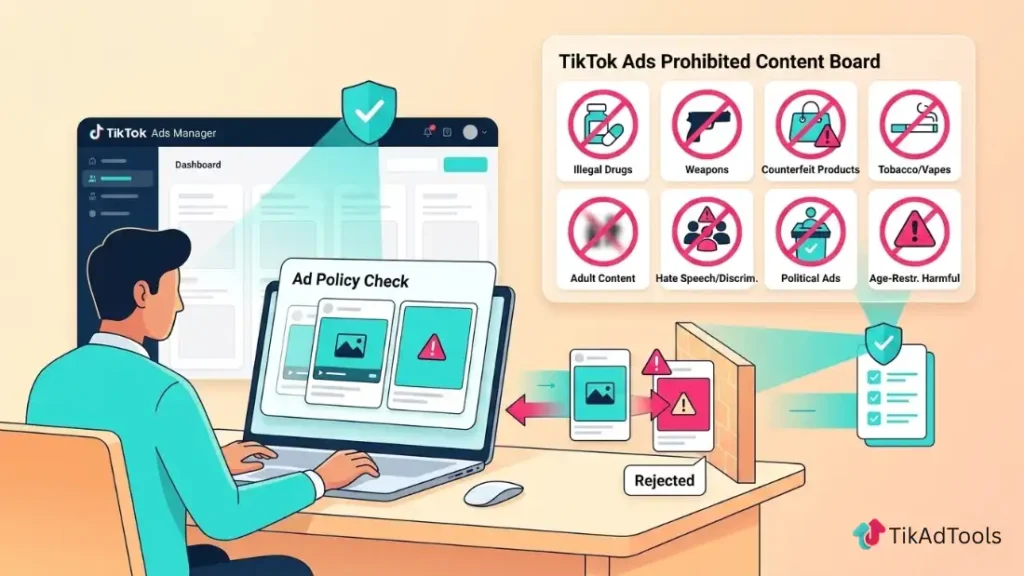
Absolute bans: no exceptions
The following categories are fully prohibited in TikTok advertising regardless of market, format, or account type:
- Illegal products and services: Illicit drugs, drug paraphernalia, and any product whose sale or promotion violates applicable law in the targeted market
- Weapons and dangerous items: Firearms, explosives, and accessories that enable illegal use
- Counterfeit goods: Any product misrepresenting a brand’s trademark or IP
- Tobacco and related products: Cigarettes, vaping products, and e-cigarettes are prohibited in paid placements
- Adult content: Nudity, explicit sexual material, and content classified as adult are banned from all ad placements. One narrow exception opened in June 2026, when TikTok began allowing Live Chat App ads in Pakistan and Bangladesh with sales rep approval and age-targeting
- Hate speech and discrimination: Any content targeting groups based on race, ethnicity, religion, gender, sexual orientation, or disability
- Bullying & Harassment: While TikTok encourages debate, commentary, and critique of ideas, opinions, or behaviors, they do not tolerate personal attacks or content that targets an individual with the intent to bully, harass, or humiliate.
- Political advertising: TikTok doesn’t allow any form of paid political advertising. This covers candidates, parties, PACs, and issue-based campaigns. The June 2026 update relaxed one piece of this, and it’s covered in the landing page section below.
- Minor-targeted harmful content: Any ad that could expose users under 18 to harmful material, including age-gated products promoted without targeting restrictions
Per TikTok’s official policy framework, the Industry Entry Policy and Ad Creative Policy are two separate layers. Your ad must pass both. An ad promoting a permitted product can still be rejected if the creative itself contains prohibited elements.
Misleading claims, get-rich-quick schemes, and deceptive practices
This section of TikTok’s policy is where most ad rejections happen in practice, because the violations are often unintentional.
According to TikTok’s misleading and false content policy, the platform does not allow ad content to feature absolute terms about a product in relation to time, region, or brand. Specific prohibited examples include: “Get slim legs right away,” financial product claims like “Get money in 10 seconds,” claims of cures for incurable diseases, and showing wrinkles disappearing through before-and-after comparisons.
The prohibition extends to your landing page, not just the ad creative. If your ad makes a moderate claim but your landing page uses superlatives or makes guarantees, the ad will still be rejected based on the full user journey.
Deceptive UI elements are also banned. TikTok explicitly prohibits fake video play buttons that do not initiate playback, fake close buttons that do not dismiss the ad, and non-functional carousel indicators suggesting multiple slides when none exist.
Get-rich-quick content falls under the financial services policy, but TikTok applies the deceptive content rule broadly. Any ad that implies passive income, guaranteed returns, or wealth through a simple action will be rejected. This applies across all industries, not just fintech.
Restricted categories: what requires special approval
Restricted categories are industries that can advertise on TikTok, but only after meeting platform-specific eligibility requirements. These requirements vary by market. What you can run in the U.S. may be prohibited in Germany, the UK, or Australia. Always check market-specific conditions against your targeted region.
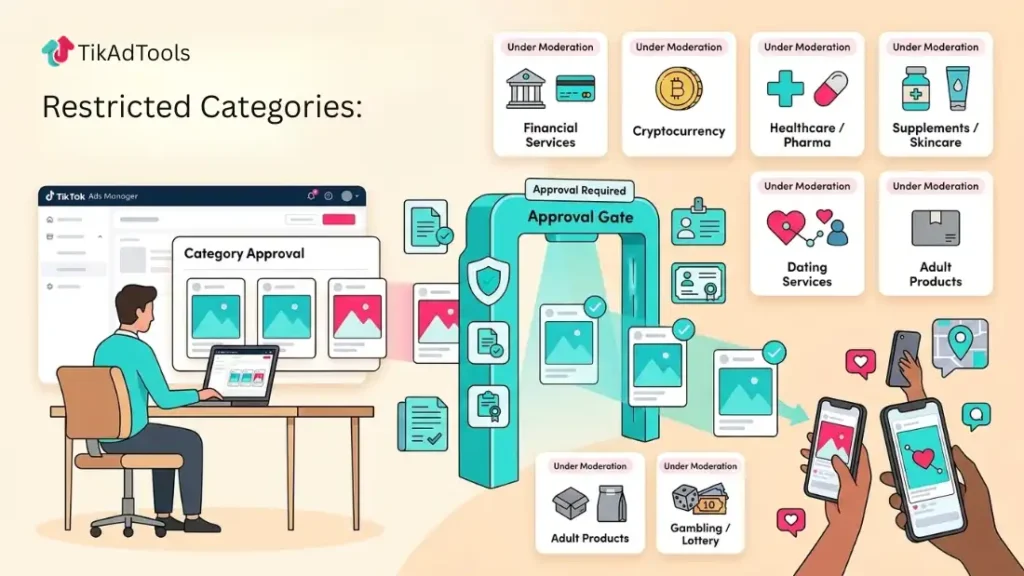
Financial services and cryptocurrency
Financial services advertising on TikTok requires prior approval. Eligible advertisers include licensed banks, credit unions, insurance companies, licensed investment platforms, and registered financial advisors. Your business must be legally registered and regulated in the markets where you are targeting.
Cryptocurrency advertising has been partially reopened since the blanket ban of the early 2020s. You can advertise crypto-related services on TikTok, but only with explicit prior approval, valid licensing in the targeted market, and no promotional language that implies guaranteed returns or downplays risk. Exchanges, wallets, and crypto news platforms are eligible in some markets. ICOs and most DeFi promotions remain off-limits.
TikTok’s policy also explicitly prohibits anything that resembles a pump-and-dump scheme, including ads framing a specific token as a certain investment opportunity.
Health, supplements, and skincare ads
Health advertising on TikTok is one of the most closely moderated categories. Pharmaceutical products require licensing documentation. Over-the-counter medications must clearly comply with local advertising standards. Supplements face the harshest creative restrictions.
For skincare specifically, TikTok prohibits before-and-after imagery that shows dramatic transformations. The platform has also removed approval for claims using words like “clinically proven,” “dermatologist tested,” and “scientifically formulated” unless the advertiser can provide supporting documentation at review.
For supplements, any claim that references weight loss, muscle gain, or metabolic impact requires careful phrasing. Phrases like “supports healthy metabolism” are typically acceptable. Phrases like “melts fat fast” or “builds muscle in 7 days” will result in immediate rejection. This also applies to your landing page headline, not just your ad copy.
Dating services, adult products, and sensitive verticals
Dating services are allowed in select markets with prior approval, but all campaigns must be restricted to users 18 and older. You cannot use romantic or suggestive imagery beyond what TikTok’s community guidelines allow for organic content.
Adult sexual products follow a similar approval path. Approval is market-dependent, targeting must exclude minors, and ad creatives must remain non-explicit. You should contact your TikTok Sales Representative directly for this category, as eligibility is not available through the self-serve Ads Manager.
Gambling and lottery advertising requires licensing documentation, geographic restrictions to approved markets, and clear responsible gambling messaging. The UK, Australia, and a handful of EU markets have additional local requirements on top of TikTok’s base policy.
Two adjacent categories opened in June 2026. Rewarded gaming became eligible in Argentina and Guatemala, and social casinos became eligible in Guatemala. Both need sales rep approval and age-targeting, and rewarded gaming also needs local licensing where required.
Alcohol opened in Cyprus and Luxembourg the same month, covering promotion, brand extensions, sponsorships, and the sale or delivery of alcohol. The creative restrictions there are specific and worth knowing before you write anything:
- You can’t offer alcohol as a prize or reward
- You can’t promote discounts or incentives that encourage consumption
- You can’t mention, depict, or incentivize irresponsible drinking
- You can’t imply alcohol improves health, attractiveness, or social success
Contraceptives and infant formula
Both of these are easy to miss because they only moved in single markets, but if you’re selling them, the changes are significant.
Contraceptive ads became eligible in Sri Lanka in May 2026. You need age-targeting and approval from local regulators where required.
Infant formula and baby food ads became eligible in Azerbaijan in June 2026. Those ads have to be age-targeted to users 18 and over, licensed by local regulators where necessary, and they can’t describe the product as a breast milk substitute or draw any comparison or equivalence to breast milk.
That last rule catches people out. A headline like “as complete as breast milk” gets rejected instantly.
TikTok’s synthetic media and AI disclosure rules for ads
AI-generated content in advertising is not a gray area on TikTok anymore. The rules are clear, the enforcement is automated in many cases, and the consequences for non-disclosure include ad rejection and account-level flags.
What counts as AI-generated content in a TikTok ad?
According to TikTok’s official AI-generated content policy page, TikTok requires creators to label all AI-generated content that contains realistic images, audio, and video. For paid ads, this rule extends to every element of your creative: voiceovers, on-screen visuals, product imagery, spokesperson likenesses, and background scenes.
Specifically, disclosure is required when your ad includes any of the following:
- A synthetic voice that sounds like a real, identifiable person
- AI-generated product imagery presented as real photography
- A digitally altered spokesperson or avatar performing in a realistic human context
- Scenes or locations generated entirely by AI tools like Midjourney, DALL-E, or Runway
- Background audio that uses AI-cloned music or environmental sound
According to TikTok’s support documentation on AI-generated content, TikTok may automatically apply the “AI-generated” label to content it identifies as completely generated or significantly edited with AI, including when a creator uses TikTok AI effects, or uploads AI-generated content that carries C2PA Content Credentials metadata from other platforms.
The rule does not apply to standard post-production work. Color grading, brightness adjustments, basic audio mixing, and non-AI visual effects do not require disclosure.
How to properly label synthetic media in paid campaigns
For organic content that becomes a Spark Ad (where you boost an existing post), the AIGC label must already be applied before boosting. You cannot add the label after the fact if TikTok’s system has already processed the creative.
For ads built directly in Ads Manager, your disclosure options are:
- Toggle the AIGC label on during the creative upload step
- Add a clearly visible caption or sticker using language like “AI-generated” or “synthetic”
- Use C2PA-embedded metadata in your creative files if you are working at scale with an agency or production partner
According to TikTok’s commercial content disclosure help article, creators receive a notification if their video potentially contains undisclosed AI content, and have a 24-hour window to respond before the video becomes ineligible for the For You feed.
Political AI-generated content faces the strictest standard: it is completely banned in paid advertising, regardless of labeling.
Landing page requirements every TikTok advertiser must follow
Your landing page is part of your ad. TikTok reviews it alongside your creative, and a non-compliant landing page will get your ad rejected even if the creative itself is fully policy-compliant.
Privacy policy and functional URL rules
According to TikTok’s advertising policies overview, landing pages must be functional and work properly in the targeted market. Based on various quality signals – including automated machine review, human review, and viewer engagement signals – your ad may be rejected, receive fewer impressions, or see its cost-per-impression increase if the landing page does not meet ad format and functionality requirements.
The basic technical requirements include:
- The URL must be active and fully functional in the target market
- Page load time must be reasonable on mobile networks – slow-loading pages are flagged by TikTok’s quality review
- The page must be directly relevant to the ad creative. An ad featuring a specific product that lands on a generic homepage will fail the relevancy review
- QR codes in ad creatives are not allowed
- The page cannot use an unpaid or paid HTC page as a landing destination for auction ads
Privacy disclosures must be present, visible, and accessible. If your landing page collects any user information, even just an email address, a clearly displayed privacy policy is required.
The political reference rule loosened in June 2026
Paid political advertising is still banned. That hasn’t changed.
What changed is what your landing page can contain. Under the June 2026 update, your landing page can now include references to content, entities, or individuals that the political advertising policy otherwise prohibits, as long as the primary focus of the page isn’t that prohibited content.
That matters more than it sounds. If your site runs a blog or news feed that occasionally touches politics, and your product page happens to sit on the same domain, you had a real problem before. Now you don’t, provided the page you’re sending traffic to is genuinely about your product.
eCommerce and lead ad specific requirements
According to TikTok’s lead generation policy, lead ads must include a privacy policy. The link to your privacy policy must be clearly displayed and easy to find, must comply with applicable data protection regulations, and must be entered in the Link URL field linking to the privacy policy page or a landing page that displays the clauses of the privacy policy.
Lead ads also come with prohibited data collection rules. You cannot use TikTok’s lead generation product to collect sensitive personal information, including racial or ethnic origin, political opinions, religious beliefs, trade union membership, or specific health information, unless you have received written consent from a TikTok Sales Representative.
For eCommerce ads linked to TikTok Shop, your product page must accurately represent the item being promoted. Price consistency between your ad creative and your landing page is required. Ad content and landing pages that contain mismatched or inconsistent information on the promotion, price, or discounts are not allowed, and missing disclaimers or absent terms and conditions also qualify as policy violations.
If you are targeting multiple markets, consider offering a currency or region switch feature on your landing page. TikTok’s policies note that market-specific exceptions may apply, and inconsistent pricing across markets can trigger a review.
Branded content disclosure: when paid promotion meets organic
Branded content is one of the most commonly misunderstood areas of TikTok’s advertising policy, because the rules apply to organic posts that have a commercial relationship behind them, not just to ads built inside Ads Manager.
What qualifies as commercial content on TikTok?
TikTok defines commercial content broadly. The platform considers content commercial when there is a material connection between the creator and a brand. This connection can be financial compensation, free products, event invitations, or any other form of value exchange.
That definition is broader than most advertisers expect. A creator who receives a product sample worth $5 and posts a video about it is required to use TikTok’s disclosure tools. A brand employee posting about their own company’s product from a personal account must disclose. Even gifted experiences – event tickets, travel, or access – qualify if the content promotes the brand that provided them.
The disclosure process works like this: after recording or uploading a video, go to post settings and look for “Disclose commercial content.” Switch it on. Then choose “Branded Content” when promoting a third-party brand or “Your Brand” when a business account is promoting its own products. The disclosure hashtags #ad or #sponsored can supplement this but do not replace the built-in toggle.
According to TikTok’s Community Guidelines on regulated commercial activities, if commercial content is not disclosed using the content disclosure setting, it will be ineligible for the For You feed. Repeated failure to make a disclosure can lead to your account being temporarily restricted from posting content or can lead to an account ban.
Before-and-after images, weight loss, and health claims
This is the intersection where branded content policy and ad creative policy overlap, and it is the area that catches the most health, beauty, and wellness advertisers off guard.
Before-and-after images that show physical transformation are prohibited in TikTok paid ads. Showing wrinkles disappearing through before-and-after comparisons is explicitly listed as prohibited under TikTok’s misleading content policy. The same logic applies to weight loss, muscle development, hair growth, and any other physical transformation claim.
For skincare brands specifically, this means you cannot show a dramatic before shot followed by a glowing after shot, even if the transformation is real and documented. TikTok’s policy prioritizes the potential for viewer deception over the advertiser’s intent.
Health claims in commercial content, whether organic branded posts or paid ads, must not imply medical outcomes. “Supports skin hydration” is acceptable. “Repairs skin damage” or “reverses aging” is not. If your product is in a regulated health category, any claim that sounds like a medical benefit will require supporting documentation or be rejected outright.
A limited exception applies only to approved cosmetic surgery ads from licensed medical institutions in the USA and Canada under TikTok’s March 2026 policy update. (Source) In those cases, before-and-after imagery may be used as long as it does not exaggerate results and the ad clearly discloses medical risks and recovery times. This exception does not extend to skincare, supplements, or other beauty and wellness products, where before-and-after transformation images remain prohibited.
The TikTok ad review process: and what to do if you’re rejected
TikTok reviews every ad before it runs. The review is automated first, then escalated to human review when the automated system flags an issue. According to TikTok’s advertising help center, most ad reviews are completed within 24 hours, though many are resolved within a few hours. During high-demand periods or for complex ads in restricted categories, the process may take longer.
The most common reasons for rejection fall into four categories: misleading claims in the creative or landing page, prohibited content in a non-approved category, technical issues with the landing page or URL, and policy violations related to identity or disclosure.
When your ad is rejected, TikTok provides a rejection reason in Ads Manager. Read it carefully. Most rejection notices include the specific policy clause that was violated.
Your options after rejection are:
- Edit and resubmit: Fix the identified issue and resubmit. This resets the review timer.
- Appeal: For borderline cases where you believe the rejection was incorrect, TikTok’s Ads Manager includes an appeal option. Use this when your ad clearly complies with policy, and you believe the automated review made an error.
- Contact support: For restricted category approvals or issues that cannot be resolved through the standard appeal process, contact your TikTok Sales Representative or the platform’s advertiser support team directly.
If multiple ads from your account are rejected in a short period, TikTok may flag your account for a broader review. At that point, fixing individual ads is not enough. You need to review your full creative library and landing page setup for systemic compliance gaps.
How to stay compliant with TikTok ad policies in 2026
Compliance is not a one-time check before you launch. TikTok updates its policies regularly, and what passed review in October 2025 may not pass in March 2026. Here is a practical framework for staying current:
Build a pre-launch checklist. Before any campaign goes live, verify: the advertiser account is fully verified (Custom Identity is no longer available), any AI-generated content is labeled, landing pages are functional and contain the required privacy policy, claims in the creative are factual and provable, and targeting restrictions match the advertiser category.
Audit your active campaigns monthly. TikTok can retroactively restrict ads that no longer meet updated policy requirements. A campaign that ran cleanly in Q3 may get flagged in Q4 if a policy update changes the standard for your category.
Monitor the TikTok Ads Manager notification center. TikTok advises advertisers to set up regular content audits to catch potential violations before they result in penalties, and to monitor account notifications for any enforcement actions.
Keep documentation for restricted categories. If you are operating in financial services, health, supplements, or cryptocurrency, maintain a file of your licensing documentation, certifications, and any written approvals from TikTok. You will need them quickly if an ad is flagged.
Run new campaigns through a compliance check before launch. The Ad Compliance Checker catches missing disclaimers, category mismatches, and other gaps that trigger a rejection, before you’ve spent any budget on the campaign.
Train your creative team on prohibited formats. The most common avoidable rejections come from creative teams unaware of the before-and-after imagery ban, the AI disclosure requirement, and the misleading UI elements rule (fake play buttons, fake close buttons). A one-page internal creative brief that covers these specifics prevents most rejections before they happen.
Watch for market-specific changes. TikTok’s global ad policies are a baseline. The EU, UK, Australia, and the U.S. all have additional local requirements layered on top. If you are running international campaigns, verify compliance against local policy documents, not just the global standard.
Where to go deeper on each compliance area
- How TikTok Ad Approval Works
- TikTok Ads Account Suspended? How to Appeal
- TikTok Ad Violations Explained
- TikTok Ads Political and Regulated Content Policy
- TikTok Ads Data Privacy and GDPR
- TikTok Ads for Alcohol, CBD, and Regulated Products
- TikTok Brand Safety Guide
FAQs
Does TikTok allow health and supplement ads?
Yes, but with significant restrictions. Health and supplement advertisers must comply with TikTok’s Industry Entry Policy, which requires licensing in regulated markets and prohibits unsubstantiated health claims. You cannot use before-and-after imagery, absolute language like “proven to cure,” or any claim that implies a medical outcome without supporting documentation. Approval is required in most markets before a campaign can go live.
What happens if my TikTok ad is rejected?
You will receive a rejection notification in Ads Manager with the specific policy clause cited. You can edit and resubmit the ad after fixing the identified issue, or use TikTok’s built-in appeal option if you believe the rejection was an error. Repeated rejections from the same account can trigger a broader account-level review, so it is worth auditing your full setup if you receive multiple rejections in a short period.
Are AI-generated voice-overs allowed in TikTok ads?
Generic text-to-speech narration that does not replicate a recognizable individual’s voice does not require disclosure. However, if your voiceover uses AI voice cloning technology to replicate a specific identifiable person’s voice, the ad creative must be labeled as AI-generated using TikTok’s AIGC label or a clearly visible caption. Failure to label AI voiceovers that cross this threshold will result in ad rejection.
Do TikTok’s organic content rules apply to paid ads?
The rules overlap but are not identical. TikTok’s Community Guidelines apply to all content on the platform, including paid ads. However, paid ads are also subject to the separate Advertising Policies, which are stricter in many areas. Content that is allowed as organic posting may still be rejected as a paid ad. For example, a personal skincare transformation video posted organically might be compliant, while the same content boosted as a Spark Ad could violate the before-and-after imagery prohibition under ad creative policy.
Can you run crypto or financial service ads on TikTok in 2026?
Yes, in certain markets, with prior approval. TikTok conditionally allows cryptocurrency and financial service advertising from licensed, regulated entities. You need to apply for category access through the platform’s Industry Entry process, provide documentation of your licensing and regulatory status, and comply with creative restrictions, including no guaranteed return claims and no language that minimizes investment risk. Self-serve approval through Ads Manager is not available for these categories in most markets.
What is TikTok’s policy on using real people’s likenesses in ads?
TikTok prohibits using the likeness, voice, or image of any public or private figure in an ad without their explicit permission. This includes AI-generated depictions of real people. Ads that feature a public figure appearing to endorse a product without a real endorsement relationship are rejected. For brand partnerships and influencer campaigns, the creator’s written authorization to use their likeness in paid amplification must be documented before the campaign goes live.
Conclusion
TikTok’s advertising policies in 2026 are the most detailed and most actively enforced version of the rules the platform has ever published. The shift from loose guidance to structured enforcement happened gradually between 2023 and 2026 updates, which locked several of those changes into the platform’s core terms.
We have walked through every major layer here: the three-tier framework that governs all ads, the year-by-year policy changes that built the current rules, the absolute prohibitions with no exceptions, the restricted categories that require approval, the AI disclosure requirements that now apply to paid campaigns, the landing page standards that are part of every ad review, and the branded content rules that connect organic and paid activity.
What the full arc of TikTok’s policy evolution makes clear is that the platform is moving toward the same transparency and accountability standards that regulators have been pushing across the digital advertising industry for years.
If you are operating with compliant practices and documented processes, the current rules are workable. If you are still relying on tactics that were loosely tolerated in 2023, you will run into enforcement in 2026.
Run your next campaign against this framework before you launch it.
Sources
- TikTok’s official documentation: Create Dynamic Showcase Ads
- TikTok Newsroom: Partnering with our industry to advance AI transparency and literacy
- Bazaarvoice: The new rules of TikTok
- TikTok’s official documentation: About the content disclosure setting for creators
- Darkroom Agency: What brands need to know about TikTok’s new rules
- TikTok’s official documentation: AI-generated content policy
- TikTok Support: AI-generated content
- TikTok Community Guidelines: Regulated commercial activities
- TikTok’s official documentation: Healthcare and Pharmaceuticals