
If you are trying to sell on TikTok using the same logic you use for Amazon or Google, you are failing.
On Amazon, commerce is driven by Intent. A user realizes they need a new phone charger, they search iPhone charger, and they buy the one with the best reviews. It is a utility-driven transaction.
On TikTok, commerce is driven by Discovery. A user opens the app to be entertained, not to shop.
They have zero intent to buy a phone charger. But then they see a video of a magnetic charger that glows in the dark and snaps satisfyingly into place. Suddenly, a dopamine hit triggers a desire they didn’t have 15 seconds ago.
Get Up to $6,000 in Free TikTok Ad Credits
TikTok offers ad credit incentives for new advertisers, helping you test campaigns with a lower upfront cost.
This is the shift from Intent Commerce to Discovery Commerce.
To win on TikTok in 2026, you must understand that the TikTok algorithm is serving your product as entertainment, not an ad.
The primary drivers are not price or specs, but Social Proof (Comments), Creator Trust, and Impulse Scarcity.
Table of Contents
Quick Summary
- The Stumble Stat: 71% of TikTok shoppers buy simply because they stumbled upon something cool, not because they were searching for it.
- The Trigger: Authentic, lo-fi reviews (UGC) trigger the Mirror Neuron effect, viewers subconsciously imagine themselves holding the product.
- The Loop: The purchase is not the end; it is the start of a new video (The Infinite Loop).
- The Search Shift: 77% of Gen Z now use TikTok for product discovery, treating it as a visual search engine.
The Stumble Economy: Why Discovery Beats Search
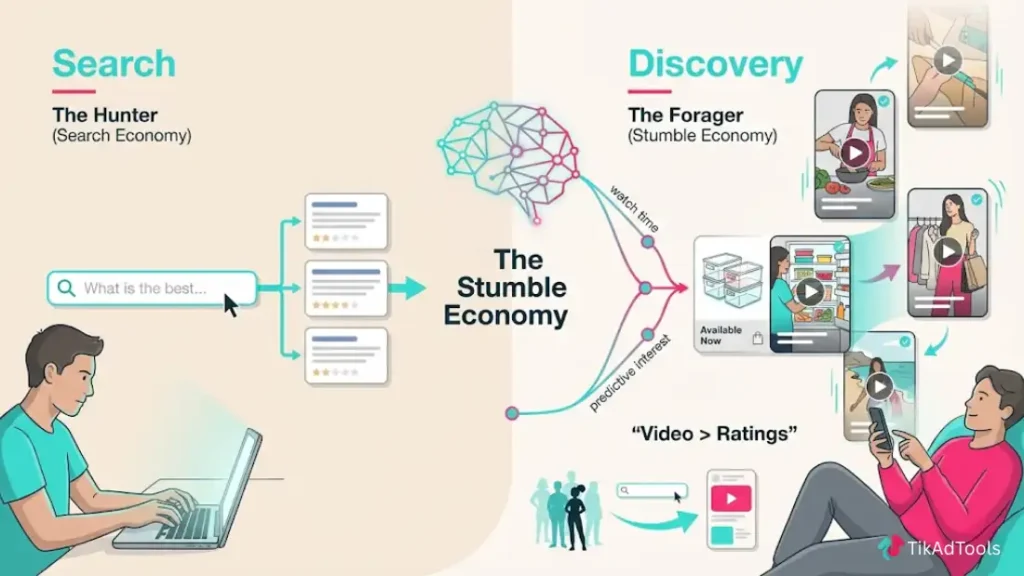
Traditional marketing relies on the Hunter mindset: the customer knows what they want and hunts for it. TikTok relies on the Forager mindset. The user is wandering through the feed, open to whatever the algorithm feeds them.
The Mechanism:
The For You Page (FYP) acts as a prediction engine. It doesn’t wait for a query; it predicts a desire based on watch time.
If a user watches a video about organizing a fridge for 15 seconds, the algorithm predicts they might be interested in clear plastic bins.
Data Insight:
This behavior is changing how search works. Data from 2025 shows that 46% of Gen Z now prefer social media over search engines for finding information.
- Implication: If your product doesn’t appear in a Top 5 listicle video or a Honest Review search result, it effectively doesn’t exist for this demographic. They trust the visual proof of a video more than a star rating on Amazon.
The Trust Triangle: Creator, Comments, and Sound
Why does a shaky video from a stranger convert better than a $50,000 polished ad? It comes down to the Trust Triangle.
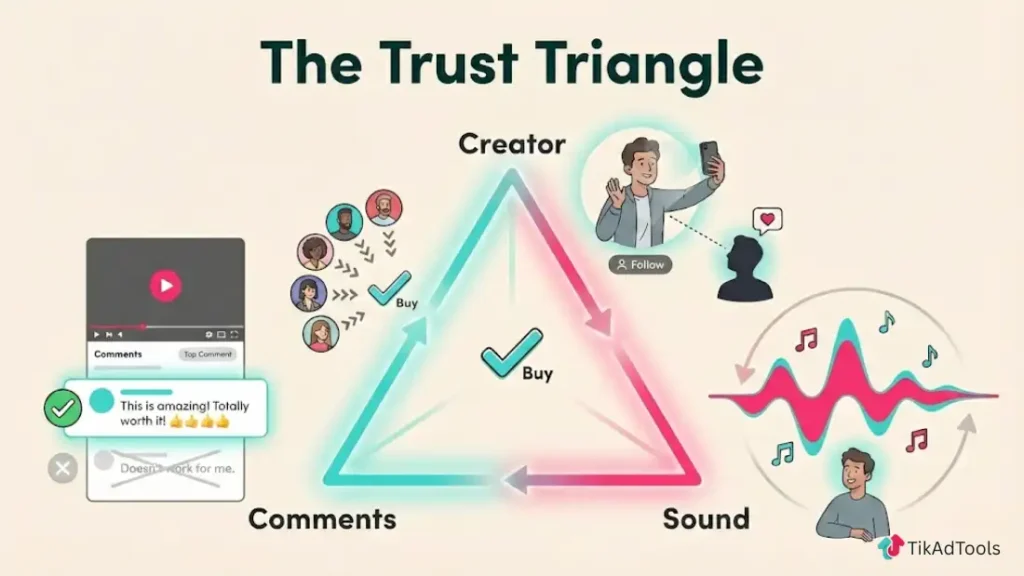
Component 1: The Creator (The Proxy Friend)
Users trust people like them over brands. In fact, 63% of users trust an influencer’s recommendation more than a brand ad.
- Psychology: This is a Parasocial Relationship. The user feels they know the creator. If the creator says, This cleared my acne, the user believes it because they have followed that creator’s journey for months.
Component 2: The Comment Section (The Validator)
This is the most overlooked factor in conversion.
Behavior Rule: Users watch the video, but they buy in the comments.
The Test: Before buying, a user opens the comments.
- Scenario A: Top comment says, I bought this and it broke in 2 days.
Result: Sale Dead.
- Scenario B: Top comment says, Just ordered mine! Shipping was fast.
Result: Herd Mentality kicks in.
Action: You must actively manage your comment section. Reply to questions with video replies to boost visibility and trust.
Component 3: The Sound (The Memory Hook)
Audio acts as a mnemonic device. 68% of users remember a brand better if it uses music they like.
Strategy: If you use a trending sound, you are borrowing the dopamine associated with that sound. When the user hears it, they are already primed to enjoy your content.
The Infinite Loop: Why the Funnel is Dead
The traditional marketing funnel (Awareness > Consideration > Purchase) is linear. It assumes the relationship ends when the credit card is swiped.
TikTok’s official model is the Infinite Loop.
- The Cycle: Discovery > Purchase > Creation > Discovery.
- The Behavior: After buying, roughly 1 in 5 users create a video about the product (unboxing, review, or usage).
- Why it matters: Your customer is your new marketing team. Their post-purchase video becomes the Discovery point for their followers, restarting the loop.
- Strategy: Incentivize this. Include a card in your box saying, Tag us on TikTok for a chance to win your next order free. This fuels the loop.
Decision Logic: How to Trigger the Impulse
You cannot treat a $20 product and a $200 product the same way. The psychology differs based on the price point.
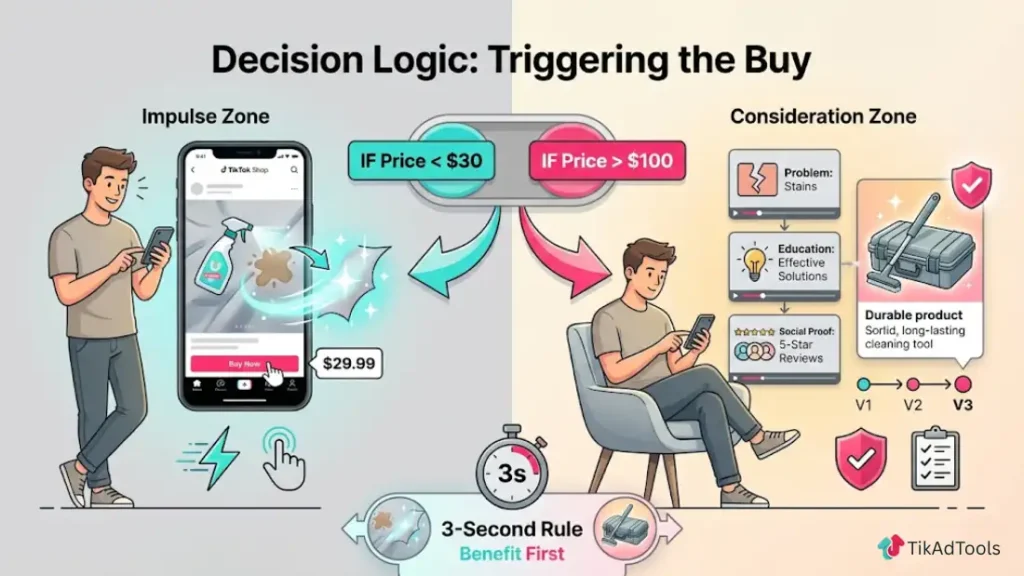
Use this If/Then Logic:
IF your price is <$30 (Impulse Zone):
Goal: Remove Friction.
Tactic: Use TikTok Shop integration. The user must be able to buy in 1-2 clicks without leaving the app.
Creative Hook: Focus on the Wow Factor or immediate satisfaction (e.g., a stain remover working instantly).
IF your price is >$100 (Consideration Zone):
Goal: Build Trust.
Tactic: Do not expect a sale on the first view. Use a Series of videos.
- Video 1: The Problem (Agitation).
- Video 2: The Education (How it works).
- Video 3: The Social Proof (Testimonials).
Creative Hook: Focus on Value and Longevity (e.g., Why this is the last vacuum you’ll ever buy).
The 3-Second Rule Application:
Regardless of price, the Benefit must be visible in the first 3 seconds. If you are selling a rust remover, the rust must disappear in 2 seconds. If you wait until the second 10, they have already scrolled.
Financial Reality: Who Actually Buys?
A common myth is that TikTok is just teenagers with no money. The 2025/2026 data disproves this.
Demographics: 37% of Americans under 60 have purchased from TikTok Shop.
Spending Power: The average TikTok Shop buyer spends $59 per purchase, with frequent buyers averaging 12 purchases a year.
Category Dominance:
While Health & Beauty accounts for 79.3% of sales, the Home & Kitchen category is the fastest-growing impulse sector. Users are increasingly buying appliances, organizers, and decor because these items have high visual satisfaction potential.
Explore these helpful articles next:
👉 TikTok Branded Mission Ads: When Should You Test?
👉 TikTok Ads for Seasonal Sales & Events: The Pulse Strategy
👉 TikTok Ads for Jewelry Sellers: UGC That Converts
👉 TikTok Ads & ROAS: How to Review Results Honestly
Frequently Asked Questions (FAQ)
How does TikTok influence people to buy things?
TikTok influences purchases through Social Proof and Discovery. When users see real people (not actors) using a product to solve a problem, it builds trust. The algorithm then retargets them until the desire converts into a sale, often leveraging the Fear Of Missing Out (FOMO) created by viral trends.
What factors influence TikTok based user purchase intention?
The three main factors are Authenticity (does the creator actually use it?), Engagement (are people confirming it in the comments?), and Convenience (is there a Buy Now button?). Data shows that 1 in 4 users bought something specifically after seeing a TikTok video about it.
What is the main reason people use TikTok?
Primarily for Entertainment and Lifting Spirits. Users are 1.3x more likely to feel excited about a purchase on TikTok compared to other platforms, meaning Joy is a key purchase driver. They are not there to shop; they are there to feel good, and shopping becomes a byproduct of that joy.
How to attract buyers on TikTok?
Stop selling features; sell Transformations. Show the Before (the problem) and the After (the result). Use trending audio to get reach, and use the Reply with Video feature to answer customer questions publicly, which builds the trust required to close a sale.
What is the 3 second rule in TikTok?
You must hook the viewer’s attention within the first 3 seconds. If you don’t show a visual surprise, a bold claim, or a relatable problem instantly, the user swipes away, and the algorithm marks your video as irrelevant, killing your reach. 63% of successful ads communicate their message instantly.
Why is Gen Z so obsessed with TikTok?
Gen Z values personalization and community. TikTok’s algorithm provides a hyper-personalized feed (The For You Page) that feels like it knows them, while the comment sections provide a sense of belonging and shared culture that traditional search engines cannot offer.
Conclusion: From Viewer to Participant
The psychology of TikTok Made Me Buy It is simple: Users don’t want to be sold to; they want to be part of a trend.
When a user buys a viral water bottle, they aren’t just buying hydration; they are buying entry into a community.
The brands that win in 2026 are the ones that invite the user to participate in the story, not just watch it.
Next Step: Want to know which psychological hook is driving sales in your niche right now? Use TikAdTool to analyze the sentiment of comments on your competitor’s top viral videos. If the comments are saying I need this for travel, pivot your next ad angle to travel essentials.