
TikTok Ads for eCommerce are paid placements within TikTok that drive product discovery, clicks, and purchases for online stores. They work by surfacing short-form video content to audiences across the For You Page, Shop Tab, and Search. Results vary based on creative quality, product fit, and campaign structure, but when those three elements align, TikTok eCommerce ads consistently outperform other paid social channels on cost-per-acquisition for new customers.
TikTok is no longer a platform where brands go to build awareness and hope something sticks. It is a full-funnel sales engine, and the eCommerce brands treating it that way are outpacing competitors sitting on the sidelines.
Get Up to $6,000 in Free TikTok Ad Credits
TikTok offers ad credit incentives for new advertisers, helping you test campaigns with a lower upfront cost.
Most store owners have watched a competitor’s product go viral and wondered what they are missing. The answer is structure: the right ad formats, the right creative approach, and the right way to scale.
In this guide, we will be covering all of it, from product fit through profitable scaling, with the 2026-specific changes you need to know right now.
Table of Contents
What Are TikTok Ads for eCommerce?
TikTok Ads for eCommerce are paid placements that let online store owners reach TikTok’s 1.6 billion monthly active users with shoppable video content.
Unlike search ads that capture existing demand, TikTok ads create purchase intent inside an entertainment feed.

In 2026, the platform supports the full purchase journey, from discovery to in-app checkout, without the user ever leaving the app.
How TikTok Ads Differ from Traditional Social Media Advertising
Most platforms serve ads based on who you already know: followers, saved audiences, or lookalikes. TikTok distributes content based on engagement signals, not follower counts.
A brand with zero followers can reach half a million people on day one if the creative earns it.
According to TikTok’s Creative Center data, cited by The Jonas Agency’s Paid Social Benchmark Report, UGC-style content outperforms polished brand creative by 2 to 3 times in conversion rate. Users skip anything that looks like a traditional ad. Winning on TikTok means making content that earns attention before it asks for a sale.
The Shift from Awareness Platform to Direct-Response Sales Engine in 2026
TikTok now offers native checkout through TikTok Shop, AI-driven campaign automation through GMV Max, and a creator affiliate ecosystem that functions as a distributed sales channel. According to Resourcera’s 2026 data, 58% of TikTok users now purchase directly through the app. For many eCommerce brands, TikTok is no longer a supporting channel. It is the primary acquisition channel.
Why TikTok Ads Are a Growth Engine for eCommerce in 2026
TikTok ads are worth running in 2026 because the platform combines massive reach, low CPMs, and a native commerce infrastructure that reduces purchase friction at every stage.
Key Platform Stats Every eCommerce Brand Needs to Know
- 1.6 billion monthly active users globally (Resourcera)
- $4 to $8 average CPM vs. $8 to $14 on Meta (The Jonas Agency)
- 0.84% average CTR across TikTok campaigns (Lebesgue)
- $33.2 billion in TikTok Shop global GMV (Resourcera)
- 71.4 million US consumers expected to buy on TikTok(eFulfillment Service)
Why TikTok’s Cost-Per-Acquisition Beats Meta and Google Right Now
TikTok’s CPM advantage is real, but not automatic. Strong creative gets rewarded with lower distribution costs. Weak creative pays full price for impressions that do not convert. According to The Jonas Agency’s Paid Social Benchmark Report, Spark Ads deliver 30 to 50% lower CPAs than standard In-Feed ads because they carry organic social proof.
Beyond cost, TikTok consistently reaches more net-new customers per dollar than Meta. Trendtrack’s analysis found TikTok had a 10% delta between total CPA and net-new CPA, compared to Meta’s 38% delta. You are acquiring genuinely new customers at a significantly lower incremental cost.
What Products and Niches Work Best on TikTok Ads
Running ads without confirming product fit first is one of the fastest ways to waste your initial budget.
Before you build a single campaign, confirm whether TikTok’s audience and algorithm are set up to sell your specific product.
Product Categories with the Highest TikTok ROAS in 2026
The top-performing categories all share one trait: they tell a compelling visual story in under 60 seconds.
- Beauty and Personal Care: The dominant category. Beauty, womenswear, and health account for over 40% of TikTok Shop GMV (eFulfillment Service).
- Fashion and Apparel: Try-on and outfit styling content converts strongly. Womenswear is the largest category by store count on TikTok Shop globally.
- Health and Wellness: Transformation content performs well with TikTok’s 25-to-44 demographic, which grew 38% year-over-year (Digital Applied).
- Home and Lifestyle: Growing at 85% year-over-year as TikTok’s audience matures (Digital Applied).
- Electronics and Gadgets: Growing at 92% year-over-year on TikTok Shop (Digital Applied).
Products that consistently underperform include commodity goods without a compelling visual story and high-specification B2B purchases that require lengthy explanation to create desire.
Signs Your Product Is a Natural Fit for TikTok’s Discovery Engine
Your product is likely a strong fit if:
- There is a clear visual transformation or demonstration available
- The price sits between $15 and $80, the impulse-buy range on TikTok
- You can create a “wow” moment in the first 3 seconds of a video
- Searching your product category on TikTok shows organic content with high views and comments like “where is this from?”
What Types of TikTok Ads Work Best for Online Stores
The right ad format depends on where your customer is in the funnel. Using a conversion-focused format on a cold audience is one of the most common budget-wasting mistakes in TikTok eCommerce advertising.
Top-of-Funnel: In-Feed Ads and Spark Ads for Cold Audiences
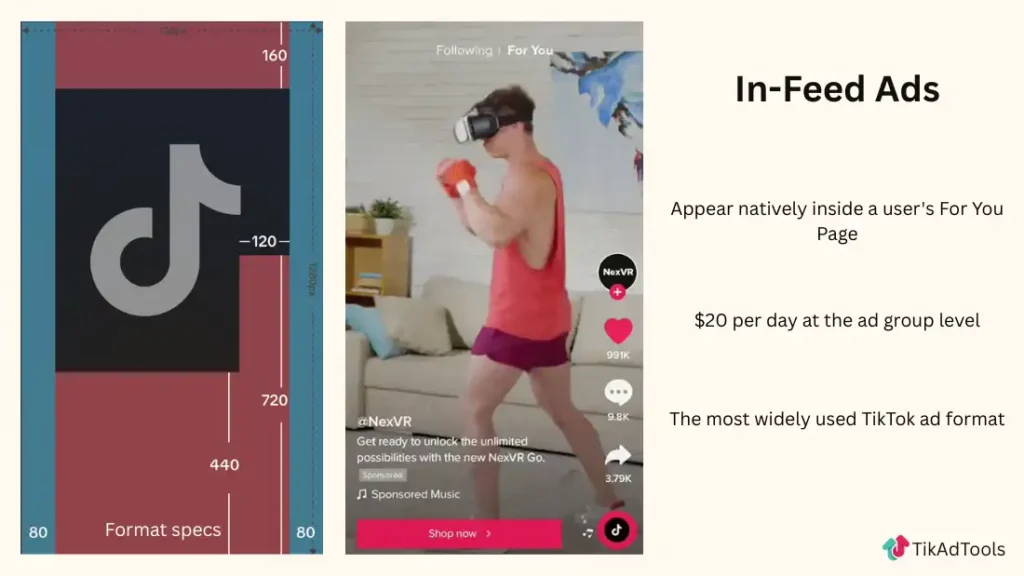
In-Feed Ads appear natively in the For You Page. They look like regular TikTok content, making them effective for cold audience prospecting. You control the creative, targeting, and CTA.
Spark Ads boost an existing organic post from your account or a creator’s. Because the post already has real likes and comments, it carries social proof that a brand-new ad would not.
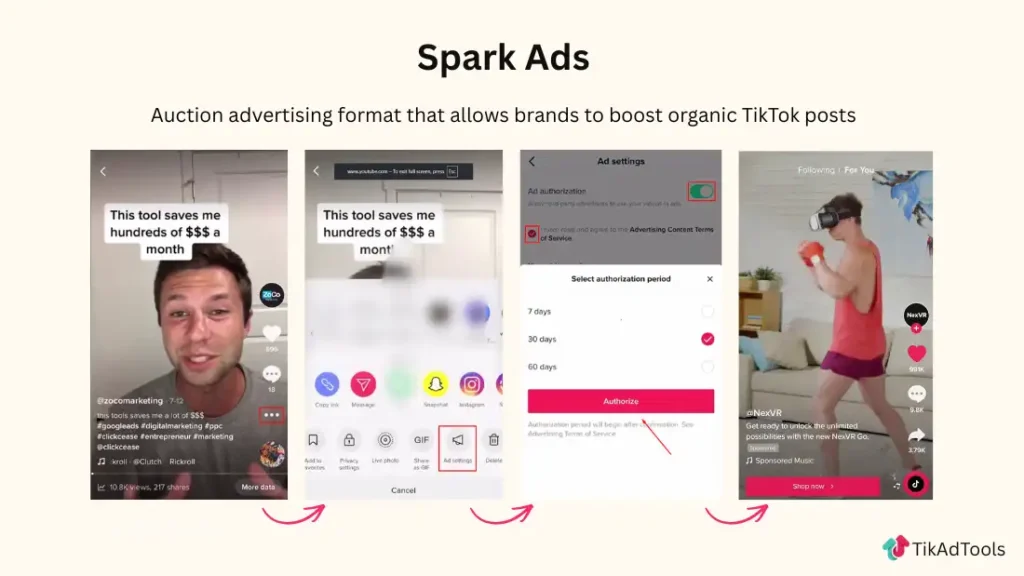
The Jonas Agency’s benchmarks show Spark Ads deliver 30 to 50% lower CPAs than standard In-Feed ads. If you have organic content already performing, turning it into a Spark Ad is your first move.
Mid-to-Bottom Funnel: Video Shopping Ads and Catalog Ads That Close
For brands driving traffic to external websites, Video Shopping Ads pair your video with a product card overlay showing your image, name, and price.
Catalog Ads pull dynamically from your product feed and retarget users who already visited your website or engaged with previous ads. Both formats work best once your pixel has enough data to support meaningful retargeting.
LIVE Shopping Ads: The Highest-Converting Format Most Brands Skip
LIVE Shopping Ads promote your TikTok Shop during a live broadcast. Conversion rates during live sessions run significantly higher than pre-recorded content because of real-time interaction and built-in purchase urgency. Most brands skip livestreaming because it feels resource-heavy. That hesitation is a direct competitive opening for you.
TikTok Shop vs. External Website: Which Should You Use?
This is the most consequential infrastructure decision you will make for your TikTok ad strategy in 2026.
Why Native Checkout Converts at a Higher Rate Than External Links
Sending users from a TikTok ad to your Shopify store adds friction: a page load, an unfamiliar site, manual payment entry, and a trust gap for a brand they discovered 30 seconds ago. TikTok Shop removes most of that.
Checkout stays inside the app, payment details are pre-saved, and the purchase path can take under 60 seconds.
According to MediaMister’s TikTok Shop statistics report, 84% of TikTok Shop users rate the platform as easy to use, and 80% cite a fast checkout experience.
TikTok also gives broader algorithmic distribution to content linked to TikTok Shop. Without TikTok Shop enabled, you are competing at a structural disadvantage.
When to Send Traffic to Shopify or WooCommerce Instead
TikTok Shop is not the right fit for every product or scenario.
Send traffic to your own website when:
- Your average order value exceeds $150 and needs more product detail to convert
- You need post-purchase flows: email capture, upsells, or subscription enrollment
- You are running retargeting campaigns to warm audiences who already know your brand
The practical approach: run TikTok Shop for your hero SKUs and external website campaigns for higher-value products or when you need to build your owned customer database.
How to Set Up TikTok Ads for eCommerce Step by Step
Follow these steps in order. Skipping the pixel or catalog connection costs you conversion data that the algorithm needs to optimize your campaigns.
Step 1: Create Your TikTok Ads Manager Account and Structure
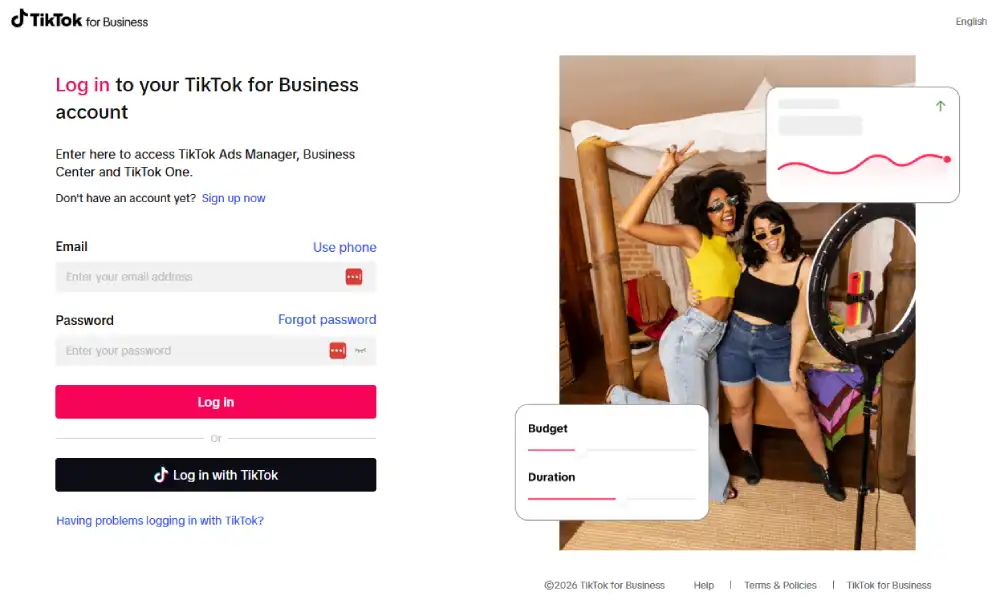
- Go to ads.tiktok.com and create a Business account
- Set up your Business Center to manage assets, ad accounts, and team access
- Connect your TikTok Shop account if you are using native checkout
- Define your structure before building: Campaign (objective) > Ad Group (audience, budget, placement) > Ads (creative)
Step 2: Install the TikTok Pixel and Connect Your Product Catalog
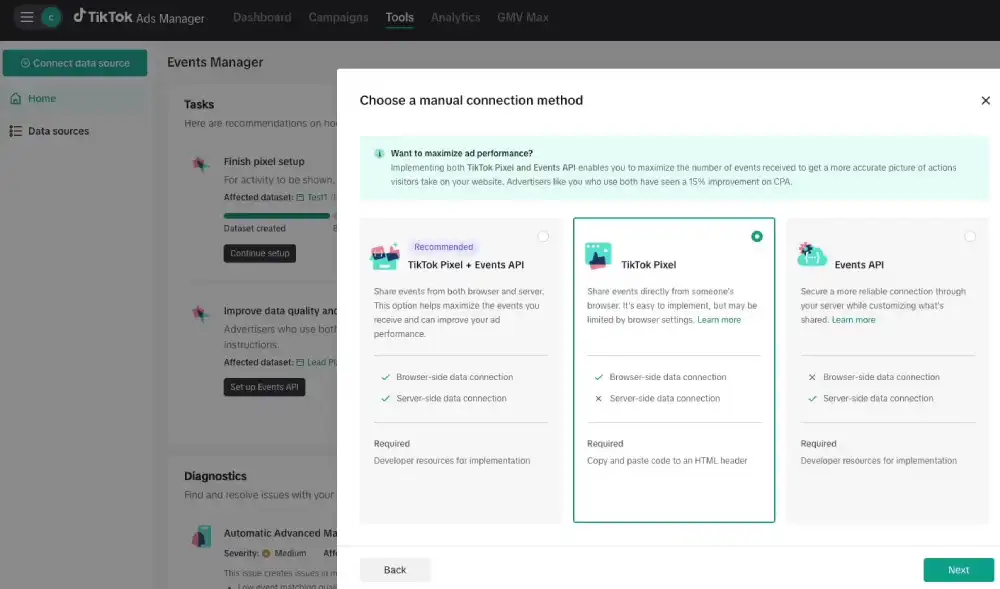
- In Ads Manager, go to Assets > Events and create your pixel
- Install via Shopify app integration, manual code, or your platform’s native connector
- Set up standard events: ViewContent, AddToCart, InitiateCheckout, and Purchase
- Verify using the TikTok Pixel Helper browser extension, then connect your catalog via Assets > Catalog
Wait until your pixel records at least 50 purchase events per week before switching to a Purchase objective. Until then, optimize for AddToCart or InitiateCheckout.
Step 3: Choose the Right Campaign Objective for Your Funnel Stage
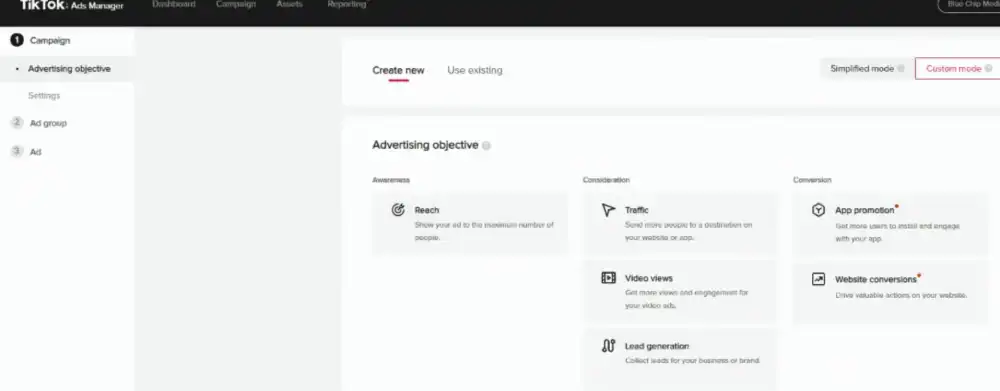
| Your Goal | Correct Objective |
| New account, no pixel data | Video Views or Reach |
| Building pixel data | Traffic |
| Purchases on your website | Conversions (Purchase) |
| TikTok Shop sales | GMV Max |
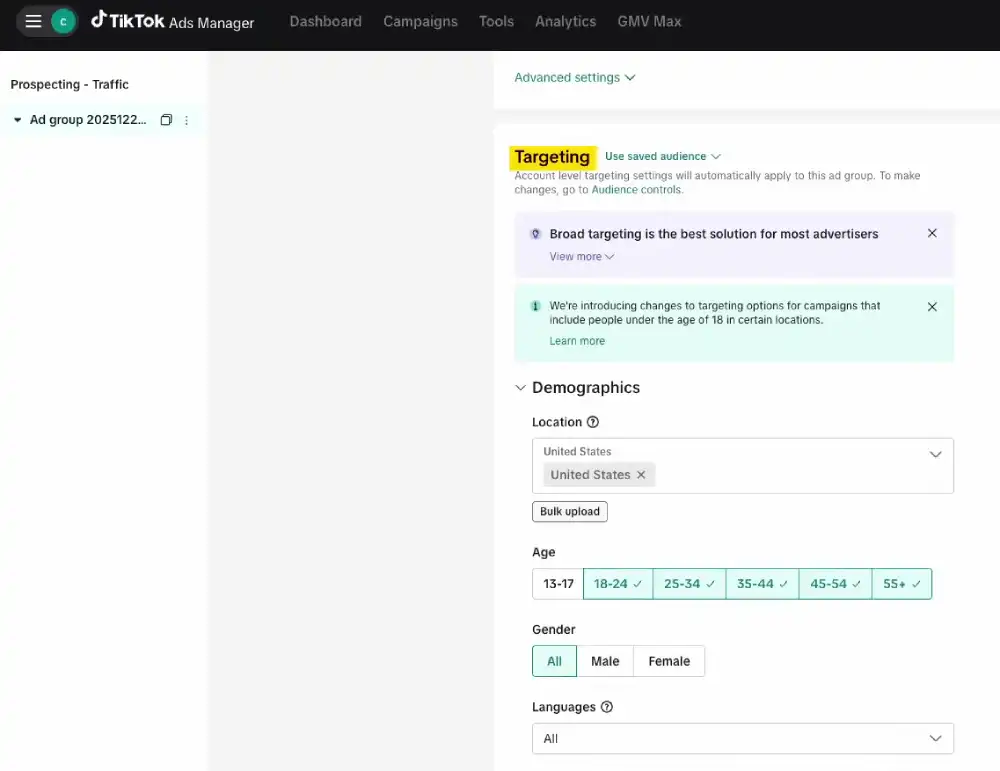
Step 4: Build Your First Ad Group, Targeting, and Budget
- Placements: Start with automatic placements. Restrict to TikTok-only once you have performance data.
- Audience: Broad targeting with strong creative outperforms narrow targeting in 2026.
- Budget: Minimum $20 per day per ad group, $50 per campaign. Plan $500 to $1,000 for a meaningful 7-to-14-day test.
- Bidding: Use Lowest Cost initially. Move to Cost Cap once you have consistent conversion data.
TikTok Ad Creative That Actually Converts in 2026
Creative is the single biggest performance lever in TikTok advertising. No targeting setup or budget structure compensates for weak creative. The Hook-Demo-Offer Formula for eCommerce Video Ads
Hook (First 3 seconds): Stop the scroll. Lead with a bold claim, a relatable problem, or a visual pattern interrupt. “I replaced my entire skincare routine with this,” outperforms any branded intro.
Demo (3 to 15 seconds): Show the product solving the exact problem your hook introduced. Specificity converts. A 10-second close-up transformation outsells a 30-second brand story every time.
Offer (15 to 30 seconds): Give a reason to act now. A discount, limited quantity, social proof (“500,000 sold”), or a direct CTA. Clarity beats cleverness.
UGC vs. Polished Creative: What TikTok’s Algorithm Rewards Now
According to TikTok’s Creative Center data, cited by The Jonas Agency’s Benchmark Report, UGC-style creative outperforms polished brand creative by 2 to 3 times in conversion rate on In-Feed placements. Phone-shot, creator-led content feels native. Your audience identifies and skips anything that looks like a traditional ad.
Build a system producing 3 to 5 UGC-style videos per week. Test different hooks and presenters. Your winning creative surfaces within 7 to 14 days. Scale it immediately.
eCommerce Buying Triggers That Turn Passive Viewers Into Buyers
- Social proof at scale: “200,000 sold” or “TikTok made me buy this” validates the decision
- Transformation specificity: A specific, measurable result beats a general claim
- Precise scarcity: “Only 50 left in the blue colorway” works. Generic “limited time” does not.
- Price anchoring: Showing a competitor’s price before revealing yours creates immediate perceived value
Real TikTok Ad Breakdowns: What Made These Campaigns Convert
According to a case study published by Signalytics, a small eCommerce brand generated $45,000 in GMV from $6,000 in ad spend using TikTok Shop and GMV Max. The structure: a specific problem as the hook, an 8-second product demo, and a 20% off code as the offer. The result was a 2.1% conversion rate on TikTok Shop, compared to the 0.46% platform average for standard campaigns (Lebesgue). GMV Max automatically allocated budget toward the organic and Spark Ad content already performing.
Targeting, Budgeting, and Bidding for eCommerce Brands
Understanding TikTok’s cost structure before you launch protects your budget from the most predictable waste patterns.
How Much to Spend: Testing Budgets for New and Scaling Campaigns
- Minimum viable test: $500 to $1,000 over 7 to 14 days to exit TikTok’s learning phase
- New account: $50 to $100 per day across 2 to 3 creatives per ad group
- Scaling: Increase budget by 20 to 30% every 2 to 3 days maximum. Larger jumps reset the learning phase.
- Holiday periods: CPMs rise during Q4 peak windows due to increased auction competition. Test creative 4 to 6 weeks ahead.
CPM, CPC, and ROAS Benchmarks by Niche in 2026
| Metric | TikTok (2026) | Meta (2026) |
| CPM (conversion campaigns) | $4 to $8 | $8 to $14 |
| CPC | $0.20 to $2.00 | $0.50 to $3.50 |
| CTR | 0.84% | 0.90% |
| Good Blended ROAS | 3x to 4x | 3x to 4x |
Sources: The Jonas Agency, Lebesgue, WebFX.
A blended ROAS below 2.5x almost always points to a creative or offer problem, not a targeting or budget issue.
How to Calculate Your Break-Even ROAS Before You Launch
Formula: Break-Even ROAS = 1 divided by your Gross Margin
Example: Product sells for $60, total cost $24, gross margin 60%. Break-even ROAS = 1 / 0.60 = 1.67x.
Set your target ROAS at least 20% above break-even before scaling. When you factor in overhead, true break-even typically sits between 2.2x and 2.8x.
GMV Max and Smart+: The Biggest TikTok Ads Changes in 2026
These two campaign types represent the biggest shift in how TikTok eCommerce ads work in 2026.
If you are still running manual TikTok Shop campaigns or have not explored Smart+, you are behind current best practice.
What GMV Max Is and Why It Replaced Standard Shopping Ads
GMV Max is TikTok’s automated campaign type built exclusively for TikTok Shop sellers. As of July 15, 2025, it became the only supported campaign type for TikTok Shop ads using the Sales objective (TikTok Ads Help Center, 2025).
You select the products to promote, set a target ROI, and TikTok pulls your organic videos, affiliate creator content, and Spark Ads. It tests them across all placements and allocates budget toward the highest-performing combinations in real time.
TikTok’s internal data shows advertisers using GMV Max in initial tests saw a 30% GMV uplift compared to manual approaches. A TikTok for Business case study on Triquetra Health shows what this looks like in practice: the all-natural supplement brand switched to GMV Max, achieved 4x ROI in the first month, gained a 136% increase in TikTok product sales, and saved 10 hours per week by eliminating manual optimization.
Smart+ Campaigns: When to Use AI-Automated Targeting vs. Manual
Smart+ is TikTok’s AI-automated campaign type for external website conversions. You provide creative assets, set your budget and objective, and TikTok handles audience selection, bidding, and creative rotation.
Use Smart+ when you have at least 50 weekly purchase events on your pixel and 5 to 10 creative variations ready for testing.
Stick with manual when: your pixel is new, or you need granular control over specific retargeting sequences.
TikTok Ads vs. Meta Ads: Which Drives More eCommerce Sales?
The right answer depends on your product, your creative, and your measurement approach. Here is how both platforms compare on the metrics that matter most:
| Criteria | TikTok Ads | Meta Ads |
| Average CPM (2026) | $4 to $8 | $8 to $14 |
| New customer acquisition | Strong (10% CPA delta) | Weaker (38% CPA delta) |
| Creative format | Native video, UGC-led | Static, carousel, mixed |
| Native checkout | Yes (TikTok Shop) | Yes (Meta Shops, limited) |
| Retargeting capability | Good, improving | Excellent |
| Best fit | Top-of-funnel prospecting | Retargeting, warm audiences |
Sources: The Jonas Agency, Trendtrack, WebFX.
The most meaningful differentiator is new customer acquisition. Trendtrack’s attribution analysis shows TikTok’s 10% net-new CPA delta versus Meta’s 38%.
On Meta, a significant share of attributed conversions are re-acquisitions of customers who already know your brand. On TikTok, you are consistently reaching people who have never bought from you before.
The most effective approach in 2026: use TikTok for discovery and new customer acquisition, then use Meta retargeting to close users who engaged but did not convert. Both platforms perform better together than either does alone.
How to Scale TikTok Ads Profitably: And Avoid the Mistakes That Kill ROAS
Scaling TikTok eCommerce ads profitably requires creative discipline, controlled budget increases, and knowing the mistakes before you make them.
The Creative Refresh Cadence: How Often to Update Ads Before Fatigue Kills Performance
According to Lebesgue’s benchmark data, performance declines when ad frequency exceeds 5 to 7 views per user. On TikTok, that threshold arrives faster than on any other platform. A practical refresh schedule:
- Weekly: Test 2 to 3 new hooks on your best-performing format
- Bi-weekly: Introduce a completely new creative concept
- Monthly: Retire ads with CTR below 0.5% or CPA more than 30% above target
More creative tests per month consistently outperform fewer, higher-production creatives per quarter.
Scaling from $1K to $10K Per Month Without Collapsing Your ROAS
- Apply the 20 to 30% budget increase rule: never raise daily spend by more than 30% every 2 to 3 days on a performing campaign
- Use horizontal scaling: duplicate winning campaigns at the same budget rather than doubling the spend on one
- At $5,000 per month or more, maintain at least 10 to 15 active creative variations in rotation
- Your spend ceiling per creative is the daily spend where ROAS starts declining. That is a creative limit, not a budget limit. New creative solves it.
The 5 Most Common TikTok Ads Mistakes eCommerce Brands Make (and the Fixes)
- Scaling before the learning phase ends: You see a good day-two CPA and double the budget. CPA spikes. Fix: Wait for 50 conversion events and 7 days of data.
- Wrong campaign objective: Running Conversions on a pixel with 10 events per week produces expensive, inconsistent results. Fix: Match the objective to your data volume.
- Running Meta-style creative: Polished branded video with logos and voiceover does not perform on TikTok’s For You Page. Fix: Film on a phone, use a real person, sound like a creator.
- Ignoring creative fatigue: Running the same 2 ads for 30-plus days. Fix: Apply the weekly refresh cadence above.
- Launching without the pixel installed: Conversion campaigns without pixel data force TikTok to optimize blindly. Fix: Verify all standard events and build 50 weekly purchase events before running conversion objective campaigns.
Explore these helpful articles next:
👉 TikTok Ads Credit, Coupon, and Promo Code: How to Get Up to $6,000 in Free Ad Spend
👉 TikTok Pixel Setup for eCommerce Tracking (Manual Guide)
👉 TikTok Dynamic Showcase Ads: eCommerce Personalization
👉 TikTok Ad Funnel Templates for eCommerce Stores
Frequently Asked Questions
How long does it take for TikTok Ads to start delivering results?
Most campaigns exit the learning phase within 7 to 14 days, provided your ad group generates at least 50 optimization events in that window. For a brand-new account, treat the first two weeks as data-gathering, not peak performance. Your CPA is typically highest in week one and stabilizes as TikTok identifies your best-converting audience segments.
How much do TikTok Ads cost for eCommerce?
The minimum daily budget is $20 per ad group and $50 per campaign. A meaningful test requires $500 to $1,000 over 7 to 14 days. For conversion-optimized campaigns, you can expect CPMs of $4 to $8 and CPCs of $0.20 to $2.00 based on current benchmarks (The Jonas Agency, Lebesgue).
Are TikTok Ads worth it for small eCommerce brands?
Yes, with the right product fit and creative approach. TikTok’s lower CPMs make it more accessible than Meta for smaller budgets, and a $500 to $1,000 test produces meaningful data if your product fits the platform.
Do I need a TikTok account to run TikTok Ads?
Yes, you need a TikTok Business account, but no existing followers or organic content to launch campaigns. If you plan to run Spark Ads, you need an active TikTok profile with published posts. For TikTok Shop and GMV Max, you also need a registered Seller account connected to your Ads Manager.
What is the difference between TikTok Shop Ads and regular TikTok Ads?
Regular TikTok Ads drive traffic to external websites or profiles. TikTok Shop Ads, run exclusively through GMV Max since July 2025, keep the entire purchase journey inside the app and optimize across paid, organic, and affiliate content simultaneously. Without a TikTok Shop account, you cannot run GMV Max campaigns.
How do I know if my TikTok Ads are working?
Track three core metrics: CPA, ROAS, and CTR. A CTR below 0.5% signals a weak hook or poor audience fit. A ROAS above your break-even point (typically 1.67x or higher, depending on margins) means the campaign is profitable and ready to evaluate for scaling. Always cross-check platform-reported ROAS against your first-party attribution data.
Conclusion
TikTok eCommerce ads in 2026 reward brands that commit to the platform’s mechanics. The CPM advantage over Meta is real.
The new customer acquisition edge is backed by data. TikTok Shop has removed the checkout friction that held the platform back as a direct-revenue channel just two years ago.
What separates profitable brands from those cycling through failed tests is not budget size. It is product fit, a correctly structured campaign, a strong creative system, and the discipline to let data guide every scaling decision.
You now have the full framework. Start with your best product, one well-structured campaign, and three UGC creatives. The data from that launch tells you exactly where to go next.