
Most fitness coaches burn their first ad budget on the wrong thing. They obsess over the hook and skip the one policy that actually gets accounts flagged.
TikTok doesn’t ban weight-loss advertising outright. It restricts it hard. Most coaches get the restriction wrong in both directions.
Some avoid fitness offers entirely out of fear. Others get flagged for claims TikTok clearly prohibits, like guaranteeing results or selling a product as the sole cause of weight loss.
The coaches scaling on TikTok right now aren’t the ones with the best physique. They’re the ones who understand what the platform actually allows.
Get Up to $6,000 in Free TikTok Ad Credits
TikTok offers ad credit incentives for new advertisers, helping you test campaigns with a lower upfront cost.
Table of Contents
TL;DR
- TikTok restricts, not bans, weight-loss and muscle-gain claims, and requires them to target adults 18 and older through a healthy-lifestyle framing.
- The policy blocks specific claim types: unrealistic results, guaranteed outcomes, product-alone claims, and body-shaming, not the phrase “fat loss” itself.
- TikTok lookalike audiences now run on Narrow, Balanced, or Broad settings built from a Custom Audience, and you can’t build one from a raw email list.
- Spark Ads let you boost real organic posts while keeping the engagement attributed to the original video, which is why client-result content tends to feel more native.
- Lead quality optimization with pixel or CRM signal postback filters high-ticket coaching leads more reliably than a two-question form alone.
Quick Answer
TikTok fitness ads work best when you sell strength, skill, and lifestyle change instead of fat-loss promises. The Weight Management and Body Image policy restricts weight-related claims to adults 18 and up rather than banning them. Pair authentic creator content run through Spark Ads with a qualifying lead form.
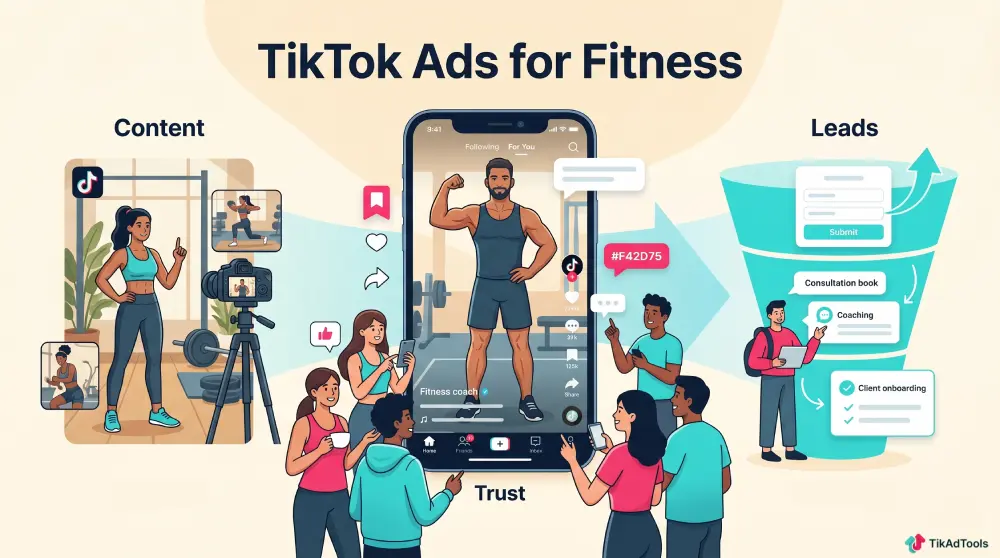
What fitness Ads actually cost in 2026
TikTok hasn’t published an official CPC or CPM benchmark for the fitness vertical. Any exact dollar figure you see floating around for “fitness ad costs” is coming from a third-party blog, not from TikTok itself.
What actually moves your cost is the auction. Your creative, your audience size, and your bid strategy all matter more than your industry label.
Competition matters too. A high-CTR hook lowers your effective cost. A generic one doesn’t.
TikTok does publish hard minimums you need to know before you launch. Daily budgets must exceed $50 at the campaign level and $20 at the ad group level, according to TikTok’s own budget guidelines.
Undershoot either number and your ads won’t deliver.
For a full breakdown of how TikTok pricing works across formats, the TikTok ad cost guide walks through the auction mechanics. Want a live estimate for your own account and country? Run it through the CPM calculator.
Don’t trust a fixed seasonal rule
Coaches assume January is expensive because every trainer launches a transformation campaign at once. That’s a reasonable hypothesis, not a guarantee.
It also changes by market and audience size. Test it instead of assuming it.
Launch a small campaign in December and another in March, then compare your own CPM. The budget strategy guide covers how to plan spend around demand swings without guessing.
Can you advertise weight loss on TikTok?
Yes, within limits. TikTok’s Weight Management and Body Image policy, last updated in June 2026, says weight-loss and muscle-gain claims must target users 18 and older, according to TikTok’s current advertising policy page. Claims must also be framed through a healthy lifestyle.
The policy doesn’t ban the topic. It bans specific claim types.
TikTok explicitly prohibits unrealistic weight-loss or muscle-gain claims and encouragement of disordered eating. It also blocks claims that a product alone, without diet or exercise, causes results.
Suggesting that losing weight or building muscle is easy or guaranteed is off-limits too.
The body-image half of the policy is separate and just as strict. Ads and landing pages can’t shame someone’s appearance or imply there’s one “right” body type.
Claims that looking a certain way makes someone more confident, successful, or popular are also prohibited.
Rules shift by country too. Several markets, including Bangladesh, Nigeria, and the UAE, permit certain weight-loss surgical procedures and meal replacement products with sales-rep approval.
A separate market group allows weight-loss supplements under the same conditions. Check your target country before assuming a global rule applies.
If you’re advertising an actual supplement product, the TikTok supplements policy guide covers the category-specific rules. For the complete rulebook across every restricted category, the TikTok ad policy breakdown is the place to check before you write a single hook.
What actually gets a fitness ad rejected
There’s no secret blacklist of banned words. TikTok’s reviewers look at claim types, not keywords.
Swapping “fat loss” for a synonym doesn’t fix a claim that’s still exaggerated or guaranteed.
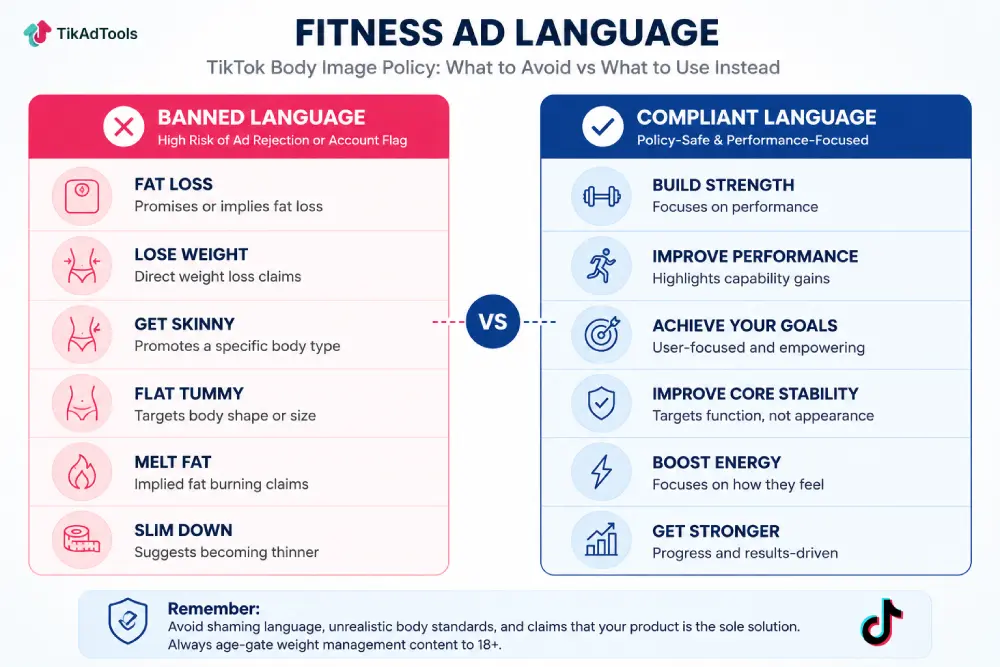
Four claim patterns cause most rejections in this category:
- Unrealistic or guaranteed results, like “lose 20lbs in 30 days, guaranteed”
- Product-alone claims, like “lose weight without changing your diet or exercise”
- Body-shaming or ideal-body messaging, like implying a viewer needs to “fix” their body
- Weight-related claims not gated to an 18-plus audience
Run your copy through the compliance checker before you submit. It catches most of these patterns faster than waiting on a rejection email.
Compliant vs. risky ad language
“Lose 10lbs fast” reads as a guaranteed, unrealistic outcome. It gets flagged.
“Build strength with a plan that fits your schedule” reframes the same offer around a healthy lifestyle instead of a number.
Watch muscle-gain copy too. “Build strength in 30 days, guaranteed” trips the same rule as a weight-loss guarantee.
TikTok restricts unrealistic muscle-gain claims the same way it restricts fat-loss claims.
Creative formats worth testing
The correction video is a strong format to test, not a proven universal winner. Open with a split screen, wrong form on top, correct form on bottom.
Hook it with a specific mistake your audience makes.
Keep any result you mention real and documented. “This fix added weight to my client’s lift” only belongs in an ad if you can back it up.
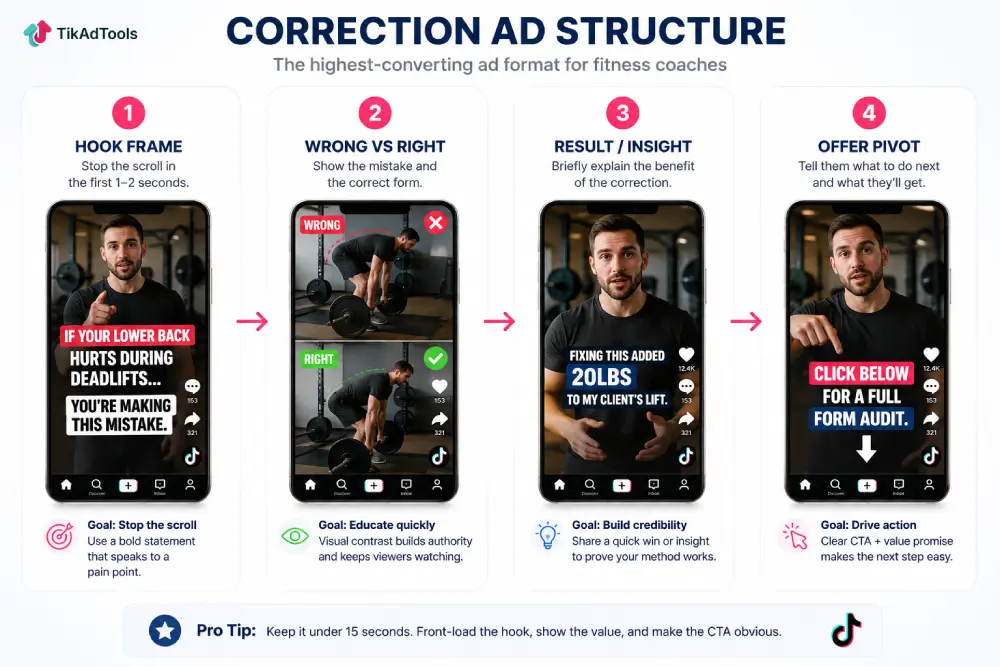
Fabricated outcome claims create both a compliance problem and a trust problem.
Before-and-after photos aren’t formally banned. But they carry real risk under the body-image policy if they imply an ideal body type or an unrealistic outcome.
Client-journey content sidesteps that risk better. Show someone meal-prepping or hitting a personal record in their own words.
Keep production simple. Phone footage with clean captions often outperforms polished studio content on TikTok’s feed.
CapCut handles the cuts and captions without a full edit suite. Read through TikTok ad hooks before you film, since the first two seconds decide whether anyone sees the offer.
Spark Ads for fitness creators
Spark Ads let you boost an existing organic post. Every view, like, comment, and follow it earns still counts toward that original video, according to TikTok’s Spark Ads documentation.
That’s the main reason they read as more authentic than a studio-shot in-feed ad.
TikTok describes Spark Ads as a way to build brand trust and use creator content to drive performance with fewer production resources. That’s a real benefit.
It’s not a guarantee Spark Ads will beat every other format in your account. Test it against your best in-feed creative before assuming it wins by default.
Gymshark’s #Gymshark66 challenge is worth studying as an example of organic UGC and influencer participation. It built the brand’s TikTok presence, but it’s not a Spark Ads case study.
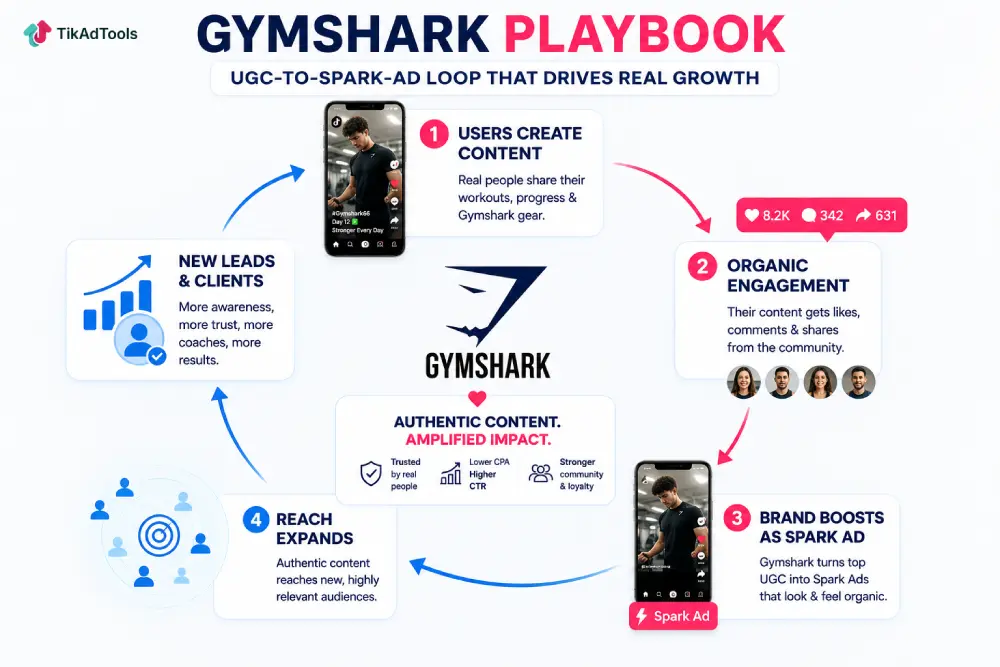
The modern version of that playbook is simpler. Find your best-performing organic client video, get authorization if it’s not your own account, and boost it as a Spark Ad.
Full setup steps live in the Spark Ads guide. The UGC ad guide covers how to source and structure creator content before you boost it.
The UGC finder helps if you don’t have a strong organic post yet.
Building a high-ticket coaching funnel
For 1:1 coaching, lead generation ads with an instant form usually beat sending cold traffic straight to a sales page. A long page adds friction for someone who’d have booked a call in two taps.
Mentioning a price range in the ad itself, like “programs starting at $150,” screens out browsers before they hit your calendar. You’ll get fewer leads. Most of them will be real.
A two-question form helps, but TikTok now has better tools for this. Lead quality optimization uses deeper-funnel signals, like qualified leads or booked calls fed back through the pixel, Events API, or a CRM connection, according to TikTok’s lead quality optimization documentation.
That beats guessing based on one form answer.
Someone who answers “not yet” to a readiness question isn’t a wasted lead. They’re just not ready for this offer right now.
Feed your CRM data back into TikTok and let the algorithm learn what a real customer looks like. The lead generation guide walks through setting the connection up.
Low-ticket challenges and apps
For challenges or subscriptions under $50, a conversion objective optimized for completed payment usually fits better than a lead form. That threshold isn’t a TikTok rule.
It’s a starting point based on how much friction a lower-priced offer can absorb before people drop off.
Lean on urgency and community in the creative, like a challenge start date or real participants. The conversion ads guide covers how to set the optimization event correctly.
You want to be tracking purchases, not clicks.
Targeting fitness buyers without guesswork
Targeting “fitness” as a flat interest pulls in people watching parkour clips right alongside people ready to buy a coaching program. Layer in behavior signals related to your offer instead of relying on one broad interest.
Skip the “1% lookalike” instinct carried over from other platforms. TikTok’s lookalike tool runs on Narrow, Balanced, or Broad audience sizes built from an existing Custom Audience.
TikTok’s own FAQ confirms you currently can’t build a lookalike straight from an email list, per TikTok’s lookalike audience. You’ll need pixel or app data as the source instead.
Your source audience also needs at least 100 matched users before TikTok can build from it.
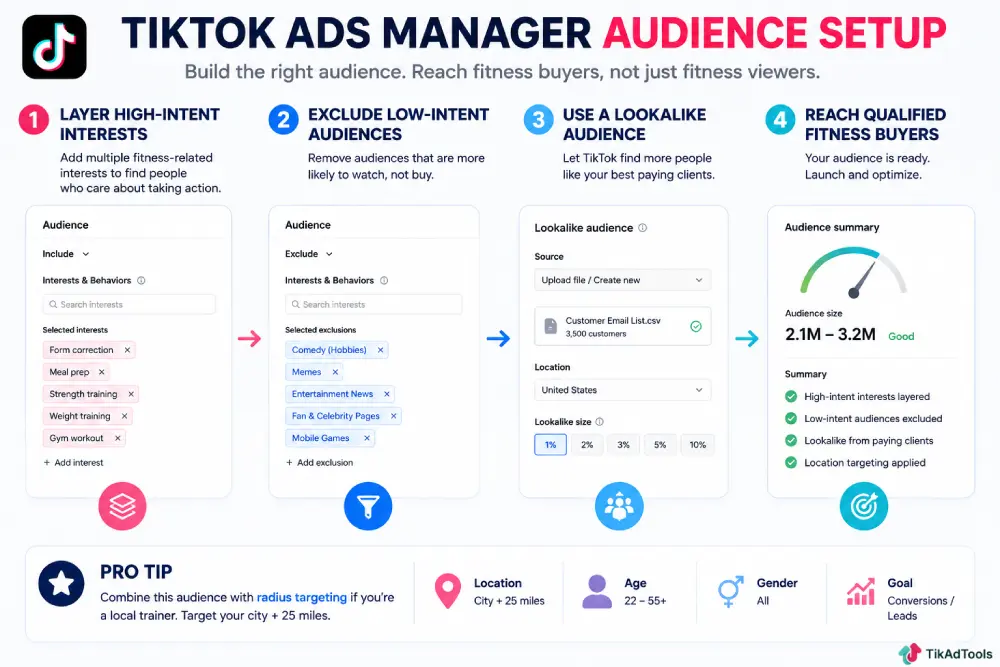
Set the lookalike audience builder up once your pixel has enough volume. Check the lookalike audiences guide for the full setup flow.
If you’re a local trainer, don’t rely on a fixed mile radius. TikTok’s location targeting runs on city, DMA, and zip code selections instead, according to TikTok’s location targeting documentation.
TikTok even notes that delivery based on location signals isn’t guaranteed to be precise. Target your actual service area by city or zip code rather than assuming a radius setting exists.
The targeting guide breaks down every option available in Ads Manager.
FAQs
Can you advertise weight loss on TikTok?
Yes, with restrictions. Claims must target adults 18 and older, be framed through a healthy lifestyle, and avoid guaranteed, unrealistic, or product-alone claims. Gyms, coaches, and fitness apps can advertise freely as long as the specific claims stay compliant.
How much do TikTok ads cost for fitness coaches?
TikTok hasn’t published a fitness-specific benchmark, so treat any exact number you see elsewhere as an estimate. Your real cost depends on creative quality, audience size, and competition in the auction.
Does TikTok ban before-and-after photos?
Not by name, but the format carries real risk if it implies an unrealistic outcome or an ideal body type. Client-journey content built around a real person’s experience usually carries less compliance risk while converting just as well.
Can you build a TikTok lookalike audience from an email list?
No. TikTok’s current lookalike tool requires an existing Custom Audience, typically built from pixel or app data. It also needs at least 100 matched users before it can generate a lookalike.
Should fitness coaches use lead forms or website traffic?
Lead forms tend to work better for high-ticket coaching, since a long sales page adds friction someone might not push through. Website conversion campaigns fit lower-priced challenges or subscriptions where the purchase decision happens fast.
What creative format works best for fitness ads on TikTok?
Correction videos and client-journey content both test well because they feel native to the feed. Running your strongest organic post as a Spark Ad tends to outperform a studio-shot version of the same message.
Final thoughts
Get the compliance details right and the rest of the funnel gets a lot easier to build. Sell the skill, set your targeting up correctly, and if you haven’t run a TikTok campaign yet, TikTok Ads Manager is where all of this actually comes together.