
Launching a new TikTok ad campaign feels like a gamble. Sometimes your CPA (Cost Per Acquisition) is $10 one day and $50 the next. This volatility isn’t a bug; it is a feature called the Learning Phase.
Every time you hit publish, TikTok’s algorithm enters a period of exploration. It blindly tests different users, times, and placements to figure out who your ideal customer is. During this time, costs fluctuate wildly, and performance is unpredictable.
Get Up to $6,000 in Free TikTok Ad Credits
TikTok offers ad credit incentives for new advertisers, helping you test campaigns with a lower upfront cost.
The problem? Most advertisers panic. They see a bad day, tweak the budget, or change the creative, and unknowingly reset the learning clock back to zero.
They get stuck in a Learning Limited loop where the algorithm never gets smart enough to deliver stable results.
This guide explains the exact math required to exit the learning phase quickly and the operational discipline you need to stop sabotaging your own campaigns.
Table of Contents
Quick Summary
- The Magic Number: You need approximately 50 conversions per ad group within a 7-day period to exit the learning phase.
- The Do Not Touch Rule: Editing targeting, creative, or bidding during the first 48–72 hours will almost certainly reset the learning process.
- Budget Math: Your daily budget must be at least 10x your target CPA. If you want a $20 cost-per-sale, your daily budget must be at least $200.
- Consolidation is Key: Running too many ad groups splits your data. Merge audiences to feed the algorithm faster.
- Avoid Narrowing: In 2026, broad targeting helps the system learn faster than restrictive interest stacks.
What is the TikTok Ad Learning Phase?
The Learning Phase is the initial testing period of a new ad group where TikTok’s algorithm actively explores audiences to identify who is most likely to convert. During this stage, delivery is unstable, and CPA fluctuates.
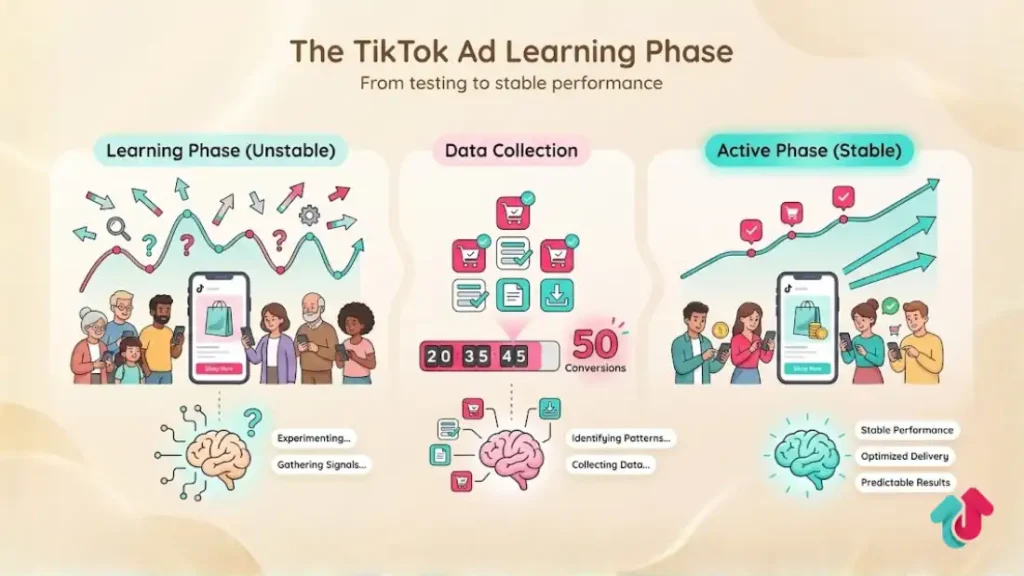
The phase ends once the system gathers roughly 50 conversion events within a week, allowing it to transition into the stable Active phase, where performance becomes predictable and scalable.
1. The Math of Exiting: Why You Are Stuck
The algorithm runs on data, not luck. If you do not feed it enough signal, it starves.
The 50-Conversion Threshold
To graduate from Learning to Active, an ad group needs 50 conversions in 7 days.
If you are optimizing for Purchases, this means 50 sales.
If you are optimizing for Add to Cart, this means 50 carts.
The Common Mistake: Many small brands set a budget of $50/day hoping for $20 sales.
$50 budget / $20 CPA = 2.5 sales per day.
2.5 sales x 7 days = 17.5 sales total.
Result: You fail to hit the 50-conversion target. The ad group gets stuck in Learning Failed, and performance degrades.
The Solution: Down-Funnel Optimization
If your budget cannot support 50 purchases, you must optimize for a cheaper event to get the volume.
Strategy: Start by optimizing for Add to Cart or Initiate Checkout. These events are cheaper and more frequent, allowing you to exit the learning phase in 3–4 days. Once the pixel is seasoned, duplicate the ad set and switch to purchase optimization.
2. The Touch It and Die Rule
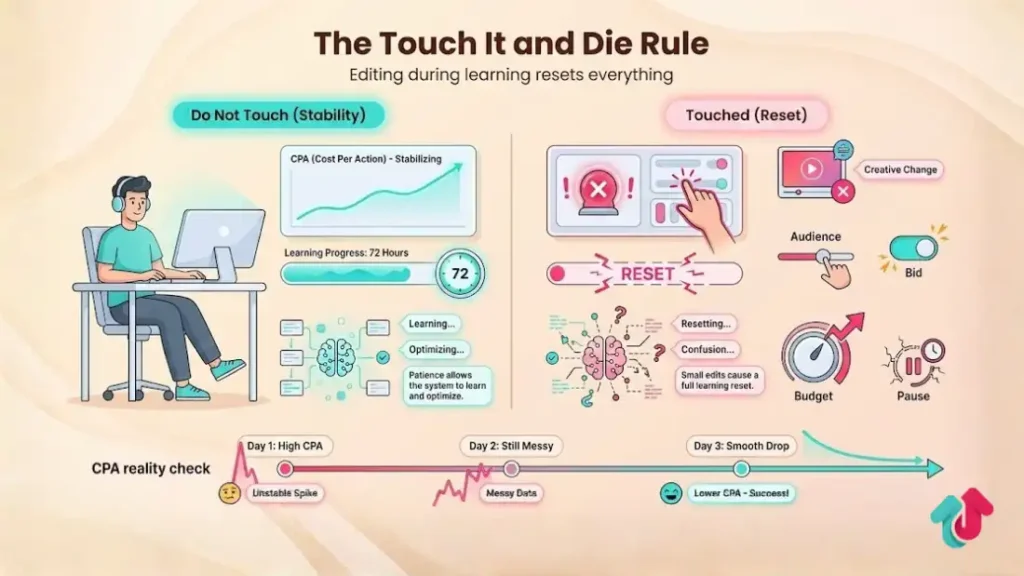
Patience is an operational requirement on TikTok. The system is incredibly sensitive to changes during the learning phase.
Actions That Trigger a Reset
Doing any of the following will reset the algorithm’s progress to zero:
- Changing Creative: Adding or deleting a video.
- Targeting Edits: Narrowing or broadening the audience.
- Bid Strategy Changes: Switching from Lowest Cost to Cost Cap.
- Budget Swings: Changing the budget by more than 20% in a single day.
- Pausing: Pausing the ad group for more than 24 hours.
Best Practice: Launch your ads and do not touch them for 72 hours. Even if the first day looks terrible, let the algorithm finish its exploration. Day 1 might have a $50 CPA, but Day 3 might drop to $15 as the system finds your buyers.
3. Account Structure Strategies to Speed Up Learning
If you are struggling to exit the phase, your account structure is likely too complex.
Consolidation Strategy
In 2026, less is more.
Bad Structure: 1 Campaign > 10 Ad Groups (Interest Stacks) > $20 budget each.
- Result: Data is fractured. No single ad group gets enough conversions.
Good Structure: 1 Campaign > 2 Ad Groups (Broad) > $100 budget each.
- Result: Data is concentrated. The ad groups hit 50 conversions quickly.
Broad Targeting Acceleration
Restricting your audience forces the algorithm to work harder.
Interest Targeting: The system has to filter users before testing them.
Broad Targeting: The system tests everyone and uses your Creative as the filter.
Insight: Broad ad groups typically exit the learning phase 20% faster than interest-based groups because the potential pool of converters is larger.
4. Troubleshooting: What to Do When Learning Failed
If you see the dreaded Learning Failed status, it means the ad group could not get enough data in time. Do not panic.
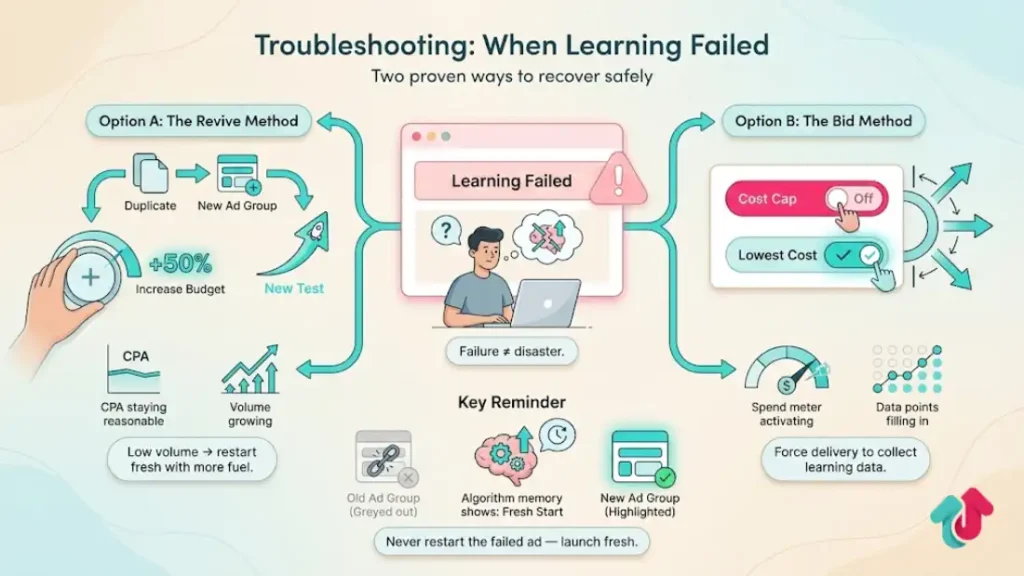
Option A: The Revive Method If the CPA was decent but just low volume:
- Duplicate the ad group.
- Raise the Budget by 50%.
- Publish it as a fresh test. (Do not just restart the old one; the algorithm remembers the failure).
Option B: The Bid Method If you were using Cost Caps (e.g., bid $20 per result) and it didn’t spend:
- Switch the bidding strategy to Lowest Cost (Maximum Delivery).
- This forces TikTok to spend the budget regardless of cost, ensuring you get the data needed to exit the phase.
Explore these helpful articles next:
👉 Best TikTok Ads for Dropshipping Stores (Product Examples)
👉 Retargeting with TikTok Ads: Remarketing Strategies That Work
👉 TikTok Ads for App Installs: Setup & Optimization Guide
👉 TikTok Ads Lookalike Audiences: Complete Setup Guide
FAQ: Learning Phase Logistics
Does the learning phase happen at the Campaign or Ad Group level?
It happens at the Ad Group level. This means if you have one campaign with five ad groups, each ad group has its own separate learning curve and data requirements.
Can I edit the ad text without resetting the phase?
No. Any change to the ad assets (video, text, link, CTA) is considered a significant edit and will trigger a re-review and a learning phase reset.
Is it better to have a higher daily budget or lifetime budget for learning?
Daily Budget is superior for stability. It forces the algorithm to pace itself every 24 hours. Lifetime budgets can sometimes spend erratically, burning cash too fast before the system has learned who to target.
Does Smart+ (Smart Performance Campaign) have a learning phase?
Yes. Even automated campaigns need roughly 50 conversions to stabilize. However, Smart+ campaigns often exit the phase faster because they automatically test multiple creative combinations simultaneously.
What happens if I never exit the learning phase?
Your ad group will likely experience delivery volatility. One day performance will be great, the next it will crash. Costs will generally be higher because the system is constantly guessing rather than knowing who your customer is.
Conclusion
The Learning Phase is the price of admission for TikTok’s powerful algorithm. You cannot cheat it, but you can plan for it.
Success comes down to simple math: Concentrate your budget. Instead of spreading $100 across five different audiences, put it all into one Broad ad group.
Give the system the data volume it craves, resist the urge to tinker for the first three days, and you will move from Learning to Profitable in record time.