
The majority of TikTok ads lose the viewer before a single message can land. Even with a big budget, the ad fails because it doesn’t match the TikTok audience’s short attention span.
Scroll speed on TikTok is relentless, and if you don’t earn attention in the first three seconds, the rest of your creative never gets seen.
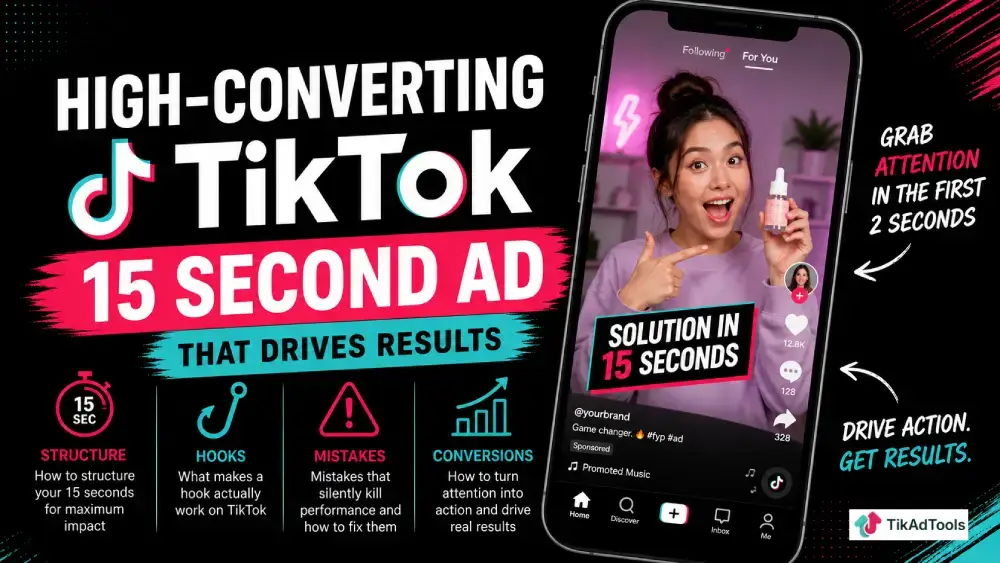
In this guide, we give you a practical framework for building a short-form ad that holds attention and drives action, whether you’re promoting a product, app, or service, applying the same creative principles that drive performance across every TikTok ad length.
Here’s what you’ll learn:
- How to structure your 15 seconds for maximum impact
- What makes a hook actually work on TikTok
- Mistakes that silently kill performance and how to fix them
By the end, you’ll have a practical understanding of how you can create a 15-second TikTok ad that actually converts, not just ones that get views.
Get Up to $6,000 in Free TikTok Ad Credits
TikTok offers ad credit incentives for new advertisers, helping you test campaigns with a lower upfront cost.
Table of Contents
Key takeaways
- The first three seconds determine whether users keep watching or scroll away.
- Native-feeling ads consistently outperform polished, overly produced creatives on TikTok.
- A single, focused message performs better than trying to cover multiple selling points.
- Your call-to-action should appear between seconds 10 and 13 for the highest completion and click-through rate.
- Testing multiple hooks with the same body content is the fastest way to find what resonates.
Quick Answer
A TikTok 15-second ad works when it opens with a strong hook, delivers one clear benefit in the middle, and ends with a short, specific call-to-action. Use the vertical 9:16 format, add on-screen captions, and shoot content that blends naturally into the For You feed.
Why 15 seconds works on TikTok
Fifteen seconds might feel tight, but it’s well matched to how people consume content on TikTok.
TikTok’s TopView ad specifications recommend videos to be between 9 and 15 seconds, which are more likely to rank among the top-performing ads across product and app categories.
This is largely because users are more likely to watch them through to the end.
A viewer who finishes your ad is far more likely to act on it than someone who watched three seconds and scrolled away.
The format also keeps your creative focused. When you only have 15 seconds, you’re forced to pick one message and one problem. That constraint tends to sharpen the pitch in ways that longer formats rarely do.
How to structure a TikTok 15-second ad
Think of the 15 seconds in three parts:
Seconds 0 to 3: The Hook:
This is the only moment that determines whether the viewer keeps watching. Show something unexpected, ask a question your audience cares about, or open with a claim they haven’t heard before.
Pair a spoken line with a bold text overlay so the hook reaches viewers watching without sound.
Seconds 3 to 11: The Core Message:
Pick one angle and deliver it cleanly. Show the product in use, highlight a specific result, or share a quick customer reaction.
Avoid listing features. Eight seconds isn’t enough for a feature rundown, but it’s plenty to make one strong point stick.
Seconds 11 to 15: The Call-to-Action:
Keep it short and specific: “Shop Now,” “Free Download,” or “Try It Today.” Pair the spoken CTA with a visible text overlay so viewers who aren’t listening still see the prompt.
Writing a hook that stops the scroll
The hook is where most TikTok 15-second ads break down. A flat opening means the rest of the creative never gets a chance.
Four hook types that consistently earn attention:
Problem-first: “Struggling to sleep even when you’re exhausted?” Signals immediate relevance to the right viewer.
Result-first: “I dropped two dress sizes before my sister’s wedding using this.” Leads with outcome, which drives curiosity about the method.
Contrast: “Everyone’s using the wrong foundation shade. Here’s how to find yours.” Common behavior becomes the setup; your content becomes the payoff.
Visual-only: A striking first frame with no words. A dramatic before-and-after or product reveal can stop a scroll faster than any line of copy.
On-Screen captions and text overlays
Many TikTok users scroll with the sound off, especially in shared spaces. If your message relies entirely on audio, a large portion of your audience misses it.
Practical tips for on-screen text:
- Place key phrases in the center or upper third of the frame, away from TikTok’s UI buttons at the bottom
- Limit each overlay to five words or fewer
- Sync text timing to the spoken word so both tracks reinforce each other
- Enable auto-captions in TikTok Ads Manager and review them for accuracy before the ad goes live
Name your product or brand visually at least once between seconds 3 and 10.
TikTok ad formats for 15-second creatives
TikTok Ads Manager supports several formats. The right one depends on your goal.
| Ad Format | Best For | What to Know |
|---|---|---|
| In-Feed Ad | Conversions, app installs, traffic | Appears natively in the For You feed |
| TopView | Brand launches, awareness | First ad users see when opening the app |
| Spark Ad | Amplifying organic content | Boosts real posts, feels the most native |
| Collection Ad | eCommerce product catalogs | Pairs video with shoppable product tiles |
For most direct-response campaigns, In-Feed Ads and Spark Ads are the right starting point with a 15-second creative.
TikTok 15-second ad best practices
Keep the focus tight. One product, one message, one action per ad. The moment you try to say three things, you end up saying nothing clearly.
A few non-negotiables before you publish:
- Hook in the first 3 seconds: Lead with a bold visual, a burning question, or a surprising statement before the viewer has a chance to skip
- Use UGC-style creative: Real people and unpolished content outperform traditional, studio-produced ads on TikTok
- Keep pacing fast: Short, dynamic scene cuts hold attention better than long static shots
- Use music or sound effects: Silent ads underperform significantly, so always pair your creative with audio that matches the energy of your message
- Refresh creative every few weeks to prevent audience fatigue.
Common mistakes that kill performance
Opening with a brand logo: It immediately signals “ad” and triggers the scroll reflex. A subtle watermark in the corner is enough.
Trying to cover too much: Pick one message and commit. Listing features, sharing a testimonial, and pitching a discount in 15 seconds makes everything feel rushed, and nothing lands.
Using a weak hook: “Check out our new product” gives viewers no reason to stop. Lead with a problem, a result, or a visual that demands attention.
Placing the CTA too early: A call-to-action on the second three hasn’t given the viewer any reason to respond. Let the message build first, then ask for action.
Testing and measuring your ad
The most efficient way to improve a TikTok 15-second ad is by hook testing.
Build three to five versions of the same creative with different first three seconds, keep everything else identical, and run them against the same audience. The version with the highest completion rate shows which hook worked. The TikTok ad script generator can draft the different hook openings for you to shoot against the same body and CTA.
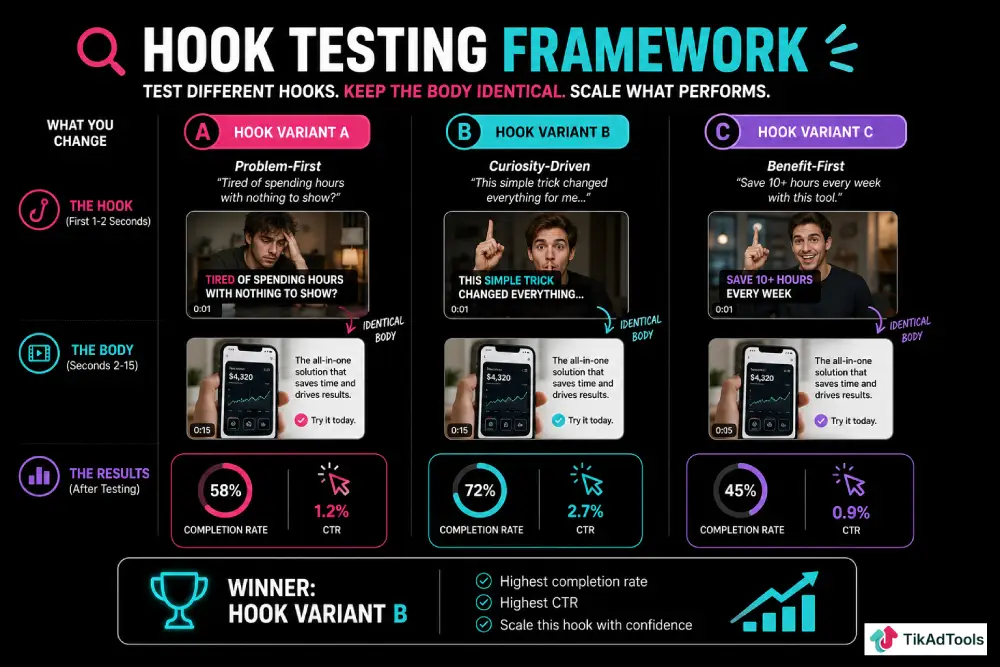
Once you have a winning hook, test the CTA. Then test the body message. Each round gives you cleaner data on what your audience responds to.
Key metrics to track:
- Video completion rate: A widely cited industry benchmark targets 30% or higher as a sign the creative is holding attention to the end
- Click-through rate (CTR): Track against your own baseline, since rates vary significantly by niche and offer
- Cost per result: Improving the creative almost always has a bigger impact than adjusting bids
For current budget minimums, check TikTok Ads Manager directly, as these figures are updated by region.
A real-world TikTok 15-second ad case study
AXE ran a TikTok campaign combining a 6-second reach layer with a 15-second In-Feed video layer featuring influencer-led content. The results from the 15-second ads stood out clearly.
According to the TikTok for Business case study, the 15-second campaign achieved a Cost Per 15-Second Video View of just €0.02, well below their €0.06 target.
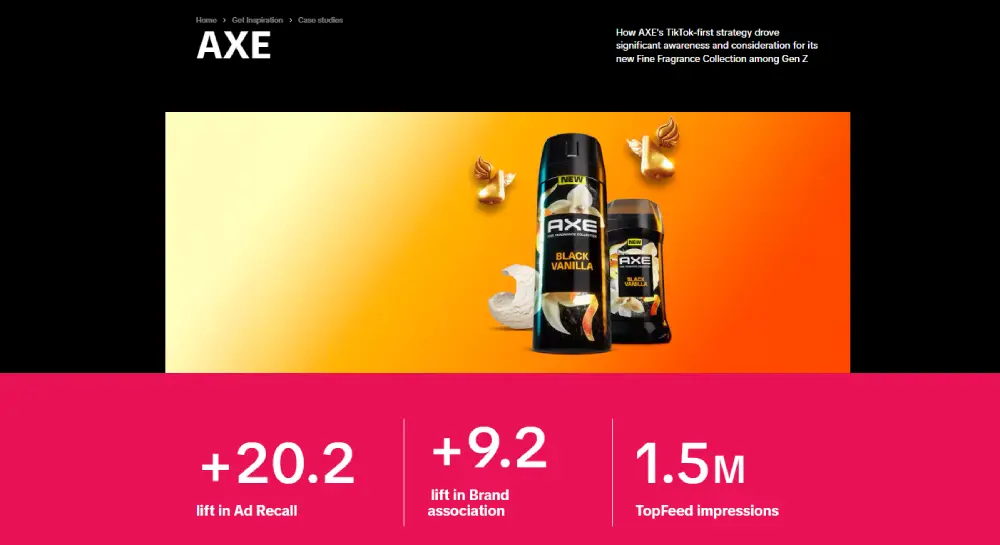
A Brand Lift Study run alongside the campaign recorded a 20.2 point lift in Ad Recall and a 9.2 point uplift in brand association among the target demographic of young men.
The creative approach was straightforward: influencer-led video, no overproduction, shot natively for TikTok.
The 15-second format was chosen specifically to hold attention long enough for the brand message to register, without pushing past the point where viewers drop off.
Frequently asked questions
What is the best TikTok ad length for direct-response campaigns?
For most product and app campaigns, 15 seconds delivers the right balance between holding attention and communicating clearly. Longer formats (30 to 60 seconds) work for complex products or warm retargeting audiences, but they need stronger storytelling to hold completion rates.
How do I make my TikTok 15-second ad look native?
Film vertically in 9:16, start mid-action rather than with branding, and use natural lighting. Spark Ads, which promote real organic posts, are the simplest path to an authentic feel without rebuilding creative from scratch.
What hook type works best on TikTok?
Problem-first and result-first hooks tend to outperform brand-forward openings because they lead with something the viewer already cares about. Pair the spoken line with a text overlay so it reaches viewers watching with the sound off.
How do I know if my TikTok 15-second ad is working?
Start with video completion rate. If viewers aren’t watching to the end, the hook or pacing needs work. Then check CTR and cost per result against your target CPA. Together, those three metrics show where the creative is doing its job and where it isn’t.
How much does it cost to run a TikTok 15-second ad?
TikTok Ads Manager sets a minimum daily budget of $50 per campaign and $20 per ad group. Your actual cost per result depends on your niche, audience size, and creative quality. Strong hooks and native-feeling creatives tend to lower your cost per click because TikTok’s algorithm rewards high engagement rates with better delivery and lower CPMs.
Conclusion
A TikTok 15-second ad doesn’t need a large production budget. It needs a hook that earns the next second, a message that makes one clear point, and a CTA that asks for something specific.
Start there, run a hook test, and let the data guide every round of improvements after that.
Sources