
In 2026, defining a good ROAS on TikTok is not about hitting one universal number; it’s about profitability based on your specific business economics.
Across platforms, TikTok’s average ROAS sits around 1.4x-2.0x for many advertisers, meaning roughly $1.40-$2.00 returned for every $1 spent. Top eCommerce campaigns often exceed 2.0x-3.0x, and apparel brands have medians near 2.6x.
These figures reflect real campaign data, but they are reference points, not targets you should chase blindly.
Get Up to $6,000 in Free TikTok Ad Credits
TikTok offers ad credit incentives for new advertisers, helping you test campaigns with a lower upfront cost.
What matters most is whether your TikTok spending generates profitable revenue after accounting for product costs, fulfillment, fees, and operational expenses. This profitability lens, not platform averages, determines what good means for your business.
TikTok is also a discovery‑first platform, where users often encounter products before they intend to buy. This behavior affects conversion timing and attributed ROAS, making direct comparisons with intent‑driven channels like search or retargeting misleading.
The right ROAS for you is the one that supports sustainable growth and real profit, not just industry averages.
In the Article, you’ll learn how to interpret TikTok ROAS through the lens of business economics, model benchmarks, and campaign goals.
Table of Contents
Quick Summary
- There is no universal good ROAS on TikTok
- Profitability determines what counts as good
- Break-even ROAS is the most important benchmark
- Different business models require different ROAS expectations
- TikTok ROAS often appears lower due to multi-touch buying behavior
What Is a Good ROAS on TikTok?
A good ROAS on TikTok in 2026 is typically above your break-even ROAS and high enough to generate profit after all costs.
For many eCommerce brands, that means a ROAS between 2.0 and 4.0, but the exact number depends on margins, average order value, and customer lifetime value.

A ROAS that looks low on the platform may still be profitable at the business level. TikTok often drives discovery rather than immediate purchases, so some conversions happen later through search, direct visits, or other channels.
Why There Is No Universal ROAS Benchmark for TikTok
ROAS benchmarks vary because every business has different cost structures.
Key factors that change what good means:
- Product margins
- Cost of goods sold
- Shipping and fulfillment costs
- Return rates
- Average order value
- Customer lifetime value
A brand with 70 percent margins can profit at a lower ROAS than a brand with 25 percent margins.
A subscription business may accept lower upfront ROAS because revenue continues over time. This is why comparing ROAS across industries or brands rarely provides useful insight.
ROAS vs Break-Even Point in TikTok
Break-even ROAS is the minimum return required to cover ad spend and costs. Any ROAS above that number generates profit.
Break-even ROAS formula: Total revenue required ÷ ad spend = break-even ROAS
Example:
- Product price: $100
- Cost to produce and deliver: $50
- Available for ads: $50
In this case, a ROAS of 2.0 may be required just to break even.
Profit begins above that threshold.
Understanding your break-even ROAS is the most reliable way to define a good ROAS on TikTok. Without this number, ROAS benchmarks have little meaning.
A good ROAS is not the highest possible number. A good ROAS is one that supports sustainable, profitable growth for your business model.
Good TikTok ROAS by Business Model
A good ROAS varies by business model because margins, pricing, and customer value differ. What counts as profitable for one model may be unsustainable for another.
The correct benchmark is always tied to break-even ROAS and long-term revenue potential.

eCommerce Brands
For most eCommerce brands in 2026, a good ROAS typically falls between 2.0 and 4.0, but this range depends heavily on margins and repeat purchase behavior.
Brands with high margins or strong retention can profit at lower ROAS, while low-margin products often require higher returns to stay sustainable.
Key factors that shape a good ROAS for eCommerce:
- Gross margin per product
- Average order value
- Shipping and fulfillment costs
- Return and refund rates
- Repeat purchase rate
A brand selling high-margin products may remain profitable at a ROAS of 1.8 to 2.2.
A low-margin dropshipping store might need a ROAS above 3.0 just to break even.
The benchmark is not the same across all stores. Profitability depends on how much revenue remains after costs.
Lead Generation Businesses
A good ROAS is determined by the value of each lead and the close rate. In many cases, a ROAS between 1.5 and 3.0 can still be strong if leads convert into high-value customers later.
Lead gen economics are different because revenue does not occur immediately. Instead, value comes from:
- Lead-to-customer conversion rate
- Average customer value
- Sales cycle length
- Retention and upsells
If one out of ten leads converts into a $1,000 customer, the campaign can remain profitable even with a lower initial ROAS. This is why lead generation businesses often evaluate performance over longer timeframes.
A good ROAS in this model produces profitable customers, not just cheap leads.
App Install Campaigns
For app install campaigns, ROAS is tied to user lifetime value rather than immediate purchases. A good ROAS depends on how quickly ad spend is recovered through in-app purchases, subscriptions, or ads.
In this model, acceptable ROAS varies widely:
- Short payback window apps may target 2.0+
- Subscription apps may accept lower early ROAS
- Gaming apps often evaluate long-term LTV
An app install campaign may appear unprofitable at first, but become profitable after 30 to 90 days if users continue spending. Because of this delay, app marketers often evaluate ROAS over a longer window instead of day-one returns.
A good ROAS supports a sustainable payback period and positive lifetime value.
Good TikTok ROAS by Campaign Objective
A good ROAS also depends on the campaign objective. Different objectives measure success differently, which changes what counts as acceptable performance.
Conversion Campaigns
For conversion campaigns, a good ROAS exceeds your break-even point and produces profit.
Many advertisers aim for 2.0 or higher, but the true benchmark is whether revenue from purchases covers ad spend and operating costs.
Conversion campaigns measure direct revenue. Because of this, ROAS expectations are usually higher than in other campaign types.
A strong conversion ROAS should:
- Cover product and operational costs
- Allow for reinvestment in ads
- Support profitable scaling
If a campaign generates consistent profit at an ROAS above break-even, it is performing well regardless of industry averages.
Awareness Campaigns
For awareness campaigns, ROAS is not always the primary performance metric. These campaigns focus on reach, discovery, and future demand rather than immediate purchases. Because of this, a lower ROAS may still be acceptable.
Awareness campaigns can influence:
- Future conversions
- Branded search
- Direct traffic
- Returning customers
A campaign may show low platform ROAS but still increase total revenue across channels. In these cases, success is measured by overall business impact rather than immediate return.
A good ROAS for awareness campaigns supports long-term growth and improves downstream performance, even if short-term returns appear lower.
Why TikTok ROAS Looks Different From Other Platforms
TikTok ROAS often appears lower than on search or retargeting platforms because user behavior is different. TikTok is a discovery-driven environment where people encounter products before they intend to buy. This delays conversions and spreads them across multiple channels.

TikTok ROAS looks lower because many users discover products on TikTok but complete purchases later through search, direct visits, or other platforms. This creates attribution gaps between ad exposure and final conversion, making platform-reported ROAS appear lower than total business impact.
On search platforms, users already have buying intent. On TikTok, they often see a product for the first time. This difference changes how ROAS should be interpreted.
Common reasons TikTok ROAS looks lower:
- Longer time between first exposure and purchase
- Multi-platform buying journeys
- Cross-device conversions
- View-through influence not fully captured
- First-touch discovery rather than last-click conversion
A customer might see a product on TikTok, research it later on search, and then purchase through a direct visit. In this case, TikTok influenced the sale but may not receive full credit in platform reporting.
Because of this discovery behavior, TikTok often plays a top-of-funnel role even in conversion campaigns.
Evaluating ROAS without considering this context can lead to misleading conclusions about performance.
Platform vs Business-Level ROAS
Platform ROAS and business-level ROAS measure different things. One reflects what the ad platform can track. The other reflects actual revenue impact across the business.
Platform ROAS measures revenue attributed directly to the ad platform, while business-level ROAS measures total revenue generated compared to total ad spend.
Business-level ROAS usually provides a more accurate view of profitability because it includes delayed and cross-channel conversions.
Understanding this distinction helps prevent misinterpretation of performance data.
TikTok Ad Platform Level ROAS
ROAS reported inside TikTok Ads Manager shows conversions attributed to TikTok within its tracking window. This metric reflects what the platform can directly measure based on pixel or event data.
Limitations of platform ROAS include:
- Attribution windows may miss delayed purchases
- Cross-device behavior may not be fully tracked
- Offline or external conversions may not be included
- Multi-channel journeys can split credit
This does not mean the metric is inaccurate. It means it represents only part of the picture.
Platform ROAS is useful for monitoring campaign trends and relative performance. However, it should not be the only metric used to judge profitability.
Business Level ROAS
Business-level ROAS compares total revenue to total advertising spend across multiple channels. This metric reflects real business performance rather than platform-specific attribution.
Business Level ROAS formula:
Total revenue ÷ total ad spend across all channels
This approach captures:
- Delayed conversions
- Returning customers
- Cross-channel purchases
- Overall business growth
For many brands in 2026, blended ROAS provides a clearer picture of whether TikTok advertising is profitable. A campaign may show a modest platform ROAS but still drive significant total revenue growth.
Evaluating both metrics together provides better context:
- Platform ROAS shows campaign-level efficiency
- Business ROAS shows true profitability
A good ROAS on TikTok is ultimately defined at the business level. If total revenue grows profitably relative to total ad spend, the advertising strategy is working, even if platform-reported ROAS appears lower.
When a Lower ROAS Is Still Profitable
A lower ROAS can still be profitable if customer lifetime value exceeds acquisition cost. Many businesses earn most revenue after the first purchase, which means immediate ROAS does not tell the full story.
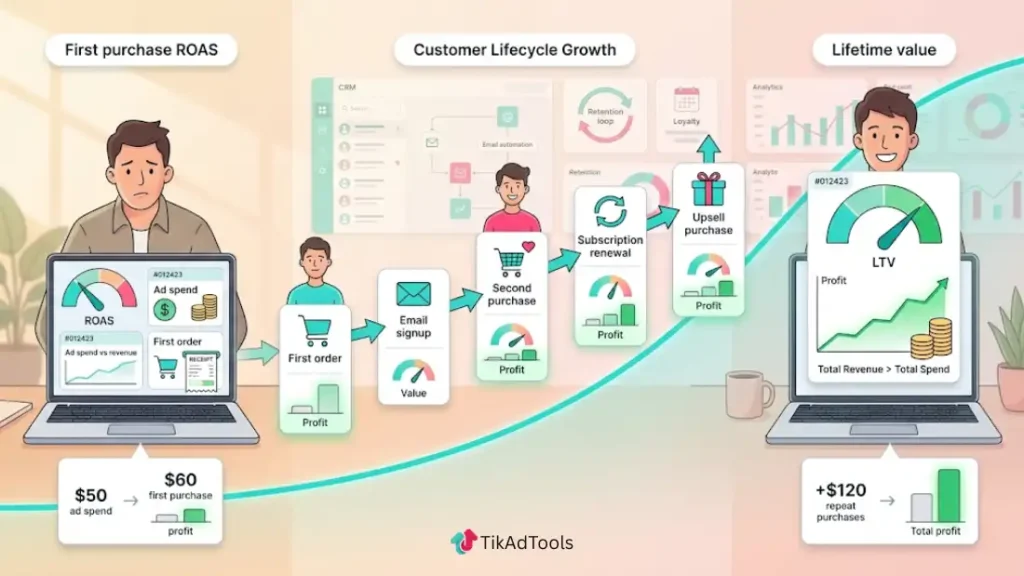
A lower ROAS is still profitable when revenue generated over a customer’s lifetime exceeds total acquisition and operating costs. If it is a repeat purchase, subscription, or upsells increase total revenue, the initial return on ad spend can appear low while the business remains profitable.
Situations where lower ROAS can still work:
- Subscription products with recurring revenue
- High repeat purchase rates
- Strong email and retention systems
- Upsells and cross-sells after the first purchase
- Longer buying cycles
Example:
If a brand spends $50 to acquire a customer and earns $60 on the first purchase, the immediate ROAS may look modest. But if that customer spends another $120 over the next six months, the total return becomes highly profitable.
This is why evaluating ROAS in isolation can be misleading. The key metric is not only first-purchase revenue but total customer value.
Common Misconceptions About Good TikTok ROAS
Many advertisers compare ROAS numbers without context. This often leads to unrealistic expectations and incorrect performance conclusions.
Common misconceptions about TikTok ROAS include assuming there is a universal benchmark, expecting TikTok to match search platform ROAS, and judging profitability using platform-reported ROAS alone. In reality, acceptable ROAS varies by margins, customer value, and business model.
Misconception 1: There Is One Good ROAS Number
There is no single benchmark that applies to every business.
A good ROAS is always relative to:
- Costs
- Margins
- Customer value
- Business model
Comparing ROAS across industries rarely produces useful insights.
Misconception 2: TikTok Should Match Search Platform ROAS
Search advertising captures existing demand. TikTok often creates demand. Because of this difference, ROAS on TikTok may look lower but still drive profitable growth.
Expecting TikTok to match high-intent search ROAS ignores how discovery-based platforms work.
Misconception 3: Higher ROAS Always Means Better Performance
A higher ROAS does not always mean higher profit. A campaign with very high ROAS but low spend may generate less total profit than a campaign with slightly lower ROAS and higher volume.
The goal is profitable growth, not just the highest ratio.
Misconception 4: Platform ROAS Equals Business Profit
Platform-reported ROAS only reflects attributed conversions. It does not capture delayed purchases, repeat orders, or cross-channel revenue.
Business-level profitability should always guide decision-making.
Explore these helpful articles next:
👉 TikTok Ads for Sports & Activewear Brands: Winning the Feed
👉 TikTok Book Marketing: How Authors Use Ads to Reach Readers
👉 TikTok Ads for Alcohol-Free Beverage Brands: The Sober-Curious Boom
👉 TikTok Ads for Weddings & Event Services: How to Turn Views Into Booked Clients
FAQs
What is a good ROAS on TikTok in 2026?
A good ROAS on TikTok in 2026 is typically 2.5-3x or higher, but the right number depends on your profit margin and goals. eCommerce brands often see 1.5-2x as average on TikTok, with 2.5-3x considered healthy for scale and 3-5x achievable only for top‑performing, highly optimized creatives and offers.
What is the average ROAS for TikTok ads?
The average ROAS for TikTok ads across industries usually falls around 1.4-2.0x, meaning many advertisers get 1.40-2.00 back for every 1.00 spent. For eCommerce specifically, benchmarks often sit in the 1.5-2x range, reflecting TikTok’s discovery‑driven nature and lower purchase intent compared to search platforms like Google.
How do I know if my TikTok ROAS is profitable?
You know your TikTok ROAS is profitable when it’s above your break‑even ROAS, which is determined by your gross profit margin. For example, if your margin is 40%, you need about 2.5x ROAS just to break even, while a 50% margin only requires 2x; anything above that line represents true profit from your campaigns.
What ROAS should I aim for with TikTok eCommerce ads?
For TikTok eCommerce ads, aiming for at least 2-2.5x ROAS is realistic for scaling while staying close to profitability. Many brands treat 1.5-2x as acceptable for cold traffic if lifetime value is strong, and reserve higher targets like 3-4x for retargeting, proven products, or top‑quartile creative performance.
Why is ROAS on TikTok often lower than on Meta or Google?
ROAS on TikTok is often lower because TikTok is a discovery‑first, entertainment platform, while Meta and Google capture warmer or high‑intent traffic. Benchmarks show typical TikTok ROAS around 1.4-2.0x versus higher returns on Google search and Meta retargeting, which benefit from stronger purchase intent and mature conversion tools.
How can I improve my ROAS on TikTok in 2026?
You can improve TikTok ROAS in 2026 by focusing on native‑feeling creatives, rotating hooks weekly, and optimizing your funnel beyond the click. Tactics like using UGC or Spark Ads, testing multiple angles, broad but relevant targeting, and tightening landing pages and offers typically lift click‑through, conversion rate, and overall return on ad spend.
Conclution
There is no universal good ROAS on TikTok in 2026. What counts as profitable depends on your business model, margins, pricing strategy, and customer lifetime value.
While many advertisers report average ROAS between 1.4x and 2.0x, top-performing eCommerce brands often achieve 2.0x-3.0x. These numbers serve as guidance, not strict targets.
The most reliable way to define a good ROAS is to focus on profitability over platform averages. Calculate your break-even ROAS, compare platform-reported performance with total business revenue, and consider long-term customer value.
A campaign that covers costs, drives profit, and scales sustainably is a good ROAS, even if the platform metric seems modest.
In short: a good ROAS supports profitable growth, aligns with your economics, and reflects both immediate and long-term revenue, not just a number copied from an industry benchmark.