
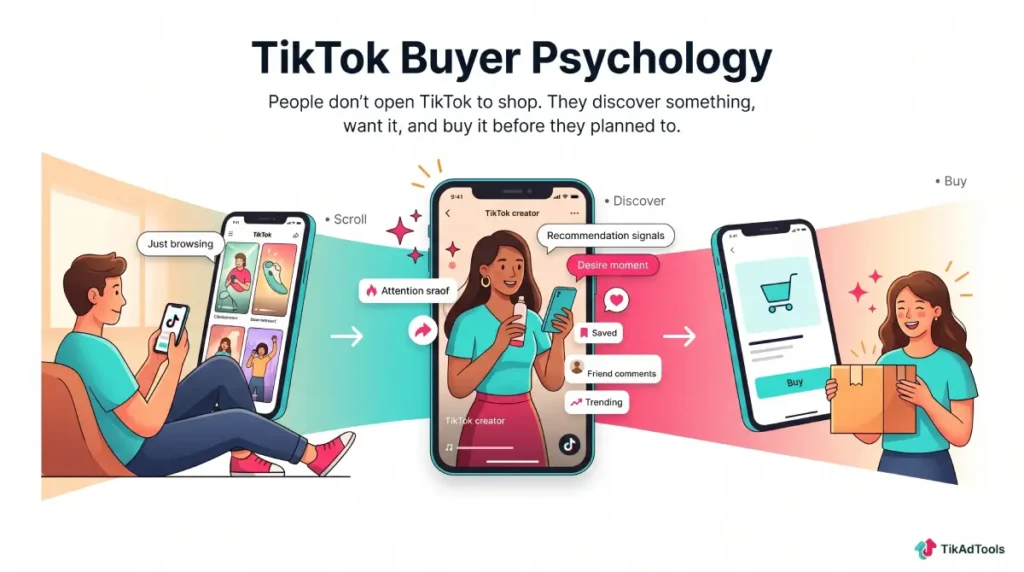
Most people open TikTok to watch, not to shop. Then a product shows up in the feed and the shopping decision starts before anyone searched for anything.
That sequence is the real story behind TikTok buyer psychology. Ads built like Google search ads or Facebook retargeting often miss it entirely.
This guide walks through what the actual research says, not the rounded-up, misquoted version that gets passed around. Every stat here is tied to its real source and its real population, and it should directly inform how you build your ad creative.
Table of Contents
Get Up to $6,000 in Free TikTok Ad Credits
TikTok offers ad credit incentives for new advertisers, helping you test campaigns with a lower upfront cost.
TL;DR
- 83% of surveyed TikTok Shop shoppers say they’ve discovered a new product on the platform, and 70% discovered a new brand, per GlobalData and TikTok Shop research.
- Discovery, social proof, urgency, and low checkout friction show up repeatedly across multiple studies, but no single trigger explains “every” purchase.
- A 2025 academic study found two FOMO-related factors together explained 68% of the variation in impulsive buying among 336 young TikTok Shop users, not that FOMO “caused” 68% of purchases.
- Nearly half of surveyed TikTok Shop purchases trace back to influencer content, and shoppers said they’d spend an average of $95 on a trusted creator’s recommendation, per PartnerCentric.
- US TikTok Shop shoppers under 60 spent about $708 a year on average, across roughly 12 purchases, at $59 per order.
Quick Answer
TikTok buyer psychology describes the behavioral patterns that turn casual scrolling into fast purchases: discovery before intent, social proof from creators, urgency from limited-time offers, and low-friction in-app checkout. These patterns are well documented across multiple studies, but they influence shoppers differently depending on age, product category, and price point.
Why TikTok shoppers buy before they plan to
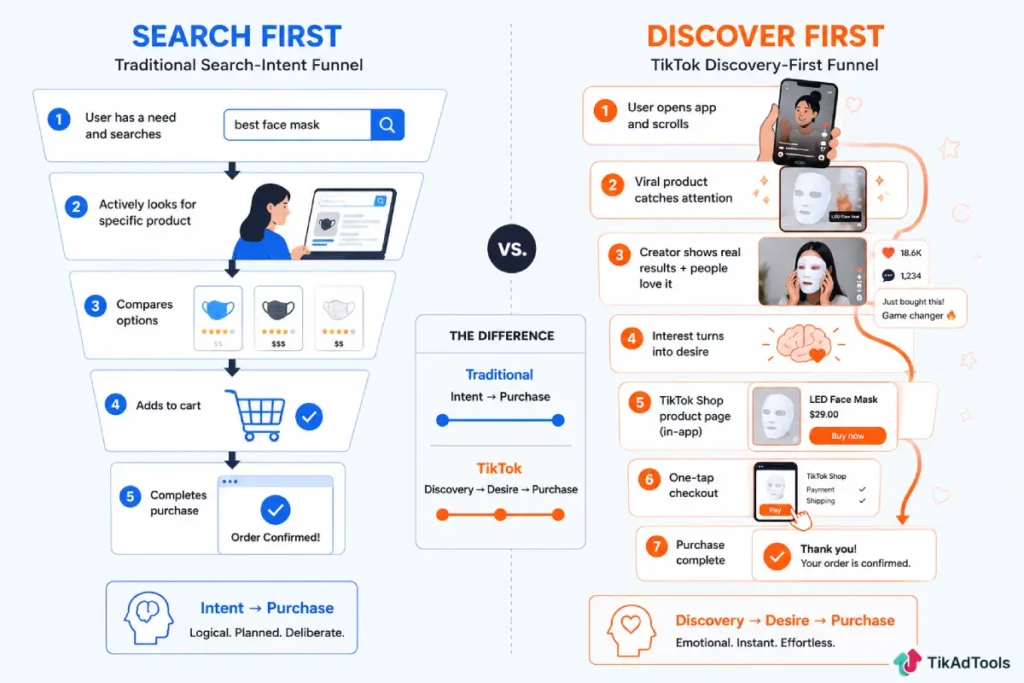
TikTok flips the usual ecommerce order. On Google, someone already wants the thing. On TikTok, discovery often comes first and intent follows.
That’s not a guess, it’s measured. Research from GlobalData and TikTok Shop found 83% of surveyed shoppers say they’ve discovered a new product on the platform, and 70% discovered a new brand there.
The same research found something worth flagging carefully: 76% of consumers who had engaged with TikTok Shop said they’d bought something from a livestream at some point in the past year. That’s a past-year purchase incidence among engaged users, not a livestream conversion rate, so don’t read it as “76% of livestream viewers buy.” This discovery-first pattern is exactly why TikTok ads for eCommerce need a different structure than a search-driven funnel. You’re building the want, not capturing it.
Key discovery and purchase-behavior stats:
| Stat | What it actually measures |
|---|---|
| 83% | Surveyed shoppers who discovered a new product on TikTok Shop |
| 70% | Surveyed shoppers who discovered a new brand on TikTok Shop |
| 76% | Engaged TikTok Shop consumers who bought from a livestream in the past year |
| 49.7% | Social shoppers on TikTok who buy at least once a month (March 2024 survey) |
Sources: GlobalData and TikTok Shop research; eMarketer.
What actually drives TikTok purchases
Four patterns show up again and again across research on TikTok shopping behavior. Think of these as mechanisms that can influence a purchase, not a guaranteed four-step formula behind every sale.
1. Discovery and novelty
The feed constantly surfaces things a user wasn’t looking for. That makes novelty genuinely useful for advertisers: an ad can introduce a product before the viewer has actively searched for anything.
2. Social proof from creators
Nearly half of surveyed TikTok Shop purchases came from influencer posts, and 63% of respondents said they take purchase suggestions from influencers, according to PartnerCentric’s consumer survey of over 1,000 Americans under 60. Respondents also said they’d spend an average of $95 on a product recommended by their most-trusted influencer.
Creator content can carry more social proof than a studio-produced brand ad, since it feels native to the feed. UGC-style ads tend to lean into this pattern hardest, but it doesn’t mean creator content wins every time, category, disclosure, and audience fit all matter.
3. FOMO and urgency
A 2025 academic study of 336 young TikTok Shop users, published in the SEARCH Journal of Media and Communication Research, found that two FOMO-related factors, desire for belonging and anxiety of isolation, together explained 68% of the statistical variance in impulsive buying behavior.
That’s a measure of how much those two factors account for differences in impulsive buying, not a claim that FOMO directly caused 68% of purchases. In the same study, 75% of respondents cited time-limited flash sales as a relevant feature, and 62% cited influencer-curated showcases.
4. Low-friction checkout
TikTok Shop keeps discovery and checkout in the same app, which can shorten the number of steps between wanting something and buying it. That’s a design advantage, not proof that friction “disappears” or that price and trust concerns stop mattering. TikTok’s shopping ad formats are built specifically around collapsing that gap.
How does TikTok shopping behavior compare to Facebook?
Be careful with blanket claims here. Both platforms support discovery, search, retargeting, and impulse buying, so a clean split like “TikTok is emotion, Facebook is intent” oversimplifies both.
What’s genuinely different: TikTok’s feed centers on short-form entertainment and creator content, so ads often need to build interest before asking for a click. Facebook still holds a larger overall social buyer base in the US through Marketplace and Shops, while TikTok Shop is growing faster off a smaller starting point.
Emotional resonance plays a real role too. A 2023 TikTok-commissioned study found 71% of respondents said they’d bought something because it “just felt right” after seeing it in their feed. That’s evidence emotion matters, not proof that logic doesn’t factor in at all, and it’s older data than most of the other stats here.
Turning this into ad creative
Build the ad around a real reason to keep watching, not a copied hook formula. A few practical moves that follow directly from the research above:
- Lead with the product in context, not a feature list. A demo or before-and-after in a real setting reads as discovery, not an ad.
- Use real people, not scripted voiceovers, where the category allows it. Creator-style content benefits from the social proof pattern above.
- Add urgency only when it’s true: a fake countdown erodes trust faster than it drives action.
- Keep the path to purchase short: every extra step is a chance for hesitation to catch up with the initial interest.
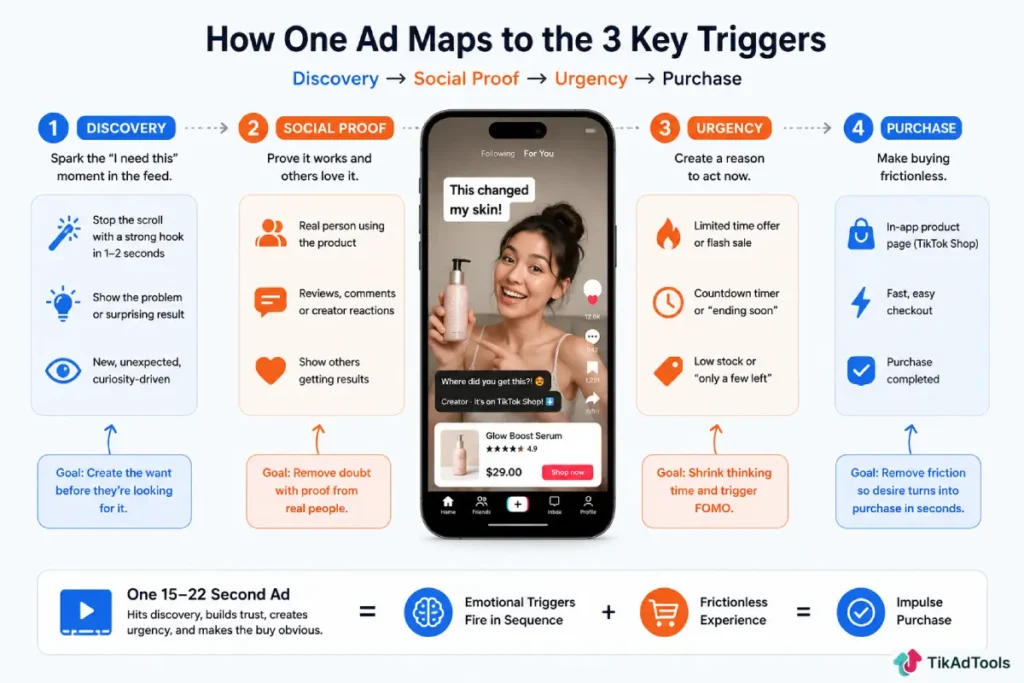
If you sell a $29 LED face mask, a 15-second clip showing how it fits into someone’s evening routine works better than a spec sheet. Just be careful with anything that reads as a before-and-after performance claim for a beauty or health device, that can trigger a compliance review.
Your hooks matter more here than your targeting does. Test a few angles before committing budget, a hook generator speeds up the first line when you’re stuck.
Some viewers won’t convert on the first exposure. A retargeting layer catches the ones who were interested but didn’t act yet.
Does this change by product price?
Yes. The lower the price, the more these patterns line up with fast, low-deliberation purchases. Higher-ticket items need more evidence before someone commits.
| Price range | What drives the decision | Creative approach |
|---|---|---|
| Under $50 | Impulse, novelty, low perceived risk | Fast hook, quick demo, direct CTA |
| $50 to $200 | Social proof, discounts, some deliberation | Creator reviews, comparison, clear value |
| $200+ | Trust, demonstration, credibility | Longer-form proof, reviews, creator credibility over urgency |
PartnerCentric’s survey found TikTok Shop buyers under 60 spent an average of $708 over the year, across roughly 12 purchases and $59 per order, showing that frequency, not basket size, drives most of the spend. Urgency alone rarely closes a high-ticket sale without real trust behind it.
FAQs
What age group buys the most on TikTok Shop?
Gen Z shows the strongest engagement: PartnerCentric’s survey found 95% of Gen Z uses TikTok and 71% have purchased something they discovered there. Millennials follow closely behind. We couldn’t independently verify a specific “47% via Edison Research” figure sometimes cited elsewhere, so we’re leaving it out.
Are most TikTok purchases impulse buys?
A meaningful share are, but not most. PartnerCentric found nearly 1 in 4 shoppers, 23%, admitted their most recent TikTok Shop purchase was impulsive. That’s a real pattern worth designing for, not the majority behavior.
How much do TikTok Shop buyers actually spend?
US shoppers under 60 spent an average of $708 over the year, PartnerCentric found, across roughly 12 purchases and about $59 per order. Frequency, not basket size, drives the annual total.
Do discounts really change buyer behavior on TikTok?
Yes. YouGov’s survey found 52% of TikTok Shop buyers cited discounts and promotions as an influence on their purchases, well ahead of influencer recommendations at just 12%.
Why does influencer content perform well on TikTok Shop?
It carries social proof and feels native to the feed rather than interruptive. PartnerCentric’s survey found nearly half of TikTok Shop purchases traced back to influencer content, and 63% of respondents said they take purchase suggestions from influencers.
Can this psychology work for higher-priced products?
It can, but urgency alone won’t do the job. Higher-priced items need more demonstration, reviews, and creator credibility to clear the hesitation that a $15 impulse buy doesn’t have to deal with. Common mistakes here usually come down to copying a low-ticket playbook onto a high-ticket product, and the TikTok ads mistakes guide covers this specific trap.
Conclusion
The research is consistent on one thing: TikTok shoppers respond to discovery, social proof, urgency, and a short path to checkout, but no single trigger explains every purchase, and the strength of each pattern shifts by price point and audience.
Build creative around the pattern that actually fits your product and price, and treat every stat you use the way this guide did, tied to its real source and its real population.
Sources