
Most advertisers treat a TikTok campaign like a switch. Turn it on, watch the numbers, and turn it off when they drop. That’s why their accounts feel like a guessing game.
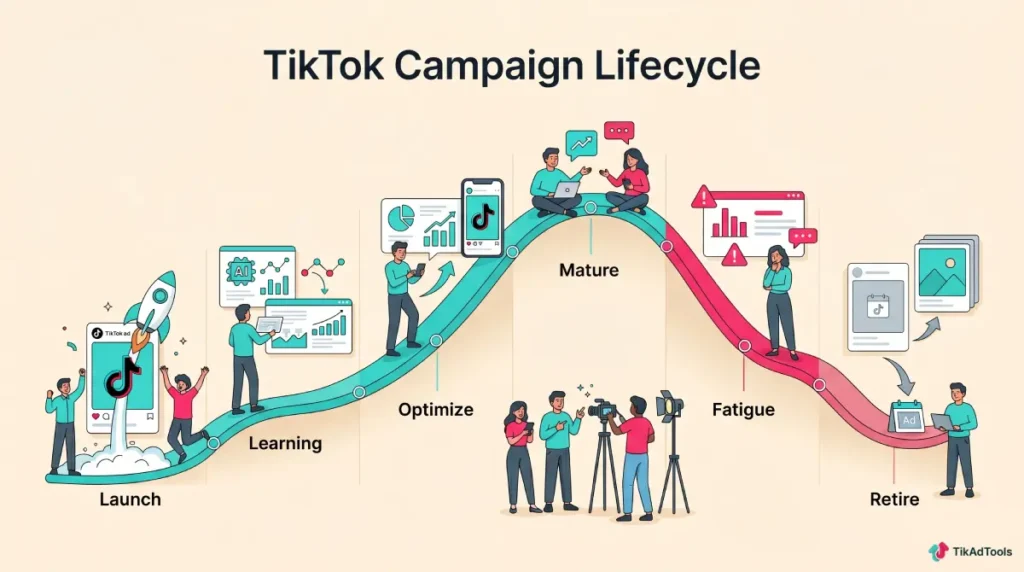
A campaign isn’t static. It moves through a TikTok campaign lifecycle with clear stages, and each stage needs a different move from you.
Get the timing wrong, and you’ll kill a winner early or pour money into a loser too long.
TL;DR
- Every TikTok campaign moves through six stages: launch, learning, optimization, maturity, fatigue, and retirement.
- The biggest mistakes happen when you act out of sync with the stage you’re actually in.
- Knowing the current stage tells you exactly when to scale, when to refresh creative, and when to walk away.
Table of Contents
Get Up to $6,000 in Free TikTok Ad Credits
TikTok offers ad credit incentives for new advertisers, helping you test campaigns with a lower upfront cost.
Quick Answer
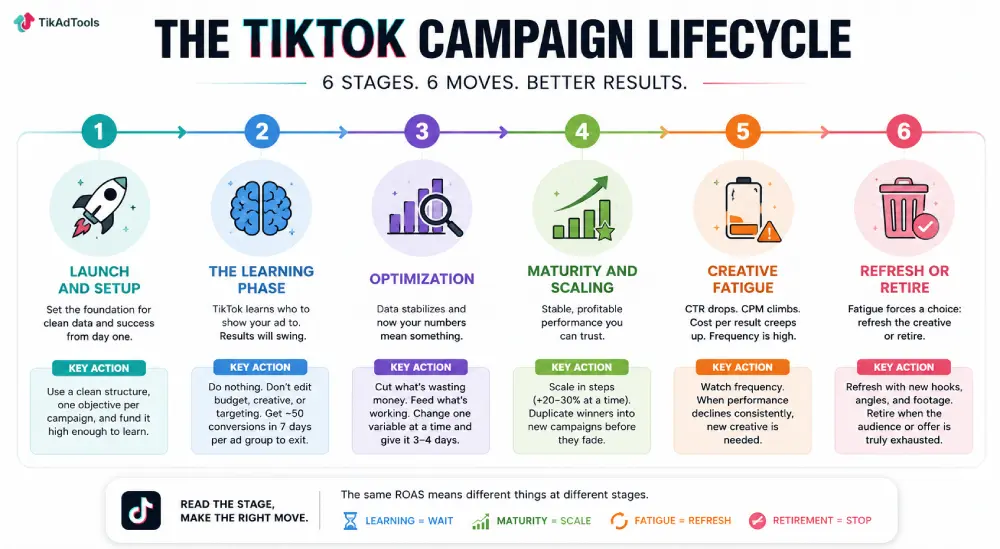
The TikTok campaign lifecycle is the path every campaign moves through, from launch and learning to scaling, maturity, fatigue, and retirement. Knowing which stage you’re in tells you what to change, when to add budget, and when to refresh creative before performance falls off.
The 6 stages of the TikTok campaign lifecycle
Think of these stages as a sequence, not a menu. You can’t skip the learning phase to get to scaling, and you can’t scale a campaign that’s already fatigued. Each one sets up the next.
Stage 1: Launch and setup
Launch decides more than people admit. The structure you build in the first hour locks in how clean your data will be for the rest of the campaign’s life.
Keep one objective per campaign and don’t crowd your ad groups. If your campaign structure is messy at launch, no amount of optimization later will untangle it.
Set your budget high enough to actually learn. A $20/day campaign chasing purchases will starve before it ever exits learning, so match spend to your target cost per action.
Stage 2: The Learning Phase
The learning phase is where TikTok figures out who to show your ad to. It’s the most fragile stage, and it’s where most accounts panic.
Per TikTok’s own learning phase documentation, volatility starts to decline around 25 results within 7 days, and TikTok’s budget guidance sizes a healthy daily budget around reaching 50 conversions in that same window. Until you hit that range, performance swings wildly, and the numbers mean almost nothing.
Don’t touch anything here. Every edit to budget, creative, or targeting resets the learning phase and burns your spend over again. Patience is the whole strategy at this stage.
Stage 3: Optimization
Optimization starts the moment learning ends, and the data turns stable. Now your numbers actually mean something, and now you can make decisions.
Cut the ad groups bleeding money and feed the ones converting. This is the stage where small optimization moves compound, like trimming weak placements or tightening a bid that’s overpaying.
Don’t make ten changes at once. Change one variable, give it 3 to 4 days, then read the result. Stacking edits means you’ll never know what worked.
Stage 4: Maturity and scaling
A mature campaign is one with stable, profitable numbers you trust. That stability is your signal to scale, not your signal to relax.
Scale in steps, not leaps. Raising budget more than 20 to 30 percent at once can knock a campaign back into learning, so scale TikTok ads in measured increments and watch cost per result after each one.
This is also the stage to test setting up new campaigns in TikTok Ads Manager using your proven winner as the template. Duplicate what works before it fades.
Stage 5: Creative fatigue
Every campaign eventually tires out, and it’s almost always the creative. Your CTR drops, your CPM climbs, and your once-stable cost per result starts creeping up for no obvious reason.
The cause is frequency. When the same people see your ad too many times, they stop reacting, which is why watching ad frequency early is worth the effort.
Here’s a real pattern. A retargeting campaign hitting a 5,000-person pool at $150/day will burn through novelty in under a week, and CTR falls off a cliff once frequency passes 3.
Stage 6: Refresh or retire
Fatigue forces a choice: refresh the creative or retire the campaign. There’s no third option where you just keep running tired ads and hope.
Refresh means new hooks, new angles, new footage, not the same video with a different caption. Tools like CapCut make it fast to cut several variations from one shoot, so you always have the next ad ready.
Retire when the audience is genuinely exhausted, or the offer’s run its course. Pulling a dead campaign isn’t failure; it’s hygiene, and it frees budget for the next one.
How long does a TikTok campaign take to mature?
Most TikTok campaigns reach maturity in 2 to 4 weeks if they’re funded properly. The clock really starts after the learning phase ends, not on launch day.
Underfunded campaigns take far longer because they crawl through learning. A campaign generating two conversions a day might need a month just to gather enough signal to stabilize.
Spend pace is the deciding factor. Hit the conversion volume TikTok needs and the lifecycle moves quickly. Starve it, and every stage drags.
Why tracking the lifecycle beats watching daily numbers
Daily numbers lie. A bad Tuesday inside the learning phase means nothing, and a great Monday during fatigue can fool you into scaling a campaign that’s already dying.
Stage tells you context. The same 2.1 ROAS means “wait” in learning, “scale” in maturity, and “refresh now” in fatigue, so reading the stage stops you from making the right move at the wrong time.
This is why your reporting should track stage transitions, not just headline metrics. Knowing how to analyze TikTok ad performance by lifecycle stage is what separates steady accounts from chaotic ones.
Frequently asked questions
What is the TikTok campaign lifecycle?
It’s the sequence of stages every TikTok campaign moves through, from launch and learning to optimization, maturity, fatigue, and eventual retirement. Each stage has its own signals and its own correct response. Reading the stage tells you whether to wait, scale, fix, or stop.
Can you skip the learning phase on TikTok?
No. Every campaign and ad group goes through learning, and there’s no setting that removes it. You can shorten it by funding the campaign well and choosing a realistic optimization event, but you can’t bypass it. Editing your campaign mid-learning only restarts the clock.
How do I know my TikTok campaign is fatigued?
Watch for three things together: falling CTR, rising CPM, and climbing cost per result with no change to your setup. Rising frequency usually drives all three. When you see this combination over several days, the creative is tired, and it’s time to refresh.
Should I retire a TikTok campaign or just refresh the creative?
Refresh first if the offer and audience are still good, but the ads feel stale. Retire when the audience is genuinely exhausted, or the product cycle has ended. A refresh keeps your proven structure while a retirement frees budget for a new test.
How often should I refresh TikTok ad creative?
Plan to refresh every 2 to 4 weeks for active spending campaigns, sooner for small audiences that fatigue fast. Watch frequency and CTR instead of relying only on the calendar. The moment performance dips with no other cause, your next creative should already be ready.
Conclusion
Stop reacting to daily numbers and start reading the stage you’re in. The lifecycle tells you the move every time, and that’s really the whole skill.
Sources