
TikTok Ads Scaling: Key Numbers
- Minimum conversions before scaling: 50 within 7 days
- Budget increase limit per step: Up to 30% every 2 days (post-learning phase); up to 40% during the learning phase
- CPA buffer before scaling: 20 to 30% below your break-even CPA
- Creative lifespan at scale: 5 to 7 days before fatigue
- Minimum new creatives per week: 4 at maintained scale
- Budget to CPA ratio: Daily budget minimum 10x your target CPA, ideally 30x for optimal results
- Smart+ learning window: At least 7 days before evaluating performance
Doubling your TikTok ad budget does not double your results. On almost every other platform, a winning campaign can absorb more spend without major disruption. On TikTok, aggressive budget increases shock the algorithm, push your ads into lower-quality auctions, and drive CPA up exactly when you expected it to drop.
Scaling TikTok ads profitably requires a different mental model. You are not just spending more. You are managing the algorithm’s learning curve, maintaining creative freshness at higher volumes, and expanding reach in a way that does not destabilize the campaigns that are already working.
This guide covers every scaling method, the exact conditions that need to be true before you scale, and the mistakes that consistently kill performance at higher budgets.
Get Up to $6,000 in Free TikTok Ad Credits
TikTok offers ad credit incentives for new advertisers, helping you test campaigns with a lower upfront cost.
Table of Contents
What does it mean to scale TikTok Ads?
Scaling TikTok ads means systematically increasing your campaign’s reach and spend while maintaining or improving your cost per result.

There are two distinct approaches: vertical scaling, which means increasing budget on existing campaigns, and horizontal scaling, which means expanding reach by creating new ad groups, audiences, or campaigns. Most successful TikTok advertisers use both simultaneously rather than treating them as alternatives.
Scaling auction ad spend is a strategy that helps you increase your ad budget and reach a wider audience while maintaining or improving performance metrics. Once your campaigns and ad groups pass the learning phase and generate consistent conversions, you can begin to scale at a rate in line with your risk tolerance.
Before you scale: the readiness checklist
Scaling a campaign that is not genuinely ready compounds problems rather than results. These are the conditions that must be true before any scaling decision makes sense.
The 50-conversion rule
For conversion campaigns, you can start to scale when an ad group generates at least 50 conversions within a week and when the campaign meets or exceeds your performance metrics. Below that threshold, TikTok’s algorithm does not have enough data to know who your buyer is. Scaling before you exit the learning phase means you are spending more money on a system that is still guessing at your audience.
Your CPA must have a buffer
Scaling always increases CPA slightly, typically by 10 to 15%, as TikTok expands into broader audiences to spend the higher budget. If your current CPA is exactly at your break-even point, any scaling attempt will push you into unprofitable territory. Your CPA needs to sit 20 to 30% below your break-even target before you touch the budget. That gap is your scaling margin.
You need creative in reserve
At scale, creative fatigue arrives faster. An ad that runs for 10 to 14 days at a modest budget might fatigue within 5 to 7 days when the budget increases significantly. Before you scale any campaign, you need a minimum of three to five new creative variations ready to deploy. Scaling into creative drought is one of the most consistent ways to watch a profitable campaign collapse.
Campaigns must be spending 90 to 100% of daily budget
Your campaigns and ad groups should be spending 90 to 100% of their budget with the cost per action at or below your target. This indicates that the system will be able to sustain the results while reaching a wider audience.
Campaigns that consistently underspend their budget signal that the algorithm cannot find enough qualifying users at your current bid level. Scaling a budget-constrained campaign produces the same underspend problem at a higher ceiling.
Vertical scaling: how to increase budget without breaking performance
Vertical scaling means increasing the daily budget on a campaign or ad group that is already working. It is the most direct scaling method and the one most advertisers get wrong.
Follow TikTok’s official budget increase limits
Never increase a daily budget beyond what TikTok’s algorithm can absorb in a single step. According to TikTok’s official budget guidance, once a campaign has exited the learning phase, increase budgets by no more than 30% per adjustment. During the learning phase, the ceiling is 40%.
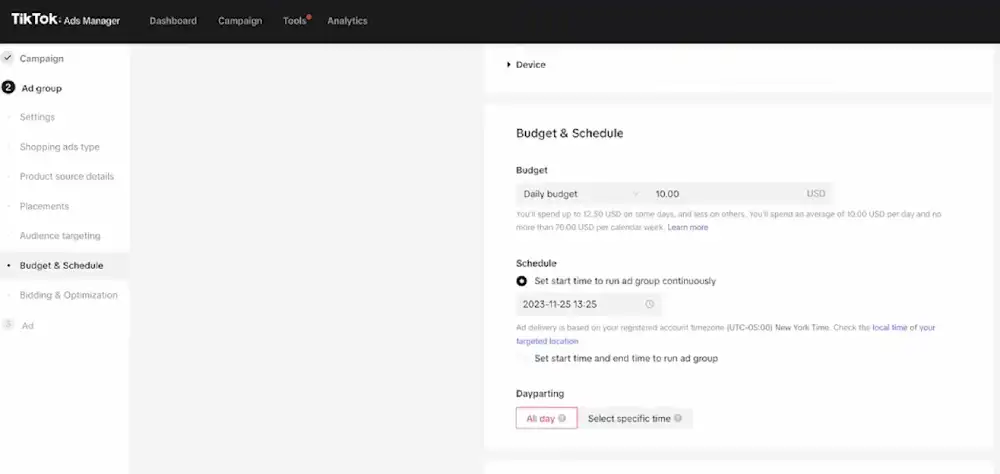
Either way, wait at least 2 days between adjustments before evaluating whether to increase again. Exceeding these thresholds forces TikTok’s algorithm into a new learning phase, causing temporary performance instability that many advertisers misread as the campaign breaking.
Use dynamic daily budget for flexibility
TikTok’s dynamic daily budget option lets you set an average daily spend over a 7-day window rather than a fixed daily ceiling. The algorithm can spend more on high-performing days and less on low-performing ones within that average. When scaling, this flexibility helps TikTok capture favorable auction windows without you manually adjusting budgets daily.
Switch to Cost Cap at scale
Maximum Delivery bidding works well for initial campaigns, collecting baseline data. When scaling aggressively, the lack of a bid ceiling on Maximum Delivery can cause CPA to spike as TikTok bids higher to spend increased budgets quickly.
Transitioning to Cost Cap bidding at scale gives you a ceiling on what you pay per conversion and forces TikTok to find volume within a defined efficiency target. Set your Cost Cap at your average CPA from the Maximum Delivery phase, not at your break-even target.
Duplicate rather than increase for larger jumps
When you need to scale faster than incremental increases allow, duplicate your winning campaign at a higher starting budget rather than aggressively increasing the existing one.
A duplicated campaign starts a new learning phase, but does so at the higher budget from day one. This is faster than incremental increases over weeks and avoids disrupting the original campaign’s performance while the duplicate finds its footing.
Horizontal scaling: expanding reach beyond your current audiences
Horizontal scaling means creating new TikTok ad groups, testing new audiences, and opening new targeting dimensions to reach users outside your current campaign’s delivery pool.
Expand to new Lookalike tiers
If you are currently targeting a 1% Lookalike Audience built from purchasers, test 2% and 3% Lookalikes in separate ad groups. Wider Lookalikes reach more users with slightly lower match quality, which typically means higher volume at a modestly higher CPA. Test the incremental CPA at each tier to find the widest audience you can profitably reach.
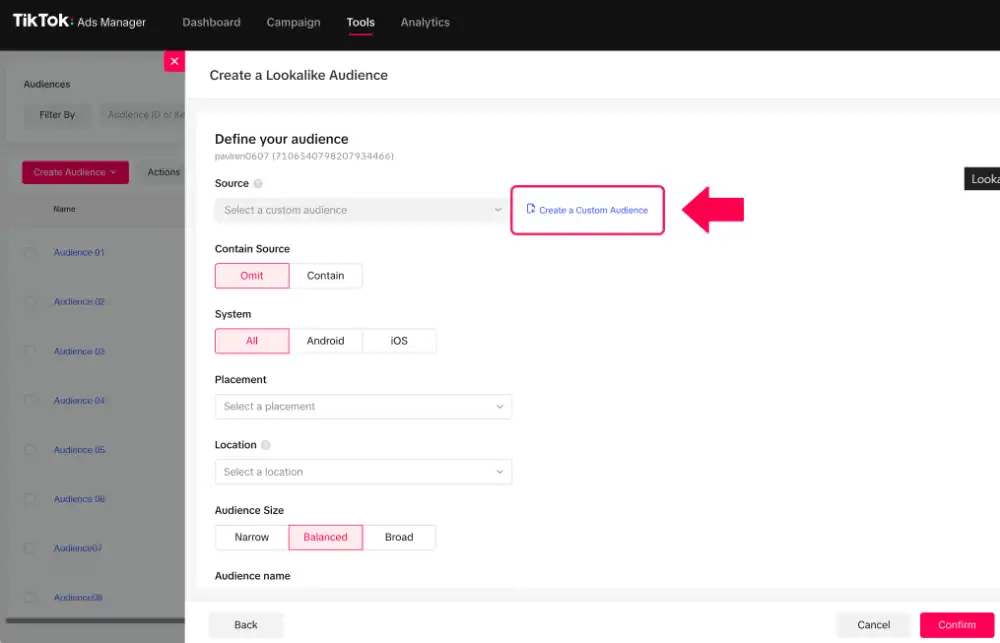
Build Lookalikes from different seed audiences
Not all Lookalikes perform equally. A Lookalike built from your top-spending customers will find different users than one built from Add to Cart events or 75% video viewers. Each seed audience tells TikTok to find users who behave like a different stage of your funnel. Test Lookalikes from your highest-value customer list, from video viewers who watched 75% or more, and from users who added to cart but did not purchase as three separate horizontal scaling streams.
Broad targeting as a horizontal scale strategy
In 2026, TikTok’s algorithm is incredibly smart. Often, the best targeting is no targeting. Create a new campaign, select only Age, Gender, and Location, and leave Interests and Behaviors empty. This forces the algorithm to find buyers based solely on your creative. If your creative hook is specific enough, it self-selects the right audience without manual filters. Broad targeting campaigns frequently deliver competitive CPA at significantly higher volume than interest-based targeting.
Test new placements
TikTok’s ad network extends beyond the TikTok feed to include partner placements. Testing your winning creative across different placement options can uncover volume at lower CPMs than the main feed, particularly for reach and awareness objectives.
Creative scaling: the most important scaling lever
Creative velocity is the variable that separates advertisers who can scale sustainably from those who hit a ceiling. At modest budgets, a single winning creative can run for weeks. At scale, the same creative burns out in days because a larger audience sees it faster.
Remix winners instead of rebuilding from scratch
You do not need a completely new concept every week. The most efficient creative scaling approach is systematic remixing of proven ads. Swap only the first three seconds while keeping the body of the video intact.
Test a visual hook, a text-based hook, and a verbal hook on the same core video. Change the background audio to a trending sound. Adjust playback speed slightly. Each variation extends the life of a proven concept without the cost or time of full creative production.
Build a creative pipeline, not a creative stockpile
Having ten creatives ready before launch sounds like preparation. In practice, most of them sit unused while one or two earn the majority of spend. A more effective approach is a continuous pipeline: four new creative variations entering testing every week, regardless of whether existing creatives are fatigued. By the time fatigue arrives, replacements are already mid-test with early performance data.
Use Spark Ads to scale organic winners
When an organic TikTok post earns strong engagement, it is signaling that the content resonates with a real audience without paid distribution. Spark Ads let you put paid spend behind that existing post, inheriting its engagement count and social proof.
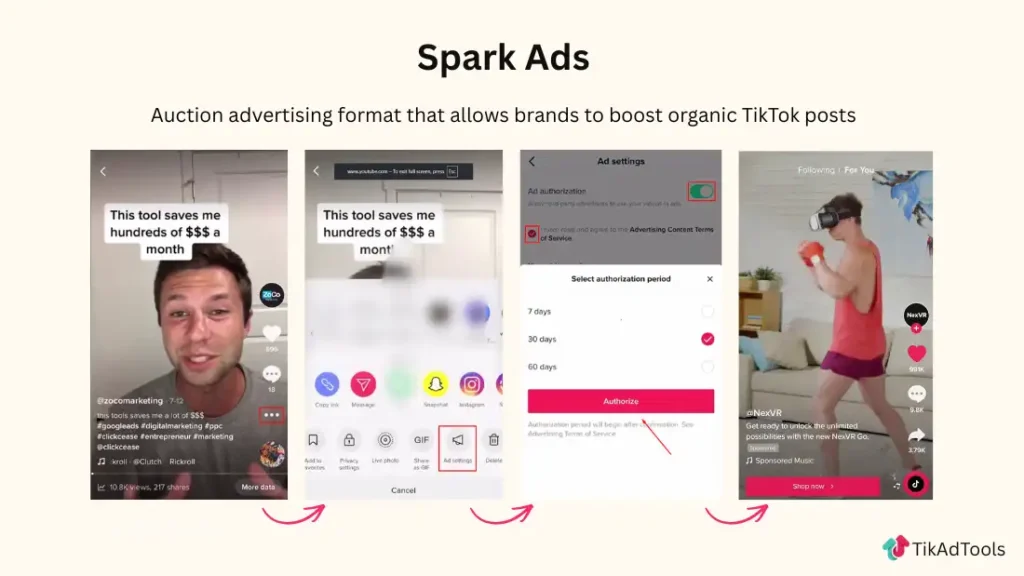
A Spark Ad built on a post with thousands of real comments and likes outperforms a standard In-Feed Ad with identical creative because the social proof reduces skepticism and improves click-through rate. At scale, Spark Ads built from proven organic content are consistently among the most efficient ad formats available.
Use Smart+ for automated creative testing at scale
New AI features like Smart+, GMV Max, and Symphony enable constant creative testing, fatigue reduction, and faster optimization for TikTok success. Smart+ campaigns use TikTok’s machine learning to automatically test creative combinations and allocate spend toward the best performers.
For advertisers scaling to higher daily budgets where manual creative management becomes a bottleneck, Smart+ reduces the operational overhead of maintaining creative freshness while the algorithm handles distribution decisions.
What not to do when scaling TikTok Ads
Understanding what breaks performance at scale is as important as knowing what drives it.
Never scale a campaign that has not exited the learning phase. More spend on a system that is still learning produces faster spending with no improvement in optimization. Wait for 50 conversions within 7 days before any budget increase.
Never make multiple changes at the same time. Changing targeting, bids, and creative simultaneously on a scaling campaign makes it impossible to identify which variable caused a subsequent performance shift. Change one thing at a time and wait long enough to see a meaningful result before the next adjustment.
Never pause a scaling campaign for an extended period. Pausing, even briefly, can disrupt delivery momentum and risk pushing a campaign back toward the learning phase. If you need to temporarily reduce spend, lower the daily budget to its minimum rather than pausing entirely.
Never scale based on a single day’s data. One strong day on TikTok often reflects auction conditions rather than genuine campaign improvement. Scaling decisions should be based on consistent performance across 3 to 5 days minimum, not a single outlier result.
Frequently Asked Questions
How do I scale TikTok ads without losing ROAS?
Scale budgets in increments no greater than 30% every 2 days (post-learning phase) rather than making large single-step increases.
Confirm you have at least 50 conversions within 7 days, and your CPA sits 20 to 30% below break-even before touching the budget.
Switch from Maximum Delivery to Cost Cap bidding once you have a reliable CPA baseline.
Maintain a continuous creative pipeline with at least four new variations entering testing weekly to prevent fatigue from compressing your ROAS as spend increases.
When should I start scaling TikTok ads?
Scale when your ad group has generated at least 50 conversions within 7 days, your campaigns are spending 90 to 100% of their daily budget, your CPA is consistently at or below your target, and you have new creative variations ready to deploy.
All four conditions need to be true simultaneously. Scaling when even one is missing typically produces a CPA spike that reverses the budget increase within days.
What is vertical vs horizontal scaling on TikTok?
Vertical scaling means increasing the daily budget on existing campaigns. Horizontal scaling means expanding reach by launching new ad groups targeting different audiences or using different creative angles.
Both approaches serve different purposes. Vertical scaling extracts more volume from a proven audience.
Horizontal scaling opens new audiences to maintain growth when existing campaigns approach their audience ceiling.
Why does my TikTok CPA increase when I scale?
Scaling increases CPA because TikTok needs to expand beyond your most responsive audience to spend the higher budget. The algorithm first converts the easiest and cheapest users in your target audience.
At higher spend, it reaches progressively less responsive users, which naturally raises the average cost per conversion. A 10 to 15% CPA increase during scaling is normal and expected.
Increases beyond that suggest the budget jump was too large, the creative has fatigued, or the audience has been exhausted. Build a 20 to 30% CPA buffer below your break-even before scaling to absorb the inevitable efficiency loss.
Should I use Smart+ or manual campaigns to scale TikTok ads?
Both have a role depending on your scale stage. Manual campaigns give you more control during the early testing phase when you need to understand which audiences and creatives work.
Smart+ campaigns become more valuable at higher spend levels, where manually managing creative testing and budget allocation across many ad groups becomes operationally difficult.
Smart+ uses TikTok’s machine learning to handle distribution decisions automatically, which reduces the management overhead that scales with budget in manual campaigns.
The most effective approach at a significant scale is running both in parallel, using manual campaigns for structured testing and Smart+ for deploying proven winners at volume.
Scale with the algorithm, not against it
TikTok’s algorithm is genuinely powerful at finding buyers when you give it the right conditions. Broad creative, sufficient conversion data, stable budgets during the learning phase, and consistent creative volume are the inputs the algorithm needs to perform. Every scaling mistake, whether that is aggressive budget jumps, premature changes, or creative stagnation, is essentially restricting those inputs.
The advertisers scaling TikTok profitably at $5,000 to $50,000 per day are not doing anything dramatically different from those at $500 per day. They use the same core principles at higher volume, with more disciplined creative pipelines, more patient budget increments, and better measurement to catch problems before they compound. Scale deliberately, maintain creative velocity, and the algorithm does the rest.
Scaling is the last stage of a longer process. The TikTok ads optimization guide covers everything that needs to be true before you get here.
Sources