
In 2026, the biggest decision you face isn’t what to sell on TikTok, but where to sell it.
For years, the playbook was simple: run an ad, get a click, and send them to your Shopify store. But the rise of TikTok Shop has broken that funnel.
TikTok is aggressively incentivizing brands to keep transactions inside the app, offering lower ad costs and higher conversion rates in exchange for a cut of your revenue and control over your customer data.
Get Up to $6,000 in Free TikTok Ad Credits
TikTok offers ad credit incentives for new advertisers, helping you test campaigns with a lower upfront cost.
This creates a dilemma. Do you choose TikTok Shopping Ads (frictionless, high conversion, rented land) or Website Conversion Ads (higher friction, lower conversion, owned land)?
The answer depends on your Average Order Value (AOV) and your need for customer data.
This guide breaks down the technical pros and cons of both, helping you decide if you should feed the algorithm or build your own asset.
Table of Contents
Quick Summary
- The Conversion Gap: TikTok Shop ads typically convert 2-3x higher than website ads because there is zero loading time and payment details are saved.
- The GMV Max Shift: In 2026, TikTok Shop ads have moved largely to GMV Max (automated) campaigns, reducing manual control but improving efficiency.
- Data Ownership: Website ads allow you to own the email and SMS data. TikTok Shop heavily restricts access to customer contact info, making LTV (Lifetime Value) marketing harder.
- Profit Margins: TikTok Shop fees (now hovering around 6-8%) + Ads can squeeze margins tighter than Shopify + Ads, despite the cheaper CPMs.
- Best Use Case: Use TikTok Shop for products under $50 (impulse buys). Use Website Ads for high-ticket items ($100+) or complex bundles requiring education.
What is the Difference?
TikTok Shopping Ads (often utilizing Video Shopping Ads or GMV Max) process the transaction entirely within the TikTok app, reducing friction but limiting data ownership.
Website Conversion Ads drive traffic to an external domain (like Shopify), allowing for full branding control and data capture but suffering from click loss where users bounce before the page loads.
1. TikTok Shopping Ads (In-App Checkout)
In 2026, TikTok is pushing this format hard. By keeping the user on the platform, they eliminate the loading screen of death.
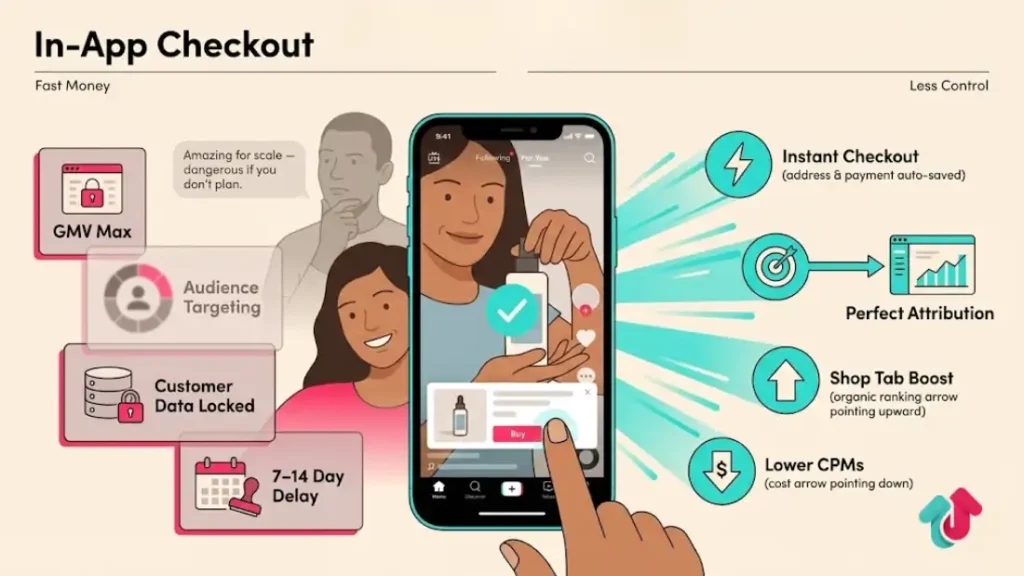
The Pros
Zero-Friction Conversion: Users don’t need to type their address or credit card; it’s already saved. This drops cart abandonment rates from the industry average of 70% down to ~45%.
100% Accurate Attribution: Since the sale happens on TikTok, there is no iOS 14 signal loss. You see every penny of return immediately in the dashboard.
The Shop Tab Bonus: Running Shop Ads boosts your organic ranking in the TikTok Shop tab, giving you a halo effect of free organic sales.
Cheaper CPMs: TikTok’s algorithm favors content that keeps users on the app. Shop Ads often get cheaper impressions than ads trying to link out.
The Cons
The GMV Max Black Box: TikTok has replaced many manual controls with GMV Max (an automated campaign type). You often cannot target specific audiences or control exact placements, you just give it a budget and a ROAS target.
Customer Data Gatekeeping: You do not get the same quality of customer data (email/SMS) as you do on Shopify. You are building TikTok’s customer list, not yours.
Cash Flow Delays: TikTok holds funds for 7-14 days after delivery. For dropshippers or cash-strapped brands, this float can break your ability to restock.
2. Website Conversion Ads (External Traffic)
This is the traditional method: driving traffic to a dedicated landing page or product page.
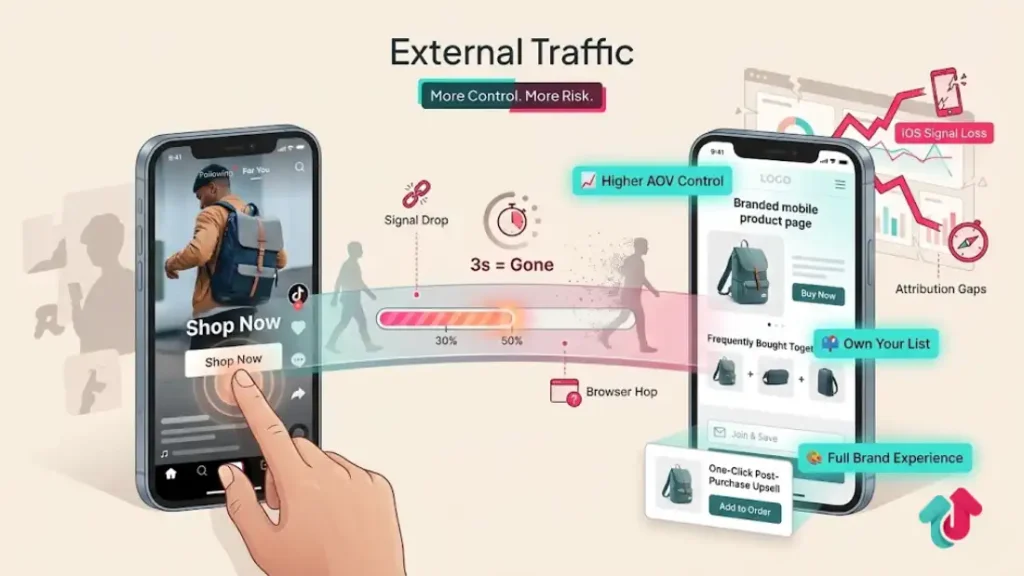
The Pros
Average Order Value (AOV) Control: On your own site, you can use apps like Frequently Bought Together or post-purchase one-click upsells. It is much easier to turn a $30 customer into a $60 customer on Shopify than on TikTok Shop.
List Building: You own the pixel. You can capture emails via pop-ups (if done correctly) and retarget these users on Meta or Google later.
Brand Experience: You control the font, the story, and the reviews. There are no competing products listed next to yours (unlike the TikTok Shop interface).
The Cons
The Link Click Drop-off: You will lose 30-50% of your traffic between the Click and the Landing Page View. If your site takes 3 seconds to load, that user is gone.
Tracking Issues: Attribution is messy. You will need third-party tools (like Triple Whale or Northbeam) to understand your true ROAS, as TikTok cannot track everything that happens on your site.
3. The 2026 Hybrid Strategy
Smart brands in 2026 are not choosing one; they are using both for different stages of the funnel.
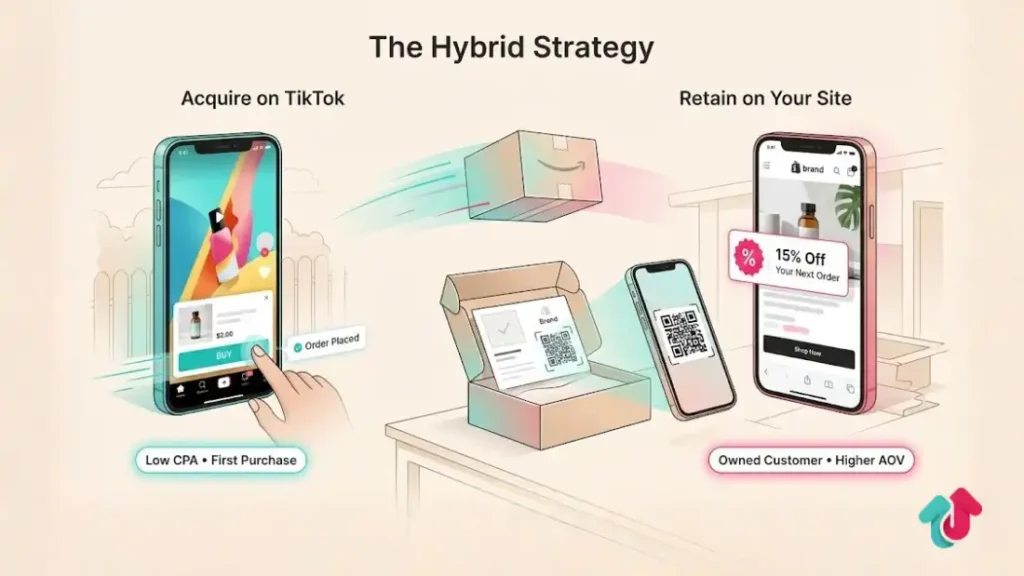
Step 1: Acquisition via Shop
Use TikTok Shop Ads to acquire the customer for the first time. The low friction allows you to get a customer through the door at a lower CPA (Cost Per Acquisition). Even if the margin is lower, you have a buyer.
Step 2: Retention via Packaging
Since you cannot easily email them, use box inserts. When you ship the TikTok Shop order, include a QR code for 15% off your next order that leads specifically to your Shopify Website. This moves the customer from rented land to owned land for their second purchase.
4. Comparison Table: Which Should You Choose?
| Feature | TikTok Shop Ads | Website Conversion Ads |
| Setup Speed | Fast (Sync Catalog) | Slow (Build Landing Page) |
| Conversion Rate | High (2% – 5%) | Low (1% – 2%) |
| Data Accuracy | 100% (On-Platform) | ~70% (Signal Loss) |
| AOV Potential | Low (Single Item Focus) | High (Bundles/Upsells) |
| Customer Data | Restricted | Full Ownership |
| Cash Flow | Delayed (7-14 Days) | Instant (Stripe/PayPal) |
Explore these helpful articles next:
👉 TikTok Ads Landing Page Best Practices for Mobile Sales
👉 Retargeting with TikTok Ads: Remarketing Strategies That Work
👉 Best TikTok Ads Hooks & Headlines for Conversions
👉 TikTok Video Specs for Ads: Dimension, Ratio, Safe Zones
FAQ: Shopping vs. Website Ads
Can I run both types of ads at the same time?
Yes, but be careful of cannibalization. If you target the same broad audience with both Shop ads and Website ads, you might bid against yourself. It is better to separate them by product (e.g., Best Sellers on Shop, Bundles on Website).
Is GMV Max mandatory for TikTok Shop Ads?
As of late 2026, TikTok is making GMV Max the default standard for most accounts, phasing out manual Video Shopping Ads. You must get comfortable with giving the AI control over targeting.
Which is better for dropshipping?
TikTok Shop is currently superior for dropshipping if you have local inventory. TikTok creates strict shipping SLAs (must ship in 3 days). If you are dropshipping from China with 10-day shipping, you must use Website Conversion Ads to avoid getting banned.
Do I pay commission fees on TikTok Shop Ads?
Yes. You pay the Ad Spend to get the view, plus the Referral Fee (commission) to TikTok when the sale happens. You must factor both into your margin.
Why is my Website Ad CPM higher than my Shop Ad CPM?
TikTok wants to keep users on the app. Their algorithm naturally gives a discount (lower CPM) to Shop Ads because they retain users, whereas Website Ads send users away, which TikTok dislikes.
Conclusion
If your goal is maximum volume and you sell a product under $50, TikTok Shop Ads are the clear winner in 2026. The friction-free checkout is simply too powerful to ignore, despite the fees.
However, if you are building a long-term brand with high AOV or subscription models, Website Conversion Ads remain essential. Use Shop to get the quick win, but use your Website to build the dynasty.