
For years, the reputation of TikTok lead generation was consistent: Cheap leads, terrible quality.
Marketers would celebrate getting $5 leads, only for their sales team to discover half the phone numbers were fake, and the other half didn’t remember clicking the ad.
In 2026, the platform will have matured. The introduction of Advanced Instant Forms and Offline Event Sets has shifted the game from a volume war to a quality war.
Get Up to $6,000 in Free TikTok Ad Credits
TikTok offers ad credit incentives for new advertisers, helping you test campaigns with a lower upfront cost.
You no longer have to choose between affordable Cost Per Lead (CPL) and high intent. You can have both, but only if you abandon the frictionless strategies of the past.
Minimizing CPL this year requires a counterintuitive approach: adding more friction to your forms, strictly excluding the pangle placement, and feeding sales data back into the algorithm.
This guide details the technical setup and creative frameworks required to generate leads that actually pick up the phone.
Table of Contents
Quick Summary
- The Friction Paradox: Adding a custom question (e.g., What is your budget?) often lowers CPL because it filters out low-intent bots that waste your ad spend on invalid clicks.
- Instant Forms Win: Native TikTok Instant Forms currently convert at 15-25%, whereas sending traffic to an external landing page typically converts at 2-5%.
- The Pangle Ban: For lead gen, you must manually disable Pangle. It is the primary source of accidental clicks and bot traffic.
- Manual Entry: Turn off Auto-Fill for at least one field (like email). Forcing the user to type manually increases contactability by over 40%.
- The Feedback Loop: You must upload your Converted Leads list back to TikTok (Offline Events) so the algorithm learns to find buyers, not just fillers.
What is the Best Strategy for TikTok Lead Gen?
The most effective strategy in 2026 is using Native Instant Forms with a High Intent configuration.
This involves selecting Higher Intent in the form settings (which adds a review screen), adding at least one Conditional Logic question to disqualify bad fits, and strictly targeting Broad Audiences (no interests) to allow the algorithm to find prospects based on form submission data rather than demographic guesses.
1. The Mechanic: Instant Forms vs. Website Traffic
The biggest lever you have for CPL is where the transaction happens.
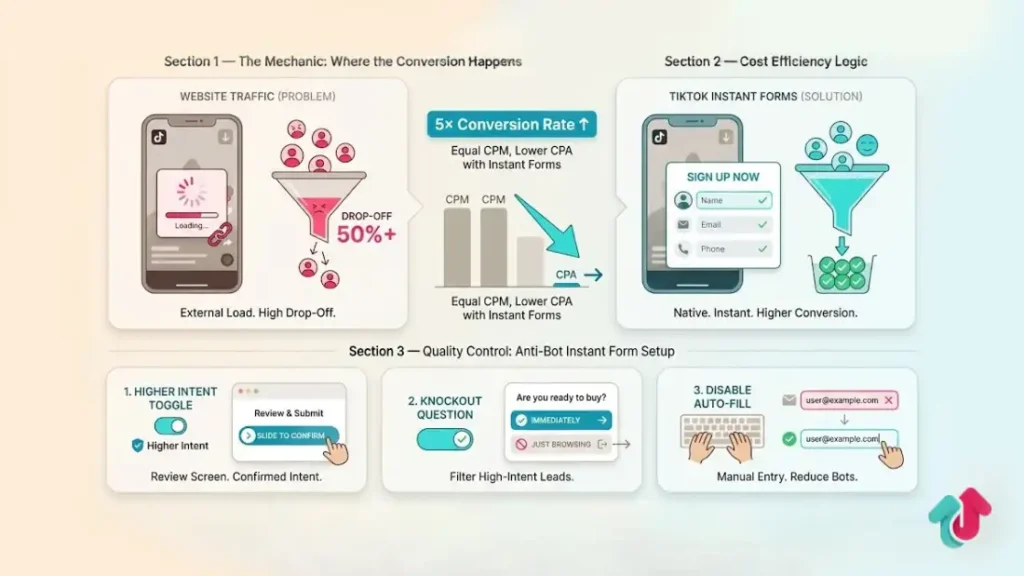
Why Instant Forms Dominate
TikTok users are in a lean-back entertainment mode. The moment a loading screen appears for an external website, drop-off rates spike to 50% or higher.
The Data: Native Instant Forms load instantly and pre-fill user data. This creates a conversion rate that is often 5x higher than external landing pages.
The Cost Benefit: Because the conversion rate is higher, the CPA (Cost Per Action) naturally drops, even if the CPM (Cost to reach people) is the same.
When to Use Landing Pages
Only send traffic to a website if your offer requires deep education (e.g., a complex B2B SaaS tool or a $2,000 course). For everything else, gyms, real estate, solar, insurance, coaching, keep them on the app.
2. Quality Control: The Anti-Bot Setup
Low CPL is useless if the leads are fake. You must engineer your form to block accidental clicks.
Step 1: Select Higher Intent
When creating your Instant Form, you will see two options: More Volume and Higher Intent.
Always choose Higher Intent.
Why: It adds a Review Screen at the end of the form. The user must slide to confirm their info. This single step eliminates 90% of accidental pocket-clicks and bots.
Step 2: The Knockout Question
Do not just ask for Name and Email. Ask a qualifying question that forces a thought process.
Bad: Are you interested? (Yes/No)
Good: When are you looking to replace your roof? (Immediately / 1-3 Months / Just Browsing).
Logic: Users who select Just Browsing can be routed to a Thank You screen immediately, while high-intent users are routed to the booking calendar.
Step 3: Disable Auto-Fill
TikTok pulls the email address linked to the user’s account. Often, this is an old, dormant email.
The Fix: Create a Custom Question for Email Address rather than using the default user information field. This forces the user to manually type their current, active email.
3. The Pangle Danger Zone
This is the single most common mistake that inflates CPL with garbage data.
The Problem: By default, TikTok enables Automatic Placements, which include Pangle (TikTok’s audience network of gaming apps) and Global App Bundle.
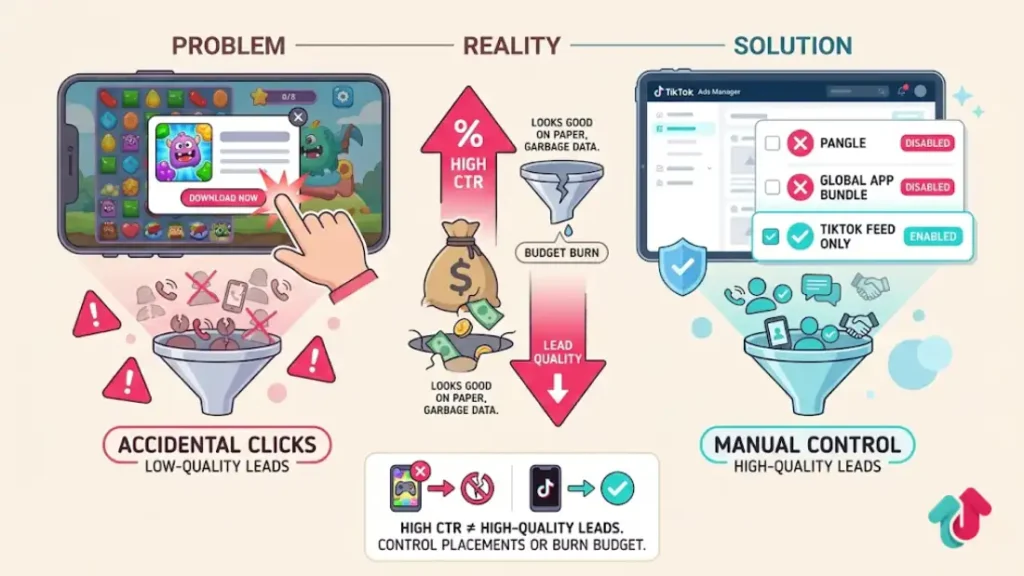
The Reality: Users playing mobile games often click ads accidentally to get an extra life or close a pop-up. These leads will never answer the phone.
The Solution:
Select Placements Manually.
Uncheck Pangle.
Uncheck Global App Bundle.
Run on TikTok Feed Only.
4. Creative Strategy: The Greenscreen Authority
Lead gen creative is different from e-commerce creative. You aren’t selling a product; you are selling a result.
The Calling Out Hook
Start by addressing the specific avatar and their pain.
Script: If you live in [City Name] and you’re tired of [Problem], stop scrolling.
Why: This filters the audience immediately. Only relevant people watch past the second 3.
The Raw Aesthetic
Highly polished ads perform poorly for lead gen because they look like corporate commercials.
The Winner: Use the Green Screen effect. Put a screenshot of a news article, a chart, or the Calendar Booking page behind your head. Point to it and explain the offer.
Psychology: This signals Information, not Advertising. It builds trust (E-E-A-T) because you are acting as a reporter or advisor.
5. Technical Optimization: The Offline Feedback Loop
In 2026, you cannot just optimize for Form Submits. You must optimize for Qualified Leads.
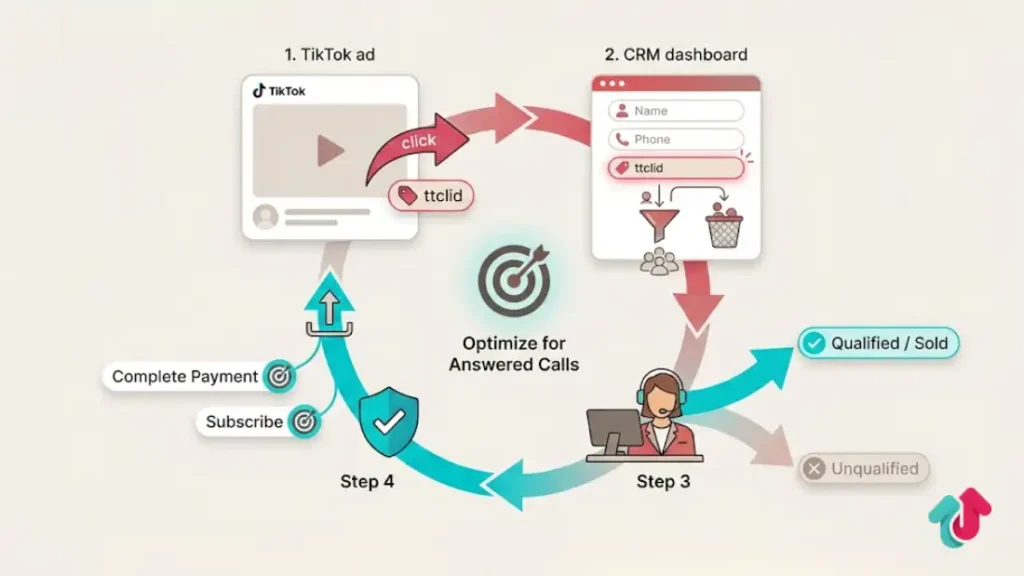
The Workflow:
Capture the Click ID (ttclid): Ensure your CRM (GoHighLevel, HubSpot, Salesforce) captures the ttclid parameter when a lead comes in.
Score the Lead: When a sales rep talks to the lead and marks them as Qualified or Sold, record that timestamp.
Upload to TikTok: Use TikTok Offline Events (or a tool like Zapier) to send that specific lead back to TikTok as a Complete Payment or Subscribe event.
The Result: The algorithm stops finding people who fill out forms and starts finding people who answer the phone.
Explore these helpful articles next:
👉 TikTok Ads Budget Strategy for Small Businesses
👉 Common TikTok Ads Mistakes New Advertisers Make
👉 TikTok Ads Policies New Update: What Advertisers Must Know
👉 TikTok Ads for Fashion & Apparel: Creative Trends to Copy
FAQ: Lead Generation Troubleshooting
What is a good CPL benchmark on TikTok?
This varies by industry. In 2026:
Solar/Home Improvement: $25 – $45
Personal Injury/Legal: $50 – $100
Gyms/Local Business: $10 – $20
Coaching/Info Products: $5 – $15
Why are my leads not answering the phone?
You likely have Auto-Fill on, or you are running ads on Pangle. Switch to manual entry questions and disable Pangle immediately. Also, speed to lead matters; contact them within 5 minutes.
Can I target B2B leads on TikTok?
Yes, but do not target by Interest. Target by Creative. Make a video that only a business owner would understand (e.g., Stop paying too much for your payroll software). The algorithm will naturally find business owners based on who watches the video.
Should I use a Lead Magnet (Free Guide)?
Yes. Direct to Consult ads have a very high CPL. Offering a Free Cheat Sheet or Calculator first builds trust. You can then upsell the consultation on the Thank You page of the form.
Does CRM integration require a developer?
No. TikTok has a native Leads Center that connects directly with Zapier, Salesforce, and HubSpot. You can set up the integration in 5 minutes inside the Tools menu of Ads Manager.
Conclusion
Minimizing CPL on TikTok in 2026 is an exercise in adding friction strategically.
If you make it too easy to sign up, you pay for ghosts. By using High Intent Instant Forms, forcing manual data entry, and strictly excluding the Pangle network, you filter out the noise.
You might get fewer leads total, but your Cost Per Qualified Lead, the only metric that actually affects your bank account, will drop significantly.