
If you are a sports or activewear brand owner, you likely have the “Gymshark” effect in the back of your mind.
You saw how they built a billion-dollar empire on influencer marketing, and you want a piece of that action.
You might think the formula is simple: send free leggings to fit people, post workout montages with trap music, and watch the sales roll in.
But here is the hard truth of 2026: That playbook is dead.
Get Up to $6,000 in Free TikTok Ad Credits
TikTok offers ad credit incentives for new advertisers, helping you test campaigns with a lower upfront cost.
The FitTok ecosystem has matured. Users are no longer just looking for cool gear; they are searching for identity.
On Amazon, people buy running shorts because they need to run. On TikTok, they buy membership into the 5 AM run club because they want to be a runner.
The brands winning today aren’t selling fabric specifications or moisture-wicking technology; they are selling the feeling of a personal best.
This guide breaks down exactly how to translate that feeling into profitable ad campaigns, bypassing the vanity metrics to focus on what actually moves inventory.
Table of Contents
Quick Summary
- The Shift: Gen Z doesn’t buy activewear; they buy aesthetics (e.g., the Pilates Princess, the Hybrid Athlete).
- The Creative: Static images fail. You need movement-first hooks (e.g., the Squat-Proof Test) to prove quality in 3 seconds.
- The Format: Spark Ads outperform standard ads by 142% in engagement because they look native and authentic.
- The Compliance Trap: Avoid before/after weight loss claims to keep your ad account safe from strict body-image policies.
The Psychology of FitTok: Identity Over Fabrics
Why do users buy a $60 sports bra on TikTok when they can get a generic one on Amazon for $20? The answer isn’t quality; it is the mirror neuron effect.
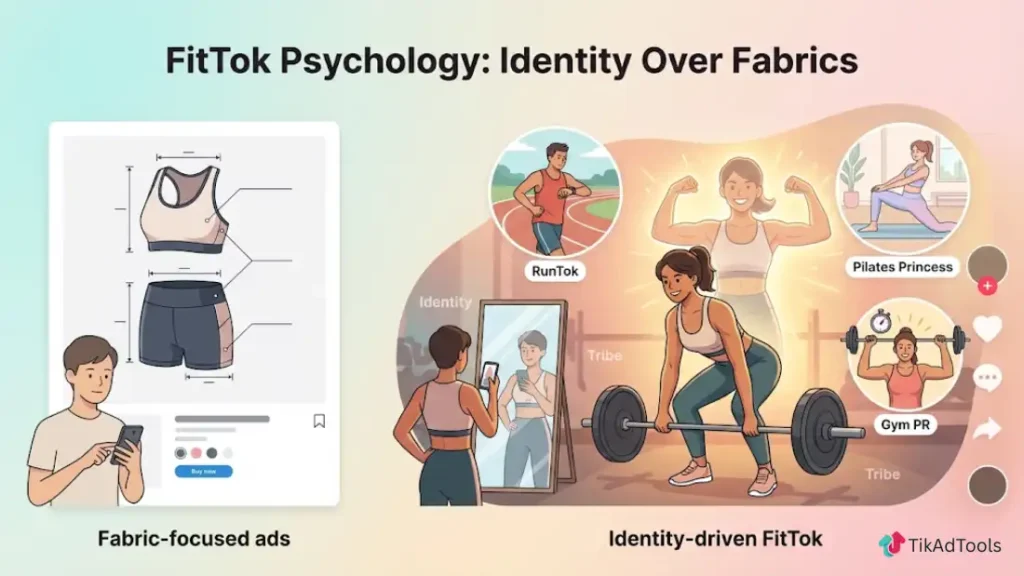
When a user scrolls through their feed and sees a creator hitting a personal record (PR) while wearing your gear, their brain doesn’t just register the clothing; it simulates success. They aren’t buying the shorts; they are buying the confidence to hit that PR.
Traditional fashion ads fail here because they focus on the garment, like the stitching, the fabric, or the fit. But TikTok is an identity engine. The user is asking, Does this brand fit the person I am trying to become?
If you are selling to the #RunTok community doesn’t care about style. They care about chafing, gel pockets, and split times.
If you are selling to the #PilatesPrincess aesthetic, they care about color coordination and sculpt fabrics. Your ad must signal that you understand their specific tribe’s struggles and goals, not just that you sell clothes.
Understanding TikTok’s Sports Ecosystem
You cannot target fitness and expect to win. That is like targeting Food; it is too broad. You need to understand the distinct subcultures that drive spending.
The RunTok Tribe
These users are obsessed with data and discomfort. They buy gear that solves pain. Ads here should focus on utility: phone pockets that don’t bounce, socks that prevent blisters, and vests that hold hydration. They value ugly, authentic reviews over polished studio shots.
The GymTok & Hybrid Athlete Tribe
This group values durability and aesthetics. They want to look good while lifting heavy. The Pump Cover (oversized tees) and Squat Proof leggings are the currency here. They respond to high-energy edits, loud music, and aggressive before/after transformation energy (even if you can’t explicitly show it).
The Pilates & Wellness Tribe
Here, the vibe is slower, softer, and more aesthetic. It is about the low-impact lifestyle. The content here is less about sweat and more about the Morning Routine. Ads should feature matching sets, green juices, and sunlight. The selling point is butter-soft fabric and comfort, not compression.
Turning Organic Content Into Paid Ads
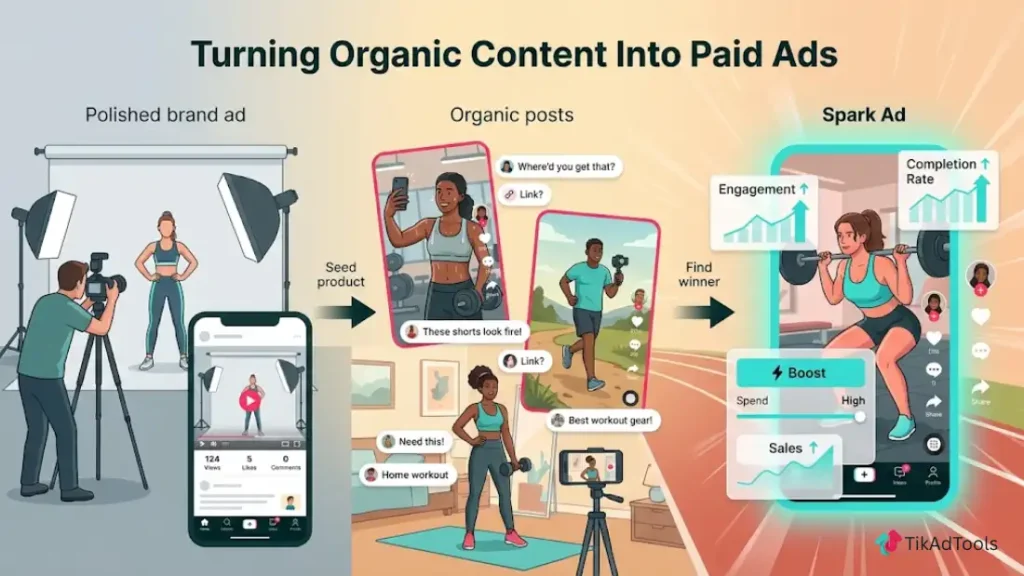
A polished studio ad often performs worse than a shaky iPhone video in the sports niche. Users have banner blindness for anything that looks like a commercial.
The Spark Ad Advantage
Spark Ads (boosting an organic post) have a 134% higher completion rate and 142% higher engagement rate than standard ads, according to TikTok’s own performance data.
The Strategy:
- Seed the Product: Send gear to 20 micro-influencers (5k-50k followers). Do not ask for a review. Ask them to film their actual workout wearing the gear.
- Wait for the Winner: Monitor which video gets the most organic views and positive comments.
- Spark It: Request the Spark Code from that creator and put ad spend behind their post.
- Why: It comes from a human handle, not a brand handle. It looks like a genuine recommendation from a peer, not an interruption from a corporation.
Targeting Strategies: Broad vs. Interest Stacks
Apparel is visually universal, meaning you don’t always need to narrow your audience.
The Broad Targeting Play
For mass-appeal items like black leggings or seamless tees, let the algorithm do the work. Set your targeting to Age 18-44 with No Interests and optimize for Complete Payment.
The video is the target. If the video shows a girl doing Pilates, the algorithm will naturally find Pilates lovers based on who stops scrolling to watch.
The Interest Stack Play
For niche sports items (e.g., Jiujitsu rash guards, Marathon hydration vests), you need to guide the algorithm.
Stack specific terms like Marathon running, Ironman Triathlon, or Garmin. Crucially, exclude terms like Dropshipping or Affiliate Marketing to avoid wasting money showing your ads to other sellers.
Budgeting & Metrics: ROAS vs. MER
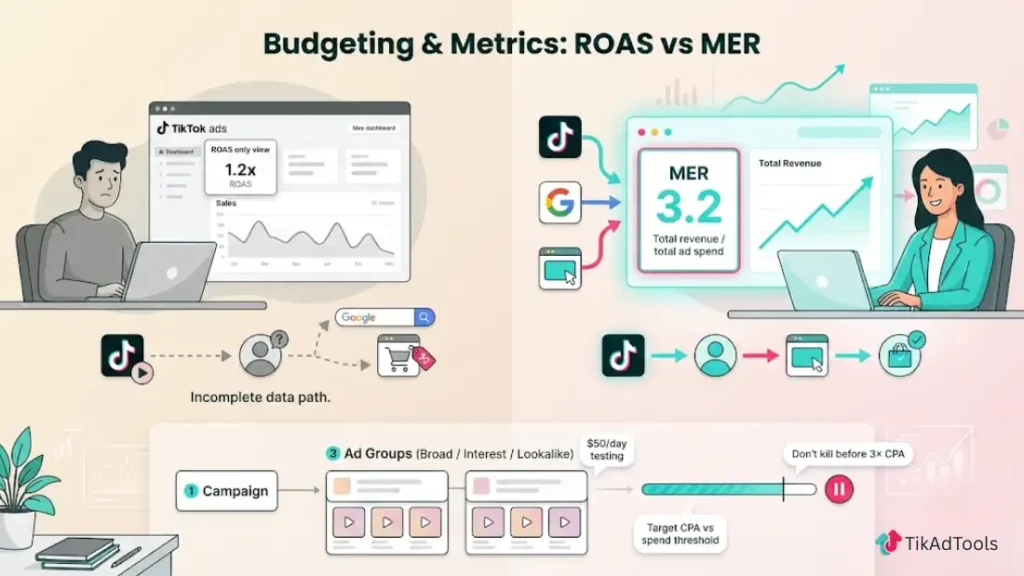
In 2026, relying solely on pixel-tracked ROAS (Return on Ad Spend) is dangerous because user journeys are complex. A user might see your TikTok ad, but buy later on Google.
The New Metric: MER (Marketing Efficiency Ratio)
- Formula: Total Revenue / Total Ad Spend (Across all channels).
- Goal: Aim for a MER of 3.0 or higher. This means you make $3 in total revenue for every $1 spent on ads.
Minimum Viable Budget:
- Testing: Start with $50/day per ad group.
- Campaign Structure: 1 Campaign > 3 Ad Groups (Broad, Interest, Lookalike) > 3 Creatives per group.
- The Rule: Do not kill an ad until it has spent 3x your Target CPA (Cost Per Acquisition). If you sell $50 leggings and want a $20 CPA, spend at least $60 before turning it off.
Seasonal & Event-Driven Strategies
Sports marketing is unique because it follows two calendars: the Retail Calendar (Holidays) and the Athlete’s Calendar (Biology).
If you only advertise during Black Friday, you miss the moments when your customer is physically most motivated to buy.
A runner needs gear in March (Marathon Prep), not just December. A lifter is looking for bulking gear in October, not July.
To win in 2026, you need to sync your ad spend with these three Motivation Waves.
The Winter Arc & The Resolution Drop-Off (Q1)
January is obvious, but it is also the most expensive time to advertise because everyone is bidding on Fitness.
The smarter play on TikTok is to target the Winter Arc trend. This is a massive subculture focused on grinding in silence during the dark months to reveal a transformation in spring.
- The Angle: Instead of generic “New Year, New Me” ads, run the discipline over motivation creative.
- The Opportunity: The Quitter’s Cliff happens in mid-February. This is when most people give up. Launch a Get Back on Track campaign during this week with a high-urgency offer to capture the people falling off the wagon.
The Summer of Sport Halo Effect (2026 Special)
2026 is a massive year for sports, hosting both the Winter Olympics and the FIFA World Cup. While you cannot use trademarked terms like the Olympics or the World Cup without sponsorship, you must draw on the energy.
- The Strategy: During these events, the algorithm is flooded with sports content. Run ads that tap into national pride or Game Day aesthetics.
- The Creative: Training like a pro or Jersey-style streetwear. If the world is watching soccer, sell the lifestyle of the fan or the athlete, even if you just sell gym shorts.
Compliance: Navigating the Body Image Police
Fitness is a high-risk category on TikTok. One wrong claim can get your ad account suspended, as platforms are increasingly strict about protecting user mental health.
The Red Flag Zone (Automatic Rejection)
- Before/After Photos: TikTok hates these. They are often flagged as unrealistic body image or misleading health claims.
- Negative Focusing: Zooming in on belly fat, muffin tops, or cellulite. This triggers the body-shaming algorithm.
- Medical Claims: Lose 10lbs in these leggings. This is classified as medical misinformation.
The Safe Zone (Approved Content)
- Focus on Capability: Instead of looking thinner, say running faster or lifting heavier.
- Focus on Comfort: Use terms like buttery soft, second-skin feel, and high compression.
- Inclusivity: Show different body types to signal that your brand is safe and welcoming.
Explore these helpful articles next:
👉 TikTok Content Trends That Boost Paid Performance
👉 Why Are My TikTok Shop Products Frozen or Under Review?
👉 TikTok Ads for Alcohol-Free Beverage Brands: The Sober-Curious Boom
👉 TikTok Ads for Weddings & Event Services: How to Turn Views Into Booked Clients
FAQ: TikTok Ads for Sports & Activewear
Is fitness Big on TikTok?
Yes, absolutely. Fitness is consistently one of the top 3 content categories on TikTok, with the hashtag #FitTok amassing billions of views. Unlike Instagram, which often focuses on polished photos, TikTok fitness content thrives on raw, educational, and relatable videos.
What is the Gen Z fitness trend in 2026?
The dominant Gen Z fitness trend is hybrid training combined with social wellness. Gen Z is moving away from purely aesthetic goals (like getting a six-pack) and towards performance and community. They want to be Hybrid Athletes who can run a 5k and lift heavy weights.
What fitness brands use TikTok to advertise?
Leading activewear brands like Gymshark, Alo Yoga, and Lululemon are the gold standard for TikTok advertising. However, they rarely use traditional TV-style commercials. Instead, they rely on User-Generated Content (UGC) and Influencer Challenges.
What is the latest fitness trend in 2026?
In 2026, the biggest shift is towards Recovery as a lifestyle and gamified fitness. We are seeing a surge in content around cold plunges, saunas, and mobility routines, moving rest days from a passive activity to an active content pillar.
What’s the difference between activewear and sportswear?
While often used interchangeably, the difference lies in utility. Sportswear is designed for a specific sport with technical properties (e.g., a padded cycling bib or a high-compression marathon suit). Activewear is designed for the transition between exercise and daily life (e.g., yoga leggings you wear to a coffee shop). On TikTok, Activewear sells better with lifestyle/aesthetic content, while Sportswear requires Performance/Stress Test content.
What fitness brand is Gen Z wearing?
Gen Z favors brands that signal Community and Aesthetics over legacy sports logos. Brands like Alo Yoga (for the Wellness aesthetic), Arc’teryx (for the Gorpcore/Outdoor trend), and Gymshark (for the Lifter identity) are currently dominating. They prefer brands that represent a specific subculture or vibe rather than generic athletic gear.
Final Playbook: How to Win in 2026
The era of posting and hoping is over.
To win on TikTok in 2026, you must operate like a media company, not just a clothing brand. You need a system that churns out movement-first creative every week, tests it with $50 budgets, and doubles down on the winners using Spark Ads.
Your customers are scrolling right now, looking for the gear that makes them feel like an athlete. Show them the movement, and they will buy the fabric.