
Opening your TikTok Ads Manager dashboard can feel like staring at the cockpit of a fighter jet.
There are dozens of columns, numbers, and acronyms fighting for your attention. If you focus on the wrong ones, you might scale a losing ad or kill a winning one.
In 2026, the rules of metrics have changed. On Facebook, you might obsess over the Link Click. On TikTok, the Link Click is irrelevant if your Hook Rate is zero.
Get Up to $6,000 in Free TikTok Ad Credits
TikTok offers ad credit incentives for new advertisers, helping you test campaigns with a lower upfront cost.
The platform is unique because it is entertainment-first, meaning your ad costs (CPM) are directly tied to how long people watch your video.
This guide filters out the noise. We will break down exactly which metrics matter, provide the 2026 benchmarks for what is considered good, and explain how to use Diagnostic Metrics like Hook Rate to fix broken campaigns.
Table of Contents
Quick Summary
- The Golden Rule: TikTok lowers your costs if your video is engaging. High engagement (Likes/Shares/Watch Time) = Lower CPM.
- CPM Benchmark: Expect to pay $3.20 – $10.00 per 1,000 impressions. If it’s over $15, your creative is likely failing.
- CTR Goal: Aim for a Click-Through Rate (CTR) of 1.0% or higher. Anything below 0.7% usually indicates a weak hook or irrelevant offer.
- The Secret Metric: Hook Rate (2-second views / Impressions) determines if your ad stops the scroll. You need 30%+ to scale.
- Profit Metrics: ROAS (Return on Ad Spend) and CPA (Cost Per Acquisition) are your north stars. Use creative metrics to troubleshoot, but use profit metrics to scale.
What Are TikTok Ad Metrics?
TikTok Ad Metrics are data points used to evaluate campaign performance. They fall into three categories: Cost Metrics (CPM, CPC), which tell you what you are spending; Creative Metrics (Hook Rate, Retention, CTR), which tell you if your video is engaging; and Conversion Metrics (CPA, ROAS, CVR), which measure actual business results like sales or leads.
1. The Cost Metrics: What You Pay
These numbers tell you how expensive the auction is for your specific audience.
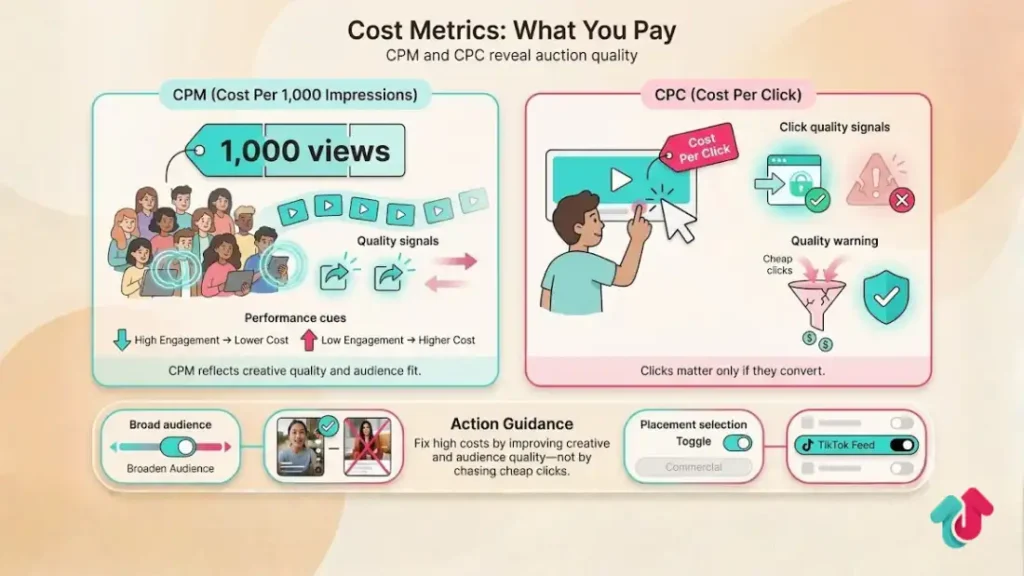
CPM (Cost Per Mille)
Definition: The cost to show your ad 1,000 times.
2026 Benchmark: $3.20 – $10.00 (Global average). In the US, competitive audiences can reach $15.00+.
Why it matters: CPM is a quality score in disguise. If your ad is boring and people swipe away instantly, TikTok penalizes you by raising your CPM. If users watch and share, TikTok lowers your CPM.
Action: If your CPM is high, try broadening your audience or testing a more native-looking video.
CPC (Cost Per Click)
Definition: The amount you pay each time a user clicks your ad.
2026 Benchmark: $0.20 – $1.00.
Insight: A low CPC is great, but be careful of Pangle placements (TikTok’s audience network), which can give you $0.05 clicks that never convert. Always verify traffic quality.
2. The Creative Metrics: Why You Win (or Lose)
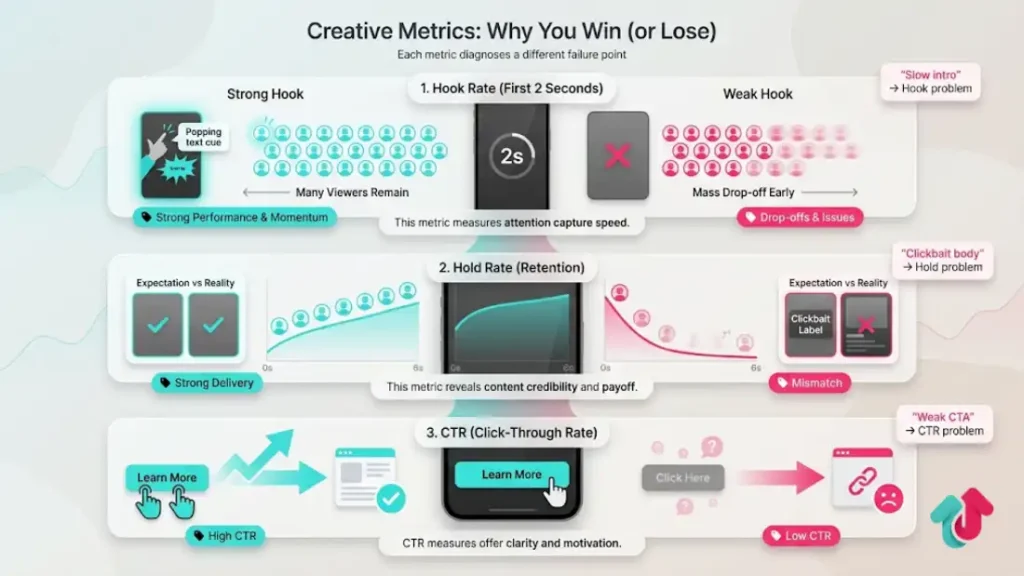
This is where TikTok differs from Google or Meta. These diagnostic metrics tell you exactly which part of your video needs fixing.
Hook Rate (Thumb-Stop Rate)
Definition: The percentage of people who watched the first 2 seconds of your video.
Formula: 2-Second Video Views / Total Impressions
2026 Benchmark: >30%.
Diagnosis: If your Hook Rate is 15%, your intro is too slow. You need a visual pattern interrupt immediately.
Hold Rate (Retention)
Definition: The percentage of people who watched up to the 6-second mark (or 50% of the video).
2026 Benchmark: >6 seconds average watch time.
Diagnosis: If you have a great Hook Rate (40%) but a low Hold Rate, your video is clickbait. You grabbed attention but failed to deliver value or entertainment in the body of the ad.
CTR (Click-Through Rate)
Definition: The percentage of people who saw the ad and clicked the destination link.
2026 Benchmark: 0.8% – 1.5%.
Diagnosis:
- < 0.7%: Your offer is not compelling, or the Call to Action (CTA) is weak.
- > 1.5%: You have a winning ad. Scale it.
3. The Money Metrics: The Goal
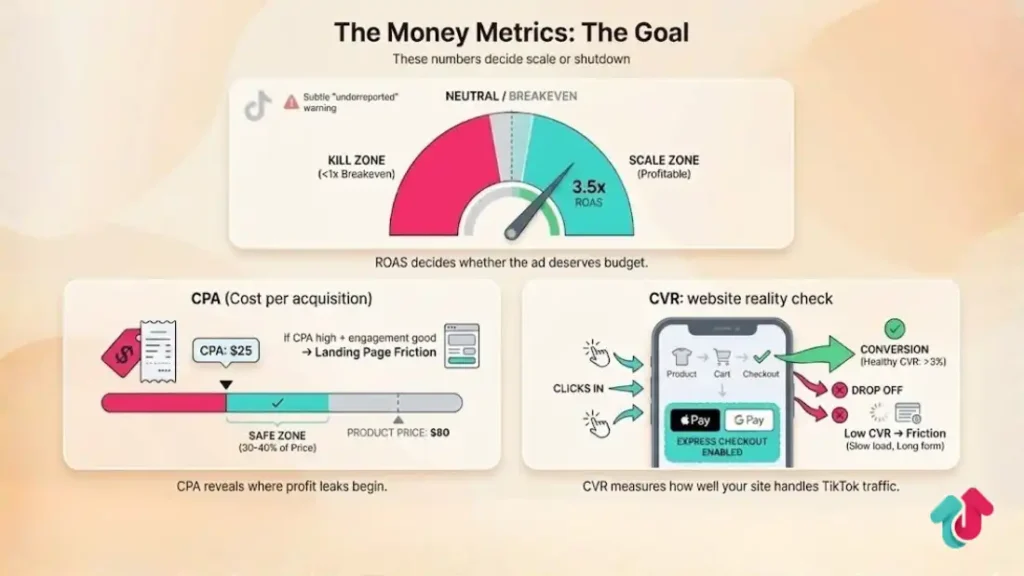
These are the only metrics that determine if you should keep an ad running or kill it.
ROAS (Return on Ad Spend)
Definition: Total Revenue divided by Total Ad Spend.
2026 Benchmark:
- Breakeven: Usually 1.5 – 2.0 (depending on your margins).
- Profitable: 2.5 – 4.0.
Note: TikTok attribution is notoriously conservative. It often underreports sales compared to Shopify or Google Analytics. Use post-purchase surveys to verify true ROAS.
CPA (Cost Per Acquisition)
Definition: The cost to get one purchase or lead.
2026 Benchmark: Highly dependent on product price. A good rule of thumb is a CPA that is 30-40% of your product’s sale price.
Strategy: If your CPA is too high but your CTR is good, your landing page is likely the problem (slow load speed or confusing checkout).
CVR (Conversion Rate)
Definition: The percentage of clicks that result in a sale.
2026 Benchmark: 1.0% – 2.5% for eCommerce.
Insight: TikTok traffic is colder and faster than Google traffic. Your landing page must be mobile-optimized and simple. Apple Pay or express checkout options are mandatory.
4. 2026 Benchmark Cheat Sheet
Save this table to evaluate your campaigns weekly.
| Metric | Status: Poor | Status: Good | Status: Excellent |
| CPM | > $15.00 | $5.00 – $10.00 | < $5.00 |
| CTR | < 0.7% | 0.8% – 1.2% | > 1.5% |
| Hook Rate | < 20% | 25% – 35% | > 40% |
| CPC | > $1.50 | $0.40 – $0.90 | < $0.30 |
| ROAS | < 1.0 | 1.5 – 2.5 | > 3.0 |
Explore these helpful articles next:
👉 Best TikTok Ads for Dropshipping Stores (Product Examples)
👉 Retargeting with TikTok Ads: Remarketing Strategies That Work
👉 TikTok Ad Learning Phase: How to Exit Faster
👉 TikTok Ads Lookalike Audiences: Complete Setup Guide
FAQ: Metrics Troubleshooting
Why is there a difference between Clicks (All) and Clicks (Destination)?
Clicks (All) includes likes, comments, shares, and profile visits. Clicks (Destination) count only the clicks that lead to your website. Always optimize for Destination Clicks to avoid vanity metrics.
What is a good frequency for TikTok ads?
Aim for a frequency of 2 to 4. Once an ad frequency hits 5+, ad fatigue sets in, and your CPA will spike because the same people are seeing the ad too many times.
How do I lower my CPM?
Improve your creativity. TikTok’s auction rewards high Watch Time. If you increase your Hook Rate and Hold Rate, the algorithm will serve your ad to more people for less money.
Does Add to Cart count as a conversion?
Only if you set it as your goal. However, for most eCommerce brands, Complete Payment (Purchase) is the only conversion metric that matters for ROI. Use Add to Cart metrics only to troubleshoot funnel drop-off.
My ROAS is 0.5, but I’m getting sales on Shopify. Why?
This is likely an attribution gap. iOS 14+ prevents TikTok from tracking every iPhone user. Use an attribution tool like Triple Whale or Northbeam, or check your Total Sales in Shopify vs. your ad spend to get a Blended ROAS (MER).
Conclusion
Data without context is just noise. In 2026, the brands that win on TikTok don’t just stare at their ROAS; they obsess over their Hook Rate.
Treat your metrics like a funnel:
- Hook Rate tells you if the creative angle is interesting.
- Hold Rate tells you if the video is entertaining.
- CTR tells you if the offer is desirable.
- CPA tells you if the business model works.
Fix the top of the funnel (the Hook), and the bottom of the funnel (the ROAS) will often fix itself.