
Small business owners often approach TikTok Ads with a lottery ticket mindset. You throw $100 at a boosted post, get zero sales, and immediately declare the platform too expensive.
The reality is that TikTok is not expensive, but it is math-heavy. The algorithm requires a specific volume of data to function.
If you feed it $20 here and there, you are effectively starving the machine, preventing it from ever learning who your customer actually is.
Get Up to $6,000 in Free TikTok Ad Credits
TikTok offers ad credit incentives for new advertisers, helping you test campaigns with a lower upfront cost.
However, you do not need a corporate marketing budget to win in 2026. You simply need budget density.
Instead of spreading $500 across ten different audiences to see what works, you must concentrate that money into a single, high-pressure point to break through the noise.
This guide outlines the exact mathematical approach to budgeting for small businesses, ensuring every dollar buys you data, learning, or revenue, never just empty views.
Table of Contents
Quick Summary
- The Magic Number: You need roughly $50/day per Ad Group to exit the learning phase effectively. Anything less often leads to zombie campaigns that never stabilize.
- Consolidate Spend: Concentration beats segmentation. Running 1 ad group with a $50 budget is mathematically superior to running 5 ad groups with $10 budgets.
- Optimization Hack: If you cannot afford 50 purchases a week, optimize for Add to Cart. It provides cheaper data that helps the pixel learn faster.
- The Safety Net Bid: Use Cost Caps (Bid Caps) if your budget is strict. This tells TikTok: If you can’t find a customer for $15, don’t spend my money.
What is the Minimum TikTok Ad Budget?
Technically, TikTok requires a minimum daily budget of $20 per Ad Group. However, the functional minimum to see consistent results is typically $50/day.
This is because the algorithm needs to generate approximately 50 conversions per week to exit the Learning Phase.
If your product costs $30, a $20 daily budget simply does not provide enough data volume for the system to optimize, leaving your campaign stuck in the learning phase indefinitely.
1. The Concentration Strategy: Solving the Small Budget Trap
The single biggest mistake small businesses make is over-segmenting. You naturally want to target Moms, Students, and Dog Owners separately to see who buys. While this logic works for large corporations, it is a mathematical trap for small budgets.
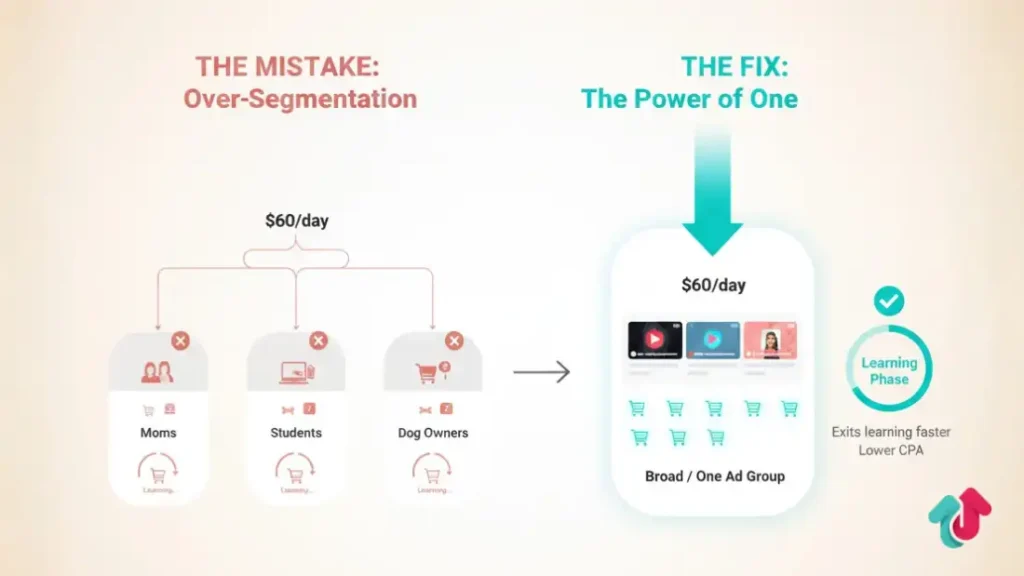
Imagine you have a total budget of $60 per day. If you split this across three different ad groups, each group only gets $20.
At that spend level, each group might generate one or two conversions a day. None of them will ever hit the 50-conversion weekly threshold required for the algorithm to learn. You essentially end up with three dumb campaigns rather than one smart one.
The Fix: The Power of One. If your budget is under $100/day, the most effective strategy is to run One Campaign containing One Ad Group.
Leave your targeting broad or use a single, robust interest stack. Place your three best videos inside this single ad group and let them compete.
By forcing all $60/day into one bucket, that specific ad group can generate 6-8 conversions daily. This allows it to exit the learning phase quickly, causing costs to drop and performance to stabilize.
2. Budget Allocation: Testing vs. Scaling
When funds are limited, you cannot afford the complex 70/20/10 budget splits that agencies use. You are either in Discovery Mode or Profit Mode, and your budget should reflect that singular focus.
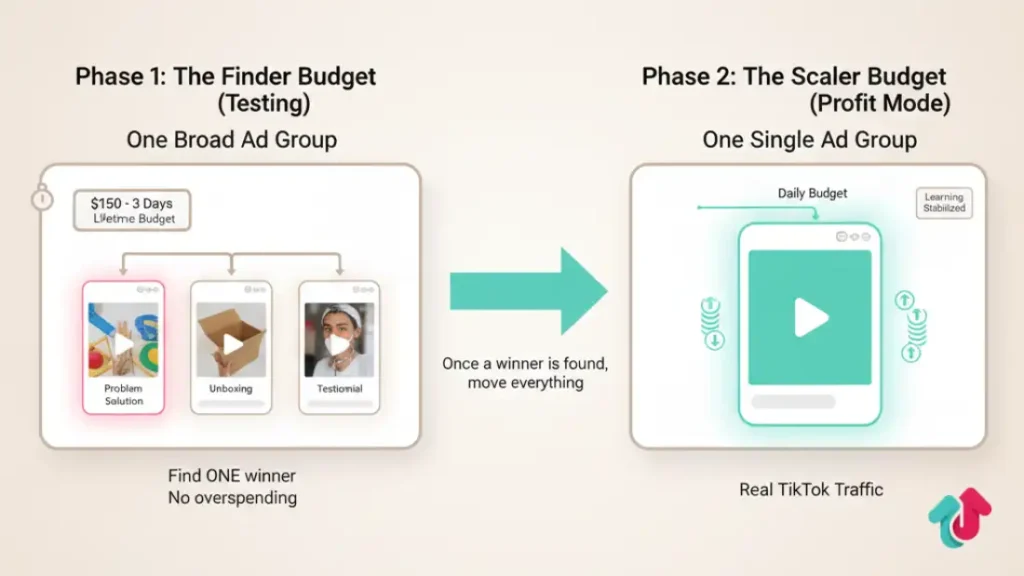
Phase 1: The Finder Budget
When starting out, allocate 100% of your budget to finding one video that makes money. Run three distinct creative angles, such as a Problem/Solution video, an Unboxing, and a Testimonial, in your single Broad ad group.
Set a Lifetime Budget for this test, such as $150 over 3 days. This prevents overspending while giving the system enough room to identify a winner. If Video A gets sales while Video B and C do not, you have your answer.
Phase 2: The Scaler Budget
Once a winner is identified, move your entire daily budget to that winning creative. Crucially, if you are spending less than $100/day, do not run a separate retargeting campaign.
Your audience pool is likely too small, and running a retargeting ad will result in high frequency, annoying your potential customers.
Let your broad campaign handle the retargeting naturally, as the algorithm will circle back to interested users on its own.
3. The Down-Funnel Optimization Trick
This is the secret weapon for low-budget accounts that struggle to exit the learning phase. The algorithm demands 50 conversions per week to function correctly.
If you sell a $50 product and have a $30 CPA, getting 50 sales requires about $1,500/week in spend. If you only have $300/week, you are mathematically locked out of optimization.
The Solution: Optimize for Add to Cart (ATC) instead of Complete Payment.
Add to Cart events happen roughly four times more often than purchases. With a $300 weekly budget, you can easily generate 50+ Add to Cart events. This gives the algorithm the data volume it needs to stabilize.
It learns to find people who are likely to add items to their cart, and a statistically stable percentage of those people will naturally complete their purchase.
Once you are consistently getting 10+ sales a day, you can switch the optimization goal back to Complete Payment.
4. Bidding Strategies for the Risk-Averse
Choosing the right bidding strategy is your insurance policy against wasted spend. Most beginners default to Lowest Cost (Maximum Delivery), where TikTok spends your full daily budget regardless of the results.
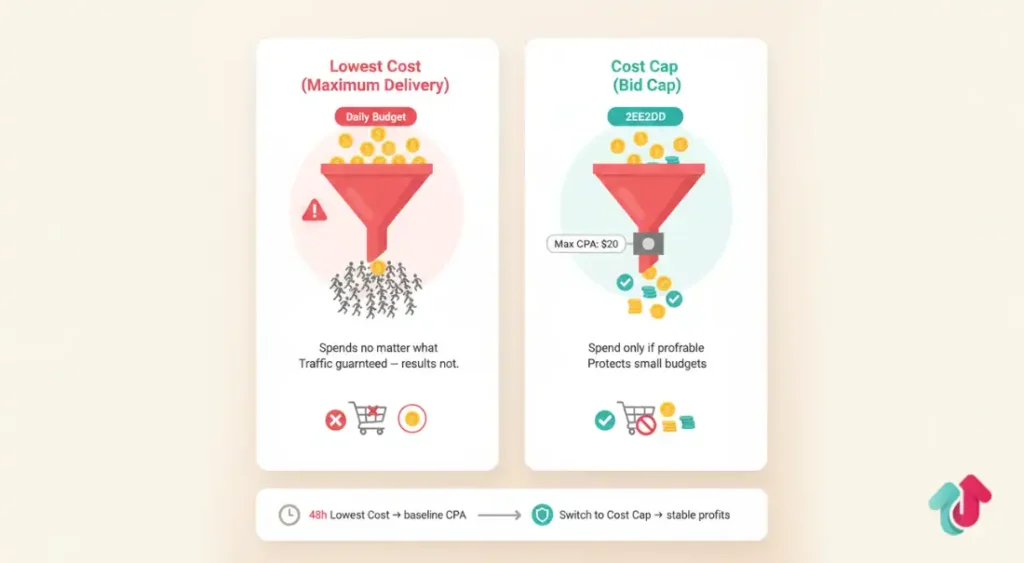
While this guarantees traffic, it also means you could spend $50 to get zero sales if your creative doesn’t land.
For strict budgets, Cost Cap (Bid Cap) is the safer alternative. This strategy allows you to tell TikTok, I am willing to pay $20 per sale. If you can’t find a buyer for $20, do not spend my money.
If the ads are ineffective, your spend will simply stay at $0, protecting your profit margin. The downside is that if your bid is too low, the ad won’t deliver at all.
A strong strategy for small businesses is to start with Lowest Cost for 48 hours to establish a baseline CPA, then switch to Cost Cap set slightly above that average to maintain profitability without burning cash.
5. The Organic Filter (Zero-Cost Testing)
The most efficient way to save ad budget is to stop testing with money and start testing with time. You can use your organic feed as a free testing ground before committing dollars.
Establish an Organic-to-Paid Pipeline. Post your creative concepts organically on your business profile and wait 24 hours. Look at the data: did one video get 20% more views or significantly higher retention than the others?
That is your verified winner. Use Spark Ads to pull that specific organic post into your ad account.
This ensures you are spending your limited budget on a creative hook that has already proven it can stop the scroll, rather than paying to find out a video is boring.
Explore these helpful articles next:
👉 TikTok Ads Frequency: Avoiding Ad Fatigue
👉 Common TikTok Ads Mistakes New Advertisers Make
👉 TikTok Ads Policies New Update: What Advertisers Must Know
👉 TikTok Ads for Fashion & Apparel: Creative Trends to Copy
FAQ: Budgeting Questions
What happens if I spend less than $20/day?
You simply can’t. TikTok’s system hard-blocks any ad group budget under $20. While you could technically pause the campaign halfway through the day, this hurts the algorithm’s pacing and usually leads to poor performance.
Should I use Campaign Budget Optimization (CBO) for small budgets?
No. CBO works best when you have multiple ad groups and high volume. For small budgets (under $100), use ABO (Ad Group Budget Optimization). It gives you full control to ensure exactly $50 is spent on your specific target audience without the algorithm shifting funds unexpectedly.
How long should I wait before killing an ad?
On a small budget, you cannot afford to wait for statistical significance. Kill the ad once it has spent 1x your Breakeven CPA without a sale. Large brands might wait for 3x, but small businesses must prioritize cash flow protection.
Is it better to run ads for 3 days/week or every day?
Every day. TikTok’s algorithm prefers consistency. Turning ads on and off shocks the system and resets learning. It is far better to spend $30/day for 7 days than $100/day for just 2 days.
Can I scale a $20 budget?
Yes, but slowly. Use the 20% Rule. If your $20/day ad is profitable for 3 days, raise it to $24. Then $28. Do not jump from $20 to $100 overnight, or you will crash the performance by resetting the learning phase.
Conclusion
A small budget is not a death sentence on TikTok; it is a discipline test. The businesses that fail are the ones that sprinkle their budget like fairy dust across too many audiences, hoping for magic. The businesses that win are the ones that act like snipers.
They consolidate their funds into one broad ad group, optimize for Add to Carts to feed the algorithm cheap data, and use Cost Caps to defend their bank account. Start with $50, put it all behind your single best video, and let the math work for you.