
Most businesses view January as a time to tighten the belt. After the heavy spending of Q4 (Black Friday and Christmas), the natural instinct is to pause ad campaigns and recover.
This is a strategic error.
The period from December 26th to January 15th, often called Q5, offers the most efficient advertising inventory of the year.
Get Up to $6,000 in Free TikTok Ad Credits
TikTok offers ad credit incentives for new advertisers, helping you test campaigns with a lower upfront cost.
Major retailers exit the auction, causing Cost Per Mille (CPM) to drop significantly, often by 30 to 50 percent compared to December peaks. Simultaneously, consumers are highly active, setting resolutions and spending gift cards.
For SMEs and brands, the question is not if you should spend, but how to structure that spend to capture this cheap traffic without wasting it.
This guide details the mathematical approach to New Year budget planning, distinguishing between Technical Minimums and Profitability Thresholds to ensure your 2026 starts in the black.
Table of Contents
Quick Summary
- The Q5 Discount: Plan for your budget to stretch 2x further. CPMs in early January often drop to $3.50–$6.50, allowing for aggressive scale.
- The $50 Rule: Ignore the $20 minimum setting. The functional minimum budget for an ad group to optimize is $50/day. Anything less starves the algorithm.
- Front-Load Spend: Allocate 70% of your total January budget to the first 10 days (Dec 26 – Jan 5) to capture peak resolution intent.
- SME Strategy: Consolidate your budget. Run one campaign with one ad group to maximize data density.
- Bidding: Use Cost Caps to protect your margin. Set your bid at your break-even CPA to ensure you only pay for profitable conversions.
1. The Q5 Efficiency Window: Why Budget Now?
To plan your budget, you must understand the market conditions of January 2026. You are buying media in a buyer’s market.
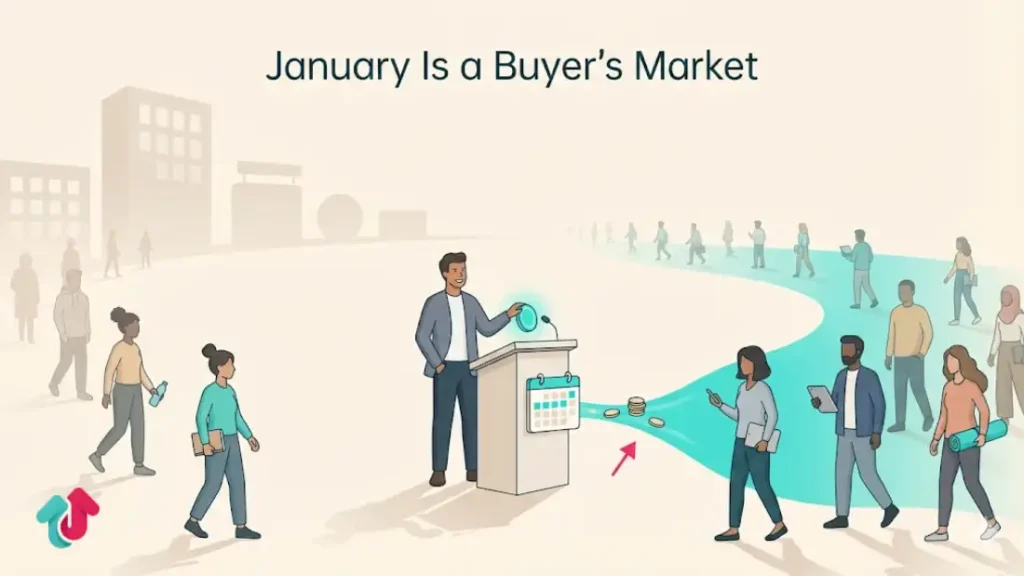
The Supply and Demand Shift. In December, you compete with Amazon, Walmart, and Nike. In January, they leave.
- CPM Drop: Historical data indicate a 30% to 50% decrease in CPM during the first two weeks of January.
- Traffic Quality: Engagement remains high. Users are in Self-Improvement mode, looking for products that solve problems (Health, Wealth, Organization) rather than gifts.
Actionable Insight: If you have a total Q1 budget of $10,000, do not pace it evenly ($3,333/month). Allocate $5,000 to January, with the majority spent in the first two weeks. You are buying the same leads for half the price.
2. Calculating the Minimum Viable Budget
New advertisers often ask, What is the lowest amount I can spend?
The Technical vs. Functional Minimum
- Technical Minimum: TikTok allows $20/day per ad group.
- Functional Minimum: $50/day per ad group.
The Math Behind the $50 Rule The TikTok algorithm requires approximately 50 conversions per week to exit the Learning Phase and stabilize performance.
- If your Target CPA (Cost Per Acquisition) is $20.
- You need 50 sales x $20 = $1,000 per week.
- Daily Budget = $142/day.
SME Reality Check: If you cannot afford $142/day, you must lower your optimization goal. Optimize for Add to Cart or Initiate Checkout instead of Complete Payment. These events are cheaper and more frequent, allowing the algorithm to learn on a smaller budget, like $50/day.
3. Allocation Strategy: The 70/20/10 Split
Do not dump your entire budget into one bucket. Use this split to balance volume with profitability.
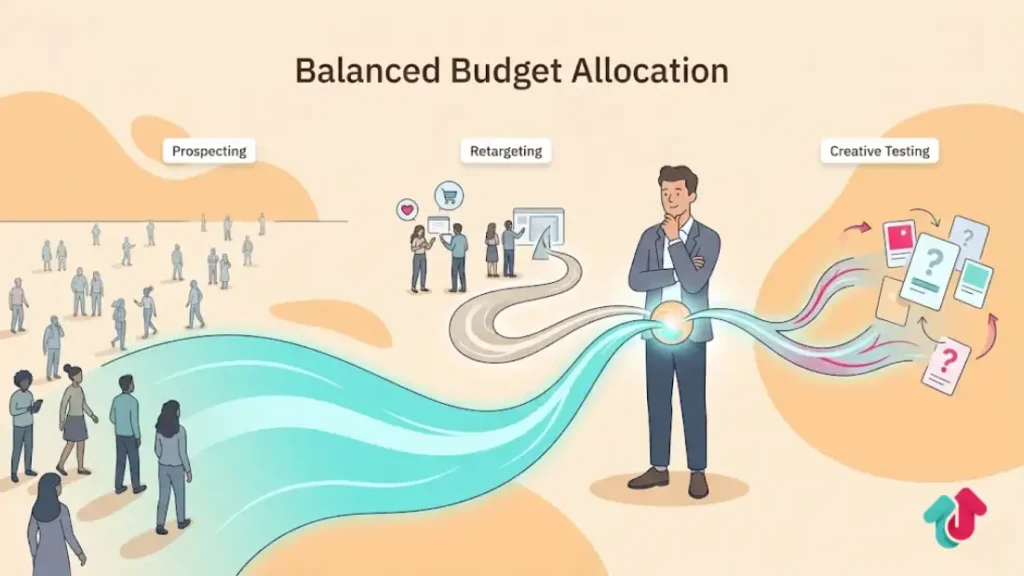
70% Prospecting (Cold Traffic)
- Goal: New customer acquisition.
- Targeting: Broad (No interests) or Resolution Stacks (Health/Finance interests).
- Format: Use Smart+ Campaigns here. These automated campaigns are showing 14% better efficiency in beta tests for broad scaling.
20% Retargeting (Warm Traffic)
- Goal: Conversion.
- Targeting: Custom Audiences. Target users who viewed 6 seconds of your video or visited your site in the last 30 days but did not buy.
- Creative: Still thinking about it? hooks or Low Stock warnings.
10% Creative Testing (R&D)
- Goal: Finding the next winner.
- Strategy: Dedicate a small portion of the budget to testing new hooks. In January, test New Year Reset vs. Gift Card Spree angles.
4. SME vs. Brand Budget Strategies
Your bank account size dictates your structure.
The SME Strategy (Budget < $3,000/mo)
Consolidation is King.
- Structure: 1 Campaign > 1 Ad Group > 3-5 Ads.
- Why: Spreading $50/day across 3 different audiences means each audience gets $16. That is not enough data for the AI. Put all your money into Broad Targeting and let the creative filter the audience.
- Bidding: Use Cost Caps. Tell TikTok, I can’t pay more than $25 per sale. This prevents you from burning cash if the ads don’t work.
The Brand Strategy (Budget > $10,000/mo)
Segmentation and Scale.
Structure: 3 Campaigns (Testing, Scaling, Retargeting).
Tactics:
- Use Spark Ads with creators ($150-$300 per creator fee) to lower CPA.
- Run specialized High Intent ad groups targeting specific sub-niches (e.g., Pilates vs. CrossFit).
- Bidding: Use Lowest Cost (Max Delivery) during the first 48 hours of the sale to dominate share of voice, then switch to Value-Based Optimization (VBO).
5. Bidding Strategies: Protecting the Downside
How you bid determines your risk level.
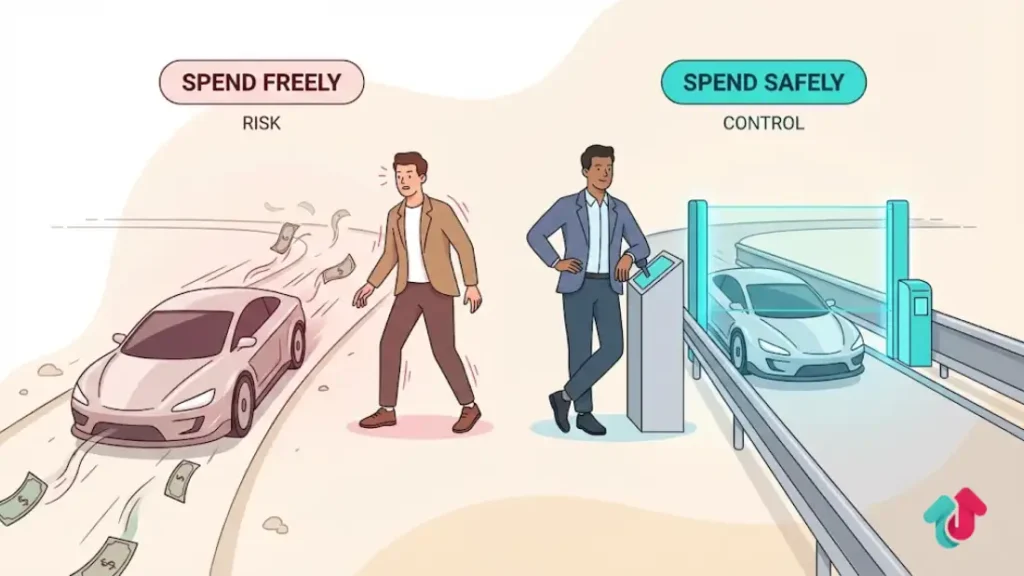
Lowest Cost (Maximum Delivery)
Pros: Guarantees your budget is spent. Best for getting data fast.
Cons: No price protection. You could spend $100 for 0 sales.
Use When: You are launching the New Year sale on December 26 and need immediate traffic.
Cost Cap (Bid Cap)
Pros: Protects profitability. If TikTok can’t find buyers at your price, it stops spending.
Cons: Delivery can stop completely if the bid is too low.
Use When: You have a strict marketing budget and cannot afford to lose money. Set the cap at roughly 1.2x your break-even CPA.
Explore these helpful articles next:
👉 TikTok Ads Optimization Checklist
👉 TikTok Ads Cost Breakdown for New Year Sale Campaigns
👉 When to Start TikTok Ads for New Year Sale Campaigns
👉 TikTok Spark Ads: Benefits, Setup & Best Use Cases
FAQ: Budget Planning Questions
What is a realistic CPA for January 2026?
While it varies by industry, expect CPAs to be 15-20% lower in January than in December. If your December CPA was $30, aim for $24 in January.
Should I budget for Smart+ campaigns?
Yes. Allocate at least 50% of your prospecting budget to Smart+ (automated) campaigns. They are currently outperforming manual targeting for broad-appeal products during high-volatility periods like Q5.
Does New Year creative cost more to produce?
Not necessarily. You don’t need a new shoot. Use Modular Editing to add a new voiceover saying Start 2026 Right over your existing product footage. Budget $0 for this if you do it in-house, or $150 for a creator to re-hook it.
When should I cut the budget?
Monitor the Resolution Curve. Usually, by January 15th, conversion rates drop as motivation wanes. Plan to reduce your daily spend by 30-40% after this date to maintain efficiency.
Is it better to spend $100/day for 5 days or $50/day for 10 days?
$100/day for 5 days. TikTok rewards data density. Getting 10 conversions in one day is better for the algorithm than getting 1 conversion a day for 10 days. Front-load your budget.
Why are my ads not spending with Cost Cap?
Your bid is likely too low. The January auction is cheap, but not free. If you cap it at $10 and the market rate is $15, you won’t get impressions. Raise the bid by 10% until delivery starts.
Conclusion
Budgeting for a New Year sale on TikTok is about recognizing the Q5 arbitrage. You have a unique window where traffic is cheap, and intent is high.
The Action Plan:
- Commit: Set a budget of at least $50/day per ad group.
- Timing: Allocate 70% of that budget to the first 10 days of January.
- Protection: Use Cost Caps to ensure you don’t overpay.
By consolidating your spend and hitting the market hard while the big competitors are away, you can secure your most profitable customers of the year before February even begins.