
Scaling a winning TikTok ad campaign is not as simple as typing an extra zero into your budget box. In fact, aggressive budget jumps are the single fastest way to destroy a profitable campaign.
The TikTok algorithm is incredibly sensitive to volatility. When you drastically increase spend, you force the system to bid on cold audiences outside your proven pocket of buyers.
The result is almost always the same: your CPA spikes, your ROAS crashes, and the ad group resets its learning phase.
Get Up to $6,000 in Free TikTok Ad Credits
TikTok offers ad credit incentives for new advertisers, helping you test campaigns with a lower upfront cost.
In 2026, scaling is no longer just about spending more money. It is about signal stability and creative velocity.
The brands winning right now are not just increasing budgets; they are using Surf Scaling with automated rules and feeding the algorithm a constant diet of fresh creative iterations to fight fatigue.
This guide provides a fail-safe protocol to take your campaigns from $50/day to $5,000/day without lighting your profit margins on fire.
Table of Contents
Quick Summary
- The 20% Rule: Never increase an ad group’s daily budget by more than 20% every 24-48 hours. Anything higher risks resetting the learning phase.
- The Surf Strategy: Use TikTok’s Automated Rules to temporarily boost budgets on days when performance is hot, capitalizing on momentum without permanent commitment.
- Creative Velocity: Creative fatigues 3x faster on TikTok than Meta. You need 2-3 new ad variations per week to maintain ROAS at a large scale.
- Horizontal First: Before you spend more on one ad set (Vertical), duplicate it to find new audiences (Horizontal). It is safer and diversifies your risk.
- The Stability Check: Never scale an ad group that hasn’t hit 50 conversions in a week. It is not stable enough to handle the pressure.
What is the TikTok Ads Learning Phase Reset?
The Learning Phase Reset occurs when a significant change (like a budget increase >20%) forces TikTok’s algorithm to delete its optimization history and start learning from scratch.
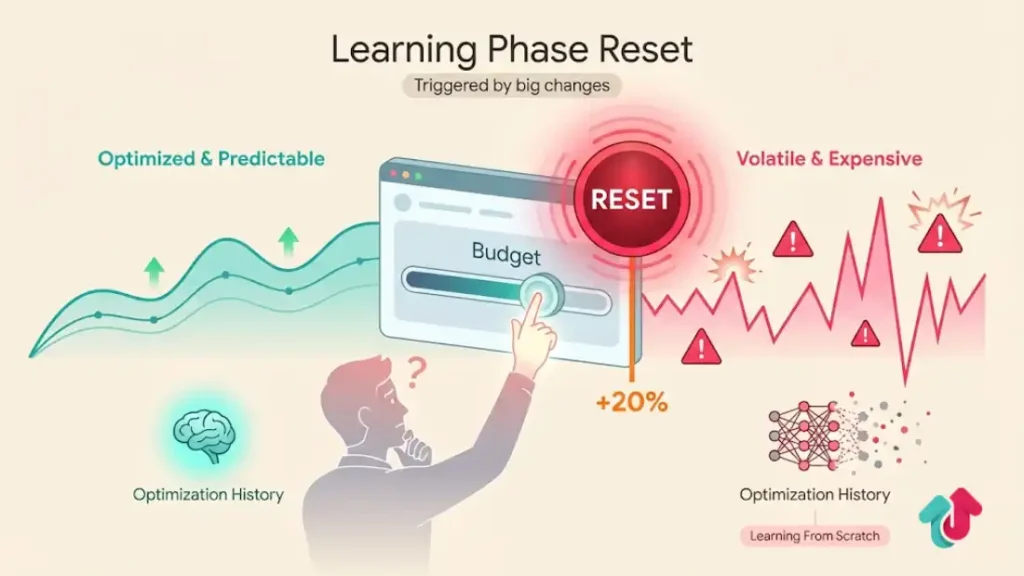
During this reset, the system enters a volatile exploration mode, causing costs to spike and performance to become unpredictable. Avoiding this reset is the primary goal of any scaling strategy.
1. The Pre-Scaling Checklist
Most advertisers fail because they try to scale a campaign that got lucky for two days. Before you touch the budget, your ad group must pass the stability test.
The 50-Conversion Rule: An ad group is only ready to scale when it generates 50 conversions within a 7-day period. This proves the algorithm has built a statistically significant profile of your buyer.
The Green Light Metrics:
- ROAS Stability: Has ROAS remained profitable for 5 consecutive days?
- CPA Variance: Is the daily Cost Per Acquisition fluctuating by less than 20%?
- Creative Depth: Do you have at least 3 active creatives in the ad group?
2. Vertical Scaling: The Ladder Method
Vertical scaling is the act of spending more money on the same winning ad group. It is the simplest method but carries the highest risk of breaking the algorithm.
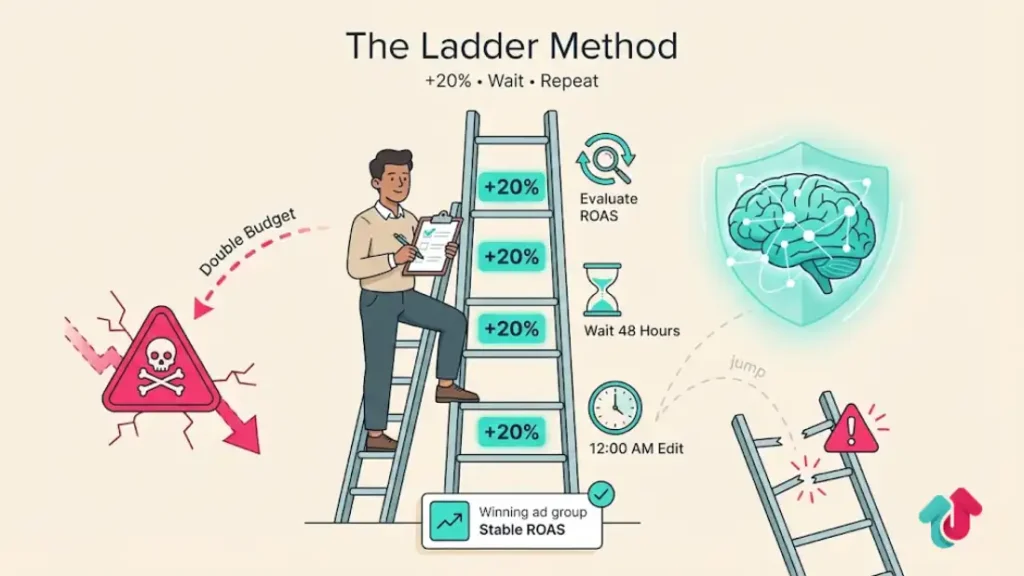
The 20% Protocol
Instead of doubling your budget, climb the ladder slowly.
Time Your Edit: Make budget changes at 12:00 AM (Ad Account Time). This gives the algorithm a full 24 hours to pace the new budget.
The Increment: Increase the daily budget by 20%.
The Wait: Do not touch it for 48 hours.
- If ROAS holds: Increase by another 20%.
- If ROAS drops: Hold for another 24 hours. If it doesn’t recover, revert to the previous budget.
Why this works: It keeps the change small enough that the algorithm treats it as a minor adjustment rather than a significant edit, preventing a Learning Phase reset.
3. Horizontal Scaling: The Wide Net Strategy
Horizontal scaling is safer because it doesn’t touch your original winning ad group. You simply clone success into new environments.
The Broad Expansion
In 2026, TikTok’s AI is often smarter than manual targeting.
- Action: Duplicate your winning ad group.
- Change: Remove all interests and behaviors. Keep only Age, Gender, and Location.
- Why: This Broad targeting forces the algorithm to find buyers based solely on your creative signals. It opens up a massive pool of inventory that interests targeting misses.
Lookalike Audience (LAL) Stacking
Once you have 1,000 purchasers, build LALs to find similar users.
- The Stack: Create a new ad group targeting a 1-5% Lookalike of Purchasers.
- Note: Do not use Website Visitors LALs for scaling. The intent is too low.
4. Surf Scaling with Automated Rules
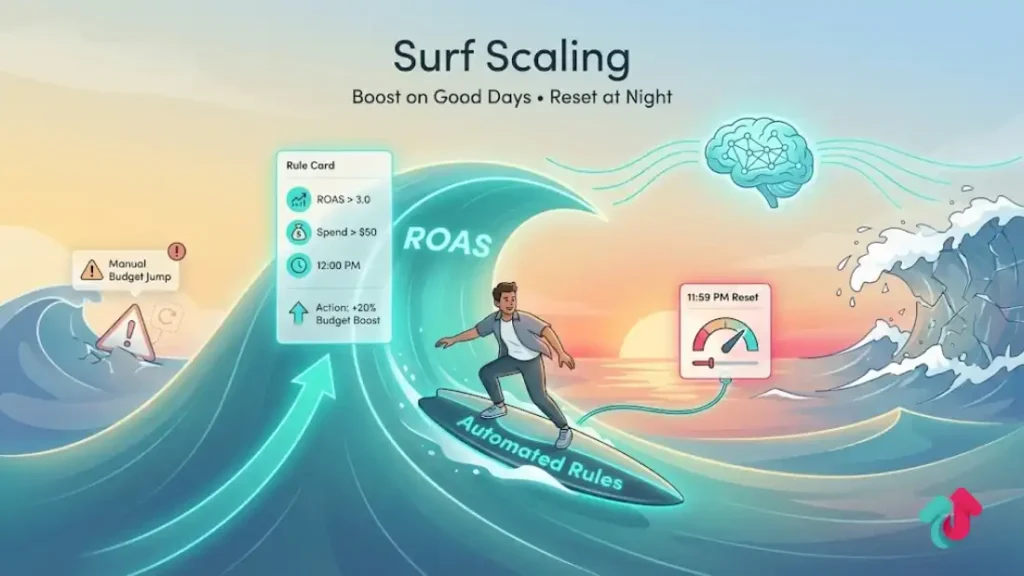
This is the advanced tactic for 2026. Instead of permanently raising budgets, you surf the waves of high performance using TikTok’s automation tools.
How to Set It Up
Go to Tools > Automated Rules and create a rule to capitalize on good days.
The Intraday Boost Rule:
- Condition: If ROAS > 3.0 (or your target) AND Spend > $50 by 12:00 PM.
- Action: Increase Daily Budget by 20%.
- Reset Rule: Create a second rule to revert the budget back to the original amount at 11:59 PM.
Why it works: You only spend more money on days when the auction is cheap, and users are buying. You protect your downside on bad days.
5. The Fuel: Creative Velocity
You cannot scale spend without scaling creative volume. If you spend $500/day on a single video, everyone in your audience will see it 4 times in a week. Ad fatigue will kill your ROAS instantly.
The Modular Refresh Strategy
You don’t need to film entirely new concepts every week. Just refresh the Hook.
The Tactic: Take your winning video and edit the first 3 seconds.
- Variation A: Text Hook (Stop doing this).
- Variation B: Visual Hook (Weird texture or movement).
- Variation C: Verbal Hook (A controversial statement).
The Result: To the algorithm, these are three new ads. This allows you to scale the same core sales pitch to fresh audiences without fatigue.
Explore these helpful articles next:
👉 TikTok Ads Landing Page Best Practices for Mobile Sales
👉 Retargeting with TikTok Ads: Remarketing Strategies That Work
👉 TikTok Shopping Ads vs Website Conversion Ads: Pros & Cons
👉 TikTok Video Specs for Ads: Dimension, Ratio, Safe Zones
FAQ: Scaling Troubleshooting
What is the best bidding strategy for scaling?
Cost Cap is the safest bid strategy for scaling. By setting a maximum CPA (e.g., $25), you tell TikTok to stop spending if it can’t find buyers at that price. This protects your ROAS as you increase the budget. Lowest Cost will spend your entire budget regardless of results, which is risky at a large scale.
Should I use CBO (Campaign Budget Optimization) for scaling?
Yes. Use ABO (Ad Group Budget Optimization) for testing new creatives. Once you have 3-5 winning ad groups, move them into a CBO campaign. The CBO algorithm is excellent at shifting budget in real-time to whichever ad group is performing best that specific day.
How do I know if my audience is saturated?
Check your Frequency metric. If your Frequency crosses 3.0 (meaning the average user has seen your ad 3 times) and your CPA rises, your audience is saturated. You must either broaden the audience (Horizontal Scale) or launch a new creative.
Why did my ROAS drop immediately after increasing the budget?
This is normal volatility. The algorithm is testing new pockets of users. Give it 24-48 hours to stabilize. If it doesn’t recover after 48 hours, you likely scaled too aggressively (vertical jump >20%) or your creative simply isn’t broad enough to appeal to a larger audience.
Can I scale by duplicating the ad group 10 times?
This tactic (often called mass duping) rarely works in 2026. It causes audience overlap, where your own ad groups bid against each other, driving up your CPMs. It is better to have fewer, high-budget ad groups than dozens of small, identical ones.
Conclusion
Scaling on TikTok is a test of discipline. The urge to let it ride when you see a profitable day is the enemy.
Stick to the protocol: 20% vertical increments for your winners, broad expansion for your new ad groups, and automated rules to catch the intraday waves.
Above all, remember that budget is just the fuel; creative is the engine. If you stop adding fresh, creative oil, the engine will seize, no matter how much gas you pour in.