
TikTok is now one of the most powerful business growth platforms on the planet. Not because it is trendy. Because it works.
Over 2 billion people open TikTok every month. They are searching for products, discovering brands, watching tutorials, and making purchase decisions, all without leaving the app. If your business is not showing up in that space, your competitors are.
But here is the problem: most businesses create an account, post a few videos, get low views, and assume TikTok does not work for them.
What actually went wrong is simpler: they had no strategy, no understanding of the algorithm, and no clear goal before they hit publish.
Get Up to $6,000 in Free TikTok Ad Credits
TikTok offers ad credit incentives for new advertisers, helping you test campaigns with a lower upfront cost.
This guide fixes that. You will learn exactly how to set up your TikTok Business account, build a content strategy that earns real reach, use TikTok ads without wasting your budget, sell through TikTok Shop, and measure results that connect to actual revenue.
Whether you are starting from zero or trying to fix a TikTok presence that is not performing, everything you need is here.
Table of Contents
What Is TikTok for Business?
TikTok for Business is TikTok’s official suite of tools, features, and advertising solutions designed to help brands and businesses grow on the platform. It gives you access to a TikTok Business account, the TikTok Ads Manager, TikTok Shop, and the TikTok Business Center, all in one ecosystem built for marketing and revenue generation. Whether you are a solo founder or a marketing team running paid campaigns, TikTok for Business is how you use the platform with strategy, not just content. Results vary based on your niche, budget, and consistency, but the infrastructure is available to every business from day one.
Why TikTok for Business Is a Must-Have Channel in 2026
TikTok is no longer an experiment for brands willing to try something new. It is a primary growth channel with a proven track record across industries, budgets, and business sizes.
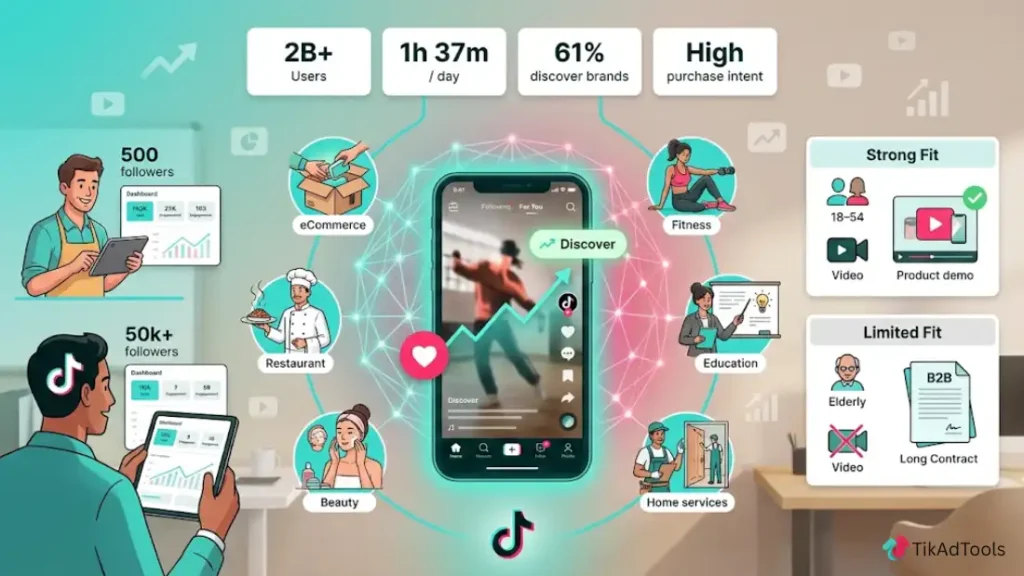
Most platforms reward the brands that got there first. TikTok still rewards quality and relevance over follower count. That means a business with 500 followers can outperform one with 50,000 if the content is right. That is a rare opportunity, and it will not stay open forever.
TikTok by the Numbers: Stats Every Brand Needs to Know
The scale of TikTok in 2026 makes it impossible to ignore as a business channel.
According to Exploding Topics, TikTok has over 2 billion monthly active users globally. They also claim that TikTok users spend an average of 1 hour, 37 minutes per day on the app, which is higher than any other social platform, including Instagram and YouTube. Additionally, 61% of TikTok users say they have discovered a new brand or product on the platform in the past 30 days.
Here is what those numbers mean for your business:
- Your audience is already on TikTok, actively looking for products and solutions
- The average user session length means your content has a real chance to be seen
- Discovery is built into the platform’s DNA, which benefits brands at any stage
According to Adobe, TikTok drives higher purchase intent per video view than Facebook or Instagram for audiences under 45. That is not an opinion; that is purchase behavior data.
Is TikTok Right for Your Business? (How to Know Before You Start)
TikTok works for most businesses, but it is not the right primary channel for every single one.
You are likely a strong fit if your target customer is between 18 and 54 years old, your product or service is visual or demonstrable, and you can produce short video content consistently. According to TikTok’s own business resources, the platform performs especially well for eCommerce, food and beverage, beauty, fitness, finance, education, and home services.
You may want to reconsider TikTok as your primary channel if your customer is exclusively over 65, your buying cycle is entirely B2B enterprise with a 12-month decision process, or you have no capacity to produce video content at any level.
That said, even B2B brands have built strong TikTok audiences by educating their industry rather than selling directly. The format is flexible. The audience is large. The question is not really “should I use TikTok?” It is “how do I use TikTok in a way that makes sense for my business?”
How to Set Up Your TikTok Business Account (Step-by-Step)
Setting up a TikTok Business account takes less than 10 minutes and gives you immediate access to analytics, ad tools, and commercial features that a personal account simply does not have.
Here is exactly how to set up TikTok for Business:
- Download the TikTok app or go to TikTok.com and create a new account, or log into an existing personal account
- Go to your profile and tap the three-line menu in the top right corner
- Select “Settings and Privacy”
- Tap “Account” and then “Switch to Business Account”
- Choose the category that best describes your business from TikTok’s list
- Add your business email address and website URL to your profile
- Connect your Instagram and YouTube accounts if relevant, as TikTok allows cross-platform linking
- Review and accept TikTok’s Business Account terms
Once you complete these steps, you will see a new “Business Suite” tab in your profile settings.
This gives you access to TikTok analytics, the commercial music library, and the ability to run ads directly from the app.
TikTok Business Account vs Creator Account: What’s the Difference?
This is one of the most common questions we see from brands starting on TikTok. Here is the direct comparison:
| Feature | Business Account | Creator Account |
| Access to TikTok Analytics | Full suite | Basic only |
| Commercial Music Library | Yes (royalty-free) | No |
| TikTok Ads Manager access | Yes | No |
| TikTok Shop eligibility | Yes | Limited |
| Link in bio | Yes (always) | Yes (after 1K followers) |
| Business Center access | Yes | No |
| Auto-message and inbox tools | Yes | No |
| Branded content toggle | Yes | Yes |
The short answer is that if you are using TikTok to grow a business, you need a Business account. A Creator account is built for individual content creators monetizing through TikTok’s creator fund. The tools, permissions, and commercial features are fundamentally different.
How to Optimize Your TikTok Business Profile for Maximum Impact
Your profile does two jobs: it tells a new visitor who you are in under five seconds, and it convinces them to follow you or click your link. Most brand profiles fail at both.
Here is what a high-performing TikTok Business profile includes:
- Profile photo: Use your logo or a recognizable brand image. Keep it consistent with your other social platforms so returning customers recognize you instantly.
- Username: Use your brand name exactly as it appears elsewhere. Consistency matters for search and recognition.
- Bio: You have 80 characters. Use them to state what you do and who you help. “Skincare for sensitive skin. Real ingredients, real results.” is stronger than “Official TikTok of [Brand Name].”
- Link in bio: Send traffic to a landing page built for TikTok visitors, not your homepage. A dedicated page converts better.
- Pinned videos: Pin your three best-performing or most representative videos to the top of your profile. First impressions matter on TikTok just as much as anywhere else.
What Is TikTok Business Center, and Do You Need It?
TikTok Business Center is TikTok’s centralized management platform for businesses running multiple ad accounts, managing agency relationships, or operating more than one TikTok profile under one business. Think of it as the command center behind your TikTok marketing operation.
It is separate from your regular Business account and lives at business.tiktok.com. Inside the Business Center, you can manage ad accounts, assign team member roles, share creative assets, connect with marketing partners, and control permissions across your entire TikTok presence from one dashboard.
Who Should Use the TikTok Business Center?
If you are a solo business owner running one account and managing your own ads, the Business Center adds complexity you do not need yet. Your standard Business account dashboard is enough to start.
You need TikTok Business Center if any of the following applies to your situation:
- You work with an agency or external media buyer who runs your TikTok ads
- You manage more than one TikTok ad account or brand profile
- You have a marketing team where different people handle content, ads, and reporting
- You are a marketing agency managing TikTok accounts for multiple clients
- You want to share creative assets, audiences, or pixel data across multiple accounts securely
How to Set Up and Navigate the TikTok Business Center
Setting up TikTok Business Center is straightforward once you have an active TikTok Business account.
- Go to business.tiktok.com and log in with your TikTok Business account credentials
- Click “Create a Business Center” and enter your business name and industry
- Add your existing TikTok ad account by entering the account ID, or create a new one
- Invite team members by email and assign them roles: Admin, Operator, or Analyst
- Connect your TikTok profiles to the Business Center so all assets are linked
- Set up your payment method under the billing section if you plan to run ads
Once you are inside, the left-hand navigation gives you access to your ad accounts, audience data, creative library, and user permissions. Start by linking your existing ad account before adding team members, so you maintain full admin control from the beginning.
How to Build a TikTok Marketing Strategy That Actually Works
Most brands fail on TikTok not because of bad content, but because they start posting without a strategy. Posting consistently without direction is just noise. A real TikTok marketing strategy starts with decisions, not videos.
Step 1: Define Your Goals and KPIs Before You Post Anything
Before you film a single video, you need to know what success looks like for your business specifically.
TikTok can drive brand awareness, website traffic, lead generation, direct product sales, or app downloads.
Each goal requires a different content approach and a different set of metrics. Trying to achieve all of them with the same content is one of the most common TikTok mistakes we see brands make. Choose one primary goal for your first 90 days.
Common starting goals and their matching KPIs include:
- Brand awareness: Video views, reach, follower growth rate
- Website traffic: Click-through rate, link-in-bio clicks, TikTok referral sessions in Google Analytics
- Direct sales: TikTok Shop conversion rate, revenue attributed to TikTok in your analytics
- Lead generation: Form submissions, email sign-ups from TikTok traffic
Set a specific target. “Get more views” is not a goal. “Reach 50,000 video views per month within 90 days” is a goal you can measure and adjust toward.
Step 2: Know Your Audience on TikTok (It’s Different From Other Platforms)
Your audience on TikTok behaves differently from the same demographic on Instagram or Facebook. TikTok is a discovery platform, which means most people who see your content will not already know your brand.
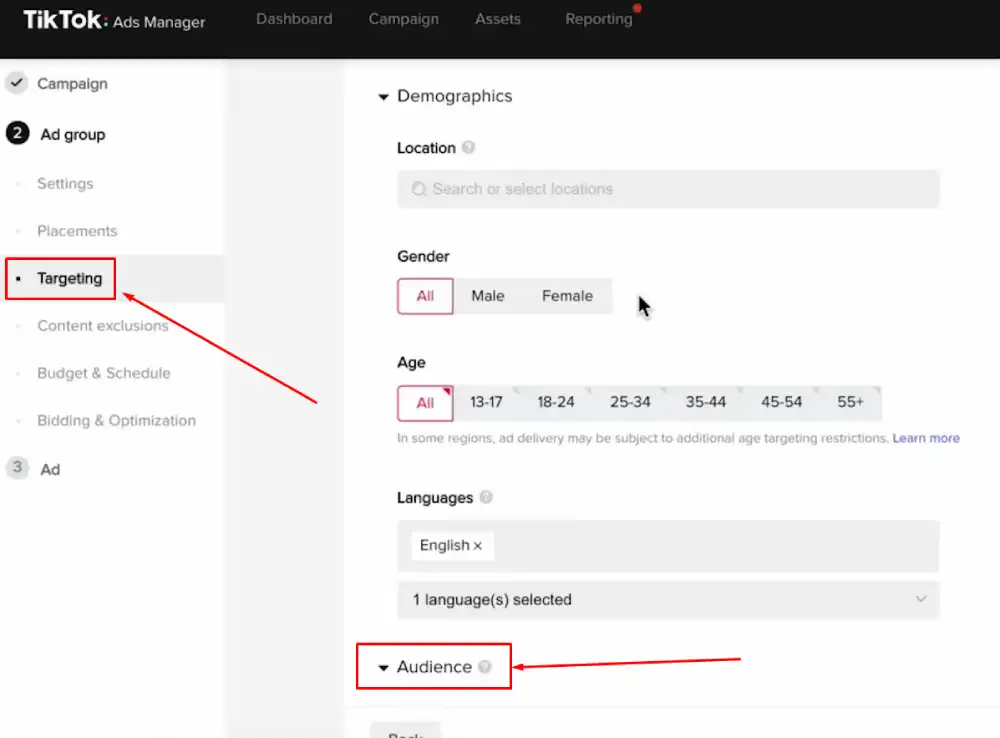
Use TikTok’s Audience Insights tool inside your Business account to understand the age, gender, location, and interests of users who engage with your content, but do not stop at demographics. Study what your target customer is already watching on TikTok by searching your category keywords and spending time in your niche’s For You feed.
The brands that win on TikTok understand that TikTok users want to be entertained, educated, or inspired. They are not on the platform to be sold to. Your content needs to lead with value and let the product follow naturally.
Step 3: Build a Content Mix That Balances Organic, Trends, and Brand Voice
A sustainable TikTok content strategy is not built on chasing trends. Trends can accelerate reach, but they cannot replace a consistent brand voice.
We recommend a content mix that follows roughly this structure for most business accounts:
- 40% educational or informational content: Teach your audience something relevant to your product or industry. This builds authority and trust over time.
- 30% brand story and behind-the-scenes content: Show the people, process, and values behind your business. This builds a connection.
- 20% trend participation: Use trending sounds, formats, or challenges when they align naturally with your brand. Do not force them.
- 10% direct promotional content: Product showcases, offers, or announcements. Keep this low, or your audience will tune out.
Your brand voice should stay consistent regardless of which content type you are producing. If you are a straightforward, no-nonsense brand, do not suddenly act goofy to chase a trend. Authenticity on TikTok is not a strategy. It is the baseline.
Understanding the TikTok Algorithm for Business in 2026
The TikTok algorithm is the single most important system you need to understand if you want to grow your business on the platform. It decides who sees your content and how far each video travels beyond your existing followers.
The good news is that TikTok’s algorithm is more transparent than most platforms. It tells us what it weighs. We just need to use that information strategically.
What Signals the TikTok Algorithm Prioritizes in 2026
According to TikTok’s transparency documentation, the algorithm weights these signals in order of importance:
- Video completion rate: The percentage of viewers who watch your video all the way through. This is the single most important metric. A video that gets 1,000 views but a 90% completion rate will outperform a video with 10,000 views and a 10% completion rate.
- Re-watches: Users who replay your video send a strong positive signal to the algorithm
- Shares: Shares are weighted more heavily than likes or comments because sharing requires genuine intent
- Comments: Especially comments that generate replies, creating thread activity under your video
- Likes: Positive signal, but weighted lowest of the five core engagement types
Device settings like location, language, and device type are also factored in for distribution, but you cannot control these. Focus your energy on the signals you can influence: video length, hook quality, and content clarity.
How to Make the Algorithm Work for Your Brand: Not Against You
The algorithm is not your enemy. It is a matching system, and it matches content to viewers who are most likely to engage with it. Your job is to make that matching process as easy as possible.
Practical steps to align with the algorithm:
- Use relevant keywords in your captions and spoken content: TikTok’s algorithm reads captions and uses auto-captioning to understand what your video is about.
- Post at consistent times: TikTok engagement peaks between 6 AM and 10 AM and again between 7 PM and 11 PM in your audience’s local time zone.
- Do not delete low-performing videos immediately: TikTok sometimes resurfaces older videos weeks later. Deleting them removes that possibility.
- Use 3 to 5 niche-specific hashtags: rather than broad ones like #fyp or #viral. Niche hashtags help TikTok categorize your content correctly.
TikTok as a Search Engine: The 2026 Shift Brands Can’t Ignore
This is the biggest change to TikTok’s role in a business marketing strategy in the last two years.
According to a study by Adobe, 65% of Gen Z users use TikTok as a search engine. They search for product reviews, tutorials, restaurant recommendations, and how-to content directly in TikTok’s search bar before going to Google. Nearly 40% of Gen Z prefers TikTok or Instagram over Google Search for discovery queries.
For your business, this means two things.
First, your video captions and spoken content need to include the exact words your customers would type into a search bar.
Second, creating content that answers specific questions is no longer just good content practice. It is search engine optimization for TikTok.
A skincare brand that creates videos titled “best moisturizer for oily skin” or “how to layer serums” is not just making helpful content. It is ranked in TikTok’s internal search results for queries with real commercial intent.
Your TikTok organic growth strategy should now include keyword research for TikTok search, not just content ideation.
TikTok Content Strategy for Brands: What Works in 2026
A TikTok content strategy for brands in 2026 is not about going viral. It is about creating content that earns trust, builds familiarity, and moves the right viewer closer to a decision.
The brands with the strongest organic presence on TikTok right now share one thing: they commit to a format, a voice, a posting rhythm, and they do not abandon it after two weeks of low views.
The Best TikTok Content Formats for Businesses
Not every content format works equally well for every business type. Here are the formats with the strongest performance data across business accounts:
- Tutorial and how-to videos: Consistently high completion rates because they have a clear beginning, middle, and end. Viewers stay to get the answer.
- Before and after videos: High share rates, especially in beauty, home improvement, fitness, and food categories.
- Product demonstrations: Particularly effective for eCommerce brands. Showing a product in use converts better than showing a product in a box.
- Day-in-the-life content: Behind-the-scenes content from business owners performs strongly because it builds trust through authenticity.
- Reactive content: Responding to customer questions or comments in video format. TikTok’s “reply with video” feature is underused by brands and generates strong engagement.
- Duets and stitches with customer content: Using real customer videos as a foundation for your own response content builds social proof while reducing your production burden.
TikTok Content Ideas for Businesses (By Industry and Goal)
Your content ideas should map to your industry and your goal, not just to what is trending.
eCommerce: Unboxing, product comparisons, “you asked, we answered” Q&A, customer review reactions, packing orders content
Service businesses (local and online): Client results, process walkthroughs, myth-busting content, day-in-the-life, pricing transparency videos
Food and beverage: Recipe creation, sourcing stories, kitchen tours, staff introductions, “how it’s made” content
Fitness and wellness: Workout tutorials, client transformations (with consent), nutrition breakdowns, “things I wish I knew” formats
Finance and professional services: Jargon explained simply, common mistakes your clients make, case study summaries (anonymized), “what does X actually cost” content
The goal in every industry is the same: make the viewer feel like they learned something or saw something worth sharing before you ever ask them to buy anything.
How Long Should Your TikTok Videos Be in 2026?
Video length on TikTok is one of the most debated topics in social media marketing. Here is what the data actually shows.
According to TikTok, videos between 21 and 34 seconds generate the highest average completion rates. However, videos between 1 and 3 minutes generate more total watch time and stronger comment engagement when the content is genuinely informative.
Match your video length to the complexity of your content. Do not pad a simple point to hit a longer duration. Do not rush a complex tutorial to keep it under 30 seconds. Let the content determine the length, then trim ruthlessly at both ends.
Short hooks matter more than short videos. If you lose a viewer in the first 3 seconds, the rest of your video length is irrelevant.
How to Write a Hook That Stops the Scroll in 3 Seconds
The hook is the most important three seconds of your video. Everything else depends on it.
A strong TikTok hook does one of three things: it makes a bold, specific claim your viewer has not heard before, it raises a question your viewer immediately wants answered, or it shows something visually unexpected in the first frame.
Examples of hooks that work:
- “Most businesses waste their first $500 on TikTok ads doing this” (Bold claim with specificity)
- “Here is why your TikTok videos are getting views but zero clicks” (Problem identification)
- [Open with the final result of your tutorial, then say “Here is how we got there”] (Visual curiosity)
What does not work: starting with your name, starting with “Hi guys,” starting with a slow pan of your workspace, or starting with “Today I am going to show you.” By the time you finish that sentence, 60% of your audience has already scrolled.
Write your hook before you film anything else. If you cannot write a strong hook, reconsider whether the content idea is strong enough to earn three seconds of a stranger’s attention.
TikTok Ads for Business: A Practical Introduction
TikTok ads for business give you the ability to place your content in front of a specific, targeted audience rather than waiting for the organic algorithm to do the work. Paid and organic TikTok are not competing strategies. They are complementary tools.
You access TikTok’s advertising platform through TikTok Ads Manager at ads.tiktok.com. This is separate from your regular Business account dashboard, though they are connected.
Types of TikTok Ads and When to Use Each One
TikTok offers several ad formats. Here is what each one does and when it makes sense for your business:
| Ad Format | What It Is | Best For |
| In-Feed Ads | Ads that appear natively in the For You feed | Traffic, conversions, brand awareness |
| TopView Ads | Full-screen ad shown when users first open TikTok | Maximum reach, major launches |
| Branded Hashtag Challenge | Sponsored hashtag that invites user participation | Campaign engagement, large brands |
| Spark Ads | Boost an existing organic post from your account | Amplifying content that already works |
| Shopping Ads | Product catalog ads linked to TikTok Shop | Direct eCommerce sales |
| Lead Generation Ads | In-app form to capture contact information | Service businesses, email list building |
For most small and mid-size businesses, Spark Ads and In-Feed Ads are the best starting points. Spark Ads are particularly useful because they let you put paid budget behind organic content that has already proven it can hold attention. You are not guessing, you are amplifying what already works.
How Much Does TikTok Advertising Cost in 2026?
TikTok ads are generally more affordable than Facebook and Instagram ads for comparable reach, particularly for audiences under 35. However, costs are rising as more brands enter the platform. If you are planning to start with paid TikTok marketing in 2026, earlier is cheaper than later.
TikTok advertising costs vary significantly based on your objective, targeting, and competition within your industry.
According to multiple industry sources and TikTok’s published advertising minimums, the following figures reflect commonly reported baseline ranges. These estimates are also referenced in 2025 TikTok Ads benchmark summaries and industry performance reports.
- Minimum campaign budget: $50 per day at the campaign level
- Minimum ad group budget: $20 per day at the ad group level
- Average CPM (cost per 1,000 impressions): $9.16 to $10 for most industries
- Average CPC (cost per click): $0.17 to $1.00 for In-Feed Ads
- TopView Ads: Typically $50 per day minimum, often requiring a managed account for larger buys
Organic vs Paid TikTok Marketing: Which Should You Prioritize First?
This is one of the most practical questions in TikTok for Business, and the answer depends on your timeline and your budget.
Start with organic if: you have more time than money, you are still figuring out what content resonates with your audience, or you have never produced TikTok content before. Organic content teaches you what your audience responds to before you spend money amplifying it.
Start with paid if: you have a proven product with existing customer data, you need results within a specific time window, or you already know what messaging converts for your brand on other platforms.
The strongest TikTok strategies we have seen use organic content to test and learn, then use Spark Ads to amplify the organic posts that are already working.
You spend money on content that has already proven it can hold attention. That is a far more efficient use of your ad budget than cold testing with brand-new creative.
How to Sell on TikTok: TikTok Shop for Businesses Explained
TikTok Shop is TikTok’s native eCommerce feature that lets customers discover, browse, and purchase products without ever leaving the app. For product-based businesses, it is one of the most significant growth opportunities on any platform in 2026.
According to Boombarg, TikTok Shop generated over $20 billion in global GMV (Gross Merchandise Value) in 2023, with significant continued growth reported through 2025. The in-app purchase experience removes the friction of redirecting users to a separate website, which directly improves conversion rates.
How to Set Up TikTok Shop for Your Business
TikTok Shop for businesses is only available in the US, UK, Southeast Asia, and a select few additional markets as of 2026.
Once your shop is live, every video you post can become a direct sales touchpoint. A viewer watching a product tutorial can tap the product link in the video and complete their purchase without ever leaving TikTok.
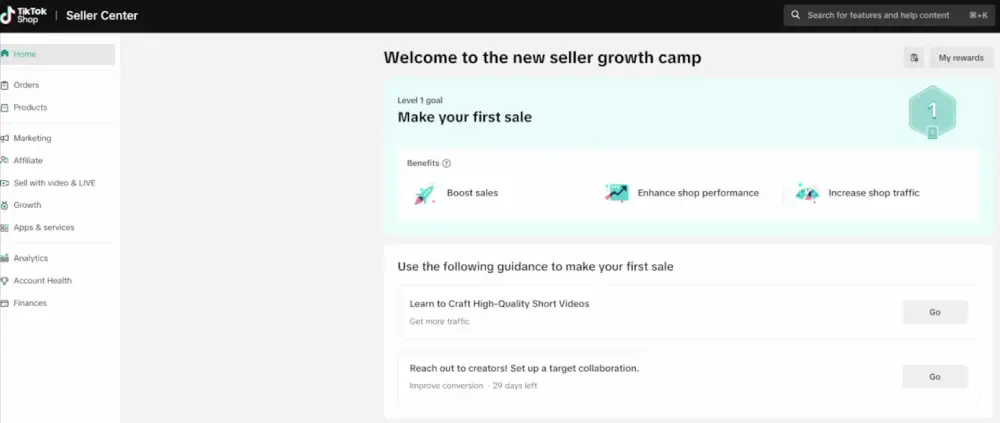
Here is the setup process:
- Go to seller.tiktok.com and click “Sign Up”
- Select your region and business type (individual seller or corporate entity)
- Provide your business documentation: business license, tax ID, and bank account information
- Wait for account verification, which typically takes 1 to 3 business days
- Once approved, go to your TikTok Business account and connect it to your TikTok Shop
- Upload your product catalog with images, descriptions, pricing, and inventory
- Set up your shipping and return policies in the seller dashboard
- Tag products in your videos by using the “Add Link” feature when uploading content
- Enable live shopping if you plan to sell through TikTok Live sessions
TikTok Affiliate Marketing for Brands: How It Works
TikTok’s affiliate marketing program, accessed through TikTok Shop, lets you recruit content creators to promote your products in exchange for a commission on each sale they generate.
As a brand, you set your commission rate, provide product samples, and creators apply to promote your products through the TikTok Creator Marketplace or directly through TikTok Shop’s affiliate program. You only pay when a sale is made.
This is one of the most cost-effective paid acquisition models available for eCommerce brands on TikTok. You are not paying for impressions or clicks. You are paying for verified revenue. According to a 2024 Influencer Marketing Hub report, TikTok affiliate content generates a higher average order value than influencer content on Instagram for product categories under $150.
The key to making it work: choose creators whose audience already trusts their product recommendations, not just creators with the largest follower counts.
A creator with 50,000 engaged followers in your niche will almost always outperform a creator with 500,000 followers whose audience is broad and disengaged.
TikTok Analytics for Business: How to Measure What Matters
TikTok analytics for business gives you the data you need to make better content decisions, not just track vanity numbers.
The most common mistake brands make with TikTok analytics is checking views and followers without looking at the metrics that actually connect to their business goal.
Your Business account gives you access to analytics through the “Business Suite” tab. The data updates in near-real time and covers your account performance, individual video performance, and audience demographics.
Key TikTok Metrics Every Business Should Track
Focus your measurement on metrics that connect directly to your business goal:
For brand awareness:
- Video views: Total views across all content in a given period
- Reach: Unique accounts that saw your content (different from views)
- Follower growth rate: New followers divided by total followers, tracked weekly
For engagement and content quality:
- Video completion rate: The most important quality signal. A rate above 60% is strong.
- Average watch time: Measured in seconds. Higher is better.
- Share rate: Shares divided by views. Strong content has a share rate above 1%.
For traffic and revenue:
- Profile visits: How many viewers clicked through to your profile after watching
- Link-in-bio clicks: Available in your Business account if you use TikTok’s link tools
- TikTok Shop conversion rate: Orders divided by product page visits within TikTok Shop
How to Use TikTok Analytics to Improve Your Content Strategy
Analytics are only useful if you act on them. Here is the process we recommend reviewing every two weeks:
First, identify your top three performing videos by completion rate, not by views. Look for patterns: what topic did they cover, how long were they, what did the hook look like, and what time were they posted?
Second, identify your three lowest-performing videos by the same metric. Look for the opposite patterns.
Third, adjust your next two weeks of content toward what the data shows, not what you think should perform.
TikTok audiences tell you exactly what they want by how they behave. Trust the data over your instincts until you have enough evidence to know when to trust your instincts.
How to Measure TikTok ROI for Small Business
Measuring TikTok ROI for small business requires connecting your TikTok activity to actual business outcomes, not just platform metrics.
Here is a simple framework:
- Set up UTM parameters on your link-in-bio URL so Google Analytics shows you exactly how much traffic came from TikTok and what those visitors did on your site
- Use TikTok Pixel on your website if you are running ads. The pixel tracks conversions and lets you attribute sales back to specific TikTok ad campaigns
- Track TikTok Shop revenue separately in your seller dashboard so you have a clear number for in-app revenue
- Calculate cost per acquisition (CPA): Total TikTok spend divided by total conversions generated from TikTok. Compare this to your CPA from other channels to assess relative efficiency
TikTok ROI for small business will often look soft in the first 60 to 90 days, especially if you are building a following from scratch. The revenue impact of TikTok marketing compounds over time as your audience grows and your content library deepens.
To make TikTok ROI tracking easier and more accurate, use the TikTok Pixel setup helper and the TikTok UTM link builder to set everything up correctly from the start.
TikTok Marketing for Small Businesses: Practical Tips to Compete Without a Big Budget
TikTok is one of the few platforms where a small business with no ad budget can genuinely compete with a brand that spends millions on marketing. The algorithm cares about content quality and audience fit, not production value or follower count.
That said, competing without a budget requires a clear strategy and realistic expectations. You will not build 100,000 followers in 30 days. But you can build a targeted, engaged audience that drives real revenue with consistent effort over 90 to 180 days.
TikTok Organic Growth Strategy for Small Teams
A TikTok organic growth strategy for a small business or solo operator should focus on depth, not frequency.
Three high-quality, well-researched videos per week will outperform seven rushed videos posted daily. Here is what a sustainable small-team organic strategy looks like in practice:
- Batch your content creation. Film four to six videos in one two-hour session per week, rather than filming one video every day. This reduces mental load and keeps your production quality consistent.
- Repurpose your best content. A video that performs well can be reedited with a new hook and reposted 60 to 90 days later. Most of your audience will not have seen the original.
- Engage in your niche. Comment genuinely on other creators’ videos in your space. TikTok’s algorithm notices creator behavior, not just content performance.
- Use TikTok search keywords in your captions. Research what your target customer searches for in TikTok’s search bar and write captions that match those queries.
How to Compete With Bigger Brands on TikTok
The honest advantage a small business has over a large brand on TikTok is personality and speed.
Large brands have approval processes, legal reviews, and brand guidelines that slow everything down. You can respond to a trend in two hours. They might take two weeks.
Large brands also struggle to show an authentic personality because everything is filtered through multiple teams.
You can show your face, tell your story, and be genuinely honest about your product in a way that a corporate marketing department structurally cannot.
The specific tactics that work for smaller brands competing against bigger ones:
- Be more specific. Large brands talk to everyone, which means they connect with no one. You can speak directly to a narrow, specific customer and win that audience completely.
- Show what they will not show. Behind-the-scenes content, pricing transparency, maker stories, production mistakes, and honest reviews of your own product build the kind of trust that a polished brand campaign cannot buy.
- Move faster on trends. Speed is your competitive advantage, Use it.
Common TikTok Business Mistakes and How to Avoid Them
These are the mistakes we see most consistently from brands that are not getting the results they expected from TikTok. Each one is fixable, but only once you recognize it.
Posting without a strategy: Randomly posting content without defined goals or a content plan is the most common and most costly mistake. Every video should connect to a specific goal, whether that is awareness, traffic, or sales. If you cannot answer “why am I making this video,” you are not ready to post it.
Treating TikTok like Instagram: TikTok rewards raw, timely, educational, and entertaining content. Repurposing polished Instagram photos or catalog-style product shots will consistently underperform. The platform has its own language. Learn it before you post on it.
Ignoring the first 3 seconds: You can have the most useful content in your niche and still fail if your hook does not earn the viewer’s next 30 seconds. Most brands spend zero time crafting their hook and then wonder why their completion rates are below 20%.
Chasing follower count instead of engagement: A TikTok Business account with 2,000 followers and a 15% engagement rate is more valuable than one with 20,000 followers and a 0.5% engagement rate. Follower count is a vanity metric. Engagement drives revenue.
Quitting too early: TikTok’s algorithm takes time to understand your content and match it to the right audience. Most brand accounts do not find their rhythm until week 8 to 12 of consistent posting. Brands that quit after three weeks of low views never give the algorithm enough data to work with.
Running ads on content that has not worked organically: Putting paid budget behind a video that has proven it cannot hold organic attention is a reliable way to waste money. Always test with organic first. Amplify what wins.
Ignoring comments: Comments are both an engagement signal to the algorithm and a direct line to your audience’s real questions and objections. Not replying to comments is a missed opportunity on both counts.
TikTok for Business in 2026: What’s Changed and What It Means for Your Brand
TikTok’s business landscape in 2026 looks meaningfully different from 2023 or even 2024. If you are building a TikTok strategy based on older playbooks, you need to update your assumptions.
The US stability deal: After a period of significant uncertainty around TikTok’s future in the United States, a deal was reached in early 2025 that gave TikTok continued operating status in the US market under a revised ownership and data governance structure.
For brands, this removes the single biggest risk that made some marketers hesitant to invest in the platform. TikTok is not going away in the US market, and the brands that continued building their presence during the uncertainty period now have a meaningful head start.
TikTok Search is now a distinct growth channel: As covered earlier in this guide, TikTok’s search function has matured into a genuine discovery engine. TikTok has added search result pages, keyword-based content ranking, and dedicated search ads. If you are not optimizing your content for TikTok search in 2026, you are leaving a significant organic traffic source untouched.
TikTok Shop has become a primary revenue channel for eCommerce: TikTok Shop’s continued expansion into more markets, combined with its live shopping capabilities and affiliate program, has shifted it from a supplementary sales tool to a primary channel for many product-based businesses. Brands that integrated TikTok Shop early are reporting it as a top-three revenue channel.
Content quality expectations have risen: As more brands and creators have joined the platform, the baseline quality of content has increased. A video that would have earned strong organic reach in 2022 now competes against significantly more polished and strategic content. This does not mean you need expensive production. It means you need better hooks, clearer value, and more intentional content planning.
AI-generated content is being deprioritized: TikTok has updated its community guidelines to require disclosure of AI-generated content, and its algorithm is showing signs of deprioritizing content that lacks authentic human presence. For brands, this reinforces the value of showing real people, real processes, and real voices in your TikTok content.
Explore these helpful articles next:
👉 TikTok Ads for Sports & Activewear Brands: Winning the Feed
👉 TikTok Book Marketing: How Authors Use Ads to Reach Readers
👉 TikTok Ads for Alcohol-Free Beverage Brands: The Sober-Curious Boom
👉 TikTok Ads for Weddings & Event Services: How to Turn Views Into Booked Clients
Frequently Asked Questions About TikTok for Business
Is TikTok for Business free?
Yes, creating a TikTok Business account is completely free. You can post organic content, access analytics, use the commercial music library, and set up a TikTok Shop without paying anything. The only cost comes when you choose to run paid ads through TikTok Ads Manager, which requires a minimum daily budget of $20 at the ad group level.
How many followers do you need to use TikTok for Business?
You do not need any followers to switch to or use a TikTok Business account. The Business account is available from day one, regardless of your follower count. Features like the link in bio are available immediately on Business accounts, unlike Creator accounts, which require 1,000 followers for that feature.
What is the difference between TikTok for Business and TikTok Ads Manager?
TikTok for Business is the overall ecosystem of tools, accounts, and features available to brands on TikTok. TikTok Ads Manager is the specific platform within that ecosystem where you build, launch, and manage paid advertising campaigns. You access Ads Manager at ads.tiktok.com, and it connects to your Business account, but the two serve different functions: one is your overall business presence, the other is purely for paid media.
Can I run ads on TikTok without a big budget?
Yes, you can start TikTok advertising with a relatively modest budget. TikTok’s minimum is $20 per day at the ad group level and $50 per day at the campaign level. For most small businesses, starting with Spark Ads, which amplify organic posts that are already performing, is the most budget-efficient entry point. You are paying to extend the reach of content that has already proven it works, rather than funding cold testing with brand-new creative.
How long does it take to see results from TikTok marketing?
Organic TikTok results typically take 60 to 90 days of consistent posting before you see meaningful follower growth or reliable traffic. The algorithm needs time to understand your content and match it to the right audience. Paid TikTok results can appear within 24 to 72 hours of launching a campaign, but optimized results typically emerge after 7 to 14 days of campaign data collection. Results also vary significantly based on your niche, content quality, posting frequency, and whether you are combining organic and paid activity.
Is TikTok good for small businesses in 2026?
Yes, TikTok is one of the best organic growth platforms available to small businesses in 2026, specifically because the algorithm distributes content based on relevance and engagement rather than existing follower count. A small business with no audience can reach thousands of targeted potential customers with a single well-crafted video. The key variables are content quality, posting consistency, and a clear understanding of what your target customer actually wants to watch. TikTok marketing for small businesses works best when you lead with education and value rather than direct selling.
Conclusion: Start Growing Your Brand on TikTok Today
TikTok for Business in 2026 is not a trend you can afford to watch from the sidelines. It is a fully developed marketing and commerce ecosystem with a proven track record of driving brand awareness, customer acquisition, and direct revenue across virtually every industry and business size.
What we have covered in this guide gives you the complete foundation: setting up your TikTok Business account correctly, understanding the difference between the tools available to you, building a content strategy rooted in algorithm logic and audience behavior, running ads that amplify what already works, selling through TikTok Shop, and measuring results that connect to real business outcomes.
The brands winning on TikTok right now are not the ones with the biggest budgets or the most followers. They are the ones that started with a clear strategy, committed to consistency, and trusted the process long enough to let it compound.
TikTok organic growth does not happen overnight, but it does happen, and the results it produces, in reach, trust, and revenue, build an asset that paid media alone cannot replicate.
Your next step is simple: pick one goal, set up your Business account if you have not already, and post your first three videos this week. The algorithm cannot learn from content that does not exist. Start now, measure honestly, and adjust as you go.