
TikTok ad trends in 2026 are no longer about creative experiments; they are about survival.
If your ads still look polished, scripted, or overly branded, you are already losing attention. You feel it in rising CPMs, inconsistent ROAS, and creatives that stop working faster than ever. What worked even six months ago now struggles to hold engagement for three seconds.
The platform has shifted fast, and these TikTok advertising trends 2026 are changing how brands create, distribute, and optimize campaigns across the platform. According to a TikTok for Business Nielsen study, an average of 53% of TikTok users say they trust others to be their real selves on TikTok.
That single data point explains why so many ad accounts are seeing performance swings. The rules have changed, but most strategies have not.
You are no longer competing with ads. You are competing with creators, comments, search results, and shopping behavior all at once. TikTok has evolved into a hybrid of an entertainment platform, search engine, and commerce channel. If your strategy does not reflect that shift, your results will stall.
This is where understanding TikTok ad trends 2026 and the wider TikTok marketing trends becomes critical if you want campaigns that continue to perform. When you align with how people actually consume content now, your performance improves faster and more predictably.
In this breakdown, you will see what is actually working, what has changed, and how you should adjust your approach to stay competitive this year.
Get Up to $6,000 in Free TikTok Ad Credits
TikTok offers ad credit incentives for new advertisers, helping you test campaigns with a lower upfront cost.
Table of Contents
What are the most important TikTok ad trends in 2026?
The most important TikTok ad trends 2026 revolve around authenticity, creator-led content, AI automation, and in-app commerce, but results vary based on how well your creative matches platform behavior. You will win when your ads feel native, your content volume is high, and your strategy aligns with TikTok’s shift toward search and shopping. If you still treat TikTok like a traditional ad channel, performance will drop fast.
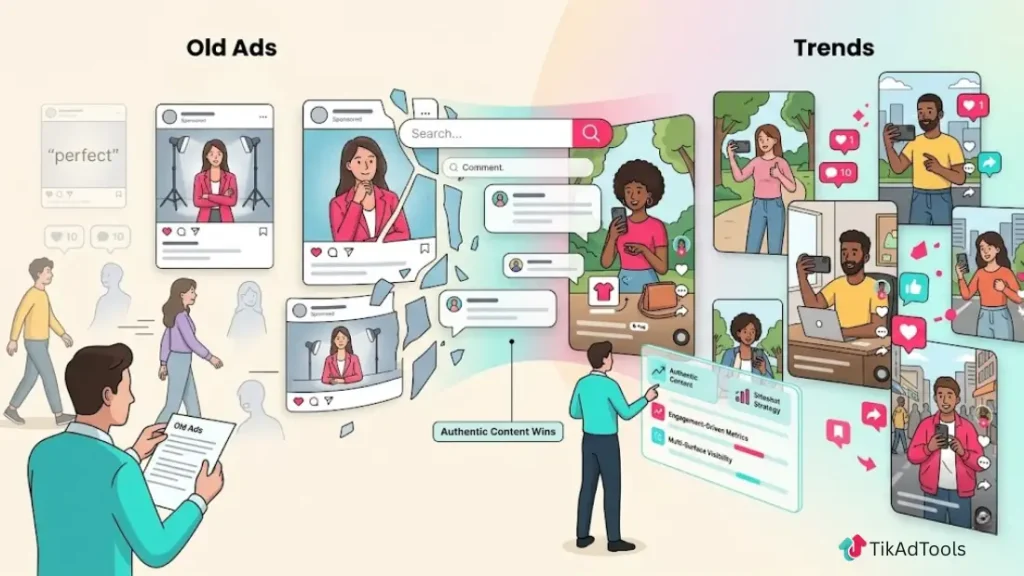
TikTok advertising trends in 2026: at a glance
- Authentic, unpolished content wins: Native-style videos outperform polished brand ads in retention and conversions.
- Creator-led ads and UGC dominate: Real creators drive trust, engagement, and lower CPAs.
- Content format matters more than ever: Educational and edutainment formats outperform pure entertainment in many niches.
- TikTok is now a search engine: SEO-style content ranks and drives long-term traffic.
- TikTok Shop drives conversions: In-app checkout shortens the buying journey and improves attribution.
- AI and automation scale performance: Tools like Smart+ and GMV Max handle targeting, bidding, and creative delivery.
- Comments and community influence results: Social proof directly impacts ad performance and conversion rates.
- Interactive, gamified formats are gaining ground: Polls, quizzes, and tappable creative turn passive viewers into participants.
What changed in TikTok advertising in 2026 (and why it matters)
TikTok advertising in 2026 shifted from media buying to ecosystem participation. You are no longer just running ads; you are feeding a system driven by creators, AI, commerce, and algorithmic distribution. These changes matter because they directly impact how your ads get delivered, optimized, and converted.
| Change | What Happened | Why It Matters to You |
|---|---|---|
| AI-driven campaigns became standard | Tools like Smart+ and GMV Max automate targeting, bidding, and creative optimization | You lose manual control, but gain efficiency and scale if your inputs are strong |
| TikTok Shop expanded rapidly | TikTok Shop GMV reached $33.2 billion in 2024, doubling year over year | You can convert users inside the app, reducing friction and improving ROAS |
| Algorithm prioritizes native content | TikTok rewards content that feels organic over polished ads | Your creative approach matters more than your budget |
| Affiliate and creator ecosystems grew | TikTok now relies heavily on affiliates and creator content to drive ads | You need creators to scale, not just in-house ads |
| New ad formats and placements launched | Formats like Top Reach, Prime Time, and Logo Takeover increase visibility | You get more exposure, but competition for attention is higher |
| Stricter content and disclosure rules | TikTok introduced clearer rules for branded and AI-generated content | Non-compliant ads lose reach or get removed entirely |
| AI-generated creative is rising | TikTok introduced AI tools for generating influencer-style content | You can scale content faster, but authenticity becomes harder to maintain |
These shifts explain why TikTok ad trends 2026 feel harder to keep up with. The platform is moving toward automation, commerce, and creator-driven distribution, and your strategy needs to match that reality.
Trend 1: authentic, unpolished content is outperforming traditional ads
Polished ads are losing to content that feels real, raw, and native to the feed. This is one of the biggest TikTok ad creative trends 2026, as authenticity now outperforms polished production. On TikTok, your audience scrolls past anything that looks like a traditional ad. What stops them is content that feels like a normal post from a real person.
We see this clearly in performance data. According to RevenueCat, users now ignore scripted and overly produced ads because they “see right through them,” while UGC-style creative that feels natural drives stronger engagement and conversions.
A strong example comes from multiple 2025–2026 TikTok ad breakdowns where top-performing ads blend into the For You feed instead of standing out as ads. These creatives use simple hooks, casual filming, and minimal editing to match organic content. (Landingi)
This matters because TikTok’s algorithm rewards watch time and interaction, not production quality. If your content feels like an ad, users skip it, and your distribution drops.
For example, this ad by Backbone generated 130K likes, 3K comments, and 8K shares, despite being nothing more than a simple selfie-style video filmed at home. You can even notice the tripod near the end of the ad, which shows true authenticity.
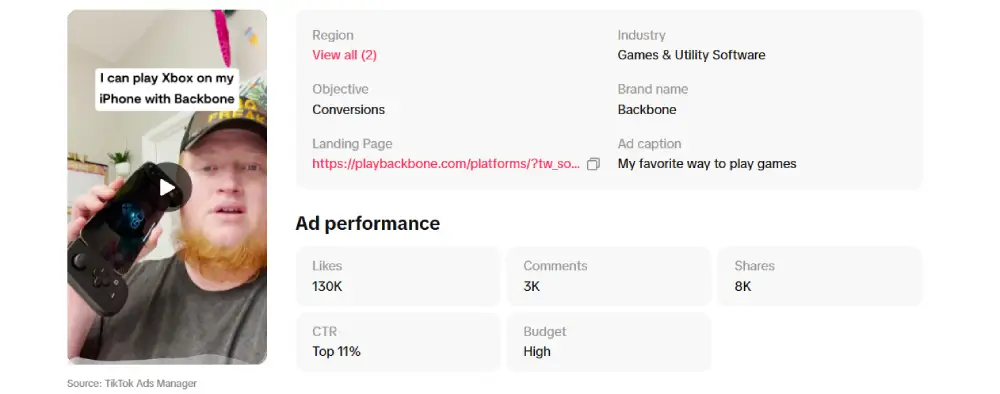
To apply this:
- Film on your phone, not in a studio
- Use natural lighting and real environments
- Start with a strong hook in the first 2 seconds
- Avoid heavy branding in the opening
When your content looks like something a user would post, your ads stop feeling like interruptions and start performing like content.
Trend 2: creator-led ads and UGC are driving performance
Creator-led ads and user-generated content are now the foundation of high-performing TikTok campaigns and continue to shape the leading TikTok ads creative trends. Creators are the best people to sell your product.
TikTok itself is built around creators, and performance data reflects that. User-generated content consistently outperforms traditional branded ads because it builds trust and relatability.
A clear example is Gymshark, which scaled its TikTok growth by working with fitness creators who post workout content using their products. These videos feel like regular creator posts, not ads, and drive consistent engagement and conversions.
This shift matters because people trust people, not brands. When a creator talks about your product, it feels like a recommendation, not a pitch.
@grizzoworld
Gym Giiiirlies. just tried this on and thought of you, even prettier in real life!! Ad: @Gymshark code: grizzo for 10% off (i receive dommission if you use my discount code) #gymoutfits
♬ You Don’t Own Me (feat. G-Eazy) – SAYGRACE
To use this effectively:
- Work with micro-creators who match your niche
- Give loose briefs, not scripts
- Turn top-performing organic posts into Spark Ads
- Test multiple creators at once to find winners
When you build your strategy around creators, you increase trust, improve engagement, and lower your cost per acquisition.
Trend 3: best performing TikTok content types in 2026
The best-performing TikTok content types in 2026 are not random. They reflect the latest TikTok ad creative trends 2026, where educational, creator-first, and native videos consistently outperform traditional ads.
They follow clear patterns based on how people consume content on the platform. If you understand these formats, you can create ads that consistently perform.
Here are the top-performing content types:
- UGC-style product demos: Real people showing real use cases, not polished brand videos
- Problem-solution videos: Clear pain point in the first 3 seconds, followed by a fast solution
- Educational content: Quick tips, how-tos, or “what you didn’t know” formats
- Edutainment content: Teaching while entertaining, often with storytelling or humor
- Trend-based content: Using trending sounds or formats while staying relevant to your product
For example, campaigns analyzed in recent TikTok ad libraries show that ads that educate or demonstrate a product outperform purely entertaining content in conversion-focused campaigns, especially in niches like beauty, apps, and eCommerce.
This matters because content format directly impacts retention and conversions. If your format does not match user expectations, your ad fails before the message even lands.
For example, an ad from Sephora highlights a key TikTok beauty trend, pairing a fast product demo with a relatable hook, and it drew strong engagement in the comments and shares, evidence of how well the beauty niche performs when the format matches the trend.
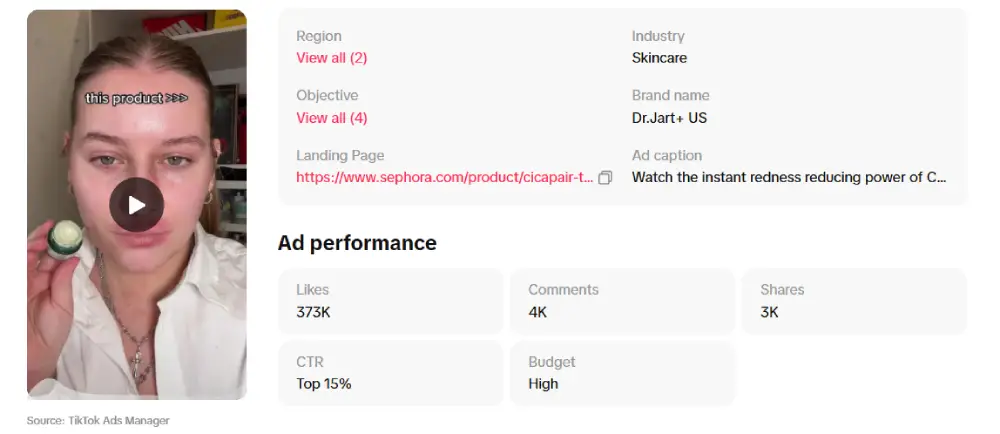
To apply this:
- Match your content type to your goal: education for conversions, entertainment for reach
- Test multiple formats at once instead of relying on one
- Double down on formats that hold attention past 5 seconds
When you align your content type with how users consume TikTok, your performance becomes more predictable and scalable.
Trend 4: TikTok is now a search engine (not just discovery)
TikTok is no longer just a discovery platform. It is a search engine now too, where users actively look for answers, reviews, and recommendations. You are competing for attention and for search visibility at the same time.
This shift is backed by user behavior data. According to Business Insider in 2022, nearly 40% of Gen Z users prefer TikTok or Instagram over Google Search for discovery. That behavior has only strengthened going into 2026.
A practical example comes from creators ranking for queries like “best skincare for acne” or “TikTok ads tutorial.” These videos appear directly in TikTok search results and continue driving traffic long after posting.
Platforms like Semrush have documented how TikTok videos now rank based on keywords in captions, on-screen text, and voice.
This matters because your content can generate consistent traffic without ongoing ad spend. If you ignore search behavior, you miss long-term visibility.
To apply this:
- Use keyword-rich captions that match real search queries
- Say your keywords out loud in the video
- Add text overlays that reinforce the topic
- Create content around “how to,” “best,” and “review” formats
When you treat TikTok like a search engine, your content works beyond the first 24 hours and compounds over time.
Trend 5: shoppable content and TikTok Shop are reshaping conversions
TikTok has moved deeper into commerce, and it is changing how conversions happen. Users no longer need to leave the app to buy. The entire journey, from discovery to checkout, now happens inside TikTok.
According to Resourcera, TikTok Shop generated over $64.3 billion in global GMV in 2025, with continued rapid growth into 2026.
A strong example is how beauty brands run live shopping sessions and short-form product demos with direct purchase links. These videos combine entertainment, education, and instant checkout, which significantly reduces friction. Reports from McKinsey & Company show that shorter purchase journeys increase conversion rates across social commerce platforms.
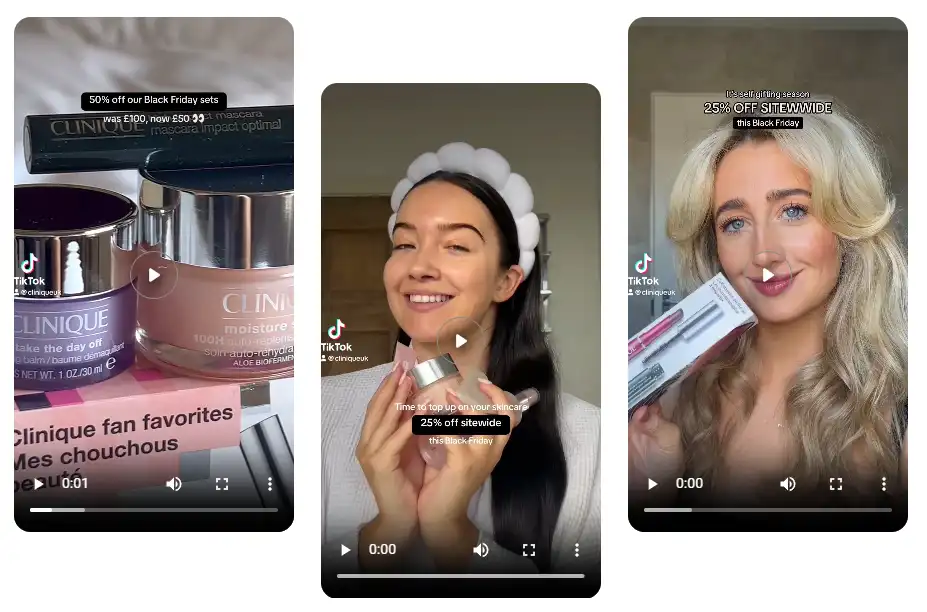
This matters because every extra click reduces conversions. When users can buy instantly, your funnel becomes shorter and more efficient.
To use this effectively:
- Connect your products to TikTok Shop
- Use creators to demonstrate products in real scenarios
- Test live shopping alongside short-form videos
- Highlight urgency through limited-time offers or stock
When you align with TikTok’s commerce model, you turn content directly into revenue.
To utilize the TikTok shop to its fullest, read this blog on TikTok GMV Max.
Trend 6: AI, automation, and creative volume are changing ad production
AI and automation are reshaping how TikTok ads get created, tested, and scaled. These innovations are also redefining TikTok advertising trends by making campaign optimization faster and more automated.
You are no longer managing every detail manually. Instead, you feed the system with inputs, and it optimizes delivery and performance.
This shift is driven by TikTok’s own tools. TikTok introduced solutions like Smart+ campaigns, which automate targeting, bidding, and creative combinations to improve efficiency.
A clear example comes from advertisers using automated campaigns combined with high creative volume.
This matters because success now depends on how many variations you test, not how perfect one ad looks; if you rely on a few creatives, performance stalls quickly.
To apply this:
- Produce multiple creative variations each week
- Use AI tools to generate hooks, scripts, and edits
- Let automated campaigns handle optimization
- Focus your effort on inputs like creative and messaging
When you combine automation with high creative volume, you give the algorithm more opportunities to find what works and scale it faster.
Trend 7: community, comments, and social proof drive ad performance
More than the creative, TikTok is about the conversation. Comments, likes, shares, and overall engagement now directly influence how your ads perform and scale.
This is backed by research. A 2025 study published in the Journal of Retailing and Consumer Services found that the quantity and quality of social proof, including likes and comments, significantly increase impulse buying behavior on short-form video platforms. (Source: ScienceDirect)
You can see this in practice on high-performing ads where comment sections are full of real user reactions, questions, and testimonials. These comments are validation. They remove doubt and push users closer to conversion.
This matters because people trust other users more than your ad itself. When your comment section is active and positive, your ad feels proven.
To use this effectively:
- Encourage comments with questions or controversial hooks
- Reply to comments to boost engagement signals
- Highlight positive comments in follow-up creatives
- Avoid turning off comments unless necessary
When your ads generate conversation, they gain credibility, and that directly improves performance.
Trend 8: passive scrolling is giving way to interactive, gamified ads
Static video isn’t the only format winning attention anymore. Interactive formats, polls, quizzes, mini-games, and tap-to-reveal creative, turn a viewer into a participant instead of a passive scroller, and that shift is showing up in performance data across the platform.
This matters because interaction is itself a signal. When someone taps, swipes, or answers something inside an ad, that action tells TikTok’s algorithm the creative earned real engagement, not just a view, which can extend distribution the same way a comment or share does.
To apply this:
- Test a simple interactive element (a poll, a this-or-that choice, a tappable reveal) inside your ad unit
- Keep the interaction tied directly to the product decision, not a gimmick disconnected from the offer
- Pair interactive formats with a fast follow-up creative for people who engage but don’t convert immediately
Interactive formats won’t replace strong hooks and native-feeling video, but ignoring them means competing for attention with one fewer tool than brands already using them.
Are TikTok ads still effective in 2026? (data + reality check)
Yes, TikTok ads are still effective in 2026, but only if your creative matches how the platform works today. The gap between good and bad performance has widened. If you adapt, results can be strong. If you do not, performance drops quickly.
At the same time, creative quality and format now determine outcomes. Analyses of thousands of TikTok ads consistently show that native, TikTok-style creatives outperform traditional ad formats across key metrics like engagement, click-through rate, and cost per acquisition. In some cases, brands report significantly higher returns when switching to creator-style content.
There is also a clear shift toward creator-driven performance. Recent data shows that creator-led ads can generate up to 70% higher click-through rates than brand-produced ads.
The reality is simple: TikTok still works, but it rewards the right inputs. If your creative, format, and strategy align with current trends, you can scale. If not, results become inconsistent and expensive.
How to adapt your TikTok ad strategy based on these trends
To adapt your strategy in 2026, you need to shift from campaign thinking to content systems. Success now depends on how well you align with platform behavior, not how much you spend.
Start with your creative approach:
- Focus on native, unpolished content instead of high-production ads
- Build a system to produce multiple creatives every week
Next, rethink how you use creators:
- Partner with creators who already speak to your audience
- Turn organic creator content into ads instead of scripting everything
Then align with how TikTok distributes content:
- Create videos based on search intent and keywords
- Use formats like tutorials, reviews, and problem-solution
Finally, optimize for engagement and conversion:
- Encourage comments and interaction to build social proof
- Use TikTok Shop where possible to shorten the buying journey
- Let automation tools handle targeting while you focus on creative inputs
When you combine these elements, your strategy becomes more adaptable and scalable. You stop chasing trends and start building a system that works with how TikTok actually operates in 2026.
FAQs
What TikTok ad creative trends are driving the best results in 2026?
The best-performing ads are UGC-style, creator-led videos that feel native to the platform. You should focus on authentic storytelling, quick hooks, and real use cases instead of polished brand messaging. We see stronger results when ads match organic content formats and encourage engagement.
Are TikTok ads better than Facebook ads in 2026?
TikTok ads often outperform Facebook in engagement and discovery, but results depend on your creative strategy. You will see better performance on TikTok when you use native-style content, while Facebook still works well for retargeting and structured funnels. We recommend testing both based on your goals.
How much do TikTok ads cost in 2026?
TikTok ad costs vary by industry and region. Global average CPM runs between $3 and $15, with US campaigns often landing in the $10 to $20 range for competitive objectives, while CPCs depend heavily on creative quality. You can lower costs by improving engagement signals and using multiple creatives. For the full cost breakdown, see the TikTok ad statistics roundup.
How do you make TikTok ads that don’t feel like ads?
You should create content that looks like a normal TikTok post, not a commercial. Use casual filming, real people, and natural hooks in the first few seconds. We find that when your content blends into the feed, users watch longer and engage more.
Do you need creators to succeed with TikTok ads?
You do not always need creators, but they significantly improve performance in most cases. Creator-led ads feel more trustworthy and relatable, which increases conversions. We recommend testing multiple creators to find what resonates with your audience.
How many creatives should you test for TikTok ads?
You should test at least 10 to 20 creatives per campaign, especially when using automated campaigns. TikTok’s algorithm performs better with more inputs, which helps it find winning variations faster. We have seen consistent scaling only when creative volume is high.
Conclusion: the new rules of winning TikTok Ads in 2026
TikTok ad trends 2026 show a clear shift in how the platform works and how you need to approach it. These broader TikTok advertising trends make one thing clear: success no longer comes from polished campaigns or precise targeting alone. It comes from how well your content fits into the way people use TikTok.
You have seen that authentic content outperforms traditional ads, creators drive trust, and content formats directly impact performance. TikTok has also evolved into a search engine and a commerce platform, which changes how users discover and buy. At the same time, AI and automation now control much of the delivery and optimization process.
You need to focus less on control and more on inputs. Your creative, your content volume, and your understanding of user behavior now matter more than anything else.
If you want to move forward effectively, start by simplifying your approach. Create more content, test faster, and work with creators who already understand the platform. Align your strategy with how TikTok actually works today.
That is how you stay competitive as the platform continues to evolve. For the mechanics behind turning these trends into results, the TikTok ads optimization guide covers creative, targeting, and budget decisions stage by stage.
Sources
- TikTok for Business: Nielsen Study on TikTok Discovery Content
- Resourcera: TikTok Shop Statistics
- Business Insider: Nearly Half of Gen Z Use TikTok, Instagram Over Google Search
- ScienceDirect: Journal of Retailing and Consumer Services study on social proof and impulse buying
- eMarketer: Creator-Led Ads Drive 70% Higher CTR
- Momentum Works: TikTok Shop U.S. GMV Growth Report